
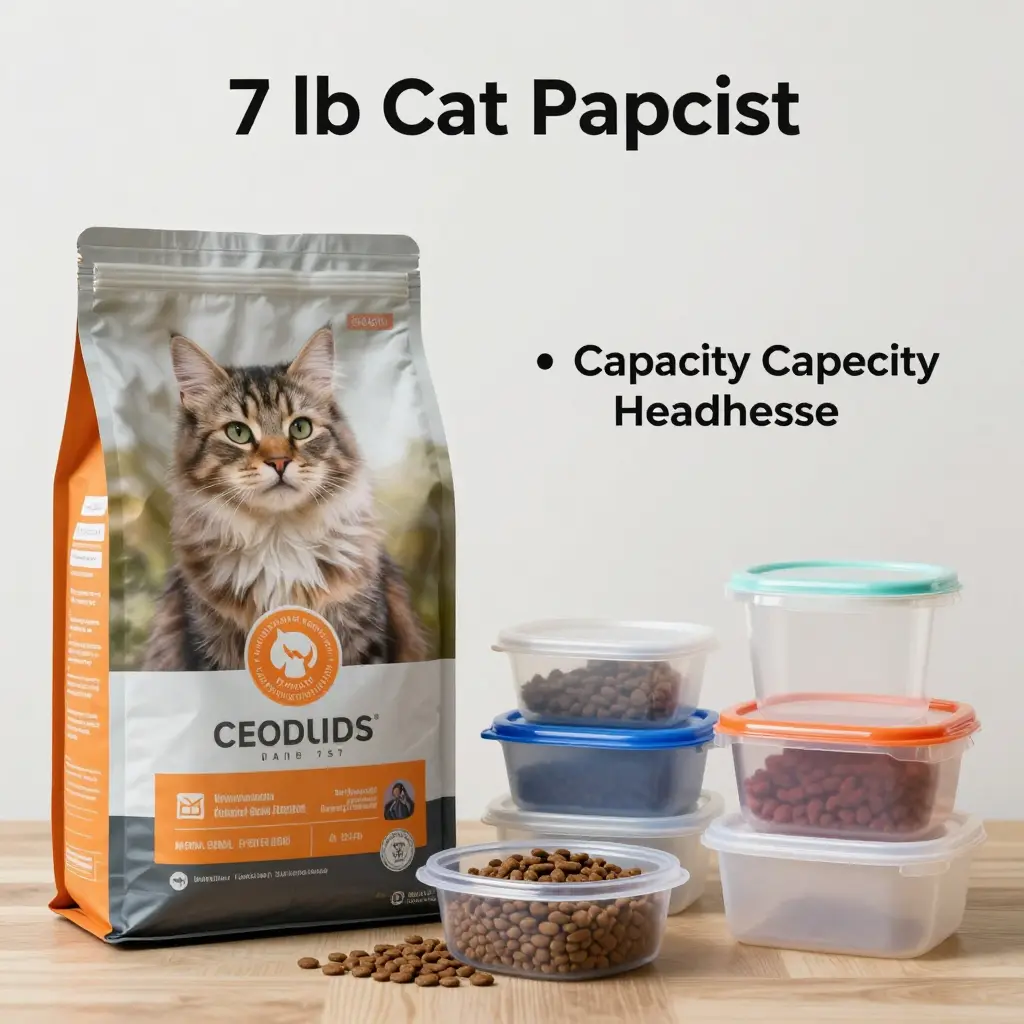
Why a 7 lb Bag Does Not Equal a 7 lb Container
A 7 lb bag of dry product and a container labeled to hold 7 lb describe different things, and treating them as one number is how buyers end up with packaging that does not fit. Anyone asking what size plastic container for 7 lb cat food runs into it immediately: bag volume is measured on the packing line, where the filler drops product into a bag with slack built in, while usable capacity is measured against a fill line that keeps a deliberate gap at the top. One number records what a machine pushed through in a few seconds. The other records what a person can scoop, seal, stack and ship without spilling.
That gap is called headspace, and it is not wasted space. It absorbs settling, protects the product during handling, and keeps seams and lids from taking the load. The trouble starts when someone reads a bag’s net weight as a container’s fill line, orders, and then finds the tub either tighter than expected or far larger than needed.
The comparison below puts nominal container sizes next to measured capacity, using dry goods packed at the weights operators actually buy. It then shows where the headspace trade-off bites in food service, where an overfull container costs accuracy and an oversized one costs shelf space, storage volume and freight.
The figures apply to restaurants, beverage chains, and catering and event buyers who purchase bulk dry goods along with the packaging that carries them, and who need a fill line they can repeat shift after shift. Teams stocking bulk dry-goods containers and buckets can check each number against their own shelving.
Bag Volume vs Usable Capacity: Definitions That Change the Answer
Three measurements decide whether a 7 lb bag fits a container, and they rarely agree. Mix them up, and a container that swallows the bag on paper will refuse to close its lid in practice. The words first, then the arithmetic.
Bag volume is the displaced volume of the sealed bag on the shelf. It counts everything the bag pushes out of the way, including trapped air and the settling gaps between pieces. A 7 lb bag might measure 12 x 9 x 4 inches, around 430 cubic inches, yet slump lower and wider once it lies flat. Bag volume describes the product as it arrives, not as it packs.
Usable capacity is the interior volume a container holds up to its practical fill line with the lid closed. It is always smaller than the listed volume of that plastic container, because rims, handles, ribs and lid clearance eat into the space. A tub sold as 6 qt, roughly 350 cubic inches, may offer about 5.3 qt of real room.
Headspace is the empty band between product and lid. It is not waste. It lets the lid seat, keeps contents away from the sealing edge, and gives a scoop room to work.
The working definitions:
- Bag volume: the space a sealed bag displaces on the shelf, trapped air and settling gaps included.
- Usable capacity: the interior room a container offers up to its practical fill line with the lid closed.
- Headspace: the empty band between the product surface and the lid that lets the lid close cleanly.
- Fill line: the level a container can be loaded to and still close, seal and carry without spillage.
- Bulk dry goods storage: decanting large bagged volumes into rigid containers for steady daily handling.
Compare bag volume against usable capacity, then budget headspace on top of that. For rigid options that hold their shape, browse our bulk storage boxes and size from usable capacity, not from the bag.
Nominal Size vs Usable Capacity vs Fit for a 7 lb Bag
| Container Nominal Volume (qt / L) | Measured Usable Capacity (qt / L) | Headspace Lost at Full Fill (%) | Practical Fill Level (%) | Fits One 7 lb Bag | Recommended Use |
|---|---|---|---|---|---|
| 6 qt / 5.7 L | 5.3 qt / 5.0 L | 12 | 87 | No – bag runs 1 to 3 qt over the brim | Sample tubs, 2-3 lb refills only |
| 8 qt / 7.6 L | 7.0 qt / 6.6 L | 13 | 86 | Partial – snug, scoop buried | Single bag, small shelf, daily scoop |
| 12 qt / 11.4 L | 10.4 qt / 9.8 L | 13 | 86 | Yes – comfortable, scoop clears rim | Single bag plus scoop and spare |
| 15 qt / 14.2 L | 13.1 qt / 12.4 L | 13 | 85 | Yes – best headspace balance | Preferred all-rounder, one 7 lb bag |
| 18 qt / 17.0 L | 15.3 qt / 14.5 L | 15 | 82 | Yes – loose, one bag plus top-up room | Two-bag rotation, thin-walled bin |
| 22 qt / 20.8 L | 18.0 qt / 17.0 L | 18 | 80 | Yes – deep reach, overkill for one bag | Bulk storage, multi-bag back stock |
Figures are averages from typical retail and commercial bins, and liquid fill lines sit higher than dry-fill lines on the same container.
Measuring the Real Volume of a 7 lb Bag Before You Choose a Container
Weighing the product settles the question. The label does not. Manufacturers print nominal figures for an ideal, uncompacted fill, so the number on a 7 lb bag rarely matches the space the material takes up once it is poured into the food-grade storage containers you plan to use. Reading that printed figure as a container size is a common way to order too small.
Dry product also settles. Between filling, palletizing and delivery, kibble compacts and can give up 5 to 15 percent of its loose-fill height. A bag measured on arrival occupies noticeably less space than the same bag straight off the line, which is why operators measure instead of assuming.
- Weigh the 7 lb bag on a calibrated scale, packaging removed, and record the net weight.
- Transfer the contents into a measuring container with a known, marked scale in liters or quarts, pouring in stages.
- Note the settled volume after a light leveling – do not shake or tamp the product down.
- Add a working headspace allowance of 10 to 20 percent so usable capacity leaves room for scooping.
- Confirm the lid closes fully with the product below the fill line, then re-check after 24 hours.
Write that number in the order notes, and repeat orders of the same product go straight to the right container.
Usable Capacity Is Not the Same as Container Volume
When someone asks what size plastic container a 7 lb bag of cat food needs, the answer starts with something most spec sheets skip: the number printed on the side of a tub is its total volume, not its usable capacity. The gap between them is headspace, the empty band you leave at the top so the product sits below the rim, settles without spilling, and still closes cleanly.

Caption: Three identical containers, one dashed fill line. The beige block is product mass, the teal band is empty headspace. Left is under-filled (product slumps and shifts in transit), center is the working sweet spot, right is over-filled (no room for settling, lids fight back and scoops drag product over the rim).
Same container, same fill line, three outcomes, depending on how far you pour.
What Each Fill State Actually Costs You
| Fill state | Product level vs. fill line | Headspace left | What it means in practice |
|---|---|---|---|
| Under-filled | Well below the line | 35-50% of the tub | Wasted cube on the shelf, product shifts and settles into a lopsided mass, scooping means digging |
| Correctly filled | Just under the line | 10-20% of the tub | Room for settling and a scoop, lid seats without pressure, stackable and stable |
| Over-filled | At or above the line | Under 5% of the tub | No settling space, product creeps into the lid thread, closures strain, spills on the first scoop |
A 7 lb bag is roughly 3.2 kg of kibble, and that weight usually takes up somewhere around 6.6 to 8.5 liters of loose volume, depending on kibble size and density. That is why a container rated at 11 to 12 liters tends to be the comfortable answer rather than a snug 8 liter tub: after the product goes in, you still have a real headspace band instead of a lid pressed onto a mound.
The Trade-Off, Stated Plainly
Buy too small and you end up in the over-filled column, where every scoop costs a small spill and the lid never quite sits flat. Buy too big and you end up in the under-filled column, where a half-empty tub holds air instead of product, and takes up shelf depth you could have used for something else. The sweet spot is the container that reaches its fill line with roughly a hand’s width of room above the product.
The same logic applies beyond pet food. If you are specifying tubs, trays and lidded rounds for a kitchen, a prep line or a catering run, our round bowls and buckets let you compare stated volume against the fill level you actually work with. Check the fill line before the price tag.
Where the Headspace Trade-off Lands
Headspace is not about filling a container to the rim. It is about leaving enough room for air movement, tools and closures without inviting staling. For a 7 lb bag of dry product, the answer sits in a narrow band rather than at either extreme.
Too Little Headspace
A fill that leaves less than 5% headspace above the settled product line looks efficient, but it cuts airflow and moisture control around the product and removes the buffer that moderates daily humidity swings. Product can press into the lid channel and interfere with sealing, especially after settling in transit. With no scooping clearance, portioning gets messy and staff overfill or spill.
Too Much Headspace
Above roughly 25-30% headspace, the container holds more air than the product needs, and that extra oxygen speeds oxidation and staleness after each opening. Moisture control also gets less predictable, because a larger air volume responds more slowly to temperature changes and can carry humidity deeper into the product. Unnecessary headspace wastes usable capacity, adds packaging cost, and makes a container feel underfilled even when it holds the full 7 lb bag.
The Working Range
For a 7 lb bag of dry product, 10-20% headspace above the settled fill line is the practical range. That band leaves enough airflow for moisture control while limiting the oxygen reservoir behind oxidation and staleness, and it keeps scooping and portioning clearance. It also keeps product below the lid sealing surface, so closures seat cleanly and containers stack without rocking.
In practice, the range usually means choosing the next nominal size up from the measured bag volume rather than an exact match. Sizing should treat the label as gross rather than usable capacity, so a settled volume near 5.5 L points to a 6-7 L container. Teams standardizing dry storage across stations can compare paper bucket containers in those adjacent sizes before committing to a full order.
Two Numbers Live on Every Plastic Container
Every plastic container carries two numbers. The one on the label is nominal volume, the raw geometric space inside the walls. Real containers then give some of it back to a lid shoulder, a stacking rib, a tapered base, and the headspace that keeps kibble from crushing or going stale. What is left is measured usable capacity, and it is always smaller – by about 1.6 qt at the 12-quart size, and 2.2 qt at 16.
The shortfall is not a rounding error, and it does not stay constant as containers scale up. Before you order a pallet of tubs for back-of-house dry storage, check how the gap behaves at each size, especially if you portion feed for several cats, a shelter, or a prep line where scoops per shift matter more than quarts on a spec sheet.
Seeing the Gap: Nominal vs Usable Capacity
These are the six sizes we stock and test most often – 2, 4, 6, 8, 12 and 16 quarts – measured empty, with a flat lid seated and a straight-edge fill. Nominal against usable, side by side:
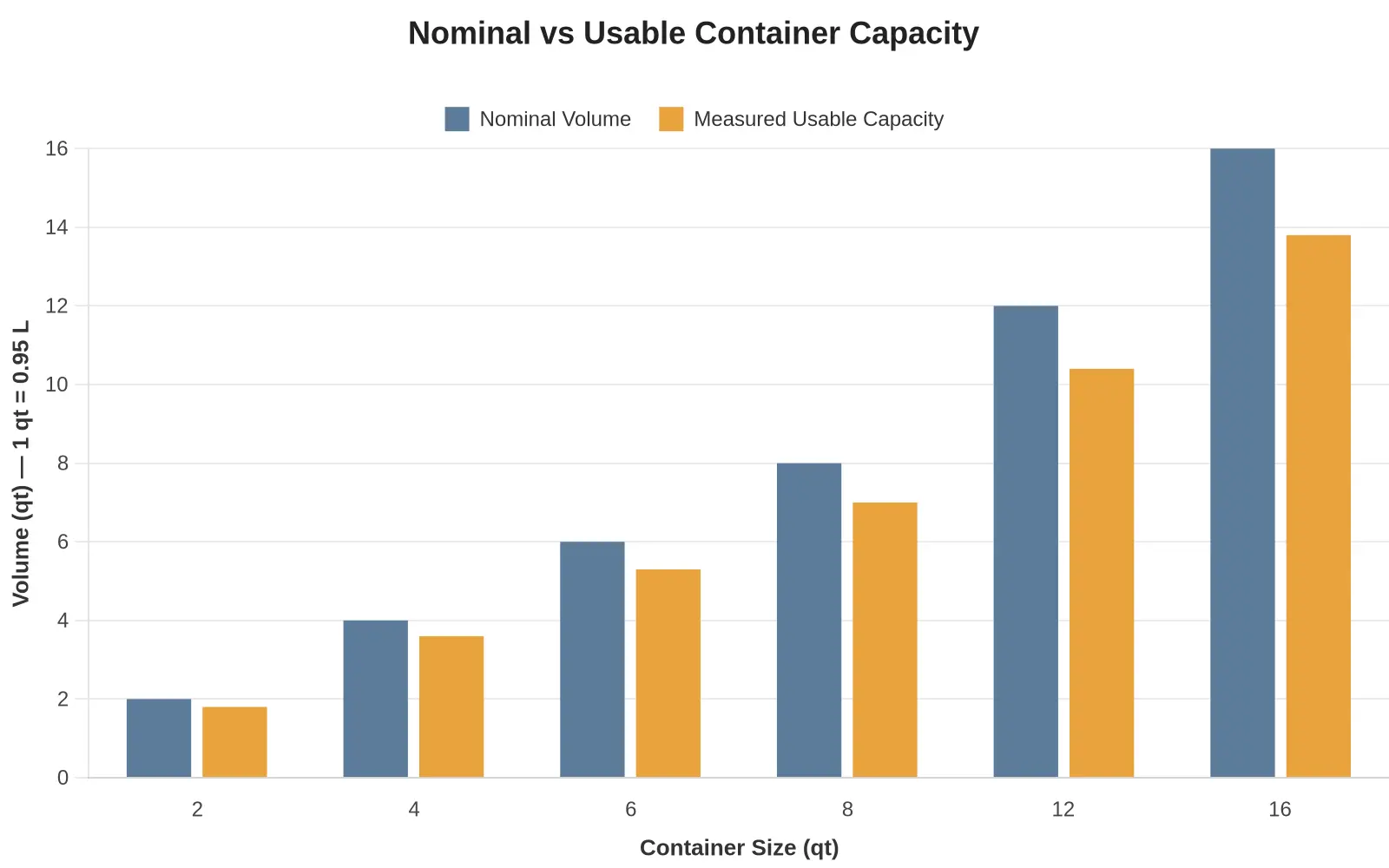
The shortfall in raw numbers: nominal minus usable runs 0.2 qt at the 2-quart size, 0.4 qt at 4, 0.7 qt at 6, a full quart at 8, 1.6 qt at 12, and 2.2 qt at 16. Small tubs forgive the design geometry; large ones amplify it.
The Second Cut: Practical Fill Volume at 85%
Usable capacity is still a best case. A container filled to the brim is one you cannot close, scoop from, or carry without a dusting of kibble in the trunk. Most kitchens work at about 85% of usable capacity: room for a scoop, a lid seal, and a little settling. The second chart shows what that leaves:
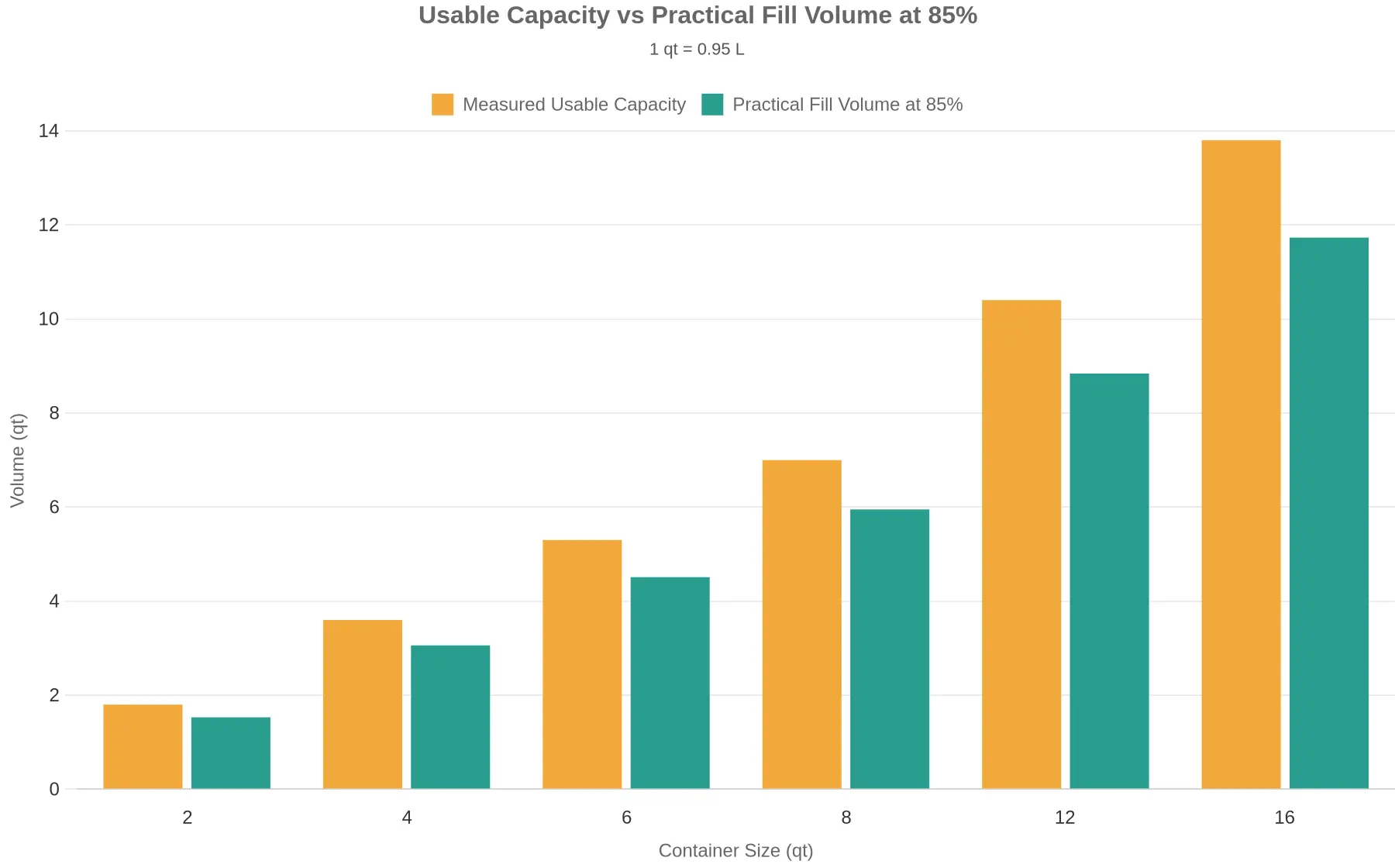
| Container Size | Nominal Volume | Measured Usable | 85% Practical Fill |
|---|---|---|---|
| 2 qt | 2.0 qt (1.9 L) | 1.8 qt (1.7 L) | 1.5 qt (1.4 L) |
| 4 qt | 4.0 qt (3.8 L) | 3.6 qt (3.4 L) | 3.1 qt (2.9 L) |
| 6 qt | 6.0 qt (5.7 L) | 5.3 qt (5.0 L) | 4.5 qt (4.3 L) |
| 8 qt | 8.0 qt (7.6 L) | 7.0 qt (6.6 L) | 6.0 qt (5.6 L) |
| 12 qt | 12.0 qt (11.4 L) | 10.4 qt (9.8 L) | 8.8 qt (8.4 L) |
| 16 qt | 16.0 qt (15.1 L) | 13.8 qt (13.1 L) | 11.7 qt (11.1 L) |
The gap between nominal and usable capacity grows with size, which is why a 7 lb bag needs a larger nominal size than its own volume suggests.
Where the Headspace Trade-Off Lands for a 7 lb Bag
So which size should you buy? A 7 lb bag of dry cat food takes up roughly 7 to 9 quarts of loose volume – about 28 to 36 standard cups – depending on kibble size and density. Stack that against the table above:
- An 8-quart tub has 7.0 qt usable and 6.0 qt of working fill, so a 7 lb bag either reaches the rim or spills over it. Fine for a 5 lb bag, not for this one.
- A 12-quart tub gives 10.4 qt usable and 8.8 qt of practical fill. The bag drops in, the lid closes without pressing on the food, and the scoop lives inside. This is the size most kitchens should buy.
- A 16-quart tub makes sense only if you buy two or three bags at a time or decant into a dispenser. A single 7 lb bag sits in deep headspace: more air exchange, faster staleness, more reaching for the scoop.
The counterintuitive part is that the bigger the tub, the larger the share you lose. Sixteen quarts nominally holds 16 qt, but you are working with 11.7 qt of practical fill once walls, shoulder and headspace are counted – a 27% haircut.
For dry storage that pairs with these tubs – scoops, portion cups, and lidded food-safe bulk storage bowls – size by usable capacity, not by the label. Pick the quart number that matches your 85% fill line, write the open date on the tub, and the bag stops overflowing the rim.
A quick rule to tape inside the storage cupboard: take the label quarts, multiply by 0.86 for usable, then by 0.85 for practical. For a 12-quart tub that is about 10.3 qt usable and 8.8 qt of working space – enough for one 7 lb bag with headspace to spare, and not quite two.
If you are building out a full dry-storage station, matching containers to scoop size matters as much as quart count. Our paper bucket containers work well as single-bag, swap-out liners for high-turnover prep areas.
Container Selection Criteria Once the Volume Math Is Settled
Density comes first. A dense kibble or powder packs more weight into the same footprint, so confirm the plastic container is rated for the filled weight, not just the liter count. Refill frequency and turnover shape the rest: fast turnover favors a simple, easy-to-clean design with a wide opening, while slower turnover favors a tighter seal and an opaque body that blocks light. Stacking and shelving constraints then settle the footprint – measure shelf height, door clearance, and how many units can safely sit on top of one another before committing to volume purchasing.
The lid is where most containers quietly fail. Match the lid style to how the bin is opened every day: a screw lid for frequent access, a hinged or snap lid for scooping, and check gasket quality and whether the gasket is replaceable. Food-contact safety is not negotiable: food-grade resin, documented compliance for the intended contents, and smooth interiors that survive regular cleaning. Browse food-safe bowls and buckets built for daily handling. Finally, compare cost per usable quart rather than cost per container, because a slightly pricier bin with honest usable capacity and a real sealing gasket outlasts a season of replacements.
- If refills happen weekly or faster, decide what size plastic container gives the widest mouth that still stacks cleanly.
- If the contents are dense, add wall thickness and lid locking before adding liters.
- If cleaning routines run daily, prioritize removable gaskets and rounded interior corners over extra features – the same logic behind sensible bulk dry goods storage.
Interior Volume Breakdown: Where Your 7 lb Bag Actually Sits
Once containers are shortlisted by opening diameter, wall strength and lid style, the next question is how the inside of one actually gets used. A container correctly sized for a 7 lb bag is not 100% product, and it never should be. In the doughnut chart below, product occupies roughly two thirds of the interior; the rest holds air gaps, cushions the kibble, and leaves room for the lid to seat.
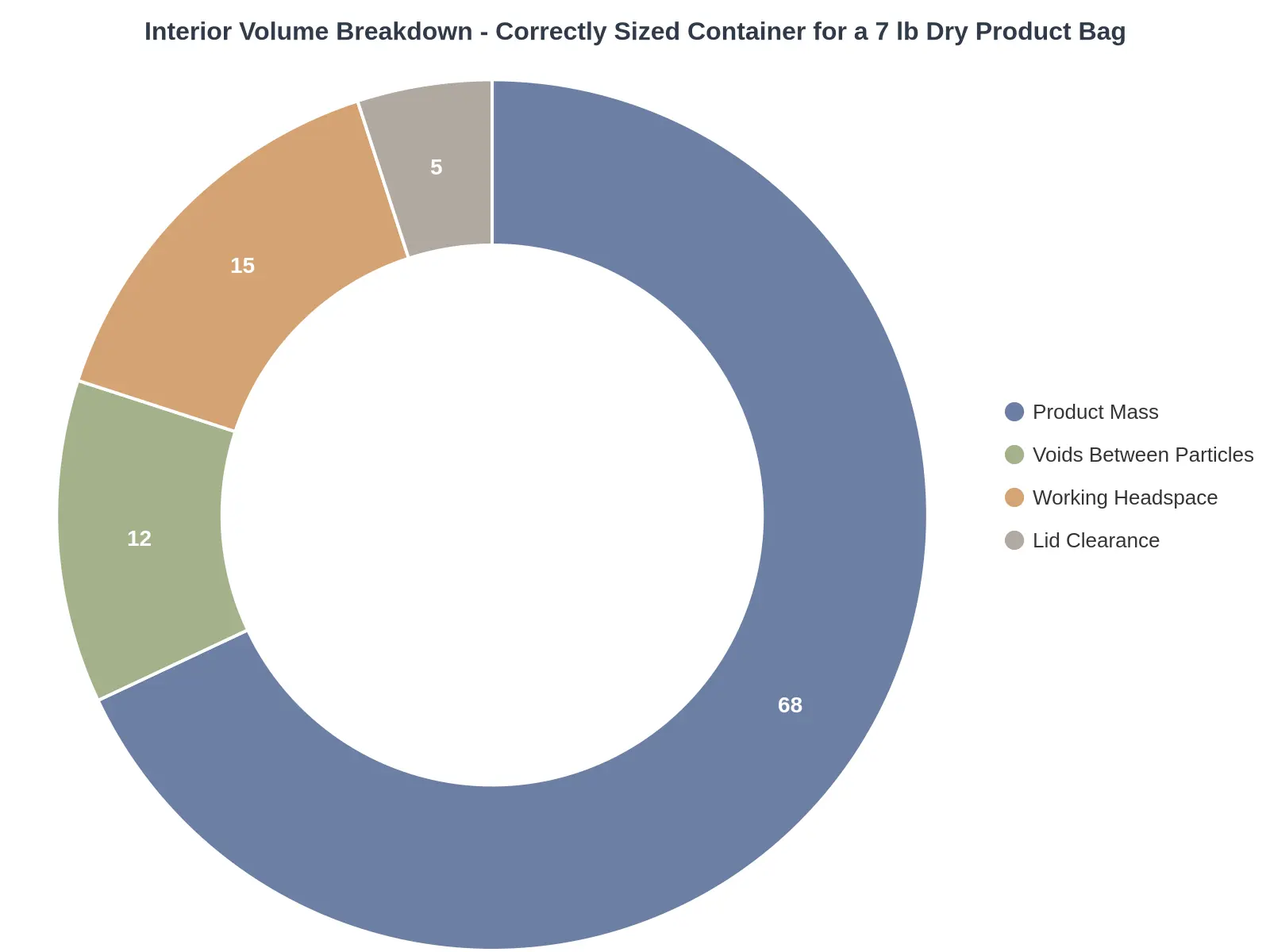
The working headspace slice (15%) is the only portion an operator can safely remove, and removing it is precisely what causes overfills and lid failures.
The padding slices are small and non-negotiable: particles settle during transport, and lids need clearance to lock without crushing product or popping off under stack pressure. If you are sourcing rigid vessels for scoop-and-serve operations like pet food, treats or dry mixes, our paper bucket containers are available in compatible capacities and lid pairings.
Frequently Asked Questions
What size plastic container holds a 7 lb bag of cat food?
A 12-quart container – about 11.4 liters nominal and 10.4 quarts usable – suits most 7 lb bags of dry cat food. At an 85% fill line that leaves roughly 8.8 quarts of working room, enough for the kibble plus the gap needed to scoop without spilling. Kibble shape and density move the answer: chunky large-bite formulas take more room than small round pellets, so if you are working out what size plastic container for 7 lb cat food, go up a size for bulky food.
Is a 7 lb bag the same as 7 quarts of usable capacity?
No. Pounds measure weight and quarts measure space, so the two figures only line up by coincidence. A typical 7 lb bag of kibble fills roughly 7 to 9 quarts once poured out, which means bag volume and container rating should be compared directly rather than assumed equal. A tub rated at 7 quarts offers about 6 quarts of usable room, so the same bag would spill over the rim – the coincidence in the numbers is exactly what makes the mistake easy.
How much headspace should a dry product container have?
About 10 to 20 percent of the container’s interior volume, which is roughly an inch to an inch and a half below the rim on a 10-quart bin. Headspace lets a scoop travel through the food, gives kibble room to settle after a refill, and keeps the rim and seal clear of crumbs. Filling to the lid makes daily use awkward and pushes food into the closure channel.
Do square or round containers use capacity more efficiently?
Square containers use capacity more efficiently, typically fitting 15 to 25 percent more interior volume onto the same shelf footprint. Round bins leave the corners of a shelf unused, which matters when a back-of-house storage area is tight. Square and rectangular shapes such as these square containers also stack, label and line up more predictably on a shelf.
Does container material thickness change usable capacity?
Not much. Thicker walls add durability and rigidity but remove only a small fraction of interior space, usually well under 5 percent. Lid geometry, internal ribs, and whether the listed size refers to exterior or interior measurements shape real capacity far more than wall gauge does.
Measure the interior of the bin, subtract the headspace you want, and compare that number with the food itself rather than with the bag label. That comparison, repeated, is what keeps sizing mistakes out of the order.
Plan Storage and Disposable Packaging on the Same Order Cycle
Settling on a container is only half a supply decision. The other half is the format that same product leaves the kitchen in. In most operations, bulk dry goods and the disposables that carry them out the door are restocked on the same cycle, against the same budget line, and reviewed by the same person.
If a container holds a known number of portions, the packaging bought for those portions should be sized against the same volume. Container-friendly takeaway boxes, paper buckets for bulk portions, cold drink cups and disposable stirrers all state capacity somewhere in their specs. Line those numbers up early and you avoid two near-identical sizes on the same shelf, a reorder that lands on the wrong SKU, and shelf space absorbed by holding both.
A supplier that publishes capacity alongside case counts makes that comparison easier to run. At ecocupbowl.com, takeaway packaging is organized by capacity, so storage containers and front-of-house supplies can be matched in a single review before the order goes out.
Conclusion: Settled Volume Decides the Container
Measure the settled volume of the bag instead of trusting the printed net weight, then choose the next nominal size up from that number. Leave 10-20% headspace above the product line so the lid seals, the stack stays stable, and the scoop moves freely. That range is the whole trade-off. Below 10%, product reaches the rim and the lid has to be forced; above 20%, air takes up interior space and each container delivers less usable capacity than its label implies. When a buyer asks what size plastic container fits a 7 lb bag, the useful answer comes from a measurement, not an estimate.
- Sizing rule: a 7 lb bag measuring 7-9 qt points to a 12-quart tub, not a 7-quart one.
- Headspace: keep 10-20% of container volume empty above the settled product line.
- Cost check: divide container cost by usable capacity in quarts before comparing two sizes.
Consistent container sizing lets teams restock in a single motion, because every container opens, fills and seals the same way. It also cuts waste, since staff stop overfilling and stop discarding the overflow.