
Before You Order: Resin and Wall Thickness Decide Performance
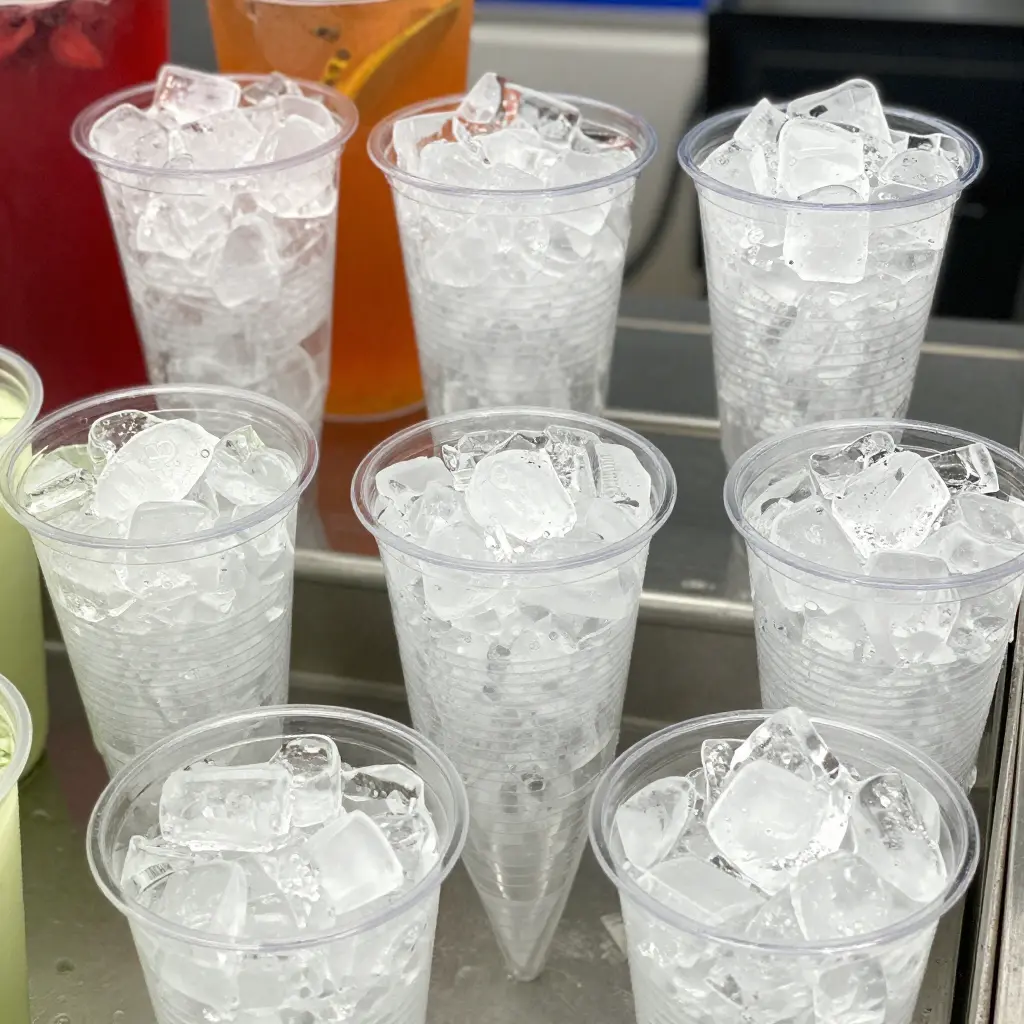
Clear plastic cone cups carry shaved-ice and crushed-ice drinks in bubble tea shops, beverage chains, restaurants, food trucks, catering and on-site event work. The cone holds a tall mound of ice, keeps syrup and toppings from pooling at the base, and makes the drink look like a treat before anyone tastes it.
Two choices decide how an order performs in service: the resin, and the wall thickness.
Resin sets clarity, cold-impact strength, and what happens once crushed ice and a spoon are in the cup. Wall thickness decides whether a full cup keeps its shape or flexes, smears and cracks. Get either wrong and the problem shows up later as a leak on the counter, a cup that looks scuffed after an hour, or a rim that stops holding a lid through the lunch rush.
If you are already sourcing for chilled menus, the cold-drink plastic cups range is a fair starting point for comparing formats side by side.
Resin Choice for Crushed Ice Service: How PET, PP, PS and PLA Behave
Crushed ice is abrasive, and most spec sheets leave that out. Every scoop drags hard-edged fragments along the inner wall, and over a shift the effect is close to slow sandblasting. Flexibility ends up mattering about as much as clarity. A glass-clear cup that crazes at the seam stops looking premium the first time it leaks.
Four resins account for almost every clear cone cup on the market, and each behaves differently once ice starts moving inside it.
PET: the clarity benchmark
PET is the closest thing to glass: crystal clarity, sharp print, and a rigid feel that reads as premium. It suits cold-only programmes where the drink is the marketing, such as tasting flights, shaved-ice specials and product launches. The weakness is stiffness under impact. Thin-wall PET cracks when a cup is knocked or squeezed hard, and it cannot handle hot liquid at all. On recycling, PET bottle collection is the most widespread of the four, but acceptance of cups specifically varies by programme, so ask your hauler instead of assuming.
PP: the workhorse for ice
Polypropylene gives up some sparkle for toughness. It flexes, resists cracking, and absorbs the knocks that come with high-volume service, which is why it survives scooped crushed ice so well. Next to PET it looks slightly hazy, so pale drinks lose some visual punch. PP is collected in code 5 streams, though less widely than PET. For most shops scooping ice all day, it is the safer default.
PS: cheap, stiff, brittle in the cold
Polystyrene is the cheapest of the four and gives good stiffness for the money. The problem is low-temperature brittleness. Chilled PS loses impact strength, and repeated ice abrasion raises fine crazing: hairline surface cracks that dull the cup and, in the worst cases, open into a leak. Recycling access is limited in most markets. It works for short service where cups are not refilled or stacked hard, and it is a poor choice for a jumbo cone packed with crushed ice.
PLA: compostable, but only through the right bin
PLA is plant-based, usually from corn or sugarcane, and the industrial-compostable claim is genuine as long as the cup reaches a commercial composting facility rather than a home bin or a landfill. Clarity is good without matching PET, and heat tolerance is the lowest of the four, so the format is cold-service only: no warm holding, no hot van. It suits eco-focused brands that already have a collection partner and can put the disposal route on the signage.
Which resin fits which service model
- High-volume crushed ice (bubble tea, shaved ice, festival stands): PP, for crack resistance through repeat handling. Specify PET only where clarity is the selling point and the wall is thick enough to take the knocks.
- Catering, events and corporate orders: PP for reliability across mixed menus. PS only for short, cost-driven service where cups are not refilled or stacked hard.
- Eco-focused brands: PLA, with a documented commercial composting route and staff who can explain it to customers.
The cold-drink cup range shows how these options line up in practice, including lid pairings.
The table compares the four resins buyers most often quote for clear cone cups used with crushed ice, on clarity, feel, cold-weather toughness, service fit, cost and end-of-life.
Resin comparison for clear plastic cone cups in crushed ice service
| Resin | Clarity | Rigidity / Feel | Low-temperature toughness | Best-fit service model | Cost position | Sustainability note |
|---|---|---|---|---|---|---|
| PET | High, sparkling clear | Stiff, crisp snap | Good; crazes on hard knocks | High-volume beverage chains | Low to mid | Recyclable #1; bottle streams widespread |
| PP | Translucent, slightly milky | Flexible, soft squeeze | Excellent; resists cracking | Food trucks, catering, events | Low, budget friendly | Recyclable #5, fewer streams |
| PS | Excellent, crystal clear | Very stiff, brittle | Poor; cracks under stress | Short indoor events | Lowest upfront cost | Rarely recycled locally |
| PLA | Clear with slight haze | Stiff, close to PET | Moderate; heat sensitive | Eco-positioned brands | Premium pricing | Industrially compostable only |
Confirm the final choice after a physical sample test with your own crushed ice, syrups and serving conditions.
Wall Thickness to Check Before Ordering
Most buyers choose cone cups on appearance. The cup looks crisp, the rim looks clean, the price looks right, and the order goes through. The batch then meets a van, a cooler and two crates pressed together, and behaves nothing like the sample did.
Wall thickness is the easiest number to verify and the one that predicts most failures you will actually see in service.
Why thickness decides whether your cone cups survive crushed ice
- Rim deformation. Crushed ice is heavy and it shifts. A thin rim rolls or goes oval, the lid no longer seats squarely, and the closure you specified becomes a suggestion.
- Cracking at the cone tip. The point carries the highest stress on the least material. Thin walls there crack against a scoop, or split quietly and leak onto the counter ten minutes later.
- Weight-bearing under a squeeze. A scoop pressed in, a hand gripping the body, a carrier wedged into a crowded van: the force all lands on the wall. Thick walls flex and recover. Thin ones crease and stay creased.
- Perceived quality. A cup that feels flimsy reads as cheap, whatever you charge for what is inside it.
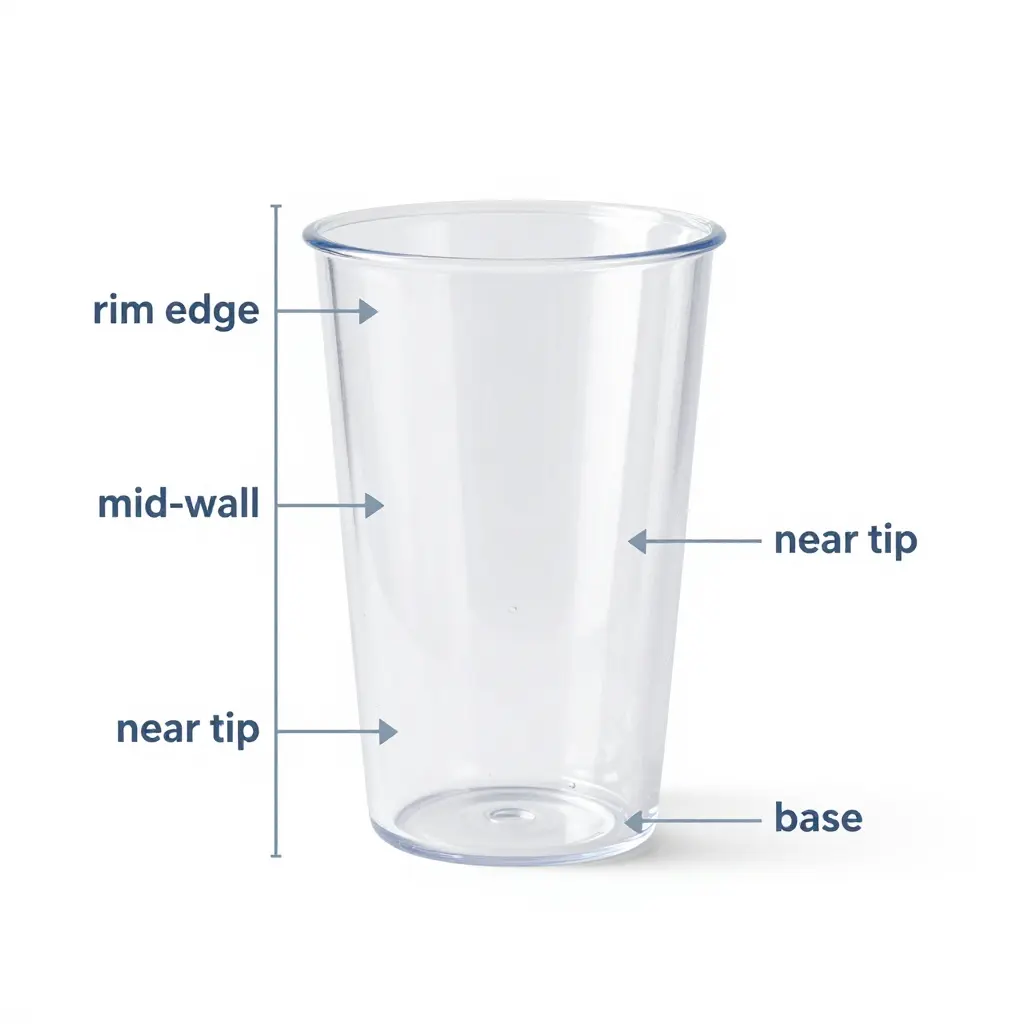
The four measurement points that matter
| Location | Where exactly | What it tells you |
|---|---|---|
| Rim edge | Just below the rolled lip | Whether lids and carriers will grip and hold |
| Mid-wall | The widest band of the body | Overall stiffness and how it feels in hand |
| Near the tip | The last section before the point | Crack and leak risk under scoop pressure |
| Base | The flat or rounded floor | Stability in carriers and on trays |
Two cheap verification methods
No lab needed. A digital caliper and a kitchen scale will settle most of it.
- Caliper readings on a sample batch. Pull five to ten cups from the carton and measure all four points on each. Write the numbers down. Spread within a single case is often a louder warning than the average.
- Weight per cup across suppliers. Cups of the same resin and the same nominal size should land in a tight weight band. If supplier B’s cup is consistently lighter than supplier A’s at the same stated thickness, the wall is thinner somewhere, however similar the rim looks.
What to record for every sample batch
Keep these five notes together and the next order stops being a guess:
- Measured thickness in mm at all four points (rim, mid-wall, near tip, base)
- Cup weight in grams, averaged across the sample
- Resin grade as stated by the supplier, and whether it matches what you requested
- Behaviour after 30 minutes of crushed ice: sweating, softening, rim movement
- Squeeze-test result: does the cup spring back, crease, or split?
Test the whole system, not just the cup. Pair the cones with compatible lids and holders from our cup carriers and holders range so squeeze loads go into the carrier instead of the rim, and keep a backup volume of in-stock cups and sleeves for event peaks. A thickness spec only protects you when the rest of the kit fits it.
Where to Measure Wall Thickness on a Cone Cup
A cone cup is a drawn part, not a sheet of plastic bent into a cone. The material stretches as it is pulled toward the point, so the wall thins on the long draw and stays heavier where the draw is short. One reading at the lip says very little about the rest of the part, and the four-point table above only helps if you measure each point the same way.
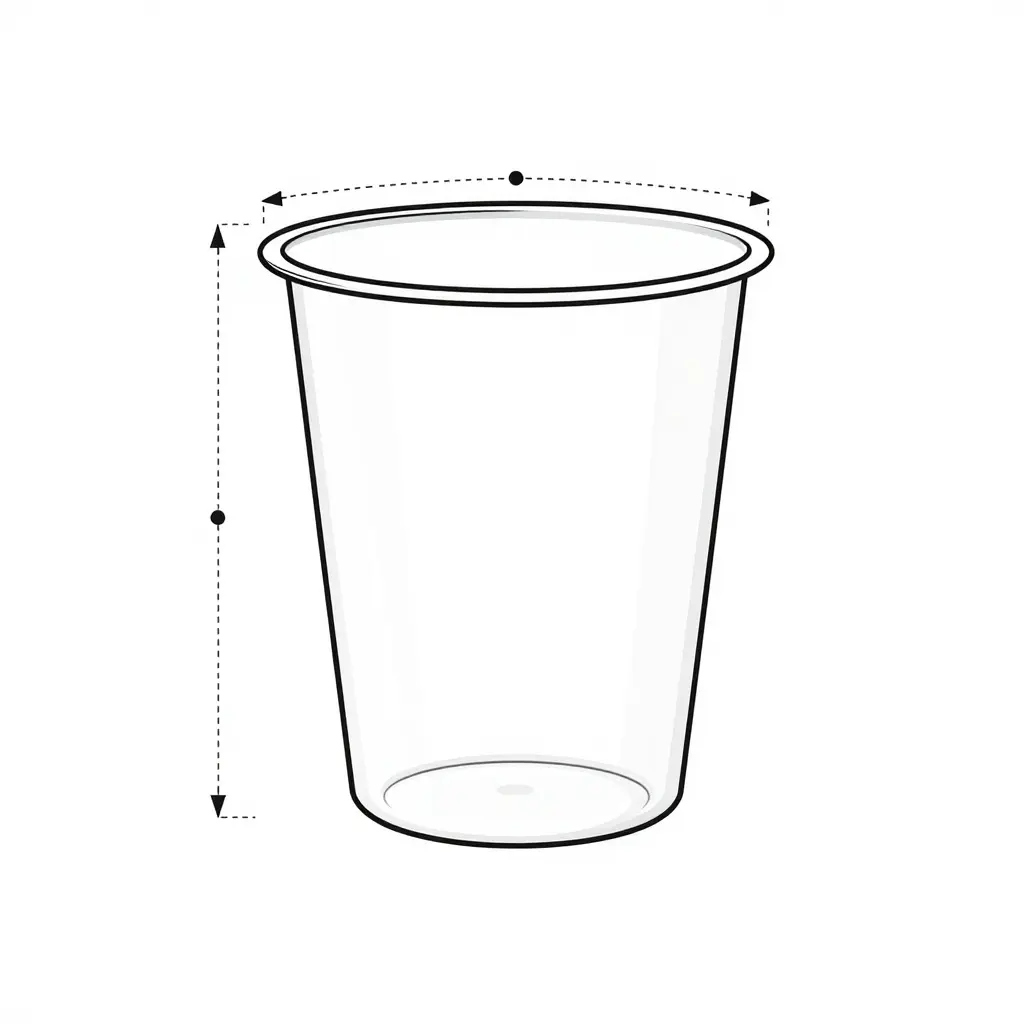
How to take the readings
- Close the caliper on the wall with light, even pressure and read the same spot twice. If you are checking dozens of cups, a thickness gauge with a rounded anvil is more repeatable.
- Take at least three readings per zone, spaced around the circumference, and keep the lowest. The lowest number is the wall your customer gets.
- Measure one cup straight from the carton and another after 30 minutes of crushed-ice service, because cold and load change how the part behaves.
- Put the numbers into the spec sheet so a reorder has something to compare against.
While you are still narrowing down suppliers, it helps to compare the plastic cups for cold drinks range side by side and put every sample through the same four-point test. Same method, same tool, same zones: that is how a thinner lot gets caught before it reaches your counter.
What Crushed Ice Really Asks of a Clear Cone Cup
A filled cone cup is never at rest. Ice scours the inside, the wall sits close to freezing, condensation forms outside, the cup presses against its neighbours in a carrier, and staff squeeze it to add syrup. Any one of those is survivable on its own. Together they turn a cheap cup into a puddle on the counter.
Each stress shows up differently in service, and each is answered by a different part of the specification.
Continuous abrasion from ice fragments
Crushed ice works like a slow grinder. Every scoop, stir and refill drags ice shards along the inner wall, and after enough of it you get crazing: fine whitish hairline patterns that leave a clear cup looking foggy and tired. Crazing is also where real cracks begin.
The counter is a resin with adequate molecular weight and a wall thick enough not to flex under the scrape. PET wins on clarity; PP tolerates repeated flexing better where cups are handled constantly.
Low-temperature embrittlement
Cold makes plastic stiffer and less forgiving. The thinnest point on a cone cup is the tip, and that is where a brittle grade fails first, usually as a clean split after a light knock against a carrier or a counter edge.
Impact-modified polypropylene or a heavier PET base holds up far better than a thin standard-purpose grade. If a supplier quotes an unusually light cup, ask what resin it is and what drop performance they can confirm.
Condensation on the outer wall
A cold cup in a warm room sweats. That water makes the cup slippery for staff and softens low-grade printing, and wet walls slide against each other in a carrier, so cups lean and press on one another.
A slightly thicker sidewall keeps the cup stiff while the surface is wet, and a print method that resists moisture keeps branding readable through a long service window.
Stacking pressure inside carriers
Carriers are a compression test. Cups are stacked, nested and leaned, and the bottom cups carry everything above them. Too little wall rigidity shows up as ovalized bodies, jammed stacks, and cups that collapse or refuse to separate.
Consistent taper tolerance, a reinforced rim bead and a thicker sidewall are what prevent that. Rigidity, not just weight, is the number worth checking.
Repeated squeezing when staff add syrup or toppings
Every time someone grips the cup to dose syrup, spoon in toppings or press on a lid, the rim takes a squeeze. Weak rims split, star-crack or separate at the seam, and it tends to happen at peak hours.
A properly rolled rim plus a flexible resin grade absorbs that pressure better than a thin, rigid edge.
Stress factors at a glance
| Stress factor | What you see in service | Attribute that counters it |
|---|---|---|
| Ice abrasion | Crazing, hazy walls, fine stress lines | Higher molecular weight resin, adequate gauge |
| Sustained low temperature | Tip cracking, brittle splits after a knock | Impact-modified PP or thicker PET base |
| Condensation | Slippery grip, softened print, sliding stacks | Thicker wall for wet stiffness, moisture-resistant print |
| Carrier stacking | Ovalized bodies, jammed nests, cup collapse | Tight taper tolerance, reinforced rim bead, thicker sidewall |
| Squeezing at the topping station | Rim splitting, star cracks, seam separation | Rolled rim, flexible PP, consistent weld seam |
Order the companion items with the cups
Cup performance rarely lives alone. If your team doses syrups and fruit, add sauce and portion cups so portions stay controlled and the rim is not over-handled. Wide straws let crushed ice flow instead of being rammed through a narrow bore, which takes pressure off the cup. A supply of skewers and stirrers gives staff a tool for mixing, so hands and cup walls are spared the squeeze.
Match the resin and wall thickness to your actual ice, your actual carriers and your actual rush, and the cup stops being the weak link in the line.
Cup weight and squeeze resistance by wall thickness band
The chart below plots four wall-thickness bands (0.35 mm, 0.45 mm, 0.55 mm and 0.65 mm) against two measures: average finished cup weight in grams, and squeeze resistance on an index from 1 to 10.
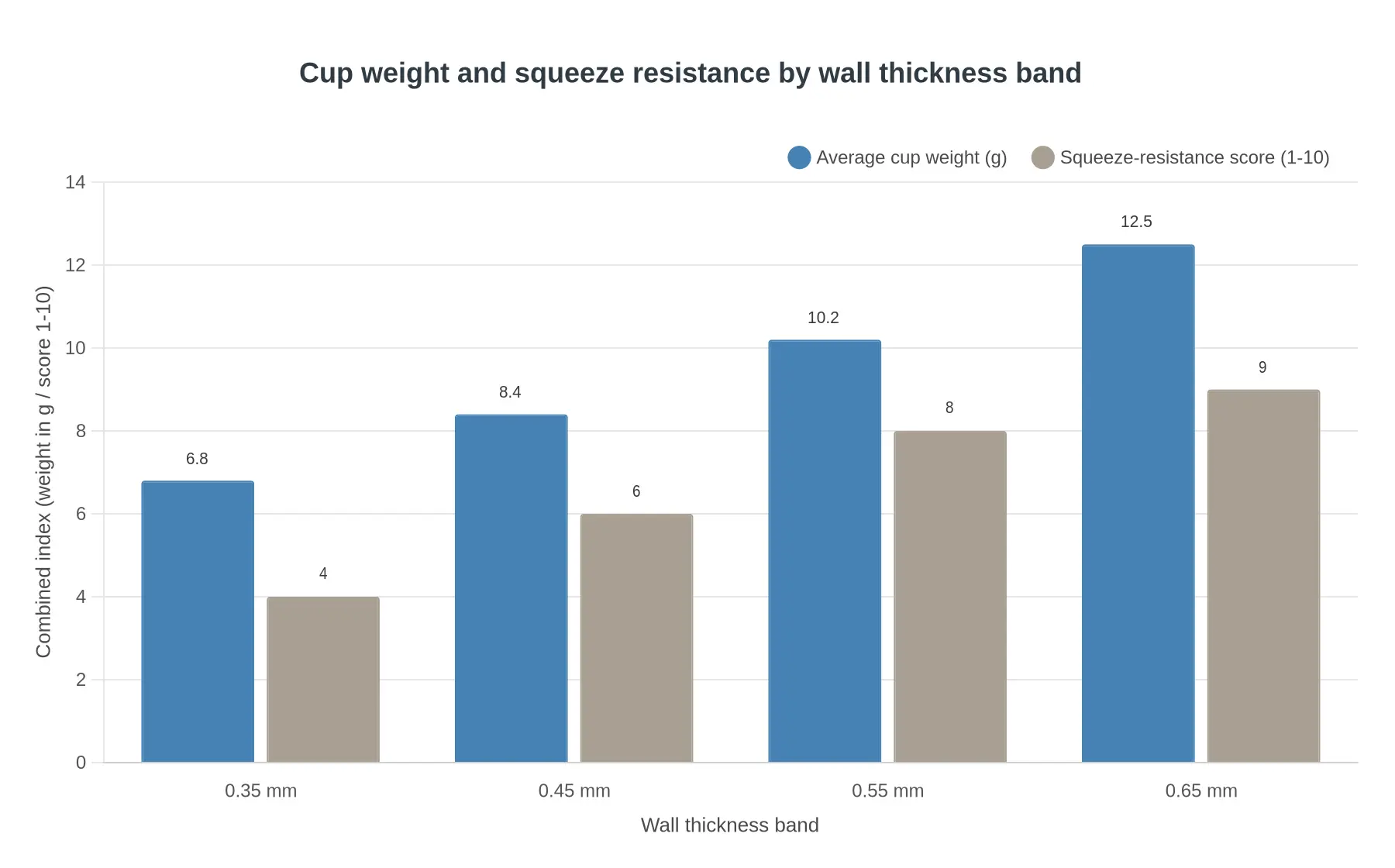
Thicker, heavier cups resist crushed-ice stress better, up to the point where cost, freight weight and plastic waste outweigh the gain. For most menus the 0.55 mm band is a sensible stopping point: squeeze resistance sits at 8 out of 10 and the cup weighs 10.2 g, while 0.65 mm adds 2.3 g per cup for one more point of stiffness. Across a few thousand servings a week, that extra resin and freight shows up on every invoice, and the extra point rarely moves the complaint rate by the same amount.
If crushed ice is only a small part of your menu, the lighter bands still work with a firmer lid and a steady two-hand pickup. Check the spec sheet for wall thickness before you commit to a pallet, then order a single case and squeeze it yourself.
Where to Buy Clear Plastic Cone Cups: The Vetting Checklist Before Your First Order
With resin and wall settled, the remaining question is which supplier gets the first purchase order. It is also the one that costs most to get wrong.
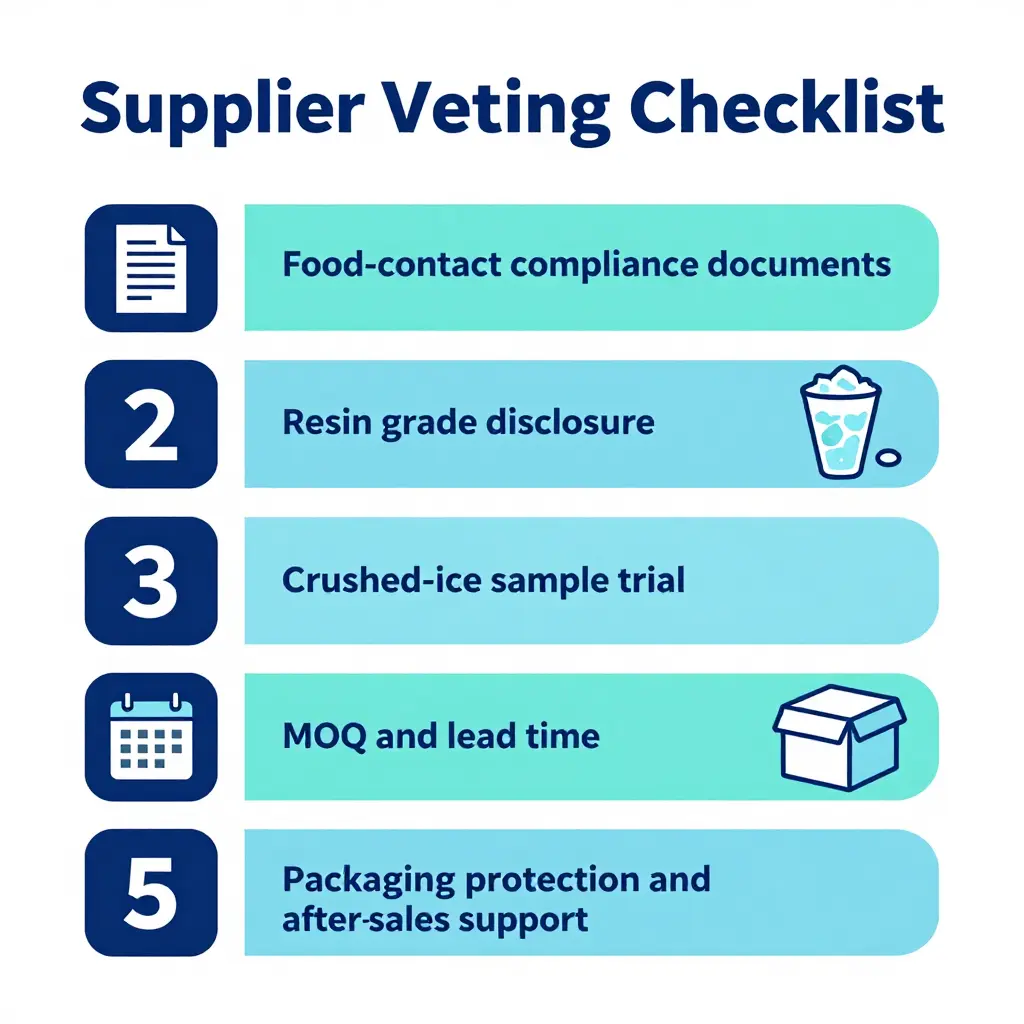
1. Documentation comes before the price list
Ask for food-contact compliance paperwork up front: a declaration of compliance, migration test reports, and the standard the cups are made to (FDA 21 CFR, EU 10/2011 and 1935/2004, or GB 4806 for the China market). A supplier who hesitates here is usually short of paperwork rather than answers. Batch-level traceability matters too, so ask whether reports are tied to a production lot or issued once for a catalogue item.
2. Push for resin grade disclosure
“Clear plastic” is not a specification. Ask whether the cup is PET, PP or a blended sheet, whether the resin is virgin or recycled, and what grade it is. Crushed-ice service puts sustained cold load and abrasion on the wall, so a vague answer here tends to reappear as cracking or crazing along the rim.
3. Run a real crushed-ice trial
Never approve on a photo. Request samples of the exact SKU you intend to buy and test them the way customers will use them:
- Fill to your normal serving line with crushed ice and beverage, then hold for 30 to 45 minutes.
- Stack filled cups two high and check for bulging or rim deformation.
- Drop one from waist height onto hard flooring and note where it fails.
- Watch condensation and grip, especially with the cup in a carrier.
- Compare two thickness options side by side and weigh cost against breakage.
4. Understand MOQ: stock versus custom
| Factor | Stock items | Custom production |
|---|---|---|
| Minimum order | Usually by carton | Often by the tens of thousands |
| Lead time | Days | Weeks plus tooling and proofing |
| Best for | Trials, seasonal peaks, topping up | Branding, unique sizes, long-run cost |
| Risk | Pay-as-you-go, lower commitment | Committed volume, longer cash cycle |
Be honest about your first-order volume. A supplier who pushes you into a custom run when stock will do is not protecting your cash flow.
5. Confirm lead time and reorder reliability
Ask for the lead time on a repeat order, not just the first one, and ask how often the SKU goes out of stock. For a bubble tea shop, two weeks without the right cup size is two weeks of compromised service or lost sales. Get the reorder window in writing.
6. Check that packaging survives the courier
Cone cups crush from the rim and the point. Confirm that inner packing uses sleeves or dividers, that cartons are rated for stacking, and that the pallet or carton count fits your storage. Ask for photos of the actual export packing before shipment.
7. Test after-sales responsiveness early
Send a technical question before you buy and time the reply. Ask how short shipments, damaged cartons and spec drift are handled, and who your contact is once the invoice clears. Fast answers during the sales phase are a reasonable preview of the service afterwards.
Where we stand
We manufacture and supply disposable tableware, packaging paper and boxes, and we work to three priorities: safety, durability and eco-friendly practice. In practice, that means documented food-contact materials, walls built for crushed ice rather than display ice, and support that answers when you call. Pricing stays competitive because repeat orders matter more to us than one large invoice.
If you are consolidating a launch order, buy the peripheral items in the same shipment. Browse our in-stock boxes for beverage and takeaway use and our paper bags for carry-out orders so cups, packaging and carriers land together.
Your purchasing path, in short
Request documentation and samples in the same email. Trial the samples with crushed ice for a week. Confirm MOQ, repeat lead time and packing specs in writing. Then place a modest first order on stock items, measure breakage and your reorder rhythm, and move to custom production only once the numbers hold up. That sequence turns a technical shortlist into a supply relationship you can plan around.

Sample, test with crushed ice, confirm the specification, place the order.
Pre-order checklist for clear plastic cone cups
Work through this before you sign off on a bulk order, so resin grade, wall thickness and packing standards are confirmed in writing instead of assumed from a photo or a sales chat.
- Confirm the resin type and its stated grade (food-grade PET or PP, for example) and ask for the specification sheet by email.
- Confirm wall thickness at the rim, at the mid-wall and at the tip, and note the tolerances allowed.
- Weigh at least ten cups drawn from different cartons and check that the weight spread is tight.
- Test-fit your existing lids and cup carriers on the actual sample.
- Check food-contact documentation, including migration or food-safety test reports valid for your market.
- Confirm MOQ, price breaks and lead time, counting both production and shipping days.
- Check that carton packing protects against crushing: sleeve counts, dividers, outer carton strength.
- Approve and keep one physical sample as the signed reference standard for future shipments.
File the recorded values with that approved sample, so a reorder is verified against the same numbers rather than a fresh conversation. If you are building a full serving setup, line up compatible trays and plates for a complete serving setup in the same purchasing window.
Frequently Asked Questions
Which resin is best for crushed ice in clear plastic cone cups?
There is no single best, and almost every clear cone cup is PET or PP. PET gives the highest clarity and handles 0 to 5 °C service without hazing; it is the usual pick for cold-only menus, though thin PET crazes and can crack under hard knocks, so it needs adequate wall thickness and no hot liquid. PP looks slightly hazy and is much tougher, which makes it the safer default where cups are scooped, stacked and handled all day. Polystyrene goes brittle at freezer temperatures and is a poor fit for dense crushed ice; PLA works for cold service if you have a commercial composting route.
What wall thickness should I order for crushed ice service?
Cone cups are usually specified between about 0.35 mm and 0.65 mm. For crushed ice loaded from a scoop, treat 0.5 to 0.55 mm as the practical floor, and step up to 0.65 mm if filled cups are stacked for transport or lids have to hold under load. The thin end, 0.35 to 0.45 mm, suits shaved ice eaten with a spoon, where the cup is not scooped into or squeezed.
Are clear plastic cone cups recyclable or compostable?
PET cone cups can go into PET (#1) collection where the hauler accepts food-soiled cups, so rinse and dry them and check the local programme first; they are not compostable and do not belong in organics. PP is collected in #5 streams where those exist, and PS (#6) rarely is. PLA is certified for industrial composting (EN 13432 and equivalent standards) but needs a commercial facility, not a home bin or a landfill. If compostability is a hard requirement and no collection partner exists, paper or moulded pulp cones are the simpler route.
How many samples should I request before ordering?
Two or three per candidate SKU is usually enough: your target thickness plus one heavier gauge, pulled from the batch you would actually buy. Run them through a 24-hour cold hold with crushed ice, syrup and stacking, then check rim strength, seam integrity and clarity. That is enough to judge a cup before committing to a carton.
Can I combine cone cup orders with other disposable tableware?
Yes. Cone cups ship alongside most other disposables at case or pallet quantities, and consolidating SKUs onto one shipment cuts freight and receiving labour. Pair them with wooden cutlery for scoop service, paper food trays for drip plates and carrier bases, or in-stock cutlery for ready-made event kits.
Bringing It All Together: A Decision You Can Repeat
The order of the checks matters more than any single spec. Match the resin to your ice and your serving temperature first, and get the grade stated in writing rather than assumed. Then verify wall thickness on physical samples at several points, because a single reading at the rim tells you very little about a cup that gets filled, stacked and carried. Vet the supplier last: documentation, MOQ, repeat lead time, after-sales support. Price comes after those three.
The next step that saves a painful first order is a sample request that states the resin grade and arrives with measured readings taken from the same production lot you would be buying. Ask for numbers at several points on each cup, and for the MOQ and lead time in the same reply. How a supplier answers that request tells you how organised they are, which is most of what you are buying.
Plan consolidation at the same time. Cups, sleeves, boxes and cutlery from one supplier mean one delivery window, one packing list and fewer SKUs to count in, and a reorder becomes a short email instead of another round of quotes. Our single wall paper cups and fast food boxes are typical companion categories that ship comfortably alongside cold-drink cups.
A supply line that works is a boring one: the third reorder matches the first, same resin, same wall, same lead time, nothing to sort out on the loading dock.