
Print methods, artwork and approval workflow
Custom Printed Food Packaging: Print Methods, MOQ and Artwork Files
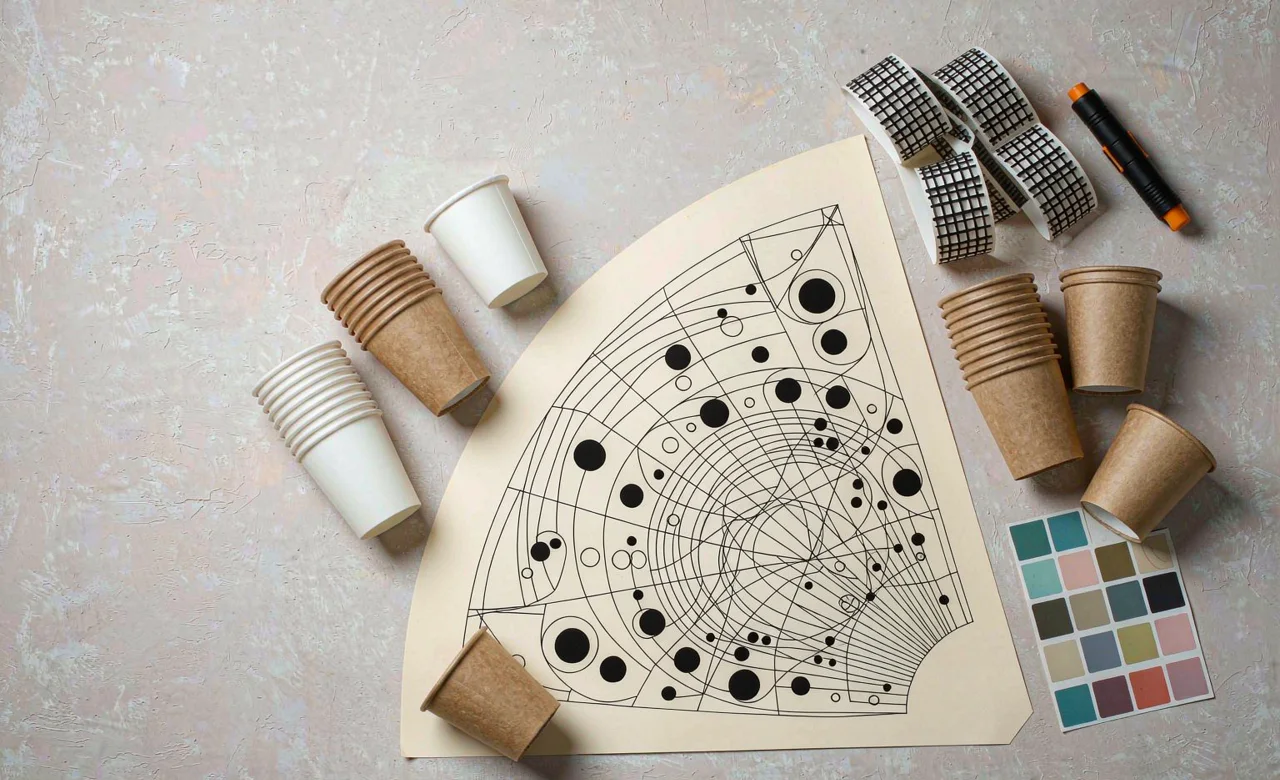
Custom printed food packaging is produced by flexographic, offset or digital printing, and the right method depends on artwork and run length: flexography for high-volume spot-colour logos, offset for photographic detail, digital for proofs and short runs. A paper cup is printed flat as a fan-shaped die-cut blank, not a rectangle, so artwork must be built on the dieline for that exact cup size. Send vector files with outlined fonts, Pantone or CMYK colours and at least 300 DPI before a proof is approved.
Print Method Selector
The press decides what your artwork can reproduce, how many colours make economic sense, and whether a plate charge applies.
| Method | How it prints | Colour capability | Setup | Best fit |
|---|---|---|---|---|
| Flexographic | Flexible plates on a rotary press with fast-drying inks; printed before forming | Up to 7 spot colours, full-wrap 360° printing; solid colours and simple gradients | One plate per colour, a fixed cost amortised across the run | Logo-led designs at volume; published industry benchmark is 20,000+ cups per design |
| Offset | CMYK plates and blankets build the image from screened dots | CMYK process plus optional Pantone spot inks; photographic images, skin tones and fine gradients | Plates plus press setup; higher unit cost than flexo | Premium runs and artwork that genuinely needs photo-quality detail |
| Digital | Inkjet or toner with no plates at all | Full colour, no spot-ink limitation; closest colour approximation to Pantone | No plate or setup cost | Pre-production proofs, samples and sub-MOQ runs |
The honest trade-off. One or two spot colours usually cost less than CMYK because they need fewer plates; three or more spot colours invert the economics, and photographs or continuous-tone gradients require CMYK. A digital proof is close to bulk flexo output but not identical, because ink chemistry and substrate behaviour differ — that is why a physical printed sample belongs in the approval loop.
What Sets the MOQ and the Colour Count
Minimum order quantity is not one number for the whole catalogue. It follows the blank, the plate count and how many SKUs share a print run. Confirm the per-SKU figure on your quotation.
| Product line | Blank / dieline | Print method normally used | MOQ driver | Colour count driver |
|---|---|---|---|---|
| Single wall paper cups | Fan-shaped blank; dieline changes with each capacity | Flexographic, digital for proofs | One plate per colour; plate cost spread over the run | Up to 7 spot colours; 1–2 is the usual branded-cup range |
| Double wall and ripple wall cups | Inner cup blank plus outer wrap; recycled outer board shifts the white point | Flexographic or offset | Two components to print and register | White backgrounds print greyish on recycled outer board — design around it |
| Kraft bowls and lids | Curved bowl blank; lid dieline keyed to rim diameter | Flexographic | Dieline is diameter-specific, so sizes cannot share plates | Spot colours dominate on kraft; confirm contrast on the brown substrate |
| Takeaway boxes and clamshells | Larger flat folding blank with windows and panels | Offset or flexographic | Blank size and number of printed panels | CMYK where photography is used, spot for the logo |
| Cup sleeves and paper bags | Small sleeve blank or flat SOS bag blank | Flexographic or digital | Low blank cost makes short digital runs viable | Usually 1–4 colours |
Plate and setup charges are commonly billed per size on a first order — ask whether they repeat on reorders. The exact MOQ, plate charge and available colour count for your SKUs are stated in the custom print quotation.
Artwork Guidelines and Dielines
Most artwork rework comes from four avoidable file problems. Check them before the first proof is issued.
File format
Vector, outlined, 300 DPI
Supply AI, PDF or EPS with all fonts converted to curves. Raster elements need 300 DPI or more at final print size. Logos taken from a website at 72 DPI will print as a blurry stamp and cost a revision round.
Colour space
Pantone or CMYK, never RGB
Specify brand colours in Pantone PMS or CMYK. A PMS code ending in C is for coated stock and U for uncoated stock, and the same number looks different on each. Use the Pantone Color Bridge to judge a spot-to-process conversion, or ask whether the press supports extended gamut CMYK+OGV.
Dieline
Build on the exact template
Place artwork on the supplier’s dieline for that specific cup size and wall type. The solid line is the cut path, the outer dashed line is the 3 mm bleed, and the hatched strip is the seam the artwork must keep clear of. A cup is printed flat as a fan, not as a cylinder.
Brand consistency
Lock the logo as a spot ink
The usual professional structure is a hybrid: the logo’s signature colour is locked as a Pantone spot ink so every batch matches, while photography and gradients run in CMYK. A brand guide containing only RGB or HEX values is not a print specification.
Inks, coatings and adhesives are part of the packaging unit screened under PPWR, so the ink declaration belongs in the certifications and compliance file for EU and US state shipments.
Digital Proof Workflow with an Approval Gate
Four steps, each with a defined output. Production starts only after written approval of a physical printed sample.
Vector files, outlined fonts, 300 DPI, Pantone or CMYK values, correct dieline and seam clearance checked against the SKU.
A PDF or digitally printed proof showing placement, wrap alignment, bleed and readable minimum text size. Colour is indicative only.
A sample printed by the intended production method on the real substrate, so kraft tone, spot ink and registration can be judged.
The approved sample becomes the production reference. Changes after this point require new plates and a revised schedule.
Where the Overseas Lead Time Goes
Printed orders add artwork and tooling stages before the freight clock starts. The inland and ocean legs below are published route data for shipments out of Wuhan; the production schedule itself is confirmed per order.
| Stage | Who controls it | How to shorten it | Published timing reference |
|---|---|---|---|
| Artwork and dieline approval | Buyer and prepress | Send final vector files with outlined fonts and complete colour specs | Buyer-controlled; no fixed published value |
| Plate / tooling preparation | Printer | Limit the spot colour count and reuse plates across reorders of the same size | One plate per flexo colour |
| Proof and physical sample approval | Buyer | Approve all stakeholders in one review round; use courier delivery for the sample | Buyer-controlled; no fixed published value |
| Production run and QC | Factory | Confirm the SKU, quantity and print method before scheduling | Stated in the order confirmation |
| Inland barge to Shanghai | Forwarder / port | Book against the barge cut-off, which precedes the ocean vessel cut-off | Yangluo to Shanghai barge 3–5 days; the Han-Shen express service reaches sea in 5 days |
| Ocean transit | Carrier | Choose a direct service where available and allow for transhipment | Shanghai to Europe 30–45 days; Wuhan to Europe 35–50 days total |
Container selection, Incoterms 2020 and documentation are covered on shipping and lead times. Because the barge cut-off can precede the ocean cut-off by two to three days, a delayed artwork approval can push an order to the next sailing.
Build a Multi-SKU Custom Print Enquiry
Supplying these five fields lets the quote cover several product lines in one pass and routes it to the right print method.
| Field | What to send | Why it changes the quote |
|---|---|---|
| Product lines | Every item to be printed, e.g. paper cups, bowls, boxes, sleeves, bags | Each has its own dieline, plate set and MOQ |
| Quantity per SKU | Pieces per size and per design | Plate cost per unit falls as the run grows; short runs favour digital |
| Colour count and references | Number of spot colours plus Pantone codes, or CMYK artwork | Determines plate count and whether offset is required |
| Destination market | EU member state, US state, or other | Determines the ink, coating and PFAS declarations needed in the compliance file |
| Artwork status | Ready vector files, or a request for the size-specific dieline | Decides whether preflight can start immediately |
Send the field set through the custom print quote request, or return to the home page to shortlist product lines first.
Request a Custom Print Quote