
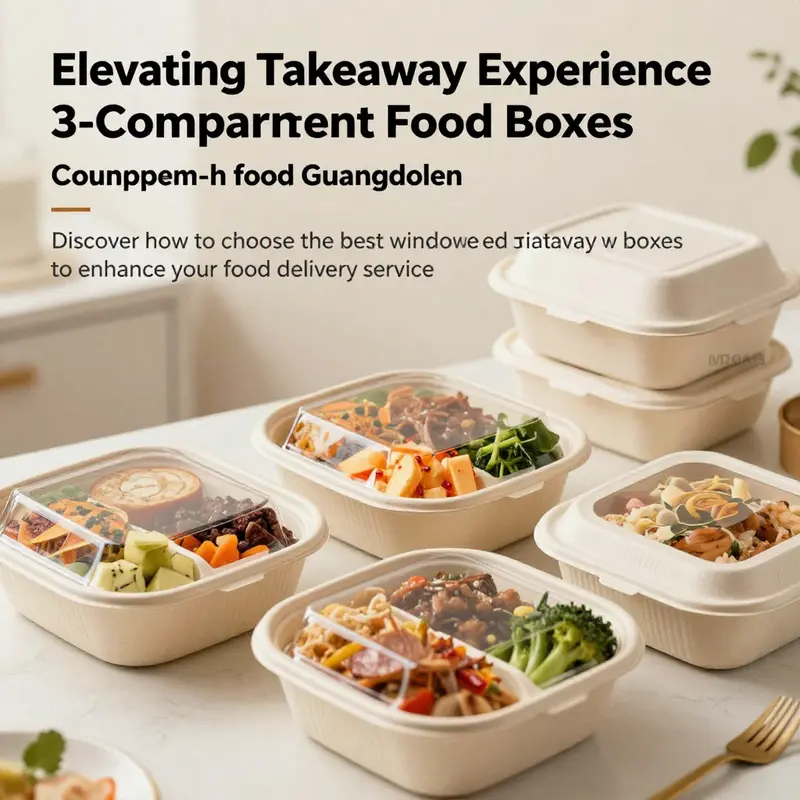
As the demand for convenient food packaging rises, 3-compartment takeaway food boxes with windows have become a popular choice among various businesses, including bubble tea shops, restaurants, food trucks, and catering services. These boxes not only provide functionality and efficiency but also present a visually appealing presentation of your culinary creations. In this guide, we will take a closer look at reliable suppliers from Guangdong, China, focus on sustainability and compliance in supplier practices, and offer tips on evaluating and selecting suppliers that meet your business needs.
Windowed Precision: Guangdong’s Role in Sourcing 3-Division Takeaway Boxes for Global Foodservice
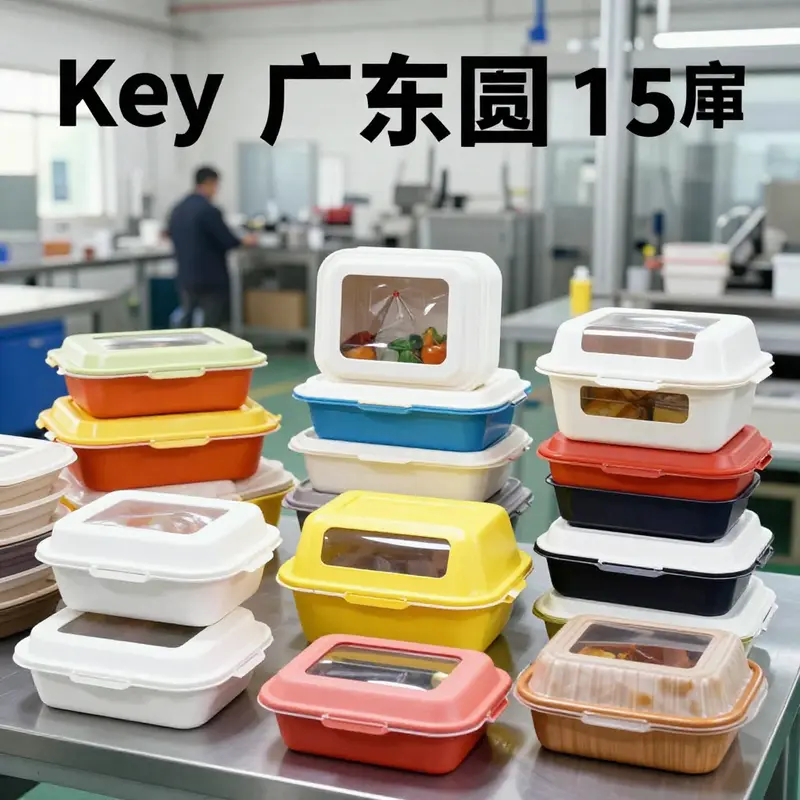
The world of takeout packaging has moved from a simple containment solution to a staged canvas for brand storytelling, product integrity, and customer experience. In the heart of this transformation lies the 3-division takeaway box with a window—a design that must balance partitioned portions, visibility, heat management, and a crisp impression of the brand. The chapter ahead unfolds not as a shopping list but as a narrative about how Guangdong, China, became the fulcrum for sourcing these specialized boxes in a way that aligns with the ambitions of modern foodservice operators. It is a story about ecosystem maturity, supply chain discipline, material innovation, and the careful calibration of cost, compliance, and creativity. Even for buyers who have never set foot in Asia’s largest packaging cluster, understanding Guangdong’s value proposition can demystify the choices that underpin reliable windowed takeout boxes, the kind that can carry complex meals—from fries and fried chicken to layered salads and dessert assortments—while protecting flavor, texture, and presentation from launch to last bite.
Guangdong’s appeal begins with its ecosystem, a dense network of raw material suppliers, component manufacturers, and finishers that collaborate across a continuous manufacturing continuum. In practice, that means a single supplier can offer a multi-material solution—from paperboard cores to molded fiber liners, from bioplastics to recyclable laminates—without forcing a brittle trade-off between strength and sustainability. The region’s mature packaging culture has grown alongside international trade, shaping a pragmatic approach to production planning, quality assurance, and regulatory compliance. For buyers, this translates into shorter cycles from concept to sample to pilot run, and then to mass production with predictable lead times. The geographic advantage—proximity to major ports such as those in Shenzhen and Guangzhou—translates into faster shipping, reduced inventory risk, and better responsiveness to seasonal demand swings. A brand running promotions during holidays can sequence designs, print runs, and logistics in a way that minimizes backup caused by last-minute design tweaks or retooling.
Within Guangdong, cities such as Guangzhou, Shenzhen, and Dongguan stand out as hubs where high-volume production coexists with high-quality customization. Here, the machinery mix is broad: advanced offset and digital printing lines support vibrant graphics and precise window placements; automated folding and bonding lines deliver self-locking, grease-resistant, and leak-proof architectures; and a cadre of die-cutting, scoring, and lamination specialists can tailor window shapes and sizes to fit three-compartment layouts. The window itself is not a mere design flourish; it is a functional instrument that reveals the contents while needing to survive the rigors of grease resistance, microwave exposure (where relevant), and handling by diverse foodservice channels. A robust Guangdong supplier can, therefore, provide a package that feels premium in a bakery or coffee shop environment while remaining compatible with fast-food throughput. It is in this dual demand—quality presentation and throughput reliability—that Guangdong’s packaging power reveals its competitive edge.
Evaluating potential partners in this corridor requires moving beyond price. The sourcing conversation must incorporate a framework of criteria that reflects the realities of international food safety expectations, environmental stewardship, production agility, and branding flexibility. Compliance remains foundational. Boxes destined for global markets should demonstrate conformance with recognized food safety standards that vary by market, such as certain certifications related to contact with food, and environmental certifications that support a brand’s sustainability promises. In practice, this means asking suppliers about their adherence to recognized safety and environmental guidelines, and requesting documentation or third-party audits that verify ongoing compliance. Production capacity and reliability then shape the risk calculus. A supplier may be able to quote an attractive unit price, but if their lines run at peak capacity or if their on-time delivery metrics are inconsistent, the business case breaks down when orders scale. The best Guangdong partners balance capacity with a track record of delivering in full and on time, maintaining stable lead times even as demand grows or product configurations diversify.
Sustainability, increasingly central to consumer expectations and regulatory reviews, is another nonnegotiable axis. For a 3-compartment windowed box, sustainability can span multiple material families—recycled kraft papers, molded fibers, and increasingly popular bioplastics such as PLA—each with its own implications for performance. The box must stay grease and moisture resistant, yet be compatible with end-of-life scenarios that consumers expect, whether compostability in appropriate streams or recyclability in standard municipal programs. Forward-looking buyers often pursue suppliers who can propose material blends that reduce carbon footprints without compromising the integrity of the window or the partition design. A supplier’s ability to source post-consumer recycled content, utilize responsibly managed forest products, or offer compostable alternatives becomes a meaningful differentiator in brand storytelling and in meeting evolving regulatory expectations across export markets.
Design and customization are where Guangdong truly shines. A takeout box must perform as a brand ambassador. It should support precise window placements that align with the product layout—allowing easy viewing of the most visually appealing portions, such as a carefully arranged chicken breast, crisp fries, or a glossy dessert layer. The window shape—rectangular, oval, or custom-cut—must complement the inner geometry while not compromising structural integrity under heat and grease exposure. The self-locking mechanisms, corner closures, and venting strategies all contribute to a packaging solution that not only looks right on day one but maintains performance through transport, retail display, and customer handling. In addition to structural engineering, print capability matters. The ability to reproduce brand colors with fidelity on packaging stock that interacts with window transparency is essential. Modern Guangdong facilities frequently offer high-precision digital and offset printing, enabling consistent color matching across large runs and enabling branded graphics that enhance perceived value.
The practical implications of this capability become clear when considering typical configurations. A 500 ml tier with defined top and bottom dimensions—Top: 125×110 mm, Bottom: 110×90 mm, Height around 45 mm—illustrates the kind of tight tolerances demanded by the market. The window must be positioned to reveal the food without exposing the top lip to the consumer, which could lead to spillage or heat loss. The self-locking design must remain secure during multi-port distribution, yet be user-friendly at the point of sale to avoid delays for staff. These specifications echo the reality that design is not cosmetic; it is a logistical and culinary performance parameter. Suppliers operating in Guangdong are conditioned to translate such specs into repeatable, factory floor realities, with engineering reviews, sample validation, and pilot runs that reveal any issues before full-scale production begins.
Another layer of complexity is the flexibility to combine materials and finishes that satisfy both performance and sustainability demands. Recycled kraft paper with internal barrier coatings can deliver grease resistance and color fidelity while enabling recycling or compostability in certain contexts. Sugarcane bagasse, another material highlighted in the broader supplier ecosystem, offers stiffness and printability with a lower environmental impact than virgin paper in many cases. Bioplastics like PLA can be suitable for certain windowed designs if heat and moisture exposure are appropriately managed, though they require clear communication about end-of-life options to avoid confusion in the consumer stream. The best Guangdong suppliers offer a menu of material options and can guide buyers toward permutations that align with brand promises, regulatory constraints, and logistics realities. They can also provide test samples and accelerated aging analyses to help predict how a given configuration will perform across the supply chain, from warehouse handling to cold-chain exposure to consumer use.
A key strategic insight for buyers is to treat Guangdong not merely as a place to order boxes but as a collaborative development environment. A credible supplier will welcome design reviews, offer precise quotations with bill-of-materials that reflect all variants, and share process maps that reveal the steps from raw stock to finished box. They will also be transparent about production capacity, lead times, and contingency plans for disruptions. In a region with such depth of capability, risk management becomes a product feature in itself. It is practical to request documentation that confirms certified processes, traceability for materials, and a clear path to scale—especially for brands planning regional or global launches. The result is not a single hurried purchase but a long-term supplier relationship built on mutual understanding of each party’s constraints and aspirations.
To guide buyers through this landscape, many procurement strategies advocate using a structured sourcing framework that recognizes the value of both speed and stability. Shorter lead times are desirable, but not at the expense of quality or compliance. A Guangdong-based supplier who can provide a transparent production calendar, forecasted capacity, and predictable sample-to-production timelines becomes a partner who can adapt as the brand’s packaging strategy evolves. When a brand’s design changes or a new product line arrives, the partner’s ability to retool quickly without sacrificing consistency is a measurable competitive edge. The sourcing journey then expands beyond a single SKU to a family of packaging solutions that share a common core in terms of windowed presentation, partition integrity, and printability. Such coherence across SKUs helps reduce the complexity of inventory, improves branding consistency, and simplifies quality control across multiple product lines.
From a practical procurement perspective, many teams find value in engaging with Guangdong-based manufacturers who can support end-to-end packaging development—ranging from initial concept drawings to 3D renderings, from sample verification to full-scale production. The iterative cycle often begins with a design brief and a set of performance tests focused on leakage resistance, grease resistance, and tensile strength of the seals. Then, a small batch is produced for field testing in partner kitchens or in a controlled pilot with select retailers. Feedback from this stage informs any necessary refinements before committing to larger runs. The goal is to arrive at a packaging solution that behaves consistently across the supply chain, preserves the visual impact of the windowed design, and aligns with the brand’s environmental and regulatory commitments. In many cases, the Guangdong ecosystem can support this evolution because their manufacturing networks are designed to absorb complexity without sacrificing throughput or consistency.
For buyers who are expanding into new markets or exploring more sustainable narratives, Guangdong’s strengths extend into the broader conversation about material diversification and end-of-life considerations. The regional supply chain has demonstrated adaptability to evolving consumer expectations around the environmental footprint of packaging. A growing number of suppliers can offer certified compositions, such as recycled paper options with responsibly sourced content or compostable alternatives that suit specific municipal programs. This is not merely about ticking boxes; it is about enabling brands to tell an authentic story of responsibility without compromising the functionality that keeps food safe, visually appealing, and economically viable for operators. The possibilities become even more compelling when considering how a windowed 3-compartment box can be engineered to minimize material use while maximizing product visibility. The art of reducing waste through intelligent design—where each partition, each fold, and each cut is optimized to carry a given meal with as little material as necessary—speaks to the maturity of Guangdong’s packaging industry. In effect, the region provides a practical playground for brands to experiment with form, function, and sustainability in tandem.
Amid these opportunities, buyers are advised to balance curiosity with due diligence. The glossy promise of a pristine window, the lure of a unique shape, or the idea of a breakthrough barrier film should be weighed against concrete performance metrics and documented compliance. A credible Guangdong supplier will not only demonstrate capabilities but also provide a robust set of references and verifiable certifications. They will understand that food-contact packaging is a regulated space with global implications, and they will articulate how their materials and processes align with those expectations. They will also recognize that packaging decisions are not isolated; they influence product quality, brand perception, distribution efficiency, and consumer satisfaction. In other words, a windowed 3-compartment box is a system, not a single component, and Guangdong’s export-ready infrastructure is primed to deliver that system with reliability, clarity, and a sense of shared purpose between brand and supplier.
For teams building a global procurement strategy, the Guangdong advantage is also about accessibility. The region has long served as a gateway to world markets, with established logistics networks, multiple port options, and a tradition of export-oriented manufacturing. This translates into capable support for label compliance, packaging recyclability statements, and the ability to translate regional specifications into international packaging standards. When combined with a mature ecosystem that values precision printing, automated finishing, and reliable supply chains, Guangdong becomes less a single sourcing location and more a strategic platform. It enables brands to pilot new windowed designs with confidence, scale regional programs quickly, and maintain a consistent quality baseline across diverse markets. That consistency, in turn, accelerates brand trust and reinforces a familiar consumer experience, whether a customer is ordering a quick-service meal or a premium casual dining package.
Within this landscape, it is important to recognize that one doesn’t need to compromise between speed and sustainability. Guangdong’s suppliers increasingly demonstrate the capability to deliver context-appropriate solutions—grease-resistant, microwave-safe where applicable, and designed for straightforward disposal in the markets where they will be used. The result is a pragmatic balance: boxes that look compelling on social media and in-store displays, that perform reliably during transit, and that align with environmental expectations without creating prohibitive cost structures for brands. This is the core reason brands gravitate toward Guangdong when their packaging strategy centers on 3-compartment takeaway boxes with windows: it is a place where design ambitions and manufacturing discipline converge, and where the business case for scale can coherently support ambitious brand stories.
To cap this exploration, consider how the supplier landscape in Guangdong supports a robust, sustainable, and scalable approach to windowed 3-compartment boxes. The region’s mix of design capability, material diversity, and export-ready logistics creates a compelling value proposition for brands seeking to elevate their packaging without losing sight of safety, performance, and environmental commitments. As a practical step, buyers can engage in a structured inquiry that assesses compliance credentials, production capacity, material options, and customization capabilities. They can request pilot runs, sample boxes, and a clear timeline that maps design approval, tooling, and mass production milestones. They can also ask for transparent cost breakdowns that reflect all components—stock, ink, lamination, window lamination, die-cutting, and finishing—while understanding how these elements may shift with different material choices. In doing so, they participate in a sourcing process that is not just transactional but collaborative, leveraging Guangdong’s depth of expertise to craft packaging that is both visually compelling and operationally sound.
For readers who want a concrete, ready-to-explore pathway, one internal resource captures part of this journey: eco-friendly-disposable-3-compartment-food-grade-packaging-box-for-fast-food-high-quality-takeout-boxes-for-fried-chicken-french-fries-packaging. It signals the broader availability of sustainable, windowed packaging options that can be adapted to Guangdong-based production capabilities, while this chapter remains focused on the strategic considerations that make such partnerships durable and scalable. In parallel, buyers should keep the broader market context in view, recognizing how an external market such as a robust packaging marketplace can complement factory-based strengths with price benchmarks, sample access, and digital audits that help validate supplier claims before a long-term commitment is made. The overarching message is clear: Guangdong offers a comprehensive, globally relevant platform for sourcing 3-compartment takeaway boxes with windows, where design fidelity, regulatory compliance, and sustainability can co-exist with speed and scale. This alignment is not incidental; it is the product of an ecosystem that has evolved to meet the needs of modern foodservice brands seeking to deliver great meals in a package that honors safety, style, and responsibility. As brands continue to navigate a shifting regulatory landscape and increasingly discerning consumers, Guangdong’s role as a packaging powerhouse becomes not just a logistical convenience but a strategic differentiator that can help steer product launches, market entries, and brand storytelling toward durable success.
External resource: https://www.alibaba.com
Sustainable Pathways and Compliance Gateways in 3-Compartment Takeaway Boxes with Window: A Guangdong-Centered Perspective
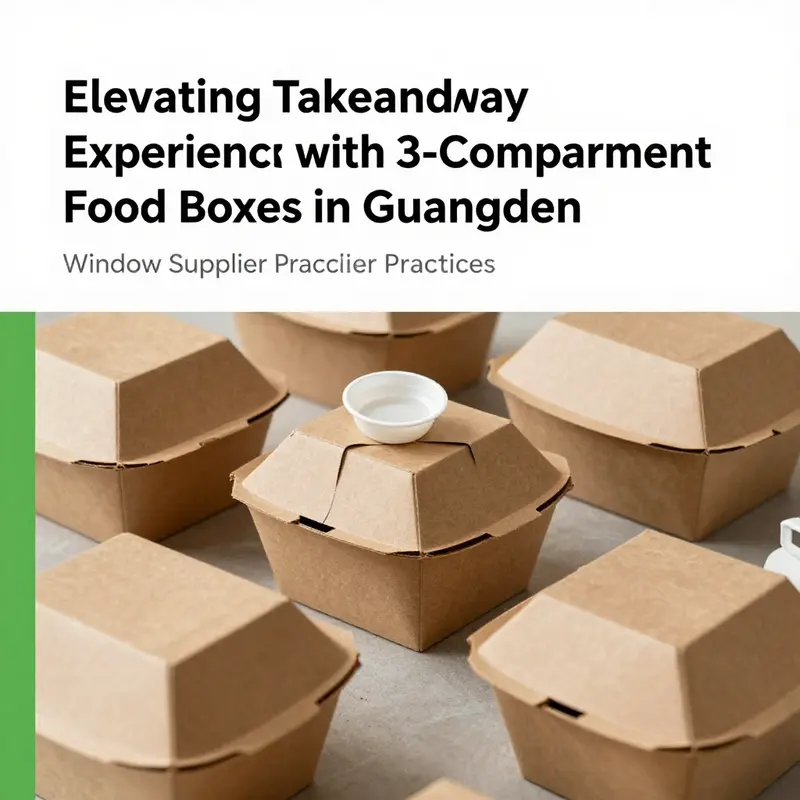
The craft of packaging for food service has reached a point where sustainability and regulatory diligence are not afterthoughts but core performance metrics. For brands that rely on three-compartment takeaway boxes with transparent windows, the path to responsible sourcing weaves together material science, supply-chain transparency, and an evolving landscape of environmental rules. This chapter unpacks how suppliers rooted in Guangdong Province—alongside adjacent manufacturing hubs—are integrating durable, high-volume production with robust compliance programs. It also explores how brands can navigate the practical balance between visual appeal, barrier performance, and end-of-life realities without sacrificing speed or cost efficiency.
At the heart of sustainable practice for three-compartment boxes with windows is the substrate. Many leading converters have shifted away from purely virgin fibers toward thick, recyclable kraft paperboard that remains sturdy enough to carry multiple compartments and maintain crisp print media. Kraft paperboard provides the structural integrity necessary to hold a three-section layout, while its surface accepts branding and artwork with high fidelity through modern offset and digital printing methods. The environmental advantage is clear when a paperboard is sourced from forests managed under credible stewardship programs and when the substrate is designed for recyclability at the end of its life. The window, which is essential to consumer appeal by revealing the product inside, is increasingly made from compostable or recyclable films such as polylactic acid (PLA) or cellulose-based laminates. These films offer a lower environmental footprint than conventional polyethylene or PET windows, especially when produced with attention to thickness and barrier performance that minimizes material usage without compromising seal integrity.
In practice, this combination of substrate and window film is not a simple swap of materials. It requires careful engineering to ensure that the packaging preserves food safety, keeps moisture and grease from compromising contents, and remains compatible with the diverse sauces and items that often populate a three-compartment layout. For example, the top compartment may be designated for a sauce or dip, while the side compartments hold starches or proteins. The packaging must resist grease migration, maintain a barrier against oxygen where necessary, and avoid delamination or warping under typical handling and transport conditions. The result is a multi-layered system where the board itself, the adhesive system, the edge seals, and the window interface are harmonized through testing that mirrors real-world use.
From a compliance standpoint, suppliers in this field frequently pursue a multi-faceted certification portfolio. The Forest Stewardship Council (FSC) certification on the paperboard demonstrates that fiber sourcing adheres to responsible forestry practices. ISO 14001 environmental management systems signal an organizational commitment to reducing the environmental footprint across the production lifecycle—from raw material procurement to waste treatment and energy use in the converting lines. Third-party verification, often through SGS or similar bodies, provides an audit trail that underscores adherence to food-contact safety standards and environmental regulations across multiple jurisdictions. These credentials matter not only for regulatory alignment but also for brand credibility; consumers increasingly expect brands to be transparent about where packaging materials come from and how they are disposed of after use.
Regulatory alignment extends beyond the supplier’s walls. In many markets, rules around single-use plastics, labeling, and compostability shape both product design and end-of-life expectations. The EU’s Single-Use Plastics Directive has reoriented many packaging strategies toward materials that are compostable or recyclable and that avoid adding persistent plastics to the waste stream. In other jurisdictions, regional and state regulations—such as California’s SB 54—drive similar emphasis on recyclability and bio-based content. For brands selling across multiple regions, governance means ensuring that each shipment carries documentation detailing material sourcing, end-of-life disposal options, and adherence to applicable regional regulations. Suppliers that can provide this documentation proactively reduce negotiation time and accelerate product launches for brands that require rapid market entry while maintaining a principled sustainability posture.
A practical dimension of sustainability in the Guangdong ecosystem is the willingness and ability of suppliers to scale responsibly. Guangdong, with its mature packaging ecosystem, offers a robust network of producers capable of handling high-volume, branded orders with consistent quality. The high-volume capability is paired with investment in automated production lines that optimize waste reduction, material utilization, and waste recycling internally. Strong capacity planning translates to reliable lead times, a critical factor for foodservice operators who must respond quickly to demand shifts or menu changes. When a supplier can run large runs without sacrificing consistency, it reduces the need for repeated rework, which in turn lowers waste and energy use per unit of packaging produced. In this vein, the choice of production technology—whether high-precision digital printing for flexible branding or traditional offset printing for bulk runs—must align with the brand’s design complexity and the expected order cadence. The ability to maintain precise window placements, achieve consistent color reproduction, and ensure reliable self-locking or interlocking mechanisms are all part of the sustainability calculus. Fewer rejects and less returns due to misalignment or sealing failure contribute indirectly to a smaller environmental footprint.
The supply chain transparency that underpins responsible packaging is increasingly non-negotiable. Brands expect documentation that traces materials from fiber to finished box, including supplier certifications, material safety data, and evidence of compliance with food-contact standards. In practice, this means a robust bill of materials, clear specifications for each layer, and verifiable chain-of-custody information. It also means an explicit end-of-life pathway. A well-structured supplier program will include guidance on recycling streams, composting viability where applicable, and consumer education that clarifies disposal options for the packaging and its window film. In regions where compostable windows are used, for instance, the supplier should be able to document the composting conditions required for the film to break down effectively, along with any limitations tied to composting infrastructure in a given market. The broader point is that sustainability is not just about the box’s material choice; it is about the entire lifecycle and how information flows through the supply chain to the brand and, ultimately, to the consumer.
To illustrate how this translates into practice, consider a hypothetical procurement strategy anchored in the Guangdong ecosystem. A brand seeking to source three-compartment, windowed boxes would begin with a supplier evaluation framework that weighs material integrity, barrier performance, and the ability to manage complex branding across multi-page print runs. They would require FSC certification for the paperboard and ISO 14001 for the manufacturer’s environmental management systems, along with SGS verification for food-contact compliance. They would request data on adhesive systems used for the three-compartment structure and any solvents involved in production, with a preference for low-VOC formulations to minimize indoor air quality concerns in packing facilities and distribution centers. They would also seek evidence of waste minimization practices on the line, including how trimmings and trim waste are diverted to recycling streams, and how energy efficiency is tracked and improved over time. These criteria are not merely compliance checkboxes; they are signals of a supplier’s commitment to responsible stewardship that can help a brand protect its reputation in a market where consumers scrutinize packaging as part of the product experience.
As brands scale, the question of regional specialization becomes salient. While Guangdong remains the hub for premium, customized packaging, Anhui and Zhejiang provinces have developed complementary strengths. Anhui, for example, has specialized in cost-effective, high-volume production with biodegradable materials, offering a pathway for brands seeking scalable solutions without compromising on eco-credentials. Zhejiang complements this with advanced finishing capabilities and efficient print-to-pack processes that support rapid turnarounds. For a brand with a multi-market footprint, a coordinated network across these provinces can deliver not only cost savings but also a more resilient supply chain. It is essential that such collaborations are governed by clear contractual terms and robust risk management practices, including contingency plans for raw-material shortages, port delays, or logistics interruptions that could affect lead times for peak demand periods.
Another facet of sustainable practice concerns the packaging’s behavior in the consumer environment. A windowed three-compartment box must be visually appealing yet easy to recycle. The window film’s placement should avoid obstructing essential labeling and allergen information while maximizing display visibility. The backside ply of the paperboard should carry consumer-friendly disposal instructions that reflect local recycling or composting capabilities. In markets where curbside recycling is common, a clean separation of materials—paperboard versus window film—facilitates more efficient processing. Where composting is feasible, brands can differentiate themselves by highlighting the compostability of the window film and outlining the conditions under which it will decompose. The outcome is a packaging system that not only protects food and preserves its appearance during delivery but also communicates a responsible end-of-life story to the consumer, reinforcing the brand’s environmental commitments.
In terms of documentation and risk management, procurement teams should insist on readily available material safety data, supplier audit reports, and evidence of compliance with regional restrictions on single-use plastics. The chain-of-custody information should extend beyond raw-material sources to include the recyclability or compostability of the entire packaging system. Where possible, suppliers should offer third-party verification of end-of-life performance through lifecycle assessments or equivalent studies that quantify emissions, energy use, and waste generation across the supply chain. Such rigor helps brands build credible narratives around sustainability without relying on vague assurances.
The dialog surrounding sustainability and compliance also intersects with consumer education. Packaging that communicates its own environmental properties can empower customers to dispose of it properly. This is particularly important for three-compartment boxes with windows, where the visual appeal of the contents must not be compromised by an unsightly or misleading disposal message. A well-designed packaging program includes clear, concise disposal instructions, ideally aligned with the local waste-management infrastructure of the brand’s primary markets. When a consumer understands that the window film is compostable under certain conditions or that the paperboard is recyclable in standard programs, the likelihood of correct disposal increases. This educational function, though subtle, strengthens the total sustainability impact of the packaging system and supports long-term brand trust.
To help procurement professionals ground these concepts in real-world practice, consider examining practical examples of packaging with clear window features and kraft substrates. For instance, a product page demonstrating picnic kraft paper boxes with clear windows provides tangible context for how materials, window films, and structural design converge to deliver a compelling consumer experience while remaining mindful of environmental constraints. See here for a representative example: picnic kraft paper boxes with clear windows.
In closing, sustainable and compliant production of three-compartment takeaway boxes with windows is not a singular change but an ongoing transformation. It requires a symbiotic relationship among material science, engineering, and governance. Suppliers that demonstrate a credible combination of FSC-certified substrates, ISO 14001-aligned environmental management, SGS-certified food-contact safety, and transparent supply chains stand the best chance of helping brands meet evolving expectations. For brands, the reward is clear: packaging that protects the integrity of the food, communicates a commitment to the planet, and supports a differentiated brand narrative in crowded markets. The Guangdong ecosystem, with its dense network of manufacturers and its proximity to major ports, offers a practical path to achieving these outcomes at scale with reliability and speed. The broader regional landscape—encompassing Anhui and Zhejiang—provides additional options for cost-effective, sustainable production that can be coordinated to balance regional strengths with brand objectives. As consumer interest in responsible packaging grows, the role of the supplier becomes not just a facilitator of product protection but a partner in delivering a holistic environmental story that resonates from the warehouse to the consumer’s home.
External resource: For up-to-date industry standards, compliance guidelines, and best practices for sustainable food packaging, including multi-compartment takeaway boxes with windows, consult the Sustainable Packaging Coalition’s resources at https://www.sustainablepackaging.org/.
null
null
Final thoughts
Choosing the right supplier for 3-compartment takeaway food boxes with windows is crucial for your business success. By focusing on reputable companies in Guangdong, prioritizing sustainability and compliance, and properly evaluating your options, you can enhance your food delivery service while ensuring customer satisfaction. Investing in quality packaging solutions speaks volumes about your brand and commitment to excellence. As the food service industry continues to evolve, proper packaging plays a key role in standing out from the competition.