
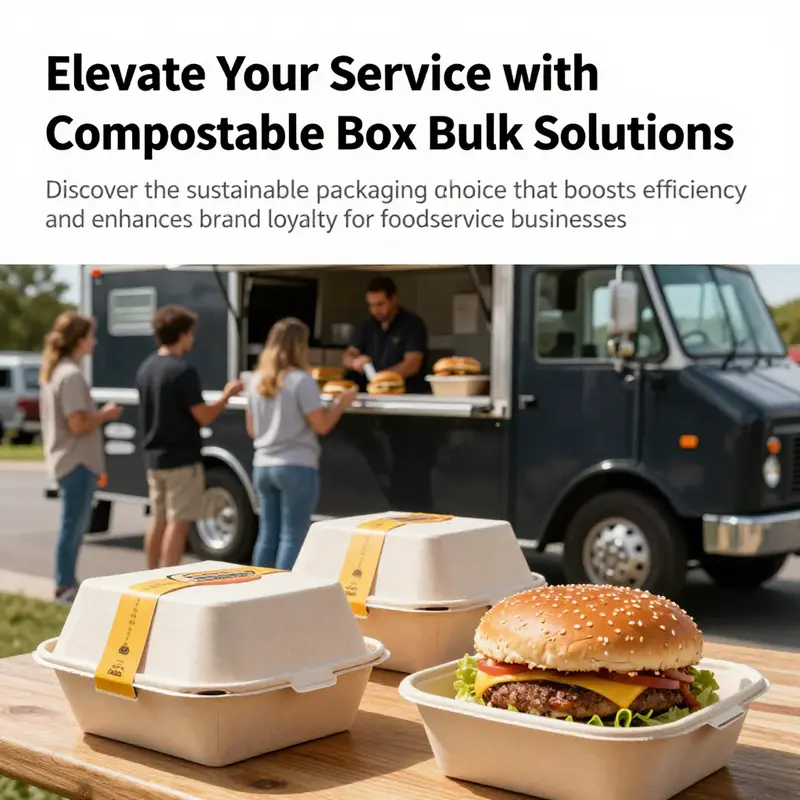
In today’s environmentally conscious market, compostable hamburger boxes are more than just a packaging option; they are an essential component for businesses dedicated to sustainability. Whether you’re a bubble tea shop, a restaurant, a food truck operator, an event planner, or part of a corporate procurement team, the need for eco-friendly solutions is stronger than ever. As regulations tighten and customers increasingly prefer green practices, bulk purchasing compostable hamburger boxes from reliable sources, especially from leading manufacturers in China, offers significant advantages. This article delves into understanding the production of these boxes, explores their economic benefits, ensures compliance with stringent standards, and highlights customization trends that can set your brand apart.
From Clusters to Kitchens: The Integrated Bulk Production of Compostable Hamburger Boxes
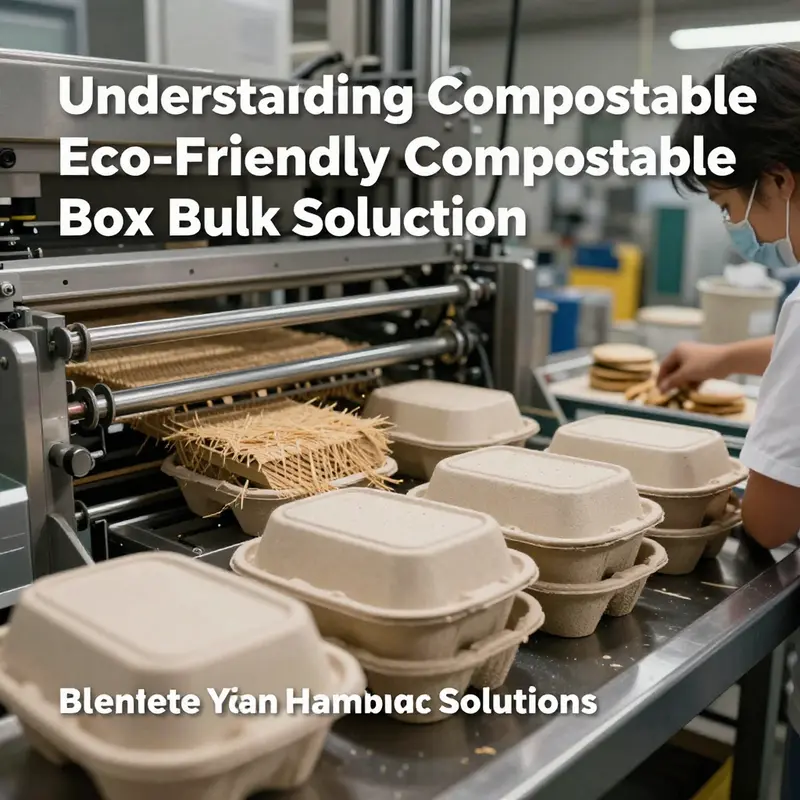
The bulk production of compostable hamburger boxes sits at the intersection of regulatory momentum, evolving consumer expectations, and the relentless push for operational efficiency in foodservice logistics. As cities tighten waste and packaging laws and diners increasingly reward eco-conscious brands, the choice to source in bulk becomes less a preference and more a strategic imperative. The story of how these boxes are made at scale starts in the dense industrial ecosystems of key regions that dominate modern packaging supply: China. There, a mature manufacturing fabric has woven together material supply, converting expertise, and global logistics into a reliable, scalable throughput that can reach hundreds of millions of units each year. This is not merely a tale of more machines in a factory. It is a narrative of a vertically integrated chain in which raw materials, processing steps, quality assurance, and regulatory compliance are synchronized to meet the exacting demands of large chains, quick-service restaurants, and meal-kit producers while preserving the compostability that is central to their public promise.
At the heart of this ecosystem are specialized clusters that cluster not by accident but by a deliberate industry logic. Regions that host dense supplier networks—where bagasse, bamboo pulp, and polylactic acid (PLA) supplies flow in concert with molding, die-cutting, and coating capabilities—enable rapid scale without sacrificing consistency. In practice, this means a producer can source certified feedstocks like bagasse or bamboo pulp, move seamlessly to high-precision forming and cutting lines, and emerge with a stack of boxes that not only look the same but perform the same across tens of thousands of units per day. The efficiency is not merely about faster cycles; it is about reducing variance in thickness, stiffness, and sealing performance so that every box can withstand the rigors of hot-holding, transit, and stacking in commercial environments, all while remaining compostable in a commercial facility. The result is a supply chain that can flex between small test runs and multi-million-unit campaigns with relative ease, a capability that reduces risk for buyers who want to pilot concepts without locking into an expensive long-term commitment.
The production of these boxes hinges on access to certified and traceable materials. Bagasse—the fibrous residue from sugarcane—offers a robust base that is both sturdy and compostable when processed correctly. Bamboo pulp brings a different set of properties: sometimes a tighter fiber structure and a clean, smooth surface ideal for coatings designed to resist oil and moisture. PLA, a bioplastic derived from renewable resources, can be used as an additive in coatings or as part of the composite layer to improve heat resistance or gloss. Each material undergoes careful formulation to balance stiffness, heat tolerance, and biodegradability, ensuring that the finished box can perform in a typical fast-food cycle—cartons handed to customers, sauces contained, and occasional microwaving in the case of reheating. The ability to mix and match these materials within a single product family enables manufacturers to customize for climate, shelf life, and branding without compromising compostability or regulatory acceptance in major markets.
The actual conversion from raw material to final box is a disciplined sequence of molding and die-cutting processes that have been refined over years of scale. In a typical run, feedstock is formed into sheets or extruded boards, then die-cut to the desired geometry and folded into the familiar rectangular form with a secure lid or lip-and-lock mechanism. Coatings—whether grease-resistant, oil-repellent, or microwave-compatible—are applied in precise thin layers to minimize material use while delivering performance that meets consumer expectations. The key is uniform thickness and consistent fiber orientation, ensuring that the box holds its shape even when new or when subjected to the rigors of a busy kitchen. In high-volume facilities, automation handles the bulk of these steps, supported by inline quality checks that catch flaws in real time. The goal is not simply to produce a box, but to produce a predictable product that behaves reliably in thousands of identical conditions, from bustling street-front takes to large-scale restaurant deployments.
Beyond the mechanical calculus lies a deeper collaboration: an integrated supply chain that preserves traceability and allows for rapid adaptation. The vertically integrated model common in these regions means a single supplier can oversee material procurement, processing, and final packaging, closing the loop between raw input and finished goods. This integration translates into shorter lead times, more transparent cost structures, and stronger assurances on quality control. For a buyer, that translates into fewer unexpected supply interruptions, more predictable pricing, and the ability to tailor packaging to evolving sustainability targets without renegotiating long-term contracts. It also allows for a higher degree of customization—branding or functional features such as grease-resistant coatings, steam-release vents, or microwave-safe interfaces—without sacrificing the environmental performance that is central to the product’s value proposition. In a market where a single misstep in certification or testing can delay an entire rollout, the reliability of a controlled, integrated production path is a critical competitive edge.
Certifications play a crucial role in translating bulk capability into market access. A robust portfolio of recognized standards—OK Compost INDUSTRY, TÜV Austria, BPI, and related schemes—acts as the passport for compostable packaging into European, North American, and other global markets. These certifications attest that the product will break down safely and efficiently in the types of composting facilities that exist in major urban centers. For procurement teams, the presence of such certifications reduces the complexity and cost of validation testing, while enabling faster validation of supplier capabilities. Yet certifications are most valuable when paired with transparent documentation and on-site audits. Buyers increasingly seek suppliers who can demonstrate traceability from raw material certificates to finished boxes and who can provide samples, test reports, and manufacturing records on demand. In this sense, the certification is not just a badge; it is a governance mechanism that underwrites trust across a multi-stakeholder value chain, from foodservice operators to waste management partners.
The business-to-business (B2B) lens on bulk production emphasizes the practicalities that enable steady procurement for large networks. The leading suppliers in this space are measured not only by volume but by reliability. They publish clear documentation of material sourcing, manufacturing tolerances, and environmental claims, and they facilitate on-site factory audits or third-party verification to reassure buyers about compliance and social responsibility. For a purchaser, this means reduced risk in supplier changeovers, less time spent validating new lots, and a clear framework for supplier performance monitoring. The ability to provide transparent MOQs, flexible lot sizes for pilot runs, and scalable lead times is often the difference between a brand maintaining a consistent packaging supply and facing costly stockouts that disrupt marketing calendars and menus. In a climate where packaging choices are a daily part of brand storytelling, the consistency offered by bulk suppliers supports not just efficiency but also reputation. A reliable supply chain translates into a smoother customer journey—from the moment a consumer sees a logo on a box to the moment the box safely degrades after disposal.
Strategic sourcing in this arena hinges on selecting hubs that optimize speed, cost, and sustainability alignment. Shanghai and Dalian emerge as critical nodes within the broader network, each offering distinct advantages. Shanghai’s port capacity and proximity to expansive distribution networks translate to shorter international transit times and easier warehousing for campaigns with tight launch windows. Dalian, with its rail connectivity into the Eurasian corridor and access to northern markets, broadens the geographic reach and supports more diverse logistics routing. Yet other regions contribute essential strengths as well. Guangdong remains a central export hub with dense manufacturing capacity and access to downstream recycling and composting infrastructure, while Zhejiang offers specialization in applications that demand unique design features, such as containers tailored for freezer or microwave use. The strategic mosaic of hubs enables buyers to orchestrate complex supply chains that balance cost, lead time, and regulatory readiness, creating a level of resilience that few single-sourcing models can match.
Innovation threads course through this bulk landscape as material science and manufacturing efficiency converge. Researchers and engineers continually experiment with formulations that enhance stiffness and heat resistance while remaining fully compostable. In parallel, automation, robotics, and digital quality-control systems reduce human error and accelerate throughput. This combination lowers per-unit costs without eroding performance and ensures that the market can push for larger volumes without sacrificing environmental commitments. For buyers, the payoffs are tangible: more consistent box performance across weather conditions, better compatibility with fast-service workflows, and a path to standardize packaging across diverse menus and delivery formats. The potential to reduce overall packaging footprints is particularly compelling for operators who must demonstrate compliance with evolving regulations while maintaining a competitive price point for customers who are increasingly sensitive to waste and litter.
A practical anchor in this landscape is the way suppliers frame their offerings to meet specific business cases. Instead of pure volume alone, buyers tend to seek packages that align with brand goals and end-of-life outcomes. Packaging engineers work with procurement teams to balance material choices, coating strategies, and form factors that keep grease and moisture at bay while ensuring that the final product remains compatible with industrial composting facilities. The design language emphasizes not only performance but also end-of-life clarity—labels, compostability certifications, and disposal instructions that help waste streams converge toward appropriate facilities. In this sense, bulk packaging becomes a narrative device: it communicates a brand’s commitment to sustainability while delivering the practical reliability that kitchens require. For those evaluating suppliers, the ability to demonstrate end-to-end traceability—through raw-material certificates, manufacturing logs, and shipment records—becomes not just a risk-management practice but a competitive differentiator.
If you would like a concrete example of how a bulk approach translates into practical choices for a large foodservice program, consider the broader takeaway packaging ecosystem. Take-away packaging boxes for hamburgers and more can be explored here to understand how design, material selection, and process control cohere in a single product family. Take-away food packaging boxes for hamburgers and more offers a window into how a single family of boxes can be configured to suit different menus while maintaining compostability and consistent performance across multiple outlets. This kind of reference point helps buyers navigate the tension between customization and standardization, illustrating how bulk producers translate broad sustainability commitments into tangible packaging that travels from a central plant to a restaurant line and, eventually, into a composting stream.
As with any strategic sourcing decision, the question is not only how to buy but how to think about sustainability as a shared value across the supply chain. The bulk model leverages scale to drive down costs, but it also enables more rigorous stewardship of materials. By consolidating material streams and standardizing finish and coating options, manufacturers can reduce waste in both production and logistics. This is not merely about packing more boxes; it is about packing the market with greener choices that do not compromise speed or flavor. In the end, the bulk approach to compostable hamburger boxes creates a virtuous circle: lower per-unit costs enable broader adoption, clearer end-of-life outcomes improve recycling and composting rates, and a more predictable supply chain frees operators to focus on menu innovation and customer experience rather than supply disruptions. The result is a more resilient, transparent, and responsible packaging system that can scale with the ambitions of large chains and the demanding pace of modern meal delivery.
Scaling Sustainability: How Bulk Sourcing of Compostable Hamburger Boxes Translates into Real Economic Advantage
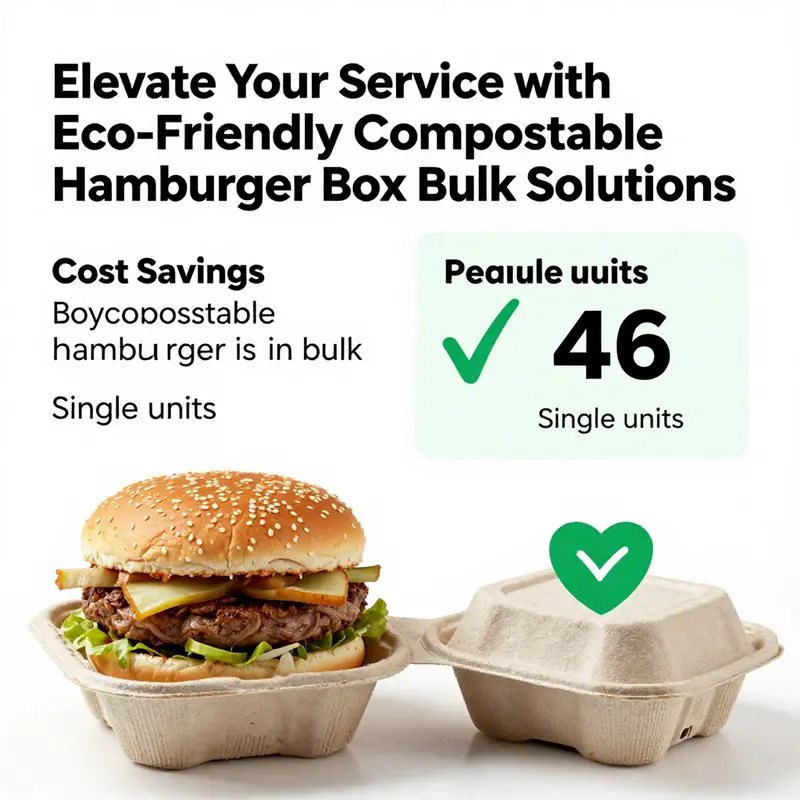
Sustainable packaging is no longer a niche requirement; it is a core lever of cost discipline, supply chain resilience, and brand integrity. When a food business shifts from ad hoc purchases to bulk sourcing of compostable hamburger boxes, the financial math changes in ways that extend beyond a simple per-unit price. The strategic value emerges from a tightly woven ecosystem where manufacturing scale, proximity to raw materials, and integrated processes converge to drive lower costs, faster turnaround, and improved predictability. In the Chinese manufacturing landscape, this convergence has become a mature capability. Regions that are well known for fast-food packaging—rooted in Zhejiang, Jiangsu, and Guangdong—have developed clustered supply chains that deliver high-volume output with consistent quality. These hubs host facilities that can operate at unprecedented scales, sometimes producing tens of millions of units each month. Such capacity is not just about meeting demand; it is about stabilizing costs in markets where material prices, energy, and freight can fluctuate rapidly. For buyers, that translates into a more reliable budgeting framework, clearer procurement planning, and a better chance to capture favorable pricing through long-term supply agreements.
A major economic driver in this environment is economies of scale. Bulk producers can amortize fixed costs across a larger number of units, which directly reduces the marginal cost of each box. In practice, large-scale plants benefit from automation in printing, die-cutting, and folding, all under one roof. Vertical integration shortens the production cycle, reduces handoffs, and minimizes the risk of bottlenecks that can derail a project with custom designs. When a buyer places a sizable order, the vendor can offer a more favorable price-per-unit, a broader range of customization options, and shorter lead times. The proximity to pulp and other raw-material suppliers matters as well. In corridors where packaging grades and biobased materials are produced, freight distances shrink and supply chain stiffness loosens. This is particularly valuable for compostable options based on bagasse, PLA, or bamboo pulp, where the cost of the base material can be a meaningful portion of total cost. Freight advantages compound this effect: near-port access in Ningbo, Shenzhen, and other major gateways means lower inland transit costs, fewer storage days, and reduced risk of stockouts during peak periods.
The economic benefits extend beyond the factory floor. Bulk procurement reduces fixed costs in several ways. First, manufacturers are more willing to offer flexible minimums or even small-batch testing lots when they can secure a larger volume in a single shipment. Second, buyers who source in bulk often qualify for better payment terms and more predictable scheduling, which improves working capital management. Third, the ability to produce in color and with branding at scale allows fast-food operators and meal-kit services to deploy sophisticated packaging designs without paying a premium for every batch. In markets with strict compostability standards, the assurance that a supplier can meet both performance and certification requirements at scale is a major financial advantage. Certifications such as OK Compost INDUSTRIAL and TÜV OK Biobased are not merely labels; they are market access tools that open doors to Europe, North America, and beyond. For companies that must navigate FDA food-contact regulations and other regional standards, a compliant bulk supplier reduces the risk premium associated with introducing new packaging into multiple jurisdictions.
From a cost perspective, the supply chain advantages are complemented by logistics efficiency. The geographic clustering of production alongside shipping nodes yields significant savings. When raw materials, finished boxes, and finished goods are all within a relatively tight corridor, the total landed cost—the sum of production, freight, customs, and duties—tends to be lower. Reports from the sector indicate material costs can be reduced by as much as twenty percent through optimized sourcing networks and reduced handling. For buyers, that translates into stronger margins or the ability to keep prices steady for longer periods, even as other costs in the value chain drift upward. The savings are not merely numeric; they translate into strategic flexibility. A restaurant chain can invest the freed capital into menu innovation, better sourcing of fresh ingredients, or enhanced waste-reduction programs, all while maintaining a compostable packaging footprint that satisfies sustainability commitments.
The economic narrative is not only about raw price declines. It is about the total cost of ownership and the value delivered by a packaging partner who can grow with a business. A manufacturer with substantial scale often provides a one-stop solution for printing, die-cutting, and final assembly. That integration reduces sample-to-production lead times, lowers defect rates, and creates a smoother feedback loop for design iterations. For brands whose identity hinges on consistent quality and reliable performance—such as leak resistance or microwave-safe coatings—the ability to test, refine, and scale a design within the same ecosystem is a meaningful economic asset. It lowers the risk that a new packaging concept will fail to meet real-world performance benchmarks, which, in turn, lowers the cost of failed launches or rework cycles.
Another layer of economic benefit comes from the ability to customize at scale without sacrificing efficiency. Mass customization—where branding, logo placement, and functional features can be incorporated across thousands of boxes—becomes a practical proposition when the producer operates at high throughput. A vertically integrated operation can coordinate color separation, embossing, and windowing in a single workflow, dramatically reducing setup costs and cycle times. For quick-service restaurants and meal-kit companies, this capability translates into a more cohesive brand experience and a more predictable production schedule. In practice, a bulk buyer can secure not only bulk pricing but also the chance to run limited-edition designs or seasonally themed packaging without the typical premium that accompanies bespoke runs. Such flexibility is especially valuable for operators who pursue promotional campaigns aligned with holidays, regional menus, or partnerships, because it preserves brand consistency across packaging while still allowing for fresh, compelling presentation.
In translating these advantages into procurement strategies, buyers often begin with a careful scan of the sourcing landscape. Platforms that host verified supplier directories can help in filtering by material type, size, certification, and customization capabilities. A practical approach is to start with a few representative SKUs in a bulk pilot to validate performance and compliance before scaling to broader categories. The path from testing to rollout is smoother when a supplier can provide transparent documentation of compliance with relevant food-safety standards and environmental certifications. For instance, a supplier with industrial-compost certification can demonstrate that the product will break down under appropriate composting conditions, a critical consideration for retailers aiming to meet circular economy targets. In parallel, buyers should assess the supplier’s ability to maintain consistent yields across color runs and to manage special-order requests without compromising on delivery timelines. The most successful buyers combine rigorous due diligence with a willingness to commit to longer-term supply agreements that reflect anticipated growth trajectories. In return, they gain more predictable pricing, preferential allocation during peak periods, and a partner capable of evolving with evolving packaging requirements.
The decision to pursue bulk sourcing also invites reflection on brand optics and regulatory alignment. The environmental narrative matters to customers, investors, and regulators alike. A supplier that can verify compostability claims with credible third-party certifications helps a brand present a credible sustainability story. It is no longer enough to claim that a box is biodegradable if the supply chain cannot substantiate end-of-life outcomes. The practical implication is that bulk buyers must prioritize suppliers who can provide robust documentation, batch-level traceability, and performance data across typical use conditions. When compliance is built into the production process, the price premium for certification is often offset by avoided penalties and market access advantages. In this way, the economic calculus becomes a blend of direct cost reductions, risk mitigation, and enhanced growth potential across markets that increasingly reward circular packaging practices.
For readers seeking a concrete pathway to bulk procurement, the following approach has delivered measurable outcomes. Begin by identifying two or three primary use cases—such as standard burger boxes, microwave-safe variants, and leak-resistant designs. Engage suppliers that operate with end-to-end control of printing and folding, and request documentation on material sourcing, compostability certifications, and food-safety compliance. Ask for sample kits and a clear bill of materials to understand where savings arise and how design choices impact cost. Prepare a short-term forecast of monthly volumes and a long-term roadmap to scale, including potential seasonality. Use this framework to negotiate flexible MOQs, favorable payment terms, and volume-based discounts. The most successful bulk buyers also negotiate integrated services, such as design support, packaging testing, and co-development of new features that align with evolving menu formats or delivery channels.
As you explore these options, consider the practical example of an established sourcing channel online that aggregates bulk opportunities for take-away packaging. For those who want to see a concrete reference to bulk, customizable, compostable options, a practical entry point is the broader category of bulk take-away packaging that supports hamburger formats. This collection can help you compare design variations, coating systems, and sealing mechanisms at scale while maintaining environmental credentials. For readers seeking a direct bridge to supplier catalogs and testing routes, the link provides a tangible starting point to gauge what is feasible within a bulk framework: take-away food packaging boxes for hamburger.
Beyond the domestic and regional considerations, the global sourcing dynamic also favors a country with an established, scalable packaging sector. The combination of high-volume manufacturing capacity, integrated production lines, proximity to fiber and pulp suppliers, and access to major international ports creates a compelling value proposition for food-service operators that rely on consistent packaging supply as a core operating cost. When a business moves to bulk purchasing of compostable hamburger boxes, it is not simply buying packaging; it is adopting a supply-chain-enabled practice that supports cost leadership, sustainability goals, and brand credibility across multiple markets. These benefits tend to compound over time as businesses scale, enabling a virtuous cycle where cost savings reinforce sustainable practices, and the sustainability narrative reinforces customer loyalty and market access.
The practical implications for different business models are clear. A local café benefits from bulk pricing that makes premium compostable options affordable enough to support a flexible, sustainable menu without sacrificing margins. A national chain can leverage bulk sourcing to stabilize pack-out costs across regions, ensuring consistent guest experiences while meeting diverse regulatory requirements. A meal-delivery service gains from reliable packaging performance and branding consistency across volumes, reducing the risk of spoilage and leakage in transit. Across these scenarios, the economic logic remains the same: scale lowers unit costs, standardization reduces variability, and certification unlocks access to markets that value sustainable practices. The result is a purchasing environment where environmental stewardship aligns with financial performance, reinforcing a brand’s long-term resilience rather than competing solely on price.
In closing this economic portrait, the message is practical and actionable. Bulk sourcing of compostable hamburger boxes is not a mere supplier choice; it is a strategic asset that can reshape a business’s cost structure, risk profile, and growth trajectory. Buyers who proceed with disciplined due diligence, rigorous testing, and clear long-term arrangements can harness the advantages of a mature manufacturing ecosystem. They will gain price stability, design flexibility, and the confidence that their packaging supports both performance and planet-friendly outcomes. For those ready to take the next step, the pathway is straightforward: map use cases, validate suppliers, test at scale, and negotiate a procurement framework that reflects both current needs and future ambitions. This is how sustainability and profitability are reconciled in bulk—through a thoughtful combination of scale, integration, and a steadfast commitment to responsible materials.
External reference: https://www.alibaba.com/product-detail/Wonwin-WWZH-1001-Biodegradable-kraft_1600785228116.html
Compliance and Certification in Compostable Hamburger Box Bulk Manufacturing
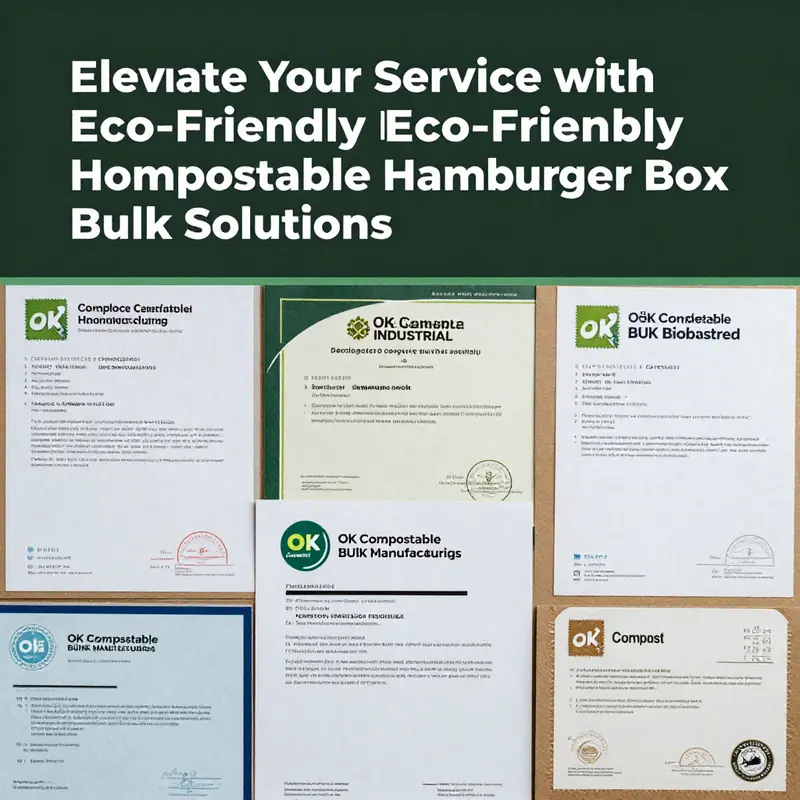
Compliance and certification are not afterthoughts in bulk production of compostable hamburger boxes; they are the backbone that ensures safety, environmental integrity, and global market access. As manufacturers scale from pilot runs to large-volume production, the integrity of every batch depends on a rigorous framework that governs materials, processing, and end-of-life behavior. In a landscape where regulations tighten and consumer expectations shift toward responsible packaging, adopting a robust compliance program is not simply about avoiding recalls. It is about safeguarding brand trust, enabling cross-border distribution, and reducing risk across the supply chain. When a buyer orders thousands or millions of units, they are not just purchasing packaging; they are underwriting a chain of custody that begins with raw materials and ends with compostability in a certified facility. Within this continuum, compliance and certification act as the seal that makes bulk procurement viable, scalable, and genuinely sustainable.
At the heart of compliance in food-contact packaging are regulations that address safety, not just compliance for its own sake. In the United States, food contact materials are governed by a framework that centers on preventing the migration of harmful substances into food. The core idea is straightforward: packaging should not release substances in quantities that could pose health risks to consumers. To translate this into bulk manufacturing, suppliers must demonstrate that their materials and finished boxes meet established migration criteria under realistic use conditions. This often means providing migration test reports from recognized laboratories that simulate typical contact scenarios—greasy, moist, or acidic foods, and varying temperatures from refrigeration to heat-lamp exposure. Such data not only proves safety but also builds confidence for brand owners seeking to minimize risk in high-volume distributions.
Across the Atlantic, the European Union adheres to a similarly stringent standard: EC No 1935/2004. This regulation requires that materials and articles intended for food contact do not transfer constituents in quantities that could endanger human health or alter the food’s composition. It is not enough to claim compliance; the regulation expects documented evidence, including materials declarations, conformity assessments, and, where applicable, ongoing surveillance of production. Suppliers targeting the European market frequently align with 1935/2004 plus the corresponding framework for good manufacturing practices. For buyers, the payoff is a robust, auditable trail that supports regulatory entry into multiple EU member states, where authorities emphasize traceability and consistent performance across production lots. In practice, bulk purchasers should request a complete dossier that demonstrates the supplier’s ability to meet both U.S. and EU requirements, thereby reducing the risk of non-compliance in key markets.
Another layer of chemical safety involves the family of restrictions commonly associated with RoHS and similar chemical limits. While RoHS originated in electronics, the philosophy of limiting hazardous substances in the supply chain has informed packaging communities as well. When boxes carry printed inks or coatings, the industry increasingly scrutinizes these materials for heavy metals and restricted substances that could migrate or pose long-term risks. A credible supplier will provide declarations and testing results that cover coatings, inks, and any additives used in barrier layers. This is particularly relevant for compostable boxes that rely on coatings to achieve grease resistance or water repellence without compromising their compostability. Buyers should look for evidence that coatings and inks have been tested for compatibility with composting streams and for absence of residual contaminants that could impede industrial or home composting processes.
Migration testing and material safety data are the practical anchors of compliance. They prove that a box will behave safely in real-world conditions—from a hot bagging line in a bustling kitchen to a cold-chain delivery route. The migration test suite typically covers overall migration, as well as specific migration for substances of concern, under standardized contact conditions that mimic the intended end use. For bulk buyers, this means demanding not just a certificate of compliance, but a full set of lab reports with test conditions, sample identifiers, and batch numbers. Such documentation creates a verifiable chain of custody that auditors can trace if questions arise later in the product’s life cycle. In a bulk sourcing scenario, it is common for suppliers to maintain ongoing testing regimes and to align with global guidelines so that every new production run carries an equivalent level of verification. This approach minimizes the risk that a new batch could drift from established safety thresholds.
In addition to safety, compostability certifications are non-negotiable in bulk procurement of sustainable boxes. The two widely recognized programs—OK Compost HOME and OK Compost INDUSTRIAL—provide independent benchmarks for whether a product will degrade under home or industrial composting conditions. OK Compost HOME certification simulates the conditions of a typical domestic composting environment, while OK Compost INDUSTRIAL assesses performance under the controlled, high-heat conditions found in commercial composting facilities. For a bulk buyer, these certifications translate into meaningful guarantees about how the packaging interacts with composting streams after use. The claims supported by such certifications are strongest when they are coupled with third-party testing and an auditable certification registry. In 2025, a strategic sourcing guide highlighted manufacturers that have earned these certifications, underscoring the value of aligning supply chain choices with recognized environmental standards. When a consumer asks about the end-of-life story of a hamburger box, a supplier with robust OK Compost certifications provides a credible, verifiable answer that resonates with sustainability-minded audiences.
But certification is not a license to relax the manufacturing process. On the contrary, it raises the bar for the entire operation. Materials must be traceable from feedstock to finished product. For bagasse, PLA, or bamboo pulp-based boxes, this means transparent declarations of material origin, processing steps, and any post-processing treatments. Sustainability is most powerful when the material’s environmental credentials are inseparable from its safety credentials. For instance, the use of water-based or bio-based oil coatings can improve compostability by avoiding petroleum-based barriers. Yet these coatings must be selected with care to ensure they do not hinder biodegradation in either home or industrial facilities. The right coatings also contribute to a safer food-contact experience, reducing the risk that any migration could occur from the interface between food and packaging. The broader implication for bulk buyers is straightforward: a supplier that combines strong regulatory compliance with credible compostability claims is better equipped to deliver scalable, safe, and genuinely sustainable packaging.
Given the breadth of requirements, the documentation package becomes a central artifact of the procurement process. Buyers should expect, and insist upon, a comprehensive set of documents with every bulk order. This includes food-contact safety certificates appropriate to the regions of sale, explicit declarations of compostability that reference the specific OK Compost HOME or INDUSTRIAL criteria, and detailed material composition declarations that include the resin or fiber base, fillers, coatings, and any additives. Beyond compliance, many buyers seek evidence of ongoing performance testing. Bulk orders should come with migration test reports that correspond to the exact product configuration used in production, including size, wall thickness, and printing or coating specifications. When suppliers can present all these documents—aligned with recognized standards and supported by third-party testing—the risk of non-compliance declines markedly, while the path to scalable, repeatable production becomes clearer.
Among the practical implications for buyers is the need for supplier vetting that reflects the realities of large-scale packaging operations. In bulk purchasing, MOQs are often flexible to accommodate testing and phased rollouts. Sensible buyers push for pilot lots accompanied by a full safety and compostability dossier. The test data should cover typical use scenarios, including microwave or freezer exposure if relevant to the product’s intended market. For the brand owner, it is prudent to request ongoing performance monitoring—lot-level certifications or batch-specific migration reports—to maintain accountability across the supply chain. This approach reduces the risk that a single misstep—such as an unanticipated coating interaction or a misunderstood migration threshold—affects a large distribution network.
Beyond regulatory compliance, the dialogue between buyer and supplier should emphasize the integrated nature of sustainability. Consumers increasingly value packaging that aligns with environmental narratives—without sacrificing safety or performance. A bulk supplier that can demonstrate both regulatory compliance and credible compostability signals a mature capability: a capability that supports a circular economy approach, reduces waste, and strengthens brand integrity. It is this fusion of safety, environmental stewardship, and operational reliability that makes bulk procurement in China or any high-volume manufacturing hub feasible and trustworthy. The scale of production, when paired with rigorous verification, can deliver consistent product performance, meet diverse regulatory demands, and support a brand’s long-term commitment to responsible packaging.
For readers seeking a practical entry point to the deeper discussion of compliant bulk packaging, an accessible resource that encapsulates the environmental certification framework can be found here: https://ecocupbowl.com/product/eco-friendly-takeout-boxes-for-food-packaging-stylish-food-containers-safe-microwave-craft-paper-lunch-boxes-leak-grease-resistant/. This example underscores how design choices—from coatings to fiber sources—can align with both performance requirements and compostability standards when guided by solid certification and transparent documentation. The broader lesson for buyers is to treat certification not as a one-time gate but as a continuous source of assurance integrated into every bulk order and every new production run. When done well, compliance and certification become competitive differentiators rather than bureaucratic hurdles.
Finally, the pathway to credible external validation sits on a foundation of standardized testing and independent verification. In the global context, the most authoritative external resource for OK Compost certification lays out the testing processes, criteria, and verification steps that laboratories follow to confirm compostability in both home and industrial environments. Engaging with this framework helps buyers understand what to demand from suppliers and why certain test reports carry more weight in international markets. Access to such external guidance reinforces the argument that bulk procurement of compostable hamburger boxes is not simply about choosing a green material; it is about choosing a responsible, verifiable, and scalable solution that respects health, environment, and commerce. External resource: https://www.tuv.com/en/services/sustainability-and-environmental-management/ok-compost-certification
From Brand Identity to Scale: Customization and Market Trends in Bulk Compostable Hamburger Boxes
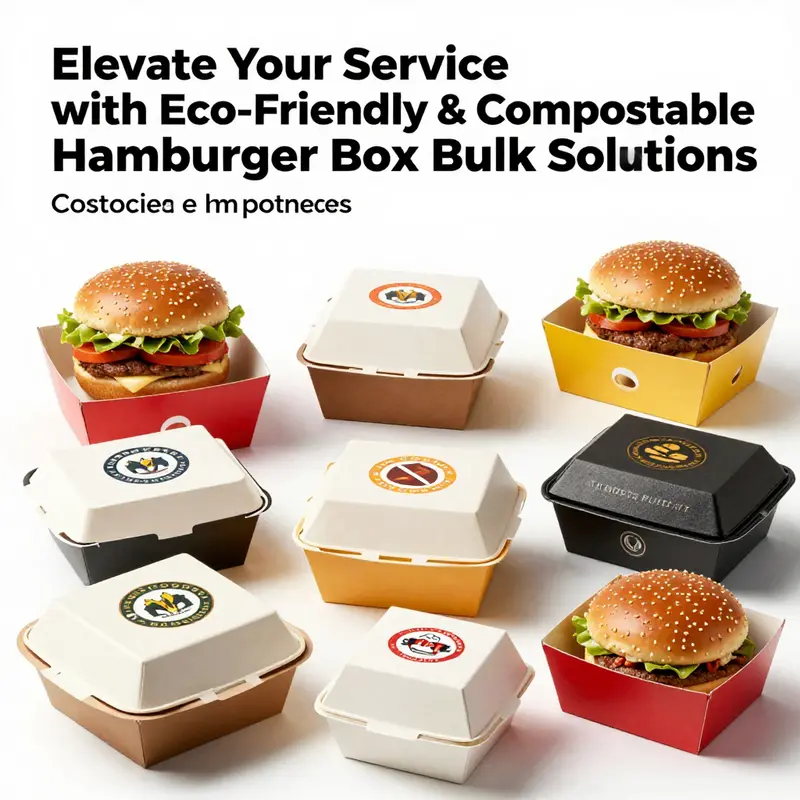
Customization and bulk procurement of compostable hamburger boxes are no longer niceties; they are competitive differentiators and operational imperatives. As environmental expectations tighten and regulatory landscapes evolve, foodservice brands, retailers, and quick-service networks are looking to packaging that behaves as an extension of their sustainability promises while still delivering reliability at scale. The convergence of design flexibility, material science, and manufacturing throughput has opened a path where a single box can carry the brand story, meet stringent food-contact standards, and be produced in quantity that keeps up with daily demand. In this context, customization is not a luxury but a core capability that shapes product fit, customer experience, and the bottom line. The story of bulk compostable hamburger boxes begins with a simple tradeoff: the need for eco-friendly materials and responsible end-of-life outcomes, balanced against the logistical realities of mass-market food service. Suppliers in this space have responded with a spectrum of choices, from bagasse and bamboo pulp to PLA and cornstarch composites, each with its own heat resistance, moisture management, and compostability profile. The result is a palette that lets brands align packaging with product category, price point, and channel strategy, while staying in step with composting certifications and safe food contact compliance. A practical way to understand this alignment is to imagine not just the box, but the entire experience around it—the brand message printed on the exterior, the interior structure designed to secure a hot burger without leakage, and the packaging’s end-of-life story told through clear certification marks that reassure customers and regulatory bodies alike.
Customization features in high demand are increasingly integrated into the box design at the source. Brand identity comes to life through branding and printing options that range from matte or glossy lamination to embossing and full-color imaging. Advanced customization now includes compatibility with brand color schemes, seasonal campaigns, and cross-promo visuals that can be applied without compromising compostability. For buyers exploring sample and testing routes, platforms that connect buyers with verified suppliers reveal a growing catalog of options. Among these, an Alibaba listing demonstrates how a biodegradable kraft hamburger box can be branded with logos and messaging while carrying robust sustainability credentials. This is more than a cosmetic layer; it is branding as customer engagement. It signals attention to detail and a commitment to a circular economy that resonates with today’s conscious consumers.
Material and structural variability is another cornerstone of customization. Buyers can select kraft paper, bamboo pulp, bagasse, cornstarch, or PLA-based options, each offering distinctive advantages for different menu items and service models. For example, bamboo pulp stands out for heat resistance, which is particularly valuable for hot food delivery where scalding temperatures can tax packaging integrity. Cornstarch-based boxes present a fully compostable path that aligns well with cold items like salads and beverages, where moisture management is critical but the thermal load is gentler. The material choice may also be influenced by the desired shelf life, transit time, and end-of-life infrastructure in the target market. The ability to mix and match materials within a single supplier ecosystem helps businesses tailor the packaging portfolio to regional tastes and service formats while maintaining a cohesive sustainability narrative.
Size and design flexibility complete the customization triad. Clamshell configurations, foldable designs, and dedicated compartments can be engineered to accommodate a range of items—from a single burger and fries to more complex assortments that include sushi, sandwiches, or burgers with extra toppings. A standard, well-documented size such as a 6-inch option with dimensions around 160×155×90mm offers a balance of portability and product containment, while allowing space for internal dividers or inserts that prevent leakage or sogginess. The beauty of bulk customization lies in the ability to scale these designs without sacrificing fit or performance as demand surges. The right design can reduce product damage, minimize food waste, and improve transport efficiency, which are critical considerations for fleets and delivery platforms.
Certifications and compliance are non-negotiable in a market where food safety and environmental claims must withstand rigorous scrutiny. Reputable suppliers now routinely offer internationally recognized certifications such as OK Compost INDUSTRIAL or TÜV OK Biobased, which provide independent verification of compostability and biobased content. For food-contact safety, FDA and EU compliance considerations remain priority checkpoints. The chain of custody from raw material to finished box, including any coatings or inks used in branding, must meet these standards to avoid regulatory friction. A robust certification framework not only reduces risk; it also accelerates adoption by procurement teams seeking to validate sustainability claims to customers, investors, and regulators.
The strategic value of bulk procurement extends beyond compliance. Scale brings cost efficiency, which is why MOQs and bulk pricing play a central role. Suppliers with strong manufacturing clusters in Guangdong and Zhejiang can offer substantial savings on large runs, while still providing flexible MOQs for testing and pilot programs. For cornstarch-based options, wholesale pricing can dip to notably favorable levels, often around tens of dollars per thousand units, depending on packaging details and certification requirements. The math is straightforward: the per-unit cost drops with volume, and the cost savings are magnified when the boxes are designed to support fewer SKU variants and lower complexity in packaging lines. For national chains and third-party distributors, these savings can translate into more competitive menu pricing, reduced packaging waste, and a more consistent customer experience across locations.
Sourcing considerations broaden beyond price and appearance. Bulk buyers must balance production capacity with lead times, quality control, and supply reliability. Regions such as Guangdong and Zhejiang are renowned for their export-readiness and proximity to major ports, which streamlines international logistics and reduces transit times. Inland hubs near Wenzhou or Hangzhou offer potential cost advantages, especially for mid-volume purchases, without compromising the quality or consistency of the packaging. A well-structured sourcing strategy often involves a staged approach: initial small-batch testing to validate fit, coating performance, and branding fidelity; followed by a ramp to full-scale production that aligns with seasonal demand and promotional campaigns. In this context, the ability to obtain sample kits—typically in the range of USD 100–150 depending on complexity—becomes a prudent first step for brands transitioning to compostable packaging at scale.
The procurement landscape is increasingly networked through platforms that connect buyers with verified suppliers. While these marketplaces simplify supplier discovery, the most effective partnerships are built on a shared understanding of sustainability goals, supply chain transparency, and a mutual commitment to quality. The best suppliers provide not just products, but a pathway to a more sustainable revenue model. They offer transparent lead times, reliable certifications, and the capacity to customize packaging at scale while maintaining consistent performance in a variety of distribution environments. The end-to-end perspective matters; a box that performs well in a restaurant kitchen might need different branding and moisture management for a meal-kit fulfillment center or a vending machine network. Successful collaborations treat packaging as an integrated element of the service proposition, rather than an afterthought.</n
Beyond design and certification, the relationship between packaging suppliers and brands often hinges on the ability to communicate a clear end-of-life narrative. Consumers increasingly want to know that their choices support a circular economy. Brands respond by choosing materials and coatings that minimize contamination during composting, using inks and adhesives that are certified for compostability, and clearly labeling boxes with the appropriate composting instructions. In addition, some suppliers offer built-in customization features such as microwave-safe coatings or leak-resistant seals, which reduce the need for additional plastic wraps or liners. These features contribute to overall sustainability by limiting waste and improving product safety, while also enhancing the customer experience by preserving the quality of the food during delivery or takeout.
As the market evolves, regional sourcing strategies continue to shift in response to labor costs, port efficiency, and environmental policy. Coastal provinces remain primary hubs for export shipments to North America and Europe, thanks to streamlined customs procedures and port access. Inland hubs are increasingly leveraged by mid-volume buyers seeking a careful balance between price and reliability. In this dynamic landscape, the most successful brands are those that build a resilient supplier base with multiple production partners across regions. Such diversification mitigates risk, maintains continuity during peak seasons, and supports a broader mix of materials to address evolving consumer preferences and regulatory expectations.
In practice, a bulk procurement strategy that emphasizes customization also supports broader ESG goals. When brands standardize on a core set of materials and sizes for hot and cold items, they reduce complexity in the packaging supply chain. Fewer SKUs translate into lower packaging waste and more efficient manufacturing, warehousing, and fulfillment. The branding opportunities become more meaningful when the box carries a consistent, high-quality aesthetic across all touchpoints. The packaging then acts as a touchpoint for sustainable storytelling—an opportunity to communicate a brand’s commitment to environmental stewardship with every burger sold. This alignment between design, materials, and lifecycle outcomes strengthens customer trust and increases the likelihood of repeat business in a competitive market.
For brands exploring options, an illustrative path might begin with a few core SKUs in a single material family, paired with a limited but flexible branding package. The goal is to validate the end-user experience and the environmental performance, then scale with confidence. The internal testing phase can leverage the sample kits to verify print fidelity, seal integrity, and heat resistance under realistic conditions. Once confidence is established, the rollout can proceed with a phased increase in MOQs, ensuring that kitchen operations remain uninterrupted while the branding and sustainability story scales across locations. In parallel, procurement teams should work with sustainability officers to map the end-of-life pathway, ensuring that composting facilities in key markets are prepared to handle the influx of compostable packaging. A thoughtful alignment of product design, supplier capabilities, and municipal composting infrastructure forms the foundation for a truly sustainable bulk packaging program.
For readers who want to see a concrete example of customization in action, consider a widely available catalog of bulk boxes that showcases customizable features and size options. A practical takeaway is to explore supplier profiles that emphasize branding options, material versatility, and certifications. These signals—branding capabilities, heat and moisture performance, and verified compostability—help buyers compare across suppliers with confidence. The packaging choices you make today can reverberate through customer satisfaction, operational efficiency, and your ESG reporting in the years ahead. And because the market rewards clarity and reliability, investing in strong supplier relationships that can deliver consistent quality at scale is as important as any design innovation.
Take the next step by examining how your brand’s values can be embedded in the packaging you choose. The packaging you select should tell a story of thoughtful design, verified compostability, and scalable production. It should function as an ambassador for your sustainability ambitions, while still performing at the level your operations demand. In a world where consumer choices are increasingly climate-informed, the box becomes a quiet but powerful voice for responsible consumption. By prioritizing customization options that align with your product line, ensuring robust certifications, and partnering with producers who can deliver at volume, you position your brand to lead in a market that prizes both quality and planet-positive impact. To see a concrete example of the kind of customization that is fueling market momentum, explore a listing that demonstrates logo-ready branding with food-grade certification and structural durability. This kind of example underscores how bulk compostable boxes can support a cohesive brand experience across channels while staying true to sustainable principles.
For readers seeking direct reference to a customization-ready option, you can explore a concrete listing that showcases logo-ready branding and compostability credentials: take-away-food-packaging-boxes-hamburger-french-fries-popcorn-chicken-nuggets-fried-chicken-boxes. This internal link demonstrates how a supplier profile can align with a brand’s design language and sustainability commitments, offering a practical blueprint for bulk customization that scales with demand. The broader lesson is clear: in the bulk compostable box market, customization is a strategic instrument, not a cosmetic add-on. When combined with reliable certifications and scalable manufacturing, it becomes the lever that translates sustainability into brand loyalty and operational excellence.
External resource: https://www.alibaba.com/product-detail/Wonwin-WWZH-1001-Biodegradable-kraft_1600347817141.html?spm=a2700.15935175.0.0.6e1d1c3aGZlqUy
Final thoughts
The shift towards sustainable practices in foodservice packaging is not just a trend but a necessary evolution. Compostable hamburger boxes represent an effective solution for businesses in various sectors, from bubble tea shops to corporate catering services. By understanding the production process, capitalizing on economic benefits, ensuring compliance with certification standards, and embracing customization trends, brands can enhance their operational efficiency while positively impacting the environment. As consumers increasingly demand sustainable options, investing in compostable packaging is a significant step toward building customer loyalty and promoting a responsible brand image.