
Why Your Containers Still Smell After Washing
If your team already scrubs, sanitizes and air-dries to spec, a faint smell in a washed tub is not a washing problem. The resin is holding what the wash cycle cannot reach.
What follows is how aroma compounds get into a plastic wall, which surface finishes keep them there, and how to judge whether a container goes back into rotation. The mechanism matters more than the cleaning routine, because no amount of scrubbing reaches the inside of the polymer.
High-turnover counters hit this fastest. One tub at a bubble tea shop can hold brown sugar syrup in the morning, curry at lunch and dressing at close, while the identical tub at the next station stays clean because it only ever sees iced tea. Same wash cycle, different outcome, and the difference is what went into the wall and how worn the inside is.
How Odor Molecules Get Trapped in Plastic
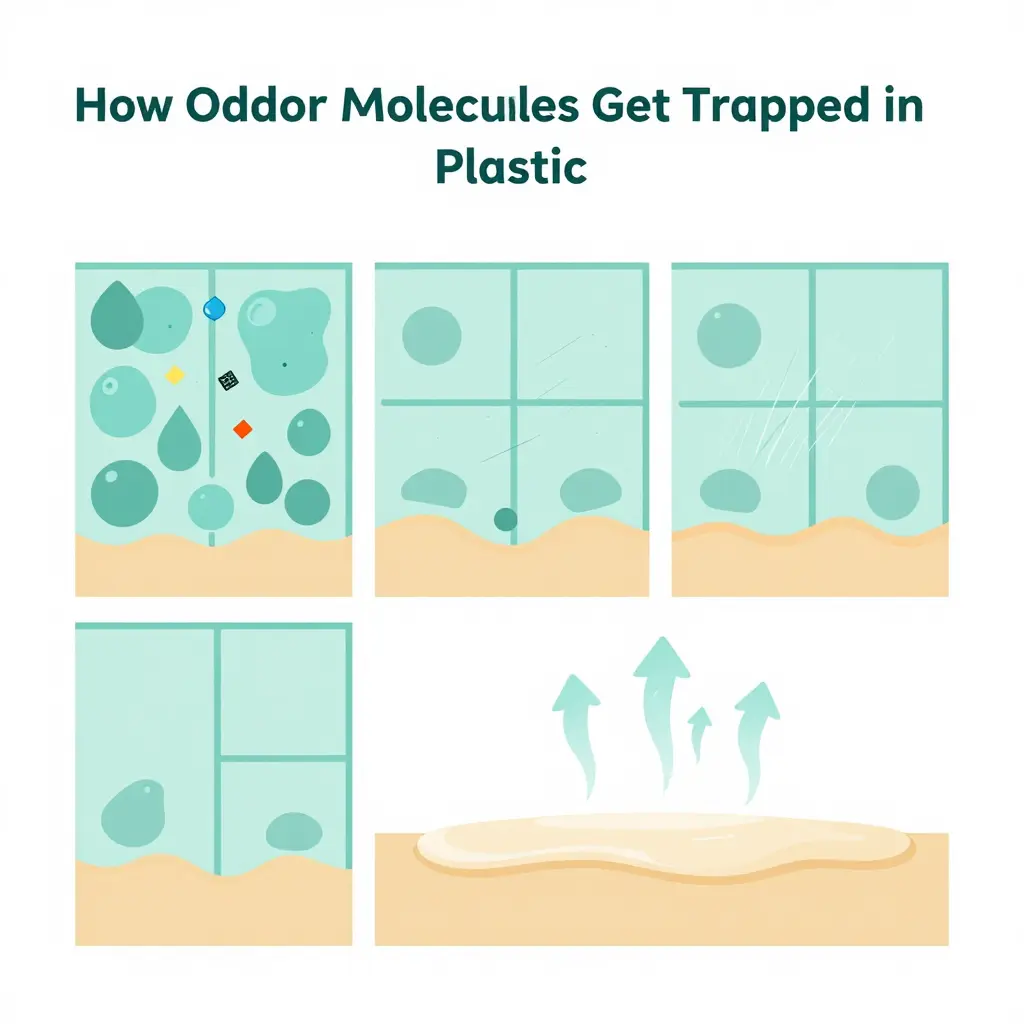
A molded wall looks sealed. Under a microscope it is a mix of two zones: tightly packed crystalline regions, and loose, tangled amorphous regions where the polymer chains never lined up. Molding can leave micro-voids behind as well. The aldehydes, terpenes and fatty acids that carry food aroma are small enough to diffuse into those loose zones and stay there, which makes odor retention in plastic containers a property of the material rather than a stain on the surface.
Which compounds stay longest comes down to chemistry. Polypropylene and polyethylene are hydrophobic: water beads off them, oil spreads and clings, and the aroma compounds that dissolve in fat come along for the ride. In food service those compounds arrive from a short list of sources:
- Dairy and milk tea residue – milk fat and creamers leave a fine sticky layer that water alone will not lift.
- Oil and fried food – cooking oil and the fat in fried snacks soak into the surface quickly.
- Strong spices – curry, garlic, cumin and chili oils are highly aromatic and highly fat-soluble.
- Sugar syrups – thick syrups, fruit sauces and caramel stay tacky and hold aroma underneath.
A bubble tea counter runs into this quickly, which is why operators end up comparing plastic cups for cold drinks by reuse life rather than by unit price alone. Even good plastic keeps some of yesterday’s menu.
Washing can make it worse. Abrasive pads and very hot cycles rough the surface and open the amorphous regions further, and each pass adds micro-scratches that act as small reservoirs. Once residue sits at the bottom of a scratch, rinsing does not reach it.
The rest hides in a film you cannot see. A fat layer thin enough to survive ordinary washing stays on the wall because it repels the water your detergent is dissolved in. It waits until the container warms up, in a microwave or under hot food or in a hot drying cycle, then softens and releases aroma again. Tubs that smell the moment they get hot have a film problem, not a detergent problem.
The Surface Trap: Why Odor Clings to Plastic Walls
Scrubbing is the wrong thing to blame. Whether the smell leaves after one wash or settles in for good depends on the geometry of the inside wall, which is the part nobody inspects.
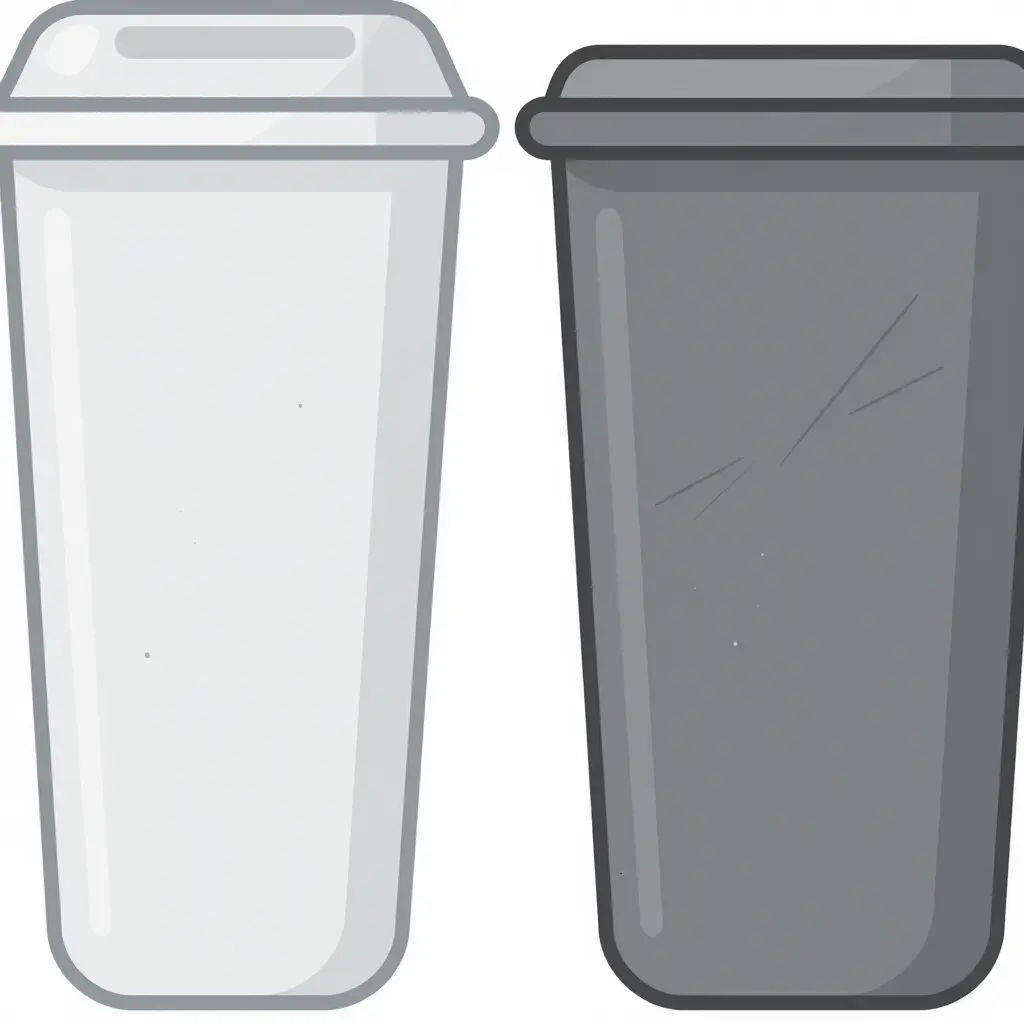
Two very different surfaces, one very different outcome
Start with the left side of the diagram. A glossy, well-polished wall gives aroma molecules almost nothing to grip: the surface energy is low, the wall is closed, and compounds sit loosely on top the way water sits on a waxed hood. Wipe it, rinse it, and most of it slides away. For a container that holds iced coffee at nine and soup at noon, that is the behavior you are paying for.
The right side is another matter. A scratched, matte or heavily abraded wall has shallow grooves and open micro-voids from every stacked lid, every stiff brush and every molded texture. Fat-loving compounds from dairy, curry, garlic and roasted tea settle into them; water cannot reach the pockets, and detergent cannot lift what it cannot wet. Heat makes it worse, because a warm polymer relaxes and lets residue travel deeper. The smell is not stubborn by accident.
What this means at the sink and in the storeroom
- Texture beats scrubbing. A rough wall re-traps odor no matter how hard you clean, so abrasive pads are usually a net loss.
- Gloss is a spec, not decoration. A polished interior is a real performance property for reusable food-contact items.
- Scratches accumulate. A container that smells fine in month one can be a problem by month six, which is what rotation schedules are for.
- Resin matters as well. Some polymers are more amorphous and more permeable than others, so aroma compounds travel further into them over time.
When you specify reusable serving ware for a bubble tea counter, a catering line or a corporate lunch program, ask about the interior finish in the same conversation as capacity and lid fit. For a baseline, compare reusable bowls with a clean interior finish before committing to a full set. Smooth walls do not make odor impossible; they give the wash cycle a fair chance.
Why the Resin Decides Whether a Smell Ever Leaves
You have scrubbed the tub, soaked it overnight, aired it in the sun, and the curry note is still there. At that point detergent is not the variable. How far the aroma compounds traveled depends on the resin the container was molded from, and fatty sauces, dairy, spiced syrups and citrus oils all migrate at different rates. That is why one washing routine produces different results across a mixed stock of tubs and cups.
Before building a rotation schedule, spend ten minutes sorting containers by the resin code molded into the base. The table covers the resins most kitchens and beverage counters actually handle, the same materials behind the plastic cups for cold drinks that appear on almost every counter.
Resin Types and Odor Behavior Before Reuse
| Resin | Typical Food-Contact Uses | Odor Retention Tendency | Heat Tolerance | Reuse Verdict |
|---|---|---|---|---|
| PP (polypropylene) | Takeaway lids, meal-prep bowls, boba cups | Holds fatty odors moderately | Tolerates hot wash cycles | Strong reuse candidate |
| HDPE | Milk jugs, sauce bottles, cutting boards | Absorbs oils readily | Softens near 70-80 C | Reuse for dry or low-fat items |
| PET | Cold cups, dessert domes, salad clamshells | Low absorption, clings in scratches | Warps in hot wash | Single-use if hot or scratched |
| PS (polystyrene) | Cold cups, hinged clamshells, cutlery | Retains strong aroma | Warps easily | Avoid reuse with hot or pungent food |
| PLA / plant-based blends | Compostable cups, bowls, straws | Traps acidic and oily smells | Deforms around 55-60 C | Best kept single-use for hot or oily foods |
Note: these are general tendencies only – resin grade, additives and wall thickness all change the outcome, and your supplier’s specifications take priority over any rule of thumb.
From Resin to Surface: The Second Half of the Story
Resin sets the ceiling. It decides how clean a container can come back. Finish decides how far below that ceiling you land in practice. Two polypropylene tubs from the same pellet batch behave differently once one interior is mirror-smooth and the other is micro-textured, because a rough wall offers millions of anchor points a cloth cannot reach. That is why a new smooth container and a scuffed one of identical material smell nothing alike after the same service cycle.
So use the table to sort, not to sentence. Pull your strongest-smelling containers first, check the resin code, and the pattern usually shows up within a single shift. The finish inspection then decides what stays in rotation.
Surface Finish: The Detail Most Buyers Skip
Almost nobody asks about interior wall smoothness at the quoting stage, and it is the property that decides how much oil, sauce and aroma a container holds after service. A high-gloss interior behaves like glass: the wall is dense and closed, so an oil film beads up and rinses away. A matte, textured or heavily printed interior behaves like microfiber. Every peak and valley in that micro-relief gives fat, pigment and volatile aroma compounds somewhere to settle, and a normal rinse glides straight over them.
The glossy-versus-matte trade-off is not only cosmetic. Matte and soft-touch finishes feel better in the hand, and they ask more of your dishwashing routine and your staff’s patience. Geometry matters as much as texture: sharp internal corners, molded ribs, stacking ledges and thick rims create tight zones that water and detergent cannot reach. Scratch resistance varies by resin and finish too, and a scuffed interior grabs more film over time. Buyers who want containers that stay smell-free should weigh wall smoothness alongside resin type instead of judging by outside shine. For saucy or curry-heavy menus, start from round food containers and bowls with smooth interior walls.
Run this three-step check on a sample before you commit to a supplier:
- Hold the container against a strong light and look along the interior wall. Streaks, haze or a dull patch after washing signal a surface that is holding residue.
- Run a fingertip across the base and up into the corner radius. Drag, grit or tackiness means texture plus trapped film, not moisture.
- Rinse with warm water only, air-dry, then smell and touch the inside. A faint film or lingering odor will keep coming back on the prep line.
Smooth interiors cost little extra and save scrubbing hours, so put the finish on the spec sheet rather than discovering it after the first pallet.
Reading Odor Retention Across Resins and Finishes
A spec sheet gives you wall thickness, rim diameter and a temperature ceiling. It almost never tells you what the container smells like on the twelfth refill, and that gap is where repeat-use problems hide. Two containers from the same resin can pass the same wash cycle and land at opposite ends of the “does this smell like yesterday’s brown sugar milk tea?” question, because the interior surface is doing quiet work in the background.
Odor retention is not one property. It is the sum of how much oil and aroma compound a polymer absorbs, how deep those compounds migrate, and how easily your wash process reaches them again. Resin chemistry sets the first two. Finish sets the third.
Why a glossy interior behaves differently from a matte one
A polished wall is dense and closed. Oils from creamy drinks, fruit syrups and sauce-heavy food sit on top and leave with the mechanical action you already use. A matte wall, whether it comes from a textured mold or a matte additive, gives residue thousands of microscopic pockets, and those pockets shield aroma compounds from detergent and from the brush. A faint smell survives on a surface that looks spotless.
The same texture that softens the look in a shop’s marketing photographs also holds on to flavor molecules. It is a trade-off rather than a defect, and knowing it in advance stops you blaming the wash process for something the mold decided months earlier.
The grouped comparison
On the chart below, each resin sits on the horizontal axis with two bars side by side: glossy interior on the left, matte interior on the right. Higher numbers mean more odor retention, so shorter bars are the ones you want for refill programs. The gloss-versus-matte gap is widest on the polypropylene and HDPE categories, because those are the resins most likely to be sold in both finishes; PET and PS appear mainly as glossy products, which is why their bars sit closer together.
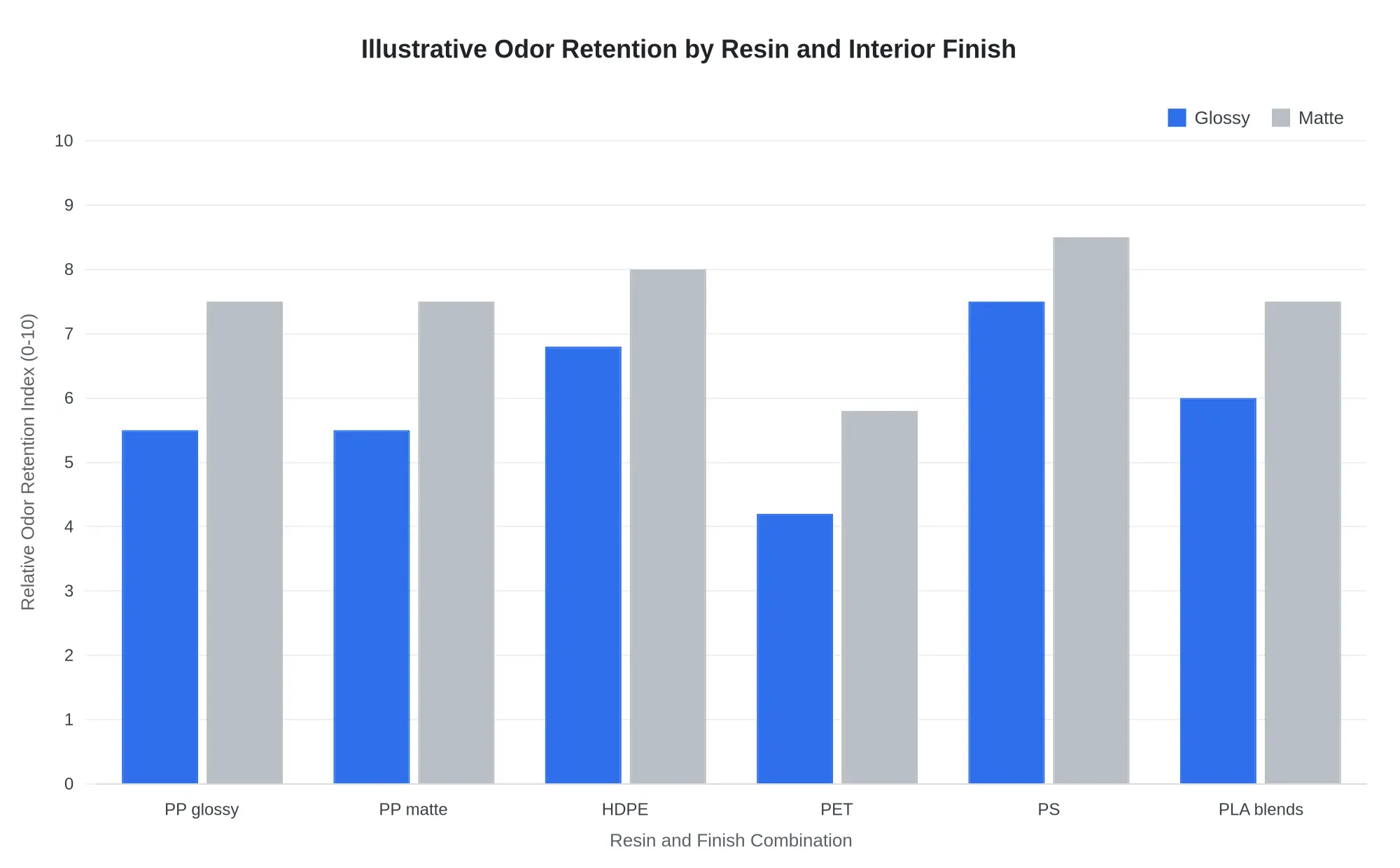
Figure: Illustrative Odor Retention by Resin and Interior Finish. The values shown are representative illustrations prepared for comparison purposes only. They are not laboratory measurements, and real-world retention will vary with wall thickness, wash temperature, detergent chemistry, dwell time and the specific aroma compounds involved.
Turning the chart into a purchasing decision
Read the bars as a ranking tool, not a specification. A few patterns hold up across bubble tea counters, catering kitchens and food truck prep lines:
- Matte adds roughly two points of retention on the same resin, which shows up by the fifth or sixth use. If your team washes in bulk and stacks wet, that gap compounds.
- PS and PLA blends sit at the high end because they are more amorphous and absorb aromatic compounds from syrups and dairy more readily. That does not rule them out for sealed single-use service; it rules them out for a rinse-and-refill loop.
- PET is the outlier and usually the most forgiving choice for cold beverage reuse, provided the interior stays glossy and unscratched. Scratching is what turns a clean PET cup into a stubborn one.
- Opaque, unpolished HDPE containers should be treated as single-use unless you can see and feel a smooth interior wall.
A useful test on your own stock: pull three containers from the last order, fill each with hot water and a pinch of baking soda, leave them twenty minutes, then smell the interior wall. It tells you more about your inventory than any index, and it takes less time than reading the rest of the spec sheet.
If you are rebuilding a refill-friendly lineup, compare molded options with a smooth interior before you commit to a full pallet; the plastic cups for cold drinks range shows which finishes are stocked and how they pair with lids and straws. Then set an internal rule: glossy interior for anything that comes back to the shop, matte for anything that leaves through the door once.
A Step-by-Step Deodorizing Protocol for Plastic Containers
Odor hides in scratches and porous walls, which is why a quick rinse rarely finishes the job. The sequence below works because each step removes a different layer: food first, then grease, then the film left in the surface itself.
-
Scrape and rinse immediately after service. Tip out leftovers and scrape the walls and corners with a flexible spatula while the food is still fresh. Rinse with lukewarm water within minutes, before residue dries into a film.
-
Dissolve the grease with warm water and a mild alkaline detergent. Fill the container with warm water plus a squirt of mild alkaline detergent and let it stand a few minutes to lift the fat. Skip very hot water, which warps thin walls and drives odors deeper into stressed plastic.
-
Work a baking soda paste into the interior walls. Stir baking soda with a splash of water into a thick paste and spread it over every interior surface, rim and corners included. Fifteen minutes is enough for the paste to lift surface film and take the edge off acidic odors.
-
Soak in diluted white vinegar. Rinse the paste away, then soak the container in a diluted white vinegar bath for 10 to 15 minutes. The acid helps with the basic odor compounds that fish and some sauces leave behind, and it dissolves the mineral film that hard water and detergent deposit on the wall. Vinegar is not a sanitizer at kitchen dilution, so keep the food-contact sanitizing step your local rules require.
-
Rinse thoroughly to remove detergent residue. Rinse with clean warm water until the surface no longer feels slippery and no suds appear. Leftover detergent film attracts fresh odors and leaves a soapy note in the next batch of product.
-
Air-dry fully, lid off, in moving air out of direct sun. Stand the container upside down on a rack in a breezy spot away from sunlight. Dry it completely with the lid removed, because trapped moisture ends up smelling musty.
-
Seal in activated charcoal or bicarbonate for stubborn odor. If a faint smell still clings, spoon in activated charcoal or bicarbonate of soda, close the lid and leave it for 24 hours. Tip it out, rinse once more and air-dry before the container returns to service.
Caution: this protocol is only for containers approved for reuse. Single-use tubs, thin takeaway boxes, and any cracked or scratched plastic should be recycled or replaced rather than reused.
Pair the routine with well-chosen food-safe bowls and containers so each piece earns a long service life at the sink instead of a short one in the bin.
Washing Habits That Make Odor Worse
Most lingering odor is made in the sink, not in the food. Water temperature, detergent dose and drying time decide whether aroma compounds leave the container or travel deeper into the wall.
The habits that cause trouble all feel like extra care. Hotter water seems cleaner, a stronger mix seems tougher, stacking wet containers seems efficient. Each one leaves the residue or the moisture that keeps the smell alive, and thin-walled items such as food-grade takeaway boxes show it first.
- Never stack damp containers or lid them early; trapped moisture feeds smell.
- Skip scalding water, which sets protein and fat films instead of lifting them.
- Measure detergent; over-diluted or over-strong doses leave aroma-trapping residue.
- Swap abrasive pads for soft cloths, since scratches become odor-holding pockets.
- Rethink warewashing for thin-walled containers; heat warps them and opens absorption paths.
Surface Condition Is the Real Culprit Behind Repeat Odor
If a container smells worse every week despite the same routine, the routine is not the variable. The inside wall is. Every scrub, every stack and every trip through a commercial dish machine leaves marks, and those marks hold the smell.
A glossy wall gives aroma molecules little to grab onto. A scratched or matte wall acts as a parking lot for fat, sugar and aroma compounds that a quick wash never lifts, so residue builds and the smell with it.
The chart below is the one our team uses when explaining this to bubble tea shops, catering kitchens and procurement teams choosing containers for repeat use. Values are illustrative trends for decision-making, not lab measurements.
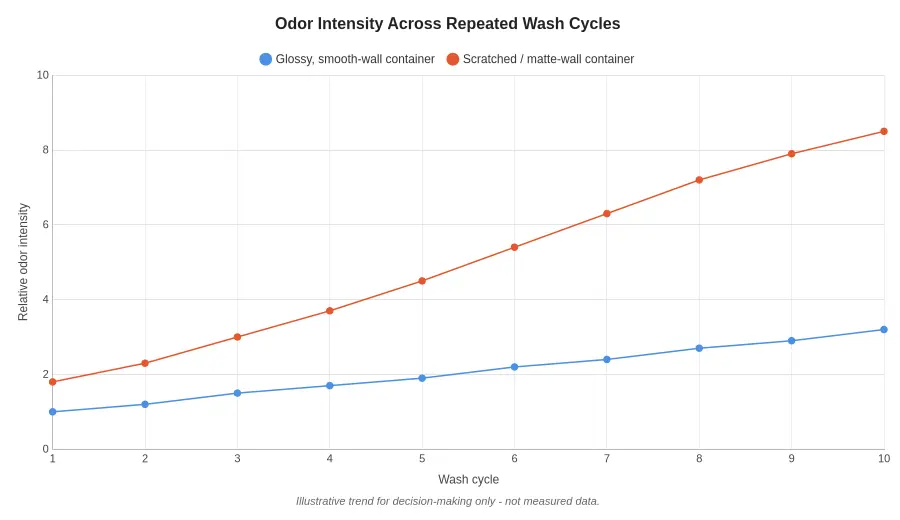
Odor Intensity Across Repeated Wash Cycles. Note: the values are illustrative trends for decision-making, not measured data.
Reading the Two Lines
- Glossy, smooth-wall container (blue): Starts low and drifts up gently. By cycle ten it is still in the polite range, which is why smooth PP and glossy surfaces are the safer bet for anything that holds milk tea, soup or sauce more than once.
- Scratched or matte-wall container (orange): Climbs steadily and steeply, crossing into noticeable territory around cycle five or six, roughly where staff start double-washing and customers start noticing.
What to Do With This
- Inspect interiors, not exteriors. Run a fingernail across the inside wall. If it catches, that container is on its way up the orange line.
- Retire on a schedule, not a feeling. Fix a cycle count per SKU. For high-fat menus, plan on pulling containers after six to eight heavy wash cycles rather than waiting for the first complaint.
- Match finish to use. Glossy interior walls for anything reused with dairy, coconut or fried food; if branding needs a matte look, keep it on the outside where odor does not linger.
If you are standardizing the rotation, compare round bowls with smooth interior walls side by side before a large order, so the finish matches how many times you actually intend to reuse each piece.
Odor rarely comes out of nowhere. It comes out of texture, and texture can be checked, limited and specified.
Frequently Asked Questions
These answers come from what we see in high-volume kitchens, where the same container is washed and refilled several times a week.
1. Can a plastic food container that still smells be safely reused?
Usually, if the odor is residue-based rather than chemical. Wash with hot water and dish soap, soak in diluted vinegar, then air-dry fully. Take the container out of service if it smells of chemicals or if scratches keep trapping residue.
2. Is vinegar or baking soda better for removing odors?
They do different jobs. Baking soda is a mild base, so a paste lifts surface film and neutralizes acidic odors from sour dairy or tomato; it also takes the edge off a smell that has already soaked in. Vinegar is a mild acid that helps with basic compounds such as the amines in fish, dissolves mineral film, and cuts grease better than water alone. Neither one replaces detergent, and neither sanitizes at kitchen dilution. Keep both: paste for absorbed smell, vinegar soak as a routine step.
3. Does freezing a smelly container remove the smell?
No. Freezing stops bacteria from growing and does not remove the compounds already in the wall, so the smell returns as the container warms. Use it to park a smell between shifts, not to fix one.
4. How many reuse cycles should a container get before retirement?
Under light loads, thin polypropylene often survives 15 to 30 wash cycles. Fat- and spice-heavy menus hit the smell threshold much earlier, closer to the six to eight cycles suggested above, and that is the number worth planning around. Track batches by date and retire on scratches, cloudiness or persistent smell, because persistent smell means residue has entered the surface.
5. Do plant-based or bamboo pulp containers hold odors less than plastic?
Not exactly. Bamboo pulp and bagasse are porous, so they absorb oil and stain readily, often more than smooth plastic. What they do not do is come back for a twentieth wash: they are single-use, they dry fast, and there is no accumulated residue left to smell through. That makes them a good fit for oily menus where reuse has stopped working, not a lower-odor version of a reusable tub. Pair bamboo pulp containers with drying racks and same-day use.
When to Retire a Container and What to Use Instead
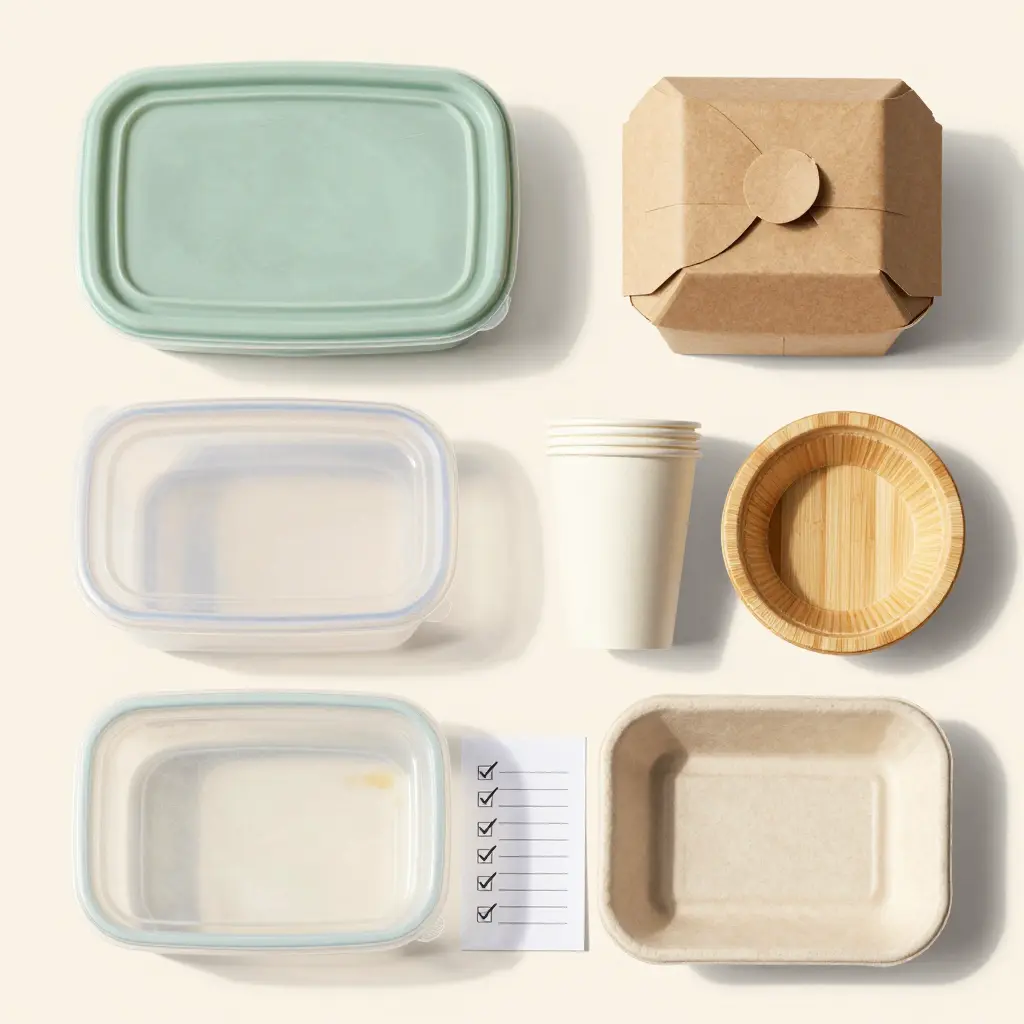
Careful washing has limits. Some containers reach a point where reuse costs more than it saves, and spotting the signs early protects flavor and keeps guests safe.
Retirement triggers to check before every reuse
- Persistent odor after two full deodorizing attempts. If a baking-soda soak and a vinegar or sun-drying cycle both fail, the smell has migrated into the polymer itself.
- Visible scratching or crazing. Fine cracks and knife scars trap oils and bacteria that no brush can reach.
- Warping. A base that no longer sits flat, or a lid that will not snap down, means heat has reshaped the resin.
- Staining that will not lift. Oil-based sauces, turmeric and tea tannins leave a permanent shadow once they bond to the surface.
- Any damage to rim seals. A nicked or stretched gasket breaks the closure, and leaks and cross-contamination follow.
Mark the retirement date on the base of every container and audit the shelf monthly. It takes two minutes and prevents most odor complaints.
When high turnover makes single-use the smarter call
If your volume means containers are washed dozens of times a week, or your menu leans on strong sauces and teas, reusable plastic quietly becomes a maintenance burden. This is where food packaging alternatives earn their place, provided you pick matched sets so lids, cups and trays work together across the whole menu.
For takeaway meals, kraft takeaway boxes stack neatly and carry sauce-heavy dishes without holding flavor. Drinks travel better in a sturdy paper cup with a compatible sleeve and lid. Cold noodle and dessert menus suit bamboo pulp products that hold their shape and compost cleanly.
For counter service and buffets, grab-and-go bowls keep portions consistent and easy to label. Bakery runs, catering spreads and food truck lines move fastest with sturdy food trays that nest for compact storage.
Whatever you choose, keep one rule: never reuse a container past its trigger, and never mix worn reusables with disposables in the same guest-facing tray.
What to Confirm With Your Supplier Before the Next Order
A short conversation before you reorder saves months of scrubbing. Odor is a specification problem more often than a cleaning problem, and the resin grade plus the finish of the food-contact layer decide how much flavor your sauces, soups and drinks leave behind. Whether you stock plastic cups for cold drinks or paper buckets built for saucy sides, ask the same five questions every time a new spec sheet lands on your desk:
- Which resin grade is used for the food-contact layer, and can you share the certificate for it?
- Is the interior finish glossy or matte?
- Is the container intended for single use or reuse?
- Does it tolerate the sauces, oil levels and serving temperatures currently on our menu?
- Do the closures and lids use the same resin as the body?
Write the answers into the purchase order, not just the inbox. A supplier who can document resin and finish specifications cuts odor complaints across a chain, because every branch, from flagship store to single food truck, receives the same predictable material. That consistency is what turns a one-off fix into a menu-wide standard, and it keeps your food plates and trays from absorbing last week’s curry.
The Short Version
Odor stays in plastic food containers because resin chemistry holds aroma compounds and surface condition gives that residue somewhere to hide, especially in scratched, chalky or porous interiors. The problem sits inside the material, so washing technique alone rarely fixes it and scrubbing harder only buys time. Any reuse decision therefore rests on two checks: the resin grade the item is made from, and the condition of its interior finish.
Use this checklist at your next stock review:
- Confirm the resin grade for every container family you reorder, and compare it against the food-grade resin options for beverage service you keep on hand.
- Inspect interior finishes on a sample from each wash batch, flagging scratches, cloudiness and any chalky texture as retirement signals.
- Match container to contents, keeping aroma-light items for dairy, water and neutral drinks, and dedicating aroma-heavy use to short-life or single-use pieces.
- Set a wash-cycle limit per SKU so containers leave rotation on a schedule rather than on the first complaint.
- Run a smell test after drying on one random unit per batch, since odor that survives a full dry cycle will not fade in storage.
A routine that gets smells out of plastic food containers starts with knowing what is in your cupboard, so plan packaging around odor performance and operational turnover rather than treating smell as a surprise.