
Where Leak Risk Meets Inventory Cost
Anyone buying disposable food containers with lids makes the same choice sooner or later: one universal lid stretched across the whole container range, or a separate lid moulded for each diameter. The universal lid keeps the lid SKU count down and makes reordering simple. The size-specific lid spends shelf space to get a tighter, more predictable seal.
Neither comes free. A universal lid means fewer cartons in the stockroom and fewer lines on the purchase order, but it flexes, and flex is where gaps open: load a sealed boba drink or a saucy takeout order and the lid can lift at the rim. A size-specific lid demands more inventory bookkeeping, and in return it grips the rim it was moulded for, which is what keeps a delivery bag or a catering tray from leaking on the way out.
How much that matters depends on what you sell. A drinks chain running three cup sizes, a food truck packing hot boxes at speed, and a caterer plating hundreds of cold items do not have the same tolerance for a single drip. The menu decides, not the catalogue. Staff matter too: a lid that needs a firm, even press is fine in a high-volume drinks shop and maddening on a two-person truck.
This article compares both approaches across a full menu range: leak performance, storage footprint, reorder logistics, and cost per order, with notes on which cup lids pair reliably with which format.
Why Lid Choice Is an Inventory and Risk Decision
Start with the mechanics: a lid seals only as well as it fits. Seated evenly on its container, it forms a continuous seal. A lid that is merely “close enough” leaves micro-gaps, and those gaps open the moment a container is tilted, stacked or bounced down a delivery route. Once sealing is a geometric match rather than a general property of plastic, lid selection stops being a packaging detail and becomes an operating variable.
Three consequences follow from that one fit decision:
- Lid SKUs carried – every container size with its own rim profile adds another line to stock, order and forecast.
- Storage and reorder complexity – more lid variants mean more shelf space, more reorder points and more minimum order quantities to balance.
- Leak risk in transport – lids that look alike but measure differently invite mis-picks during a rush, and the wrong pairing fails in the bag, not at the counter.
The effect builds quietly. A menu that spans several container heights and diameters tends to grow lids by accident: add one bowl size and three or four candidate lids may end up in the catalogue. Shelf space that could hold sellable stock goes to lid cartons instead, reorder frequency climbs because each lid runs out on its own schedule, and picking errors rise whenever two lids look alike but fit differently. Choosing bowl lids sized to your actual containers is therefore less about looks than about controlling two costs that move in opposite directions: fewer, better-matched lids lower inventory cost, while a loose fit pushes leak risk up.
That is why lid strategy belongs in a procurement conversation. Standardise on a universal lid or commit to size-specific lids across the menu, and you have chosen a stock profile, a storage footprint and a failure rate. Not a colour.
Treated as a line item in your takeaway packaging budget, lid choice becomes something you can measure, negotiate and improve. Treated as an afterthought, it taxes every order that leaves the door.
Universal Lid vs. Size-Specific Lid at a Glance

One universal lid stretches across three rim sizes; three size-specific lids match exactly.
Read the diagram left to right. A universal lid spreads its tolerance across several rim diameters; a size-specific lid commits to one. On the shelf that is fewer SKUs, and on the cup it is a tighter seal. Our bowl lids range shows how diameters are specified per container in a real catalogue.
Universal Lids: Strengths and Limits
A universal lid buys simplicity, not a perfect fit. It suits operations that value speed and lean stock over a bespoke seal on every container. It is the wrong call when liquid is the headline of your menu.
Where they work. One lid covering several container diameters means fewer SKUs to forecast, order and store, and less shelf space lost to slow-moving variants. In a bubble tea shop or on a catering line that shows up as faster picking during a rush: no hunting for the matching lid, and a usable stand-in when a size runs out mid-service.
Where they struggle. Universal lids rely on a softer rim tolerance, so seal quality falls off once a rim runs noticeably wider or thinner than the design target. Soups, gravies, milk tea with toppings and other liquid-forward items carry a higher leak risk, and the same lid can sit awkwardly on a small dessert cup or an oversized catering bowl.
| Dimension | Universal lid | Size-specific lid |
|---|---|---|
| Inventory | Fewer SKUs, less shelf space | More SKUs, heavier forecasting load |
| Reorder complexity | One line to reorder | Several lines tracked separately |
| Staff speed | Fast picking, easy substitution | Requires matching each size |
| Seal integrity | Good on mid-range rims | Tighter grip on the intended rim |
| Liquid-heavy items | Higher leak risk | Lower leak risk |
| Extreme formats | Awkward on very small or very large | Precise fit |
| Per-unit packaging cost | Shared packing lowers unit cost | Separate packing per size adds cost |
The verdict. Across a mixed menu, a universal lid reliably covers dry and semi-dry formats: rice and noodle bowls, salads, bakery items, and bento-style trays built on mid-range rims. Thin liquids still deserve a dedicated lid, so review our bowl lids collection and match rim tolerance to the containers you actually ship.
Universal lids cut SKU sprawl and picking time, but they are a mid-range solution: pair them with size-specific lids wherever liquids dominate.
Size-Specific Lids and Leak Protection
A lid built for exactly one diameter fits better. Matched to a single rim, the snap or thread engages the whole circumference at once, so rim grip is tighter and the thousandth lid behaves like the first. A universal lid flexes across a range of diameters, and that flex is where a slow drip starts.
On liquid-forward menus the difference shows up fast. Drinks closed with cup lids, along with broths, soups and sauce-heavy bowls, put real load on the rim during transport, and any gap between lid skirt and rim becomes a leak the moment a delivery bag tilts. Capacity matters as much as shape, because a lid sized to its exact container leaves it nowhere to shift. That is a smaller leak window, not a guarantee: no lid stays dry if it is filled past the line or carried on its side. Bubble tea, pho, curry and gravy bowls are where a matched lid makes the difference plain.
The trade-offs are real, though. You buy, count and store more SKUs, and the space comes out of a dry store that was already crowded. A stockout on one size can stall a whole menu line, and training gets heavier, because staff now have to grab the right bowl lids for the right bowl every single time.
Where liquid is the product, size-specific lids are non-negotiable. For broths, soups, drinks and sauce-heavy bowls, accept the inventory complexity and buy the tighter seal.
Inventory Cost vs. Leak Risk: The Lid Strategy Trade-Off
Before you commit to a lid programme across a full menu range, it helps to see the trade-off on one screen. The grouped bars below put three strategies side by side – all-universal, a hybrid mix, and all size-specific – against the same three indicators: how many lid SKUs you carry, how much monthly storage space they consume, and how much leak-incident exposure you accept.
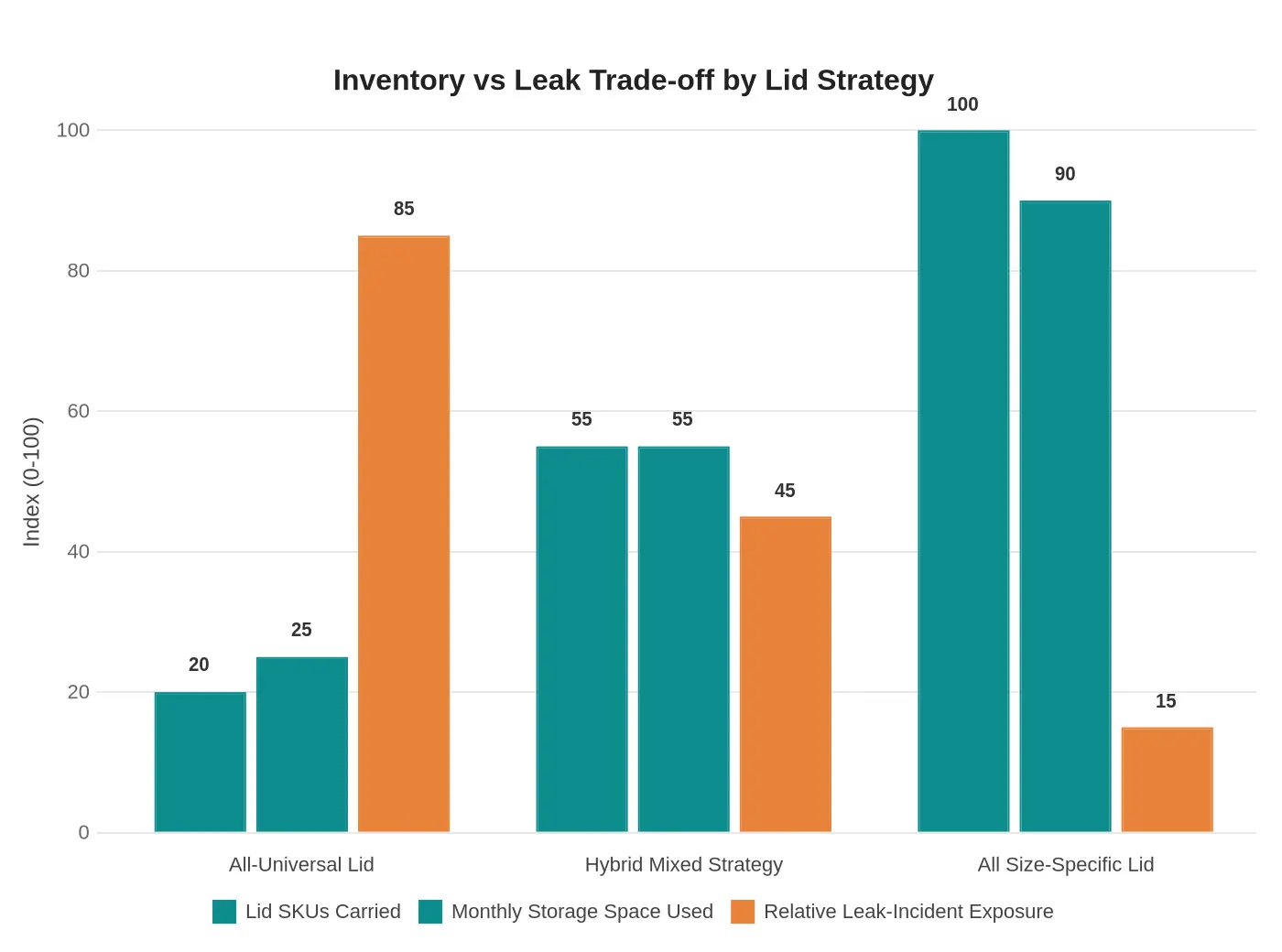
Caption: Illustrative indexes, not measured results. Bars show the inventory-versus-leak trade-off, where universal lids cut inventory cost while raising leak exposure.
How to read the bars
- Left-hand pair of bars: lid SKUs carried and monthly storage space used. Short bars mean a leaner back room and less cash tied up in slow-moving stock.
- Right-hand bar: relative leak-incident exposure. Taller means more refunds, more remakes, and more unhappy hands on the way to the car.
- All-Universal Lid: the leanest inventory profile, but the tallest leak bar – one lid cannot seal every rim equally well.
- Hybrid Mixed Strategy: the middle of the road on all three, which is why so many multi-format operations land here.
- All Size-Specific Lid: the lowest leak exposure and the highest inventory burden – right for leak-sensitive liquids, heavy on space and SKU count.
That middle ground rarely happens by accident. It comes from matching a short list of high-volume lids to your best-selling sizes, then keeping one universal option for odd shapes. If you want to build that short list, start with bowl lids that pair with each container size and check sealing performance before you scale a menu-wide rollout.
Mapping Lids Across a Menu Range: A Practical Checklist
Every container on your menu needs a lid that actually fits, and guessing at sizes is how spills and dead stock start. A lid-to-container map turns the guessing into measurements you can hand to any team member and reorder against.
- List every container format on the menu range, from cups and bowls to trays, buckets and bento boxes.
- Record each format’s rim diameter and depth so every match is a measurement, not a guess.
- Flag liquid or sauce-heavy items that need a tighter seal and stronger rim grip.
- Assign either a universal lid or a size-specific lid to each format, and note the reason on the line.
- Count the lid SKUs that result, so you know exactly what you are stocking and naming.
- Set reorder rules per SKU, with par levels and lead times tied to real weekly usage.
Three Signs Your Lid Map Needs a Revision
- Staff start double-lidding, or taping sealed edges to stop leaks.
- Two lid SKUs sit half-used in storage while one runs dry every week.
- Spill complaints cluster around the same two or three menu items.
Once the map is in place, it is easier to compare disposable food containers with lids side by side, including the bowl lids range, so rim sizes stay aligned as the menu changes. Revisit it each season, or whenever a new format joins the line.
The Decision Comes Down to Two Shapes of Risk
Choosing between a universal lid and a size-specific lid rarely feels dramatic in the moment, but it settles into two different operating realities. A universal lid keeps storage simple and purchasing predictable. Matching lids to each container size tightens seals and steadies servings on the move. The diagram below strips the choice to its core logic: start with your containers, hit the decision point, and land on a lid strategy that fits how you actually serve food.

Follow the path from container attributes to a lid strategy, where leak risk meets inventory cost.
If your menu leans on soups, saucy noodle dishes or delivery-heavy orders, review bowl and container lids that pair precisely with the vessels you already stock, so one ordering decision does not create a mismatch later.
The Hybrid Decision Framework: Where Leak Risk Meets Inventory Cost
Your menu is not one risk level. Sort the lineup honestly and it splits in two: high-leak-risk formats such as bubble tea cups, soups, sauce-heavy bowls and iced coffee, and low-risk formats that mainly need to stay covered in transit. Treat every item as if it needs a bespoke lid and you end up either with soggy deliveries or a stockroom full of lids nobody touches. The useful question is not “universal or size-specific?” but “where is leak risk genuinely high, and where are we paying for precision nobody notices?”
Split the lids, not the budget. Liquid formats deserve size-specific lids, where a matched diameter, a firm rim and correct venting decide whether a handoff is clean or a complaint. Everything else can ride on universal lids: takeaway boxes, paper food trays and bakery items do not need a bespoke fit to travel well. Add leak-proof paper for wrapped and greasy foods, plus cup carriers for multi-drink orders, and the whole menu is covered without doubling your SKU count. Because a universal lid folds several sizes into one line, it cuts both inventory cost and the storage space catering teams never have enough of.
Four rules procurement teams can apply.
- Rule 1 – Test, don’t guess. Run a tilt-and-shake test on your ten best-selling liquid items; anything that fails gets a size-specific lid.
- Rule 2 – Default to universal for dry formats. Boxes, trays, bakery items and cutlery kits ride on universal lids, reordered on a simple par level.
- Rule 3 – Cap the special SKUs. Keep size-specific lids only for formats that genuinely leak, and consolidate everything else into one universal line.
- Rule 4 – Review quarterly. New menu launches are when a hybrid lid strategy quietly drifts, so re-sort the list before placing the next bulk order.
The whole argument in one line: a hybrid lid strategy protects the items that need protecting, and stops you paying for a perfect fit where nobody will notice. For teams sourcing disposable food containers with lids across a full menu, that balance is where leak risk meets inventory cost most profitably.
Where a Typical Lid Budget Actually Goes
Lids look like a rounding error on the purchasing sheet, until you add them up across a full menu. The chart below breaks a typical lid spend into four buckets: size-specific cup lids, bowl and bucket lids, a universal lid approach, and the storage and reordering overhead that quietly disappears into inventory cost.
[CHART: Where a Typical Lid Budget Goes]
Illustrative shares only, not measured figures: proportional lid spend, where reorder and storage overhead quietly shape your true inventory cost.
FAQ: Lid Strategy, Leak Protection, and Inventory Cost
Lid decisions affect two things at once: how often a bag comes back with a complaint, and how much shelf space your lids quietly eat up. These are the questions kitchens and procurement teams ask most often.
Is a universal lid safe for liquid-heavy takeaway items?
Not as safe as a matched lid. Its flexibility across rim sizes means the seal can loosen under weight and movement, so curries and drinks may need a snugger fit. Match the riskiest items to a lid tested for them.
How many lid SKUs does a mid-sized menu actually need?
As a working rule, three to five – not one per container. Group your disposable food containers with lids by rim diameter, then assign a size-specific lid to each cluster, covering your meal bento boxes and larger courses without inflating stock.
How can we reduce leak risk without expanding SKU count?
Improve fit and handling instead of adding more lid sizes. Standardise on a universal lid for dry items, reserve your tightest seal for soups, and train staff to press corners evenly on paper buckets and bowls before bagging.
How do we evaluate per-unit lid cost against leak-related losses?
Compare per-unit lid cost against the real cost of a leak, not against a rival’s price list. Track refunds, remakes and delivery complaints per thousand orders, then weigh that figure against the upgrade to a better-sealing lid for high-risk dishes.
Next Steps: Turning Lid Strategy Into a Workable Plan
Lid choice is a balance between leak risk and inventory cost, and for most mixed menus a hybrid strategy eases both pressures at once.
What this article established
- Universal lids simplify purchasing and reduce SKU count, but they shift leak risk onto the widest containers in your lineup.
- Size-specific lids seal more reliably, yet every added size raises inventory cost through extra SKUs, minimum order quantities and slower turns.
- A menu-tiered hybrid gives tight, matched seals to liquid and hot items, and standardises lids on the dry or low-risk part of the menu.
That combination works for bubble tea shops, restaurants, food trucks, caterers and event procurement teams, because it protects the items most likely to travel badly without inflating the number of lids you forecast and store. If your menu includes larger sharing formats, review bowls and buckets alongside your lid options, since rim diameter and wall thickness there often drive seal performance more than lid material does.
Three practical next actions for procurement teams
- Audit current lid SKUs. List every lid in stock with its size, material and monthly usage. Flag duplicates that serve the same container, and slow-moving counts that tie up cash.
- Match lids to container rims. Measure the rim diameter and profile of each container in your range, then map one lid family to each rim group. Anything without a confirmed match is unverified, whatever the catalogue says.
- Test seal performance on liquid items. Run a simple tilt-and-shake check on the drinks, sauces and soups you actually serve, then log which lid and container pairing passes. Test at the fill level your team really uses, not a lab-perfect one.
For disposable food containers with lids, suppliers are often the fastest source of accurate rim data. Our team can share container and lid compatibility details for bulk orders, and help you build a tiered SKU set that fits your menu rather than a generic catalogue.