
Paper vs Plastic Takeout Bags for Hot Greasy Orders: Setting the Decision Up Clearly
A hot, oily meal is a hard test for any bag. Paper that softens at the handle, film seams that creep open on the drive, grease that reaches the customer’s car seat as a dark patch: every one of those costs a remake, a refund or a bad review, and every one is cheaper to prevent than to absorb.
Paper and plastic fail in different ways, and which one is cheaper depends on your menu rather than on the unit price. What follows compares the two under heat and grease, explains what basis weight (GSM) actually measures, and gives the figures worth putting on a supplier enquiry before a bulk order.
Basis weight is the mass of one square metre of paper, in grams, written as GSM. Within a single paper grade, more grams per square metre means more fibre — a heavier sheet that resists tearing better and costs more; less GSM saves money and gives up strength. Thickness is a separate measurement, called caliper, and the two do not always rise together. Of all the numbers on a paper bag spec sheet, GSM is the most useful.
Grease resistance matters as much as mass. Grease-resistant paper bags add a barrier — a coating, a laminated film, or a densely refined pulp — that slows oil from wicking into the fibre. That barrier is what stops a fried chicken box or a curry container from turning the bag translucent before the customer reaches the car. Barrier plus the right GSM gives you a bag that still holds its shape after a twenty-minute run.
Most people reading this deal with that trade-off daily: bubble tea chains and beverage shops, restaurants, food trucks and caterers, event planners and corporate procurement teams. Order profiles differ sharply across those groups, from a single sleeved cup to a family combo, and the numbers that matter shift with them.
Basis weight, not bag colour or price per unit, is the first specification to verify before you compare quotations. Colour and unit price are visible on any supplier page. GSM and grease rating decide whether the bag survives the meal. Buyers weighing barrier layers against paper weight can see how the two work together in our greaseproof and foil-lined food bags.
What Makes Hot Greasy Orders So Demanding for Bags
Four stresses hit a hot takeout bag at the same time, and each one makes the others worse. Knowing which one your menu loads hardest is what stops you guessing at materials.
1. Sustained heat and steam
Heat moves from the food into the bag wall and stays there for the whole delivery window. In paper, that warmth drives moisture out of the fibre, and dry fibre loses stiffness: the walls bow outward, the bag stops standing on its own, and the handles start to pull away. Steam is faster. Vapour crossing the sheet breaks fibre bonds from the inside, so a bag that felt stiff at the pass can feel floppy ten minutes later. Film has no fibre to soften, so it keeps its strength — until it approaches its heat limit, where it softens and stretches, letting a loaded bag elongate and the seams creep.
2. Grease wicking
Oil does not stay where it lands. It travels the fibre network by capillary action, which is why one drip becomes a translucent patch the size of a palm. As it spreads, it darkens the print, weakens wet strength and softens the adhesive along the seams. Film resists penetration far better in the short term, but it gains a slick interior: containers slide and lean, and some laminates and adhesives degrade under prolonged oil contact. For fried or sauce-heavy menus, greaseproof and foil-lined food bags are built for this failure mode specifically.
3. Structural load from stacked containers
Stacking turns weight into point loads. Container corners, rims and cup bases press into the sheet, and every swing of a carried bag adds a dynamic spike on top of the static load. Paper fails at its joints first: bottom seam separation, gusset splitting, handle tear-out at the punched holes. Film stretches instead of tearing, but thin film yields permanently under a corner, punctures once that corner has an edge to grip, and die-cut film handles elongate rather than break cleanly.
4. Moisture from condensation
A hot container in cooler air creates a temperature gradient, and the gradient puts water on the inside of the bag. Water pools in the bottom panel, where the paper has the least room to give. The base loses strength, the seam lifts, and the load ends up in the street. Film does not absorb condensation, but it collects it, so water finds its way through handle cut-outs and seams — and a wet film surface is hard to grip.
| Stress | Typical paper bag failure | Typical plastic film bag failure |
|---|---|---|
| Heat and steam | Softened fibre, sagging walls | Softening, elongation, seam creep |
| Grease wicking | Translucent patches, weak seams, print smear | Slick interior, load shift, ink smear |
| Stacked load | Bottom seam separation, handle tear-out | Stretch, corner puncture, handle elongation |
| Condensation | Wet base, seam lift, bottom blow-out | Pooled water, leakage at seams, slippery grip |
A room-temperature order never tests a bag the way a hot, oily, stacked one does. Read the order first and the price list second: match material and basis weight to the stress profile, then optimise cost around that.
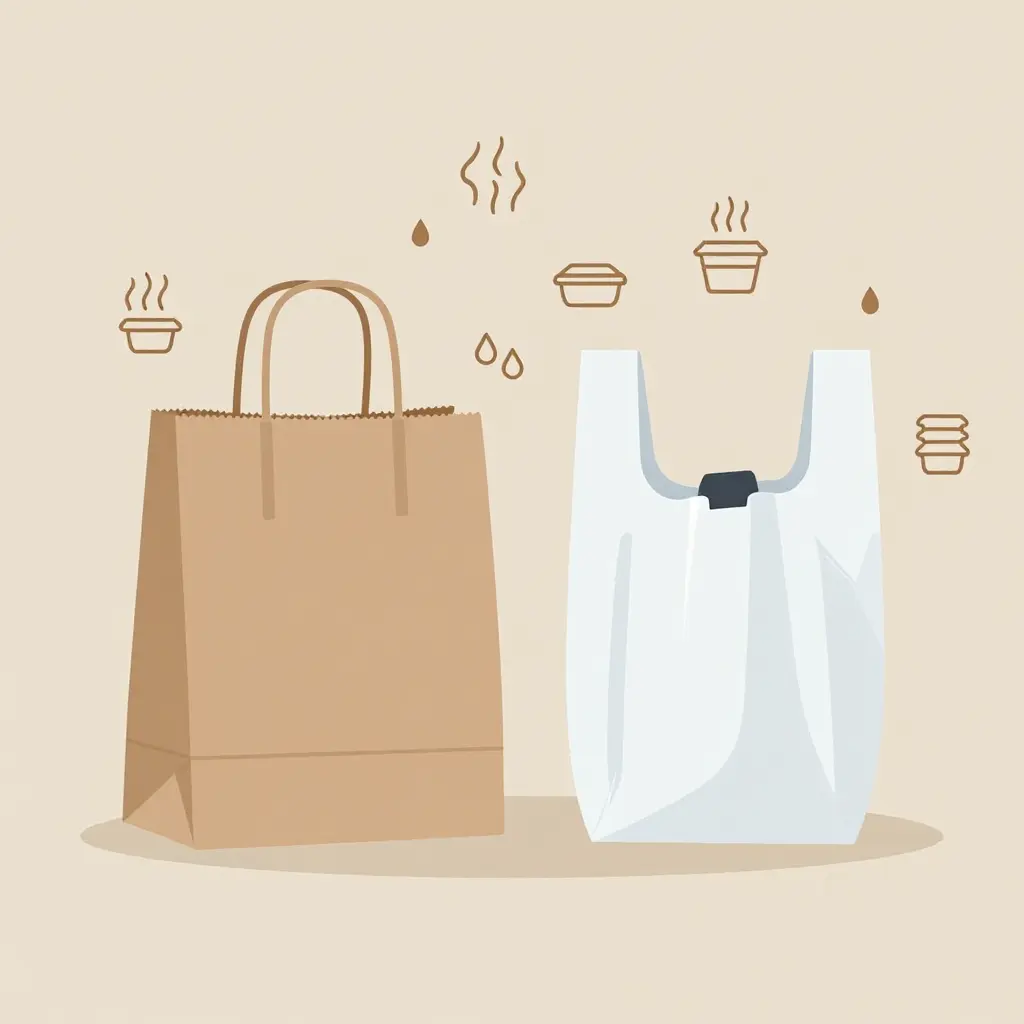
The table below is the one we send when buyers ask how the two materials actually stack up for hot, greasy orders.
| Comparison Point | Paper Bags | Plastic Bags | What to Check Before Ordering |
|---|---|---|---|
| Typical basis weight or film thickness | 40-100 gsm basis weight | 15-60 micron film | Ask for a spec sheet, not a guess |
| Heat tolerance | Dry strength holds to roughly 90 °C short-term; wet strength falls away sooner | PE starts to soften near 80-90 °C, melts around 105-115 °C | Match to your hottest item |
| Grease and oil resistance | Needs PE coating or greaseproof layer | Naturally oil-resistant | Confirm coating type and food contact grade |
| Load capacity | 5-12 kg with reinforced handle | 8-15 kg, but stretches | Test a filled bag, not an empty one |
| Breathability and condensation | Breathable, less sogginess | Sealed, traps steam | Watch fried and dumpling orders |
| Printability and brand surface | Matte finish, premium feel | Glossy, high-contrast colours | Request a printed sample first |
| Recyclability and local compliance | Recyclable only if uncoated | Thin film rarely collected kerbside | Check your city and client rules |
| Storage footprint | Bulky, needs a dry spot | Compact rolls, flat packs | Measure shelf and back-of-house space |
| Relative cost per unit | Higher per unit | Lowest per unit | Compare landed cost with freight |
Bottom line: set basis weight and heat rating against your greasiest, heaviest order first, then pick the material your budget allows. Our paper takeout bags with handles list the grades available for a full run.
What Basis Weight (GSM) Means on a Takeout Bag Spec Sheet
GSM is usually the first number on a bag spec sheet. It looks technical and answers one question: how much paper are you buying?
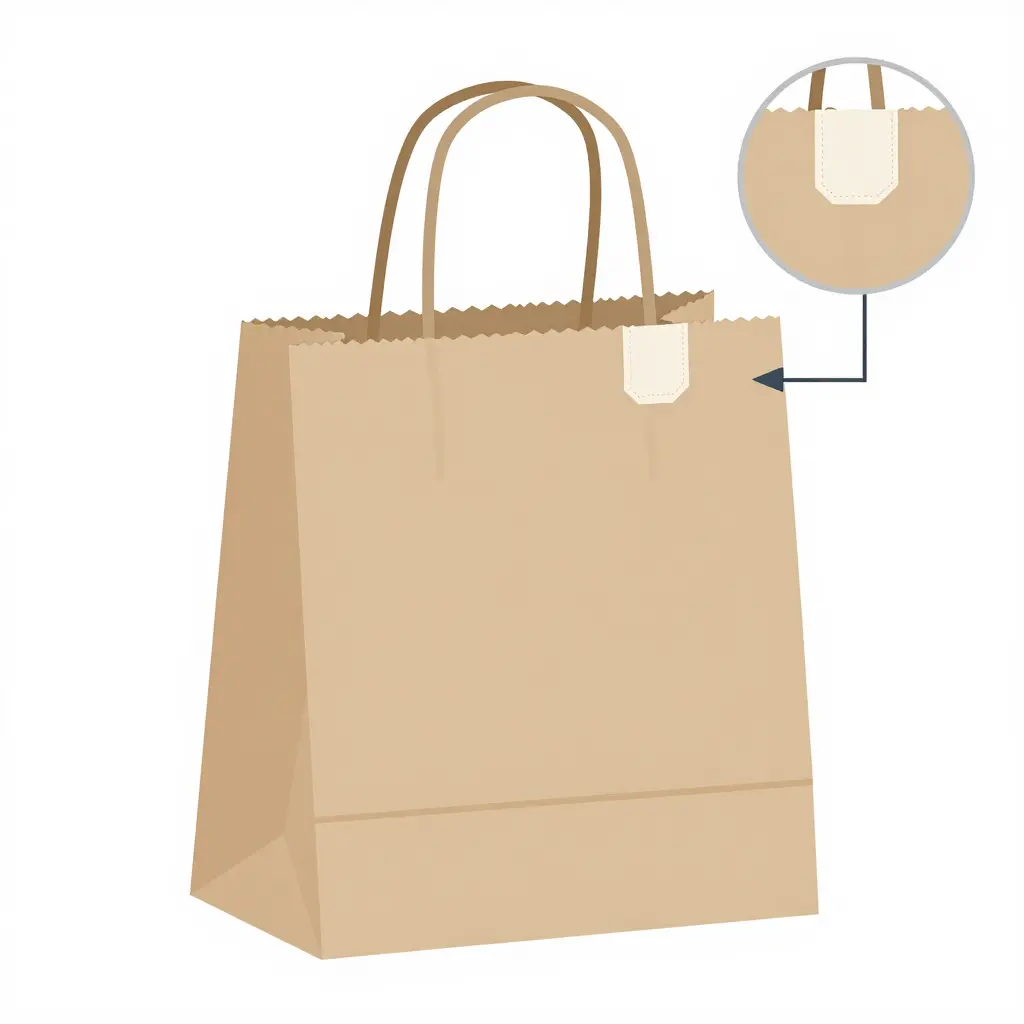
GSM is a weight, not a thickness
GSM = grams per square meter. A conditioned sample of known area is weighed, so the figure reports fibre mass per unit area and nothing else. Suppliers who quote pounds mean pounds per 3,000 square feet, where 1 lb per 3,000 sq ft works out at about 1.5 GSM: 40 lb paper lands near 60 GSM and 100 lb near 150 GSM.
Thickness is a different measurement, and this is where buyers mix the two up:
- Caliper (thickness) is measured in microns or mils with a micrometer under fixed pressure.
- GSM is measured on a scale. The two move in the same direction, but they are not the same number.
- A bulky, low-density kraft sheet at 100 GSM can be noticeably thicker and stiffer than a dense, highly calendered 120 GSM sheet.
- Caliper drives how the bag feels and how it folds at the crease; GSM drives how much fibre, cost and strength potential you get.
Why two bags at the same GSM behave differently
A 120 GSM bag from one factory is not automatically a 120 GSM bag from another. Three variables decide the rest:
- Fibre type. Long-fibre virgin kraft tears and stretches gracefully. Short recycled fibres at the same GSM tear sooner at the crease and the handle patch.
- Ply count. Two 60 GSM plies are not the same as one 120 GSM ply. Two plies resist puncture and heat transfer better, while a single heavy ply folds more crisply and prints cleaner.
- Coating. A 15 GSM PE layer, a water-based barrier coat or a laminated film changes grease holdout without changing the paper’s own weight much at all.
Practical GSM ranges for takeaway bags
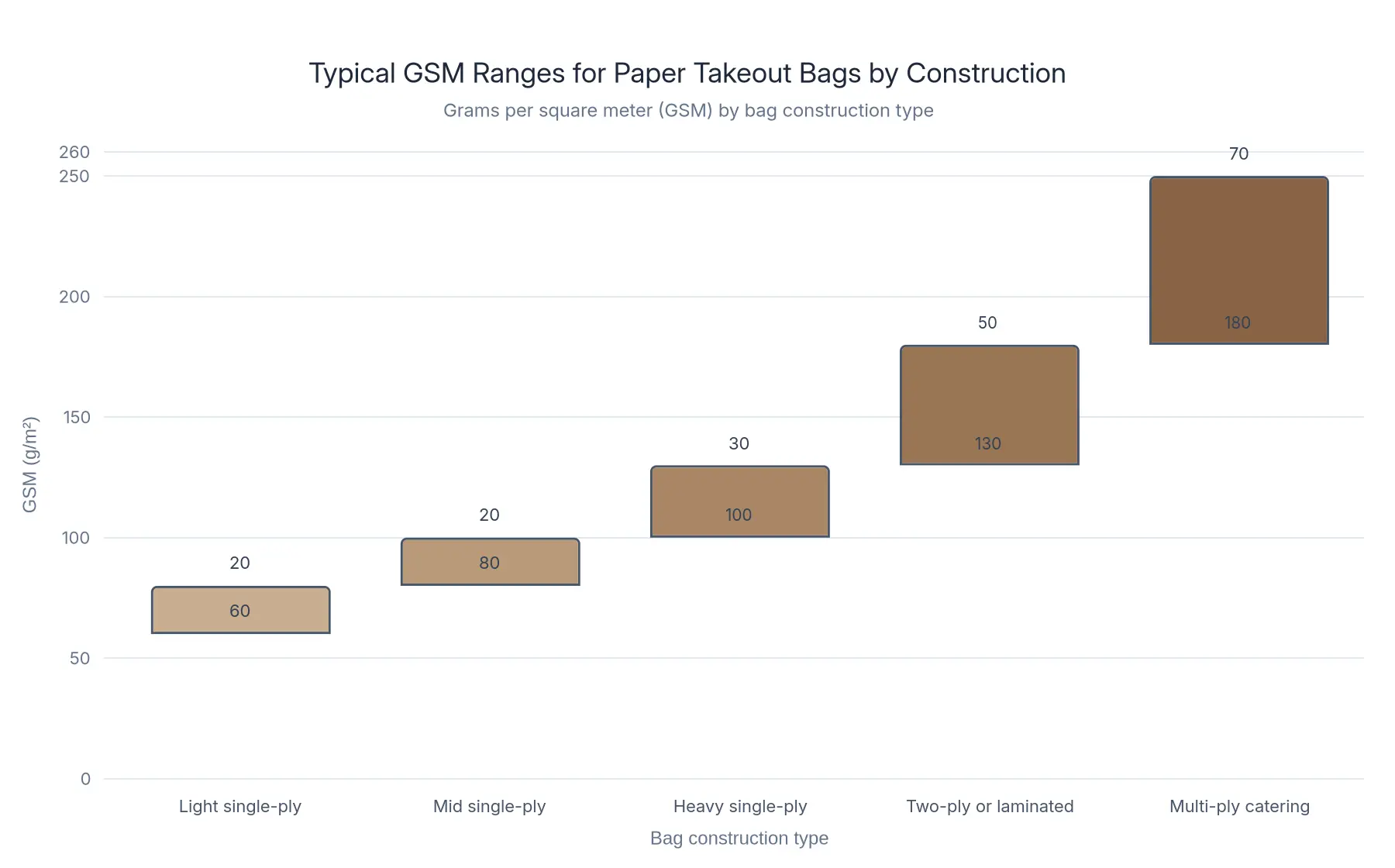
| GSM range | Typical construction | Generally suited to |
|---|---|---|
| 60 – 80 | Light single-ply kraft | Pastries, cookies, single small cups, low-weight dry items |
| 80 – 100 | Mid single-ply, flat or twisted handle | Sandwiches, burgers, 1 – 2 cup beverage runs |
| 100 – 130 | Heavy single-ply, twisted or die-cut handle | Full meal orders, 2 – 4 cups, retail and merch |
| 130 – 180 | Two-ply or coated/laminated | Hot greasy food, combos above 2 kg, catering runs |
| 180 – 250+ | Multi-ply or laminated rigid build | Large catering loads, bucket meals, family bundles |
Basis weight, load rating and handle strength
The handle joint, not the bag body, is almost always where a bag fails.
- A load rating assumes a specific handle type: twisted paper, flat paper, die-cut, or patch-reinforced.
- A 150 GSM body glued to a 100 GSM handle patch can fail before a well-built 110 GSM bag with a reinforced patch handle.
- Bottom fold and glue line quality matter as much as fibre mass. A heavy sheet with a weak glue bead still opens up mid-delivery.
- Raising GSM helps stiffness and puncture resistance, but it will not rescue a badly attached handle.
If handles are your weak link, compare paper takeout bags with reinforced handles against your current spec instead of simply pushing the GSM number up.
Why higher GSM is not automatically better
Two reasons to stop overspecifying:
- Grease resistance is a barrier property, not a mass property. A 90 GSM sheet with a proper greaseproof or PE layer holds out oil far better than a 160 GSM uncoated kraft bag. Thicker paper only absorbs more oil before the stain shows.
- Cost and handling penalties are real. Every step up in GSM means more fibre, a higher unit cost, bulkier storage, and folds that crack coatings when the sheet is too stiff to crease cleanly.
- Lighter bags also print, stack and pack faster on automated lines, which affects per-order labour more than most buyers expect.
The bottom line
Match GSM to three things: order weight, grease load and bag style. A 60 GSM pastry bag is the right call for croissants and the wrong call for a saucy noodle box. Before you commit to volume, take a sample run — fill the bags with real orders, carry one for ten minutes, and check the handle joint and the bottom corners. A spec sheet predicts performance; a sample run proves it.
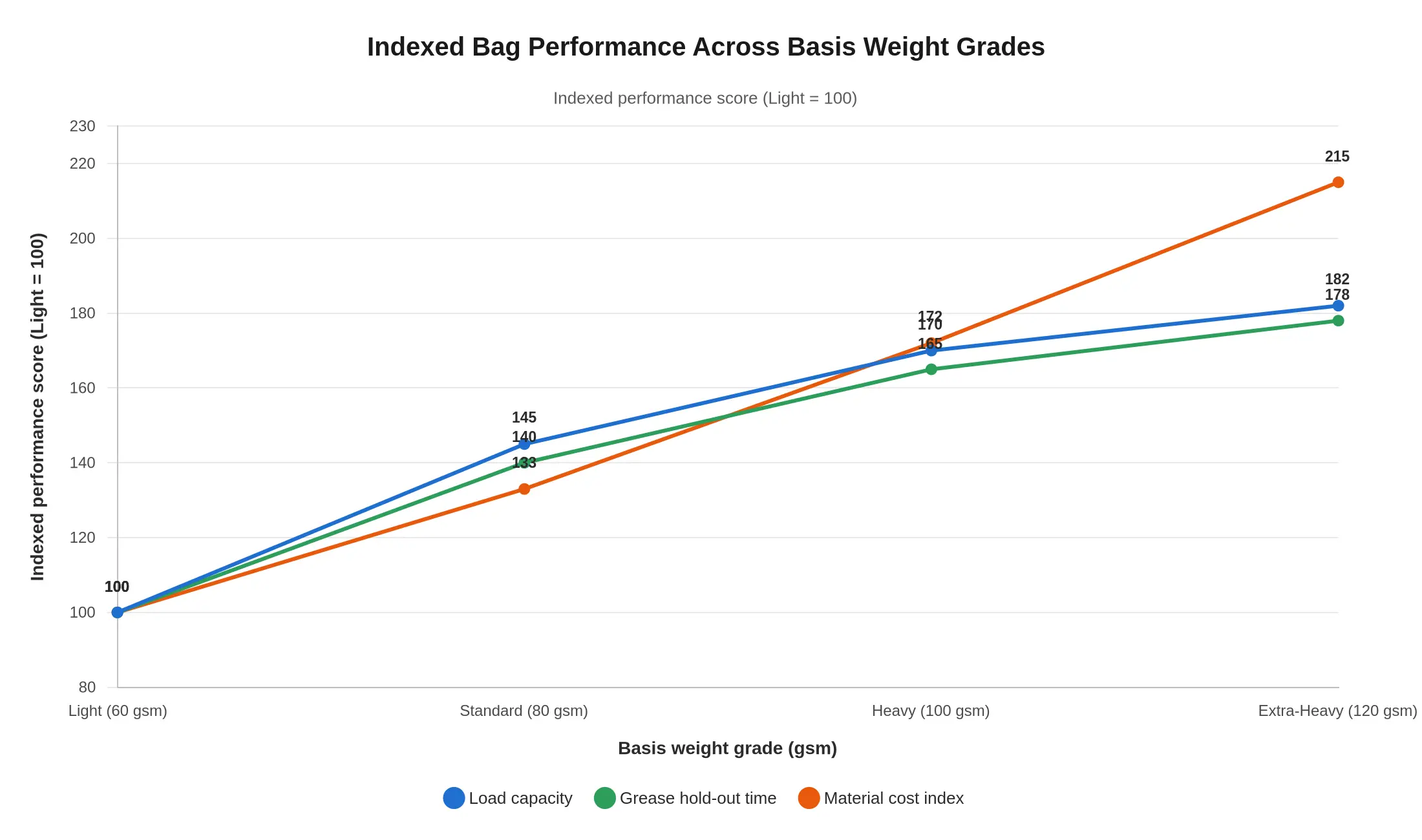
Figure 1. Illustrative index values (light grade = 100) showing how load capacity, grease hold-out time and material cost move as basis weight steps up through the light, standard, heavy and extra-heavy grades. The figures are typical of the category and meant for comparison only, so check real paper bags with handles specs before locking in a grade.
Takeaway: performance gains flatten out at the heavy and extra-heavy grades while the cost index keeps climbing, so the best-value spec for hot, greasy takeout usually sits at standard-to-heavy rather than at the thickest bag on the shelf.
Basis Weight Recommendations by Hot Greasy Order Type
Matching paper weight to what is actually inside the bag is the fastest way to stop soggy boxes, sagging carriers and grease marks on a customer’s car seat. The tiers below follow the GSM table above: Tier 1 is 60-100 gsm, Tier 2 is 100-130 gsm, Tier 3 is 130-180 gsm, and multi-ply grades run above that.
- Drinks and bubble tea cups with condensation — Tier 2, 100-130 gsm single-ply with a water-resistant or PE-coated surface, or a two-ply carrier for four to six cups. Cold cups sweat within minutes, and a light stock goes soft at the seam long before the cup is empty. The extra weight keeps the base flat and stops cups buckling in the carrier.
- Fried and grilled items with heavy surface oil — Tier 3, 130-180 gsm with a grease-resistant liner or PE coating. Oil wicks through light stock fast, and once it reaches the outside it marks clothes and tabletops. Weight plus a barrier keeps grease resistant fast food boxes presentable through delivery.
- Rice and noodle containers with steam — Tier 2, 100-130 gsm, with a breathable uncoated stock or a vented container. Steam softens fibre from the inside while the sauce works on the outside. The extra weight buys the twenty minutes it takes a courier to reach the door.
- Bakery and sandwich items — Tier 1, 60-100 gsm, greaseproof where butter or mayo is involved. These orders are short-lived and low in surface oil, so a lighter sheet keeps costs sensible. Save the heavy stock for the fryer basket.
- Multi-container catering loads — multi-ply, 180-250 gsm for the outer carrier. Four bento boxes and two buckets put real tension on handles and the base panel, and heavier board is what prevents a blowout in the parking lot.
- Cutlery and condiment add-ons — Tier 1, 60-80 gsm. Small kits do not need armour, and a light pouch keeps the unit cost down without feeling flimsy. Step up only when sauces travel in the same bag.
Treat those ranges as starting points and confirm them on samples, because the failure points in a real order show up faster than any table predicts.
Grease Barriers, Linings and Coatings: How Grease Resistance Is Actually Engineered
Paper is a web of cellulose fibres, and hot grease crosses that web the way water crosses a paper towel: by capillary wicking through the gaps between fibres. That is why thickness alone does not buy grease resistance. You either close the gaps (dense, heavily refined pulp) or cap them with a continuous barrier layer. The main options:
Uncoated kraft: breathable, printable, unprotected
No barrier at all. The strengths are real: fully repulpable and widely recyclable, breathable enough that fried food does not steam itself soggy, cheap, and the best print surface of the group because ink sinks into the fibre for a matte, tactile finish. The weakness is equally plain: oily food in prolonged contact will strike through, and heat softens the sheet and takes strength with it.
PE laminated film: the heavy-duty seal
A polyethylene extrusion coating, typically 15-25 gsm, creates a continuous, pinhole-free barrier. It handles hot oil, sauces and moisture extremely well, seals cleanly with heat, and tolerates temperatures above what most takeout orders reach. The trade-offs: PE-laminated bags are not recyclable in standard paper streams and not compostable, and the film blocks breathability, so condensation builds up around hot fried items. Printing happens on the paper side only, because the film side has to stay bare to seal.
PLA film: compostable, but mind the heat
Polylactic acid film gives a similar barrier with a better end-of-life route, breaking down in industrial composting. Heat is the catch: PLA softens around 60 °C, against 80-90 °C for PE, so it suits warm and ambient orders better than steaming-hot, oil-heavy ones. It is also stiffer and more brittle, which matters on a bag that gets folded and crushed in a delivery run.
Greaseproof paper and oil-resistant coatings
Greaseproof paper achieves resistance without any coating by refining the pulp until the fibre web is nearly closed. It works well for short-contact items such as pastries and sandwiches, stays repulpable, and keeps a natural look. For very oily food it eventually saturates. Coatings such as water-based acrylics or fluorine-free oil barriers go further, and many modern grades remain repulpable or compostable, but each formulation has its own heat ceiling and changes how ink sits on the surface. Our greaseproof foil food bags show how a dedicated barrier liner is built into a ready-to-use bag.
Multilayer constructions: structure plus barrier
Multilayer walls — paper, barrier, paper — let you separate the jobs. A kraft outer carries the load and the branding while a thin greaseproof or film liner does the oil blocking. You get stiffness, print quality and reliable resistance in one bag, at the cost of a slightly heavier, harder-to-recycle structure.
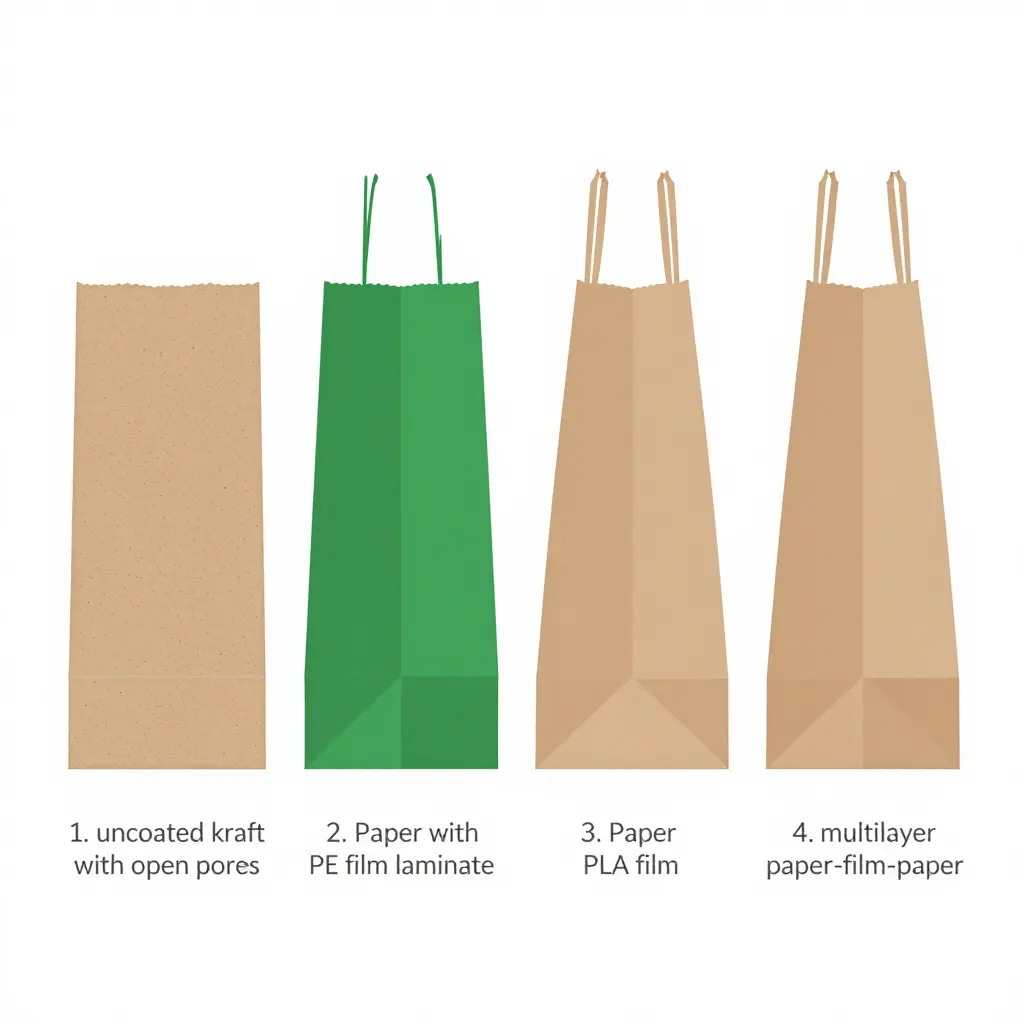
| Construction | Grease resistance | Heat tolerance | Breathability | Recyclability | Print surface |
|---|---|---|---|---|---|
| Uncoated kraft | Low | Moderate, paper-limited | High | Excellent | Excellent, matte |
| PE laminated | Very high | High | None | Poor in paper streams | Paper side only |
| PLA laminated | High | Lower than PE | None | Industrial compost | Paper side only |
| Greaseproof (uncoated) | Moderate | Moderate | Low-moderate | Excellent | Good, smooth |
| Coated oil barrier | High | Varies by formulation | Low | Grade dependent | Varies, test ink |
| Multilayer | Very high | High | None to low | Difficult | Excellent on outer |
Why a heavy uncoated bag fails where a light coated bag holds
A 100 gsm uncoated kraft bag is thicker, stiffer and feels far more premium than a 65 gsm coated one — and on an order of fried chicken with chilli oil, the heavy bag is the one that bleeds through. More fibre means more channels for grease to travel and a longer path to cross, not a barrier; heat and time finish the job. The lighter coated bag wins because a 20 gsm film is continuous, so there are no gaps to wick through and basis weight stops mattering to strike-through.
Verify the lining and the basis weight together
Check the lining specification alongside basis weight, never instead of it. Basis weight tells you what load the bag carries and how it feels in the hand; the lining tells you whether the bag survives the menu. Ask suppliers for both figures plus a grease-resistance rating, for which a kit test value is the clearest, and match the bag format to the container: paper bags for bowls are dimensioned for wide, sauce-heavy containers rather than flat boxes, which reduces tipping and side-wall stress.
What we suggest: bag a worst-case order from your own menu — the oiliest item, at serving temperature, handled the way your drivers handle it — and check for strike-through at 20 and 60 minutes. Test two or three weight-and-lining combinations side by side, then standardise on the lightest one that still passes, because that is where cost, performance and recyclability meet.
Where Paper Bags Get Their Grease Resistance
Before comparing paper with plastic, or arguing about numbers on a spec sheet, it helps to picture what a grease-resistant bag is made of. It is not one material but a stack of them, usually four, each doing one job: the printed outer layer that carries your branding, the paper substrate that gives the bag its strength and body, the barrier layer that slows grease and moisture, and the food-contact layer that sits closest to the hot buns or fried chicken.
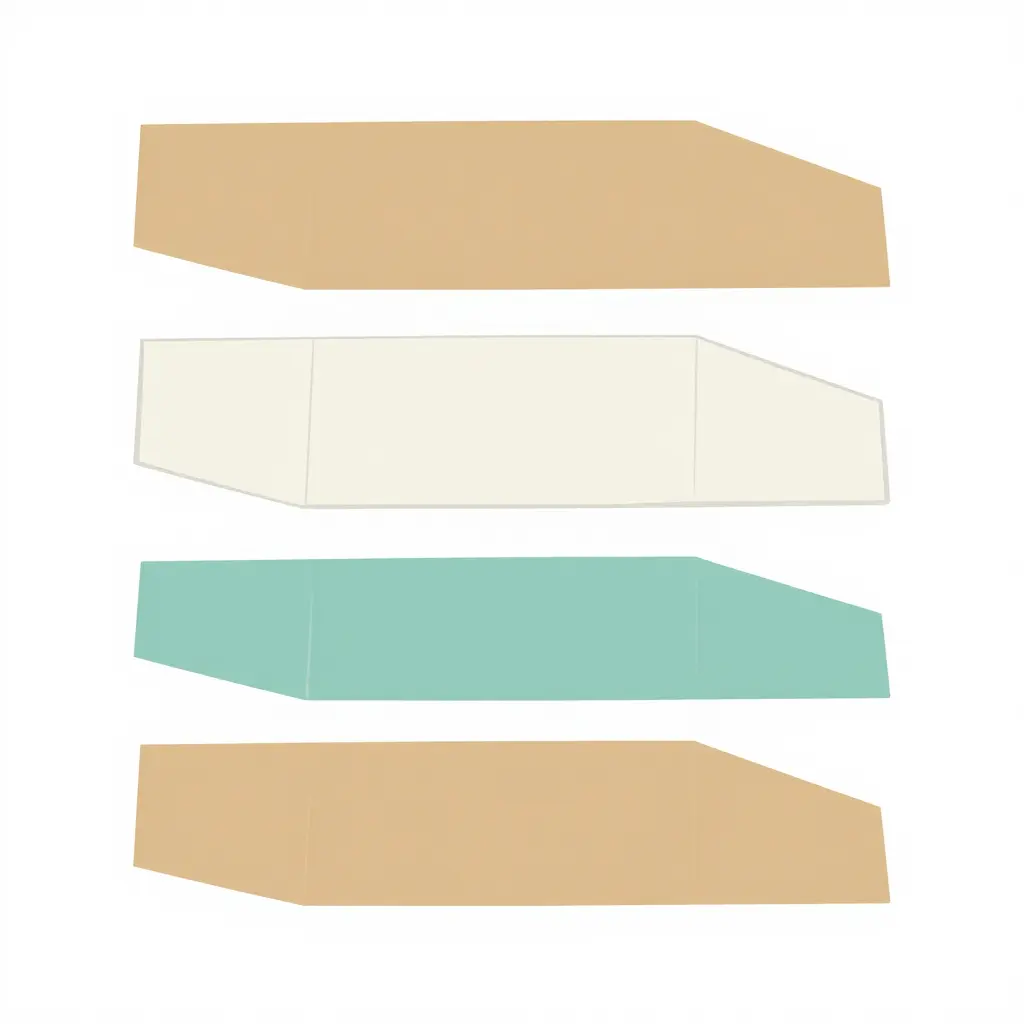
Caption: read top to bottom, the stack explains why basis weight (how much fibre is in the substrate) and grease hold-out (how long the barrier layer resists oil) are the two specs that decide whether a hot, greasy order arrives intact.
Those two specs measure different bands of the diagram. Basis weight reports fibre in the substrate, the middle of the sandwich; grease hold-out is a performance result, the time the barrier keeps oil from wicking through to the outside. A heavy bag with a weak barrier can still show grease spots within twenty minutes, and a light bag with a good barrier can look spotless while feeling flimsy in the hand. Check both numbers together, then match them to the order: a 100 gsm bag handles a paper carton of fries, while a dripping biryani or a bag of fried dumplings deserves something sturdier.
Menus with several grease levels are easier to specify by comparing stocked options side by side — our greaseproof and foil food bags show how barrier type and substrate weight pair up in practice.
Quick reference for the four bands
| Band | What it does | What to ask a supplier |
|---|---|---|
| Outer print layer | Carries branding, resists scuffing and condensation | Ink type; is it water-based or food-safe? |
| Paper substrate | Provides strength, stiffness and load-bearing body | Basis weight in GSM; virgin or recycled fibre |
| Barrier layer | Blocks grease and moisture migration | Grease hold-out rating; PE coating, PLA or fluorine-free |
| Food-contact layer | Sits against the food; must be safe and non-transferring | FDA food-contact compliance; odour and migration testing |
Cost, Durability and Eco-Positioning: Why the Sticker Price Lies
Ask a procurement team what a takeout bag costs and you will get the price per thousand from the last invoice. That number is real, and it is also the least useful one in the file. The only cost that matters is what you spend to hand a customer one successfully bagged order — bags, re-bags, labour, freight, storage and print combined.
Per-unit cost: a wide gap that starts to narrow
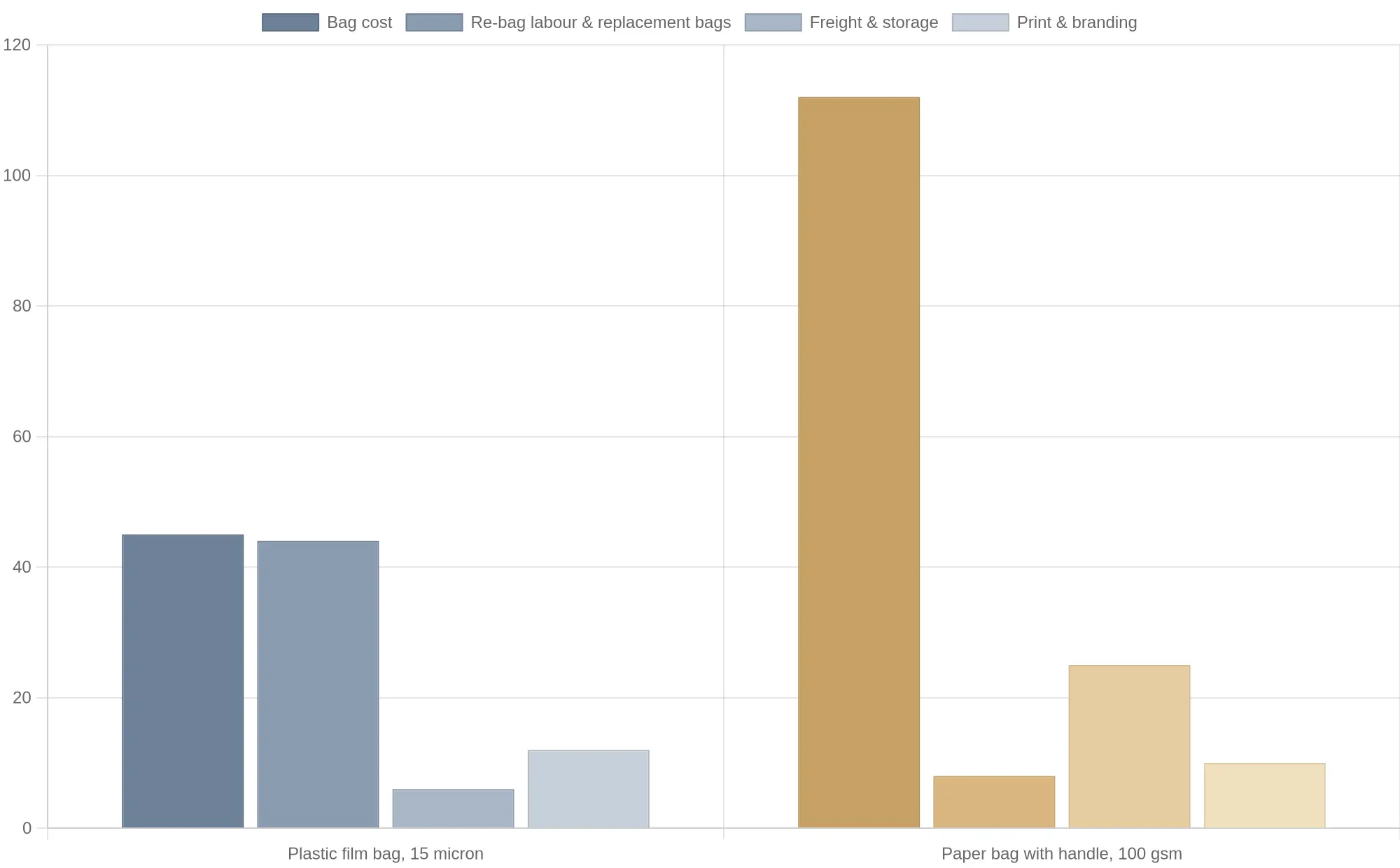
On paper (pun intended), plastic film wins easily. A 15 micron plastic carrier typically runs at about a quarter of the price of a 100 gsm handled paper bag, and that gap is genuine — it is why film still dominates low-cost, high-volume counters. The sticker price assumes one bag per order, though, and hot greasy menus rarely allow that. Double-bagging policies, plus the tendency of thin film to split at the seam when it meets a sweating burger box, quietly multiply the units you actually consume.
| Cost factor (illustrative, per 1,000 completed orders) | Plastic film, 15 micron | Paper with handle, 100 gsm |
|---|---|---|
| Bag spend (unit price × bags used) | $45 | $112 |
| Bags consumed per order (incl. double-bagging) | 1.6 | 1.02 |
| Re-bag labour and replacement bags | $44 | $8 |
| Freight and storage | $6 | $25 |
| Print and branding | $12 | $10 |
| Rough total | $107 | $155 |
Failure and re-bag rates: where the hidden money goes
A split bag is not just a wasted 3 cents. It is a thirty-second interruption at the counter, a remake conversation, and occasionally a refund. A 25% re-bag rate on greasy orders can cost more in labour than the bags themselves. Paper’s failure profile is different rather than perfect: a 100 gsm bag with a well-glued twisted handle handles steam and weight far better, but thin kraft or a weak handle attachment will fail just as dramatically once it gets damp from the bottom up.
Storage and freight volume: the cost you pay before the bag is used
Paper is bulky. A carton of handle bags takes roughly four to six times the cubic volume of the same count of film bags, which shows up in pallet counts, warehouse racking and back-of-house space. For a food truck or a small kiosk with a 1.5 square metre storeroom, freight volume is a genuine line item, not a footnote. Paper also needs dry storage: a damp corner turns a flat-packed pallet into wavy, unprintable stock.
Print and branding value: the argument film cannot win
This is where paper earns its premium. A matte kraft bag with full-surface print reads as considered, premium and photogenic in a way a printed film bag rarely manages, which matters for bubble tea chains, bakeries and caterers whose bags get photographed on a table. When branding is part of the product, explore paper bags with handles in a few basis weights and compare print coverage before deciding.
Recyclability and local regulatory direction
Recyclability is not a fixed property of a bag; it depends on what your local waste stream accepts. Film bags are technically recyclable but are rarely collected kerbside, so most end up in general waste. Paper bags are widely accepted in paper and mixed recycling and break down far more predictably when they escape into the environment. Procurement teams should read the direction of travel rather than this year’s rules: single-use film bans and extended producer responsibility fees are spreading across cities and regions, and a bag that is compliant now may carry a levy next year.
A fair word for plastic film
Balance matters here. Plastic film remains the smarter choice for light, dry, short-distance orders — merchandise, cold cups, small bakery boxes — where water resistance, low weight and near-zero storage footprint keep total cost of use low. For hot, greasy, heavy or photographed orders, paper’s print surface, perceived quality and cleaner end-of-life messaging usually justify the higher unit price.
Conclusion
Run the numbers per completed order, not per bag on the invoice. Work out bags consumed including double-bagging, add the labour cost of every re-bag, factor in freight cube and print, then layer on your municipality’s five-year direction. Once you do, one thing becomes obvious: the cheaper bag per unit is not the cheaper bag per order.
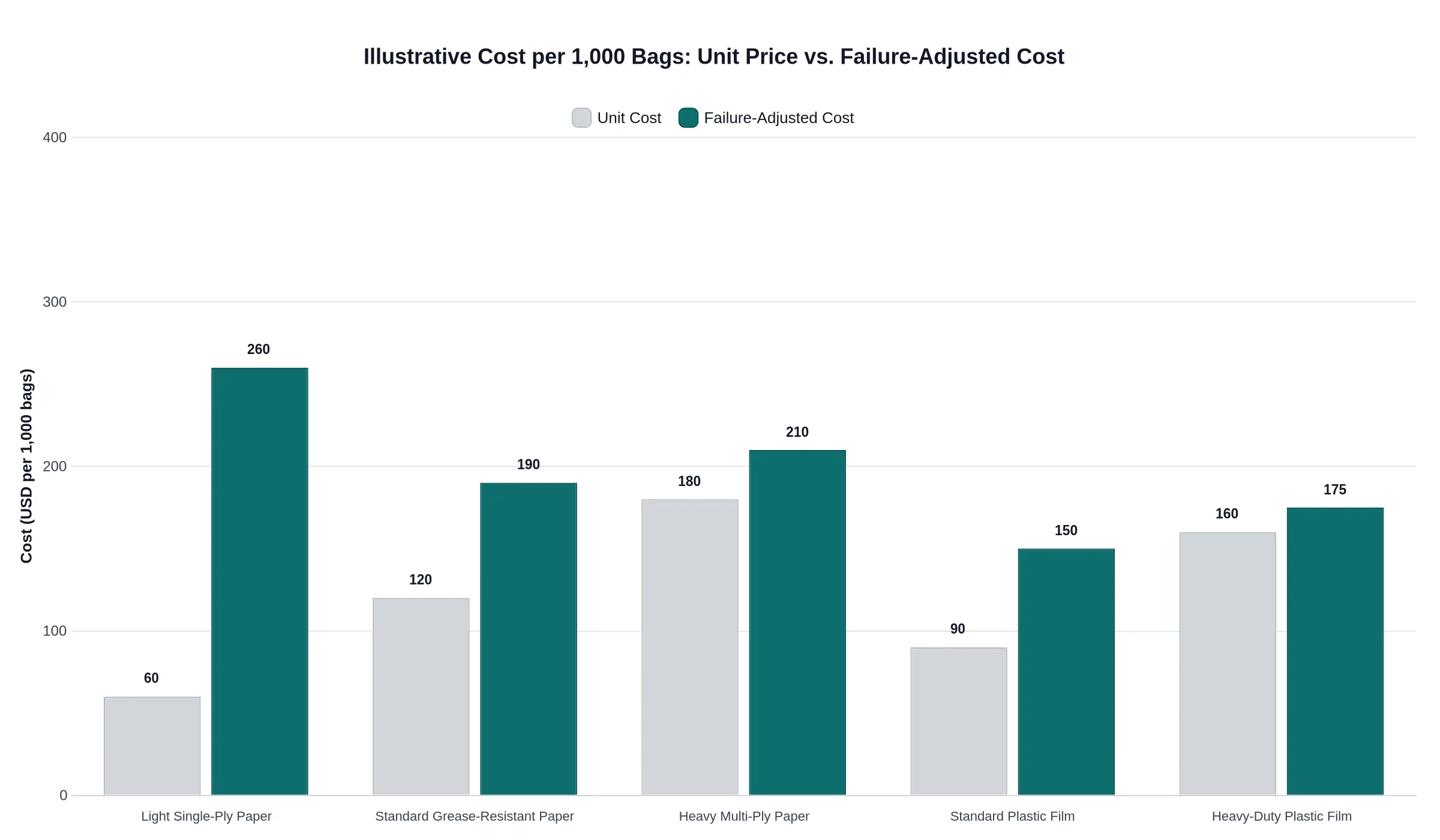
Figure 2. Illustrative cost per 1,000 bags by material and grade. The light grey bars show the simple unit price; the dark teal bars add estimated leak, tear and replacement costs to reach a failure-adjusted figure.
What the chart shows: cheap bags are not automatically economical. Once leaks, double-bagging and remade orders are counted, the light single-ply option moves from the lowest unit price to the highest real-world cost, flipping its apparent advantage over standard grease-resistant paper and both plastic films. On hot, oily menus, start with greaseproof and foil-lined food bags and compare them on the failure-adjusted basis rather than the sticker price.
How Different Buyers Should Read a Bag Specification
The same spec sheet means different things depending on what you pack, how fast you pack it, and how long the food sits in the bag.
Bubble Tea Shops and Beverage Chains
Cup count and cup stability come first. A 90-110 gsm bag with a reinforced flat bottom carries four to six sealed cups without the base bowing out mid-carry. Choose a water-resistant or PE-coated surface rather than a heavy grease barrier, since condensation from cold drinks is the real enemy, and insist on a flat-fold or die-cut handle that stacks neatly at the pickup counter. Give the supplier your cup diameter and sleeve preference before ordering so staff can load bags one-handed during a rush, and buy these bags designed specifically for cups rather than adapting a generic takeout bag. Keep one pre-printed size for single orders and one larger size for multi-cup carriers.
Restaurants
Boxed meals and combo orders need a grease barrier, either PE coating or a greaseproof liner, plus at least 100-120 gsm, because hot fried food releases oil that softens thin paper within minutes. Pick a flat-bottom bag with a gusset wide enough for your standard box footprint, and confirm the handle can carry two stacked boxes without tearing at the seam. These paper bags built for boxed meals should be sized to your most-ordered combo, not to a generic medium. In the kitchen, train staff on a fixed packing sequence — heavy box first, sides and sauces on top — so bags close flat and travel level.
Food Trucks and Catering Services
Throughput and mixed loads set the priority: 120 gsm and up with a strong folded or twisted-paper handle, since catering trays and stacked containers put far more stress on seams than a single meal does. Match the barrier to your hottest, greasiest item, and standardise on two or three bag sizes so line cooks never hesitate during service. Tray-based bag options for catering orders are worth checking against your actual foil and paper tray dimensions. Build a packing checklist per menu item and stage bags flat at the pass so nothing collapses on the drive to the venue.
Event Planners and Corporate Procurement Teams
For bulk deliveries that must arrive at temperature, specify an insulated non-woven construction with a stated hold time (30, 60 or 90 minutes) and a basis weight that supports the total load, not just the food. Choose bag styles that stack and brand well: printed non-woven totes read as part of the event rather than as packaging. Shortlist non-woven insulated bags for temperature-sensitive deliveries and confirm the closure type before committing to a print run. Agree the packing workflow with your caterer up front, including who labels bags by department or table, so distribution at the venue is fast and error-free.
Why a Written Spec Sheet Pays Off
Put your requirements on one page and share it with your supplier: basis weight, barrier type, bag dimensions, handle style, print details, pack quantity and acceptable tolerances. A written specification turns a vague conversation into a repeatable order, so reorders match the batch you approved and new staff pack the same way every shift. It also gives you something concrete to point at when a delivery arrives lighter, thinner or smaller than expected.
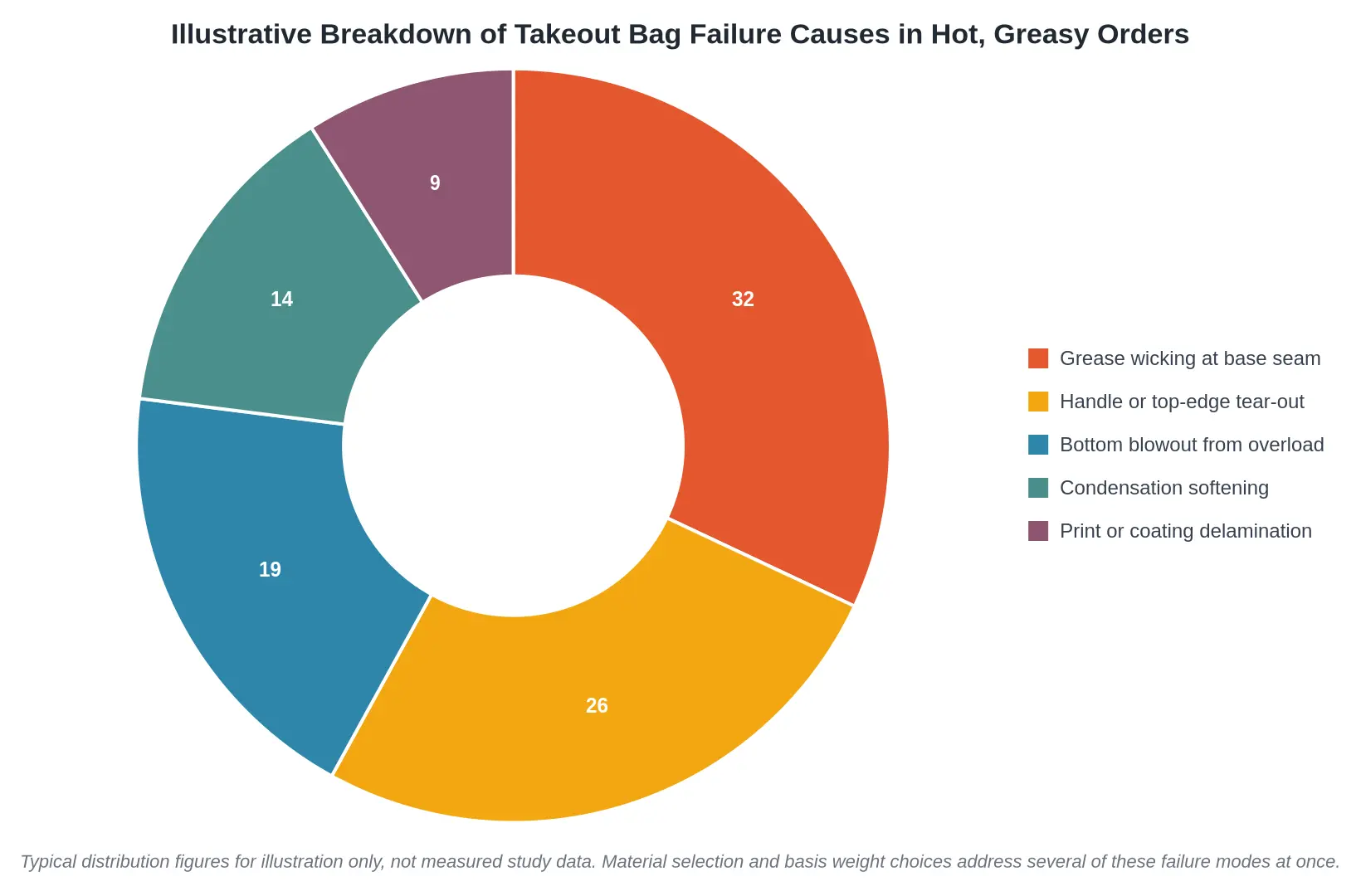
Figure 3. Illustrative distribution of failure causes in hot greasy orders: grease wicking at the base seam 32%, handle or top-edge tear-out 26%, bottom blowout from overload 19%, condensation softening 14%, print or coating delamination 9%. The figures are typical for illustration, not measured study data; material and basis-weight choices address several of these modes at once.
FAQ: Basis Weight and Material Questions
What basis weight should I choose for hot greasy takeout orders?
Between 100 and 130 gsm covers most hot greasy orders. Step up to 130-180 gsm once the bag carries fried chicken, saucy burgers, or much more than 500 g of food. That range gives enough fibre density to slow oil wicking while keeping the bag foldable and affordable; heavy combos and long delivery windows sit at the top of it.
Does a higher GSM always mean a stronger bag?
No. GSM measures mass per square metre, not tensile strength or seam integrity. A 120 gsm bag with short-fibre pulp and weak glue can split long before a well-built 80 gsm bag with long kraft fibres and reinforced side seams. Audit fibre type, wet-strength additive and handle attachment alongside basis weight.
Can paper bags safely hold very oily fried food?
Yes, when the bag is engineered for it. Standard kraft shows oil stains within minutes under fried food, so use grease-resistant paper bags or line the order with an oil-proof wrap first. Keep the contact layer oil-proof and the outer bag structural, and fried items stay crisp and leak-free through delivery.
How can I tell if a bag is truly grease-resistant?
Request the kit rating or run a simple 15-minute oil spot test on a sample. A genuinely grease-resistant bag keeps hot oil at the surface without dark translucent patches spreading through the sheet. You can compare barrier options in our food wrapping and baking paper range and pair the right liner with your bag. If oil soaks through in under ten minutes, the bag is not grease-resistant.
Are plastic bags still a valid option for some order types?
Yes. Plastic bags remain valid for cold drinks, sealed beverage cups, soups in sealed containers, and dry items with no exposed grease. The paper vs plastic decision should follow the food: grease calls for paper with a barrier, condensation and spills call for plastic. Many shops stock both and use plastic only where paper adds no grease benefit.
How do I run an in-house bag trial before a bulk order?
Run a two-week trial with 30-50 real orders per candidate bag and log every failure. Weigh each order, time how long the bag holds, and photograph seams, handles and oil patches at pickup and on arrival. Score each bag on leaks, tears and customer complaints, then place your bulk order with the clear winner.
A Repeatable Decision Framework for Hot, Greasy Takeout Orders
The rule underneath all of it: material choice follows order stress, and basis weight follows load. Five questions settle a new order.
- Confirm the heat and grease profile. Note how hot the food is at packing time, how much oil or sauce is involved, and how long the bag will sit before pickup. A fried chicken combo and a bubble tea order load the same bag wall very differently.
- Set a basis weight tier. Match paper weight to the load the bag actually carries. Lighter grades suit short, light runs; heavier grades belong with dense, sauce-forward combos that must hold their shape in the hand.
- Choose the barrier or lining type. For greasy items, lean on a greaseproof liner or foil-lined construction so oil cannot wick through the wall. For drinks and steamed items, prioritise moisture resistance instead of grease resistance.
- Verify handle and load rating. Check twisted-paper, flat-paper or die-cut handles against the real packed weight, cups and sides included, and confirm the handle attachment holds firm when the bag swings.
- Confirm print and compliance requirements. Lock in artwork, ink type, food-contact documentation, and any compostability or recycling claims before the first production run is scheduled.
Written down, those five answers are a specification rather than an opinion. The paper bags for bowls range shows how stocked options map onto the tiers, and samples of two or three candidates confirm feel, strength and print before you commit. Bulk orders can then be scoped against the same document, so quotes, lead times and incoming quality checks all point back to it.