
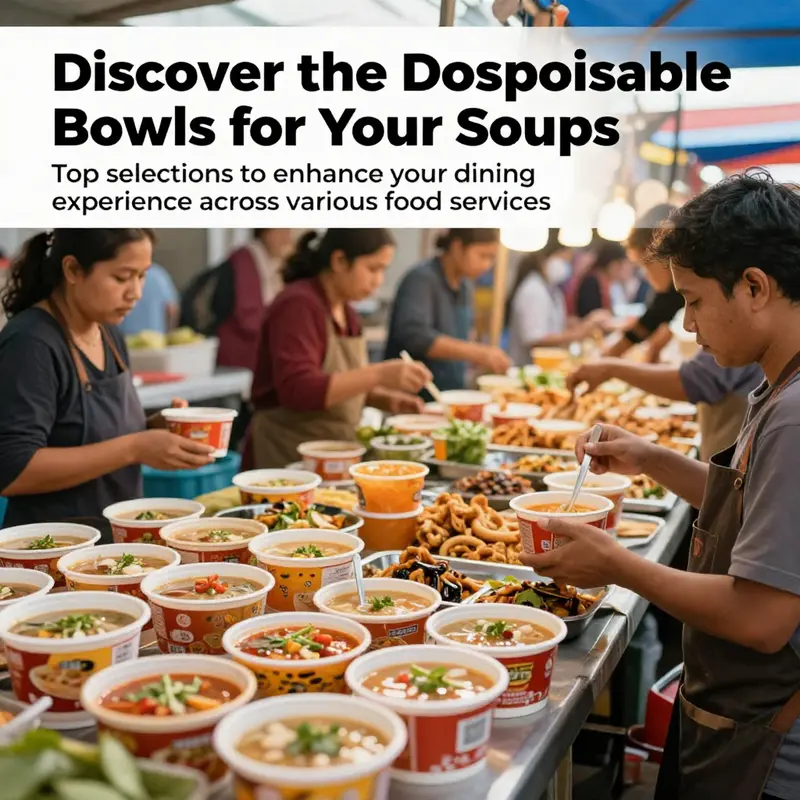
Choosing the right disposable bowls for soup is crucial for establishments like bubble tea shops, restaurants, food trucks, and catering services. Quality, durability, and user satisfaction are paramount when serving delicious soup to customers. This article navigates through the best disposable soup bowls available, emphasizing key features and benefits, alongside insightful feedback from real users. Each chapter will build on your understanding of what defines superior disposable tableware for your business needs.
Durable by Design: Navigating the Best Disposable Bowls for Soup

A bowl for soup is more than a simple vessel; it is a bridge between the cook’s intention and the diner’s comfort. The right disposable bowl protects the integrity of a steaming broth, preserves the texture of noodles or vegetables, and invites the consumer to savor the experience rather than worry about leakage, heat loss, or awkward handling. In a market crowded with options, the best choices share a core philosophy: durability without sacrificing convenience, warmth without sacrificing safety, and practicality that fits the tempo of modern service. To understand how to select with confidence, it helps to think in terms of three broad categories that cover most real-world needs. The first category is the heavy-duty, divided bowl, designed for high-volume settings where speed and reliability are nonnegotiable. These bowls are built to endure, with extra-thick walls and reinforced construction that resist warping, leaks, and the impact of thick sauces. The second category centers on compact, everyday use—specifically the ordinary 12-ounce range that aligns with a wide range of soups served in casual retail and home contexts. In appearance, these are simple, functional vessels: clean lines, a neutral color, and a price point that makes bulk purchase feasible for restaurants, delis, office break rooms, or family gatherings. The third category expands the conversation to sustainability and large servings, where plastic-free or eco-conscious options meet the needs of events, parties, and long-term environmental goals. Each category brings its own strengths, and the best decision rests on a clear understanding of the serving scenario, the expected hold time, and the tolerance for heat, density, and spillage. This is a practical, not purely aesthetic, calculus: it’s about keeping the soup hot, the bowl intact, and the dining experience dignified whether the setting is a bustling ramen shop, a neighborhood cafe, or a catered event.
In service contexts that demand durability, the heavy-duty, divided bowl stands out as a cornerstone. The design is not merely a matter of thicker plastic or a bigger footprint; it is a thoughtful engineering choice that anticipates the stresses a bowl endures when brimming with broth, oil, or chunky vegetables. The walls are reinforced, sometimes with layered materials, to prevent sagging under heat and to keep the interior from leaking into the seams when the dish is thick with sauces or garnishes. This resilience translates into tangible benefits in busy kitchens and at food stalls where speed matters. Servers and cooks can reach for a bowl, confident that it will hold together as trays tilt and lids are closed for transport. Thick walls also contribute to insulation, helping to keep a hot soup from cooling too quickly during quick service or short take-out windows. In environments like ramen bars or noodle shops, where bowls are frequently filled with broth near boiling and then delivered to tables or counters, this sturdiness is not a luxury but a necessity. Warping resistance is another key feature; a bowl that deforms under heat can create a gulp of air that accelerates heat loss or, worse, a spill as a lid is removed. The heavy-duty category often accommodates a range of sizes—from compact 16 to 24-ounce equivalents to larger vessels suitable for heartier portions or very saucy dishes. The advantage is protection against leaks and a maintainable shape that preserves the diner’s experience from the first aroma to the last spoonful. This category, while sometimes commanding a higher price per unit, pays for itself through reduced waste, fewer returns, and a smoother service flow. The investment also yields flexibility: kitchens can prepare and portion in advance, knowing the vessel will hold up during transport and service.
The second category—the everyday 12-ounce class—meets a different set of priorities. A 12-ounce capacity, which translates to roughly 355 milliliters, is a natural fit for classic broth-based soups, clear consommes, or lighter lunchtime servings. In this tier, the emphasis is on safety and accessibility: food-grade materials that can withstand regular use, straightforward handling, and compatibility with a broad range of lids and serving accessories. Aesthetics enter here too, because even in casual settings a well-designed bowl can elevate the presentation. A clean silhouette, a consistent rim, and a surface that resists scuffing contribute to a consumer’s perception of quality. The black plastic variant in this category adds a contemporary, streamlined look that complements both casual cafeterias and more polished event settings, while still offering practical advantages like visible heat resistance and reliable leakage control. Price remains a critical factor in bulk purchasing, and the 12-ounce option typically delivers an inviting balance between cost and performance. From a user’s perspective, this size is ideal for single servings that pair nicely with bread, a side of crackers, or a small dessert, and it often travels well through a crowded dining floor or a takeaway line. The compatibility with lids, heat retention, and edge comfort for fingertips are practical considerations that shape the overall user experience. When a business needs consistent, dependable everyday service, the 12-ounce bowl provides a reliable backbone of standardization. It supports a broad menu range without forcing compromises on either portion size or safety, a combination that matters as much to the server as to the guest who wants a satisfying bowl without the risk of a messy spill.
The third category—the plastic-free, large-serving option—brings sustainability into the foreground without sacrificing function. For events, buffets, or family gatherings where large portions are common, a 35-ounce capacity can be a practical choice. These bowls are designed with plastic-free construction, often using sustainable fibers or compostable materials that can stand up to hot and cold liquids alike. The goal is to maintain a sturdy structure that does not sag under weight or heat, and to keep leakage at bay even when the vessel is filled to the brim with a hearty soup, a chunky chowder, or a steaming broth with noodles. The color options, while often understated, can be tuned to fit event themes or brand aesthetics, allowing a cohesive presentation across a buffet line or a catered table. The ecological appeal of plastic-free bowls aligns with a growing emphasis on responsible consumption and waste reduction. The trade-off sometimes involves a modest increase in per-unit cost or a different shelf-life profile, but for organizers focused on sustainability, the benefits extend beyond the meal to the overall footprint of the event. In many cases, the plastic-free option is also compatible with a variety of lids designed to preserve temperature and prevent spillage during transport, a feature that makes it attractive for large gatherings where guests may carry soup from the service area to seating or standing stations. The choice of a plastic-free option can thus harmonize with an organization’s broader environmental commitments while still delivering the reliability and heat-retention essential to a satisfying soup experience.
As one steps back to consider the full picture, several practical questions naturally arise. What size best fits a given context? How important is heat retention in a given service window? Do you prioritize leak resistance over ease of disposal, or vice versa? How will lids be used—only for transport, or also for on-table protection against splashes? The answers are rarely universal. A busy café with a steady stream of take-out orders may lean toward the heavy-duty, divided bowls for their durability and spill protection, especially when serving thick sauces or gravies alongside noodles. A modern deli that emphasizes clean lines and quick turnover might opt for the 12-ounce black plastic bowls for their balance of aesthetics and practicality, knowing staff can handle a steady pace without compromising safety or presentation. An event planner aiming for a sustainable footprint, on the other hand, could choose plastic-free bowls in a larger size to accommodate generous servings while aligning with an eco-conscious theme. The decision, in other words, rests on concrete service conditions rather than abstract ideals. Every choice should be evaluated against how it behaves in real-world usage: how it feels in the hand, how well it holds heat over a typical dining interval, and how securely it seals when a lid is engaged for transport. Even the most robust heavy-duty option becomes unsatisfying if it slows service because its lid is awkward, or if it’s too costly for a business’s daily rhythms. Conversely, a minimalist, low-cost bowl that fails under heat or thick sauces undermines customer trust and generates waste in the form of returns, substitutions, or messy table incidents. The aim is a seamless psycho-physical experience: a utilitarian design that disappears into the background as the consumer focuses on the soup’s aroma, its texture, and the moment of enjoyment.
This balance between function and form also intersects with broader values around waste and disposal. In today’s service industry, the conversation around disposable bowls frequently circles back to environmental impact. The heavy-duty category, with its reinforced walls, often relies on plastics that are not easily recyclable in all regions, which prompts service operators to consider end-of-life options and local disposal capabilities. The 12-ounce class frequently leans on conventional plastics that benefit from economies of scale but face scrutiny regarding recycling and microplastic concerns. The plastic-free category stands at the intersection of sustainability and practicality, offering a route for operators who want to minimize plastic usage without compromising performance. It is not a panacea, yet it represents a meaningful shift for large events or organizations committed to reducing plastic waste. When evaluating options, thoughtful operators weigh the total cost of ownership: the price per unit, the waste generated, the potential for spills or returns, and the degree to which the vessel supports a clean, efficient operational flow. A key part of that calculus is compatibility—whether a given bowl works with common lids, compatible sleeves or trays, or standard napkins and utensils. In many cases, standardization across a fleet of bowls reduces complexity in inventory management, training, and service workflow. A single line of bowls that share a consistent rim, insulation characteristics, and lid compatibility can dramatically simplify the back-of-house routine and the guest’s takeaway experience.
Embedded in this practical framework is an appreciation for how different formats serve different dining stories. A ramen broth with floating fats and sesame oil responds differently to heat and viscosity than a delicate consomme resting in a slender, wide rim. A thick chowder clings to the sides of a bowl and tests the rigidity of its walls, while a clear vegetable broth relies more on a lid’s tight seal to prevent a stray spill during delivery. In a sense, each category embodies a narrative about how soup travels from kitchen to table or counter to car. The heavy-duty, divided bowls tell a story of resilience amid high demand. The 12-ounce black bowls tell a story of accessible elegance and everyday reliability. The large, plastic-free bowls tell a story of stewardship and hospitality at scale. The best choice is one that aligns with the specific story a business wants to tell—the message that the meal is worth protecting, that the host cares about safety and presentation, and that the dining experience remains satisfying from first aroma to final bite.
For readers who want a concise mental map, the guidance is simple. In settings where speed and volume are paramount and where soups are hearty or saucy, prioritize a heavy-duty divided bowl. When the aim is consistent, everyday use that looks polished without overengineering, a 12-ounce black plastic bowl becomes the practical anchor. When the priority shifts toward sustainability and large servings for events, look to the plastic-free, 35-ounce option that can support generous portions without compromising the event’s environmental commitments. Of course, real-world choices often involve a blend: a kitchen may operate with both a heavy-duty option for front-line pickup orders and a plastic-free option for a themed catering event. The key is to understand the core strengths of each category and how they map to specific service moments, portion sizes, and guest expectations. In that sense, the conversation about disposable bowls resembles a conversation about any essential tool used in food service: the value lies not in a single best product, but in the reliability of the system it helps create. The bowls must do their job without distracting from the soup’s artistry, and they must do so with a predictable, repeatable performance that staff can rely on day after day.
As you consider these dynamics, you may also think about how to weave related components into a coherent serving strategy. A sturdy lid that seals tightly, a corresponding tray that protects the bowl during transport, and appropriate labeling that signals temperature and contents contribute to a polished, professional presentation. A subtle but meaningful detail is the accessibility of clean disposal options for guests—clear signage about recycling or composting where available can reinforce a brand’s commitment to responsible service. The choice of bowl should fit within a broader system that respects both the customer experience and the practical realities of a busy service environment. When a restaurant or event planner takes this broader view, the resulting strategy feels less like a pile of disparate products and more like a thoughtfully curated set of tools that work in harmony with the menu, the pacing, and the guest’s expectations.
If you are exploring specific options and want to see how real-world users describe their experiences, you can explore related product communities and guides that map performance metrics to everyday use. For readers who want a closer look at the standards, grades, and performance criteria that inform these categories, a practical overview is available in in-depth industry resources. For readers curious about further context and real-user feedback, a detailed guide discusses how different bowl constructions endure heat, weight, and time, providing a framework to compare options across brands and materials. In particular, a resource focusing on the standards and performance of soup-disposable divided bowls can illuminate how thickness, wall reinforcement, and lid-tightness translate into measurable outcomes during service. This deeper dive helps translate the high-level distinctions above into concrete decisions that can be implemented in a kitchen, café, or catering operation.
For readers who want to explore related disposables that complement the bowl decision, consider looking into products that align with the Green Soil Lotus line of disposables, which emphasizes sustainable packaging and compostable options. See Green Soil Lotus for a related example of disposables that emphasize environmental considerations alongside practical use. Green Soil Lotus.
In closing, the choice of disposable soup bowls is less about chasing a single best product and more about balancing resilience, ergonomics, and footprint within the specific context of service. The heavy-duty, divided bowls offer protection against leaks and deformation in demanding environments. The 12-ounce black plastic bowls provide a balanced, versatile option for everyday use with a modern aesthetic. The plastic-free, large-serving bowls offer a path toward sustainability at scale, especially for large events and eco-conscious brands. Each choice, when aligned with a clear understanding of the service scenario, contributes to a smoother workflow, a warmer presentation, and a more satisfying dining moment for every guest. The right bowl remains a quiet partner in the meal—one that keeps soup hot, prevents spills, and allows the flavor to remain the focal point of the experience. External guides and industry comparisons can provide further nuance, but the practical takeaway is straightforward: match the bowl to the moment, and you elevate the entire dining encounter without adding complexity to the process.
External reference for further context: https://www.plasticware.com/blog/in-depth-guide-to-soup-disposable-divided-bowl-standards-grades-performance/
Between Comfort and Construction: How the Best Disposable Bowls for Soup Balance Heat, Integrity, and Sustainability

Soup has a way of elevating a moment from a simple meal to a shared experience. The scent rises, the steam fogs the edges of the container, and the first sip carries warmth that lingers. In that moment, the quality of a disposable bowl matters just as much as the recipe inside. A bowl is not just a receptacle; it is a partner in delivering aroma, texture, and timing. The best disposable bowls for soup respond to that delicate balance with a quiet efficiency. They hold heat without scalding fingers, resist warping under a hot broth, and keep the broth from leaking onto hands, tables, or carpets. They also align with practical demands—easy handling, stackable storage, and predictable performance in a busy kitchen, cafe, or event setting. If we strip away the branding and glossy packaging, we are left with a fairly consistent set of expectations: a bowl that feels sturdy in the hand, a lid that seals securely, and a material that respects both the diner and the planet. Achieving this trifecta—heat retention, leak resistance, and environmental responsibility—requires careful choices about design, materials, and form. It is tempting to equate disposable convenience with a quick, one-size-fits-all solution. Yet the truth is more nuanced. Hot soups push the limits of what a disposable vessel can endure. The liquids are often dense and heavy with flavor, oils, and seasonings that can migrate and cause sogginess or leakage if the container is not built to withstand them. The best bowls, therefore, must combine mechanical rigidity with a thoughtful barrier against heat transfer and moisture migration. They must also accommodate a range of serving contexts—from a bustling street stall to a sit-down takeaway counter—without sacrificing consistency. In exploring these bowls, we find that there are several pillars of quality that consistently emerge as nonnegotiable, regardless of the exact material or design lineage. First is leak resistance, a property that depends not only on the bowl itself but on the lid or seal system that accompanies it. A secure lid should fit with minimal gap, resist deformation under pressure, and remain intact during transport. The material used for the lid matters as well. Polypropylene, a common lid material, offers a reliable seal and heat tolerance without introducing excessive weight. Bioplastics such as PLA bring compostability into the conversation, but they require careful handling and, often, industrial facilities to achieve full breakdown. The second pillar is heat retention. When a soup bowl holds a steaming broth, it must insulate enough to protect the hand while preserving the culinary temperature long enough for the diner to enjoy the first few bites before it drops. Insulation is frequently achieved through a layered approach: a paperboard shell with a plastic lining, or a molded fiber body that traps a thin air barrier. Each approach has trade-offs in cost, strength, and environmental impact. The third pillar is structural integrity. A bowl should resist crushing under the weight of a hearty stew or a noodle-filled broth. It should maintain its shape when hot liquid is inside, and not warp during the rigors of transport or stacking. This stability comes partly from the geometry of the walls and the thickness of the material, and partly from the chosen manufacturing method. Molded fiber, bamboo fiber, or sugarcane pulp offers excellent rigidity for many soups, while plastic-based bowls deliver a dependable, durable feel that many operators rely on in fast-paced service settings. The fourth pillar is compatibility with hot liquids. Materials vary in their tolerance to heat, with some becoming soft or deforming at higher temperatures. A bowl intended for hot soup must be rated to withstand serving temperatures without transferring heat in an uncomfortable way to the hands. The safety of the materials—especially for foods served at high temperatures—should be evident in certifications and food-grade standards. In practical terms, this means choosing bowls that are explicitly designed for hot foods, with attention to lining, coatings, and the lack of sharp seams that could harbor bacteria or cause leakage under stress. Beyond these core performance attributes lies the arena of sustainability and responsibility. A growing portion of soup service seeks to minimize environmental impact, whether through compostable fibers, plant-based linings, or recyclable plastics. Here the conversation becomes more complex, because “eco-friendly” is not the same as “end-of-life friendly.” Paperboard with a plastic lining can be suitable for short-term hot service and may be recyclable in some contexts, but the presence of a liner can complicate recycling streams. Molded fiber options, such as bamboo or sugarcane pulp, offer compostability and favorable strength, yet disposal depends on local facilities that can process such materials. PLA-based options are often marketed as compostable under industrial conditions, but those conditions are not universal. For operators, the choice then becomes a balancing act among performance, cost, and the realities of their waste streams. A thoughtful decision pushes beyond the lure of a single feature. It examines how a bowl performs when filled with something as challenging as ramen with broth, chili oil, or a thick curry. It considers how the vessel behaves after hours of service in an unregulated environment, with lids left ajar or stacked in crates. It assesses how easy it is for staff to assemble the right combination of bowl and lid to prevent leaks during transport and how well customers perceive value in relation to price. A practical way to approach this decision is through a mental model of use-case scenarios. In a quick-service setting where efficiency reigns, a durable, leak-resistant plastic bowl with a snug lid may be favored for its resilience and fast turnover. In a café that emphasizes sustainability as a selling point, a molded fiber option with a compostable lining and a compostable lid could align more closely with brand values and consumer expectations. In a large event, where hundreds or thousands of servings must be moved efficiently, stackability, uniformity, and predictable performance become the deciding criteria. The level of heat retention required may vary with the weather, the distance of transport, and the time between portioning and consumption. The best disposable bowls for soup are not those that perform flawlessly in every situation, but those that deliver dependable, consistent experience across a spectrum of contexts while aligning with operational goals and environmental commitments. That consistency begins with the fundamental material choices, and here several options emerge as common and reliable, each with its own set of advantages and caveats. Paperboard with a plastic lining is often the most cost-effective route for short-term hot food service. It offers reasonable insulation and a clean finish that makes branding straightforward. However, the lining can complicate disposal streams, and some customers may notice a slight taste transfer if the lining is not properly adhered or if the product is used with very fatty broths. Molded fiber options, including those derived from bamboo or sugarcane pulp, bring a more natural aesthetic and a higher degree of rigidity. They tend to perform well with hot liquids and can be more comfortable to hold in colder settings, thanks to their thicker walls and insulating properties. The environmental story here is nuanced—these fibers are often compostable in industrial facilities, and many consumers perceive them as more earth-friendly. Still, compostability is not universal, and success depends on the local waste infrastructure. Polystyrene, while less common today due to environmental concerns, has a long track record for heat retention and lightness. It remains a practical choice in some high-volume operations where cost and performance must be tightly balanced. It is important to note that, in many markets, there is a push to phase out PS for environmental reasons, which influences supplier availability and long-term procurement planning. Polypropylene bowls offer strength, moisture resistance, and microwave compatibility. They are less prone to leaking and often feel more robust in the hand than thinner plastics. The trade-off is that they are typically less environmentally friendly than molded fiber or PLA-based alternatives, though recycling programs for PP do exist in many regions. PLA-based options bring the compostability dimension to the forefront. Made from renewable resources, PLA can appeal to customers seeking greener choices. Yet compostability demands proper facilities and clear labeling to avoid confusion at the waste stream. In practice, a well-chosen PLA bowl may be fully compostable only in industrial facilities, not in home compost piles, which has implications for consumer messaging and municipal programs. The ideal solution often arises from mixing these materials in a way that optimizes the strengths of each while mitigating weaknesses. A hybrid approach might use a molded fiber body for rigidity and heat resistance, with a thin plastic or PLA lining for moisture management. The lid becomes an essential companion piece, frequently crafted from polypropylene or compatible bioplastics, designed to snap securely into place and resist warping. The seal should be robust enough to withstand the jostling of a crowded service line and the bumps of a delivery route without creating a mess. The mechanical design matters as much as the material choice. Subtle details can dramatically influence performance: the geometry of the rim, the coefficient of friction between lid and bowl, the thickness of the wall, and the presence of structural ribs that reinforce the sides. A well-designed rim improves the ease of handling with gloved hands and helps seal the lid more reliably. A thicker wall can slow heat transfer, which provides a more comfortable grip, while also contributing to a perception of heft and quality. Conversely, overly thick walls can add cost and reduce stackability, a critical consideration in bulk operations where thousands of units need to be stored and transported efficiently. The supply chain reality cannot be ignored. The best disposable bowls for soup must also be available in predictable quantities, with reliable lead times, straightforward packaging, and clear labeling. Businesses that source in bulk often seek compatibility with standardized lids, branded inserts, and uniform packaging that reduces waste and simplifies handling. In many cases, suppliers offer customization options, such as flexographic printing up to a certain color limit, enabling brands to extend their visual identity to the packaging. When considering cost, it is not enough to compare per-unit price. The total cost of ownership includes storage space, the risk of leakage in transit, labor associated with waste management, and the potential for customer dissatisfaction if a product fails under pressure. A cheaper option that leaks or warps can end up costing more in refunds, replacements, and reputational harm than a slightly more expensive but dependable choice. For operators, a practical evaluation often begins with a simple test: fill the bowl with a representative hot soup, seal it with the lid, and simulate transport. The test should include a shake and tilt to reveal any weaknesses in the seal. Temperature retention can be assessed by timing how long the bowl remains comfortable to hold and how long the soup stays hot. A core advantage of a well-chosen disposable bowl lies in the peace of mind it offers. Not only does it deliver a satisfying experience to the diner, but it also reduces the cognitive load on staff who must manage dozens of cups and lids during peak hours. A bowl that performs reliably makes it easier to train new staff, standardizes service, and minimizes waste through fewer mishaps. The upstream decision, of course, is how to approach the market with the best balance of performance and sustainability. This is where the ongoing dialogue between suppliers, operators, and waste managers matters most. Operators should seek bowls that meet or exceed recognized standards for food safety, heat resistance, and structural integrity. They should examine the lifecycle implications of each material and consider how their waste streams will handle them. The market has increasingly rewarded transparency. Clear labeling about heat tolerance, compostability, recyclability, and any special disposal instructions helps customers make informed choices and reduces the likelihood of contamination in recycling streams. The research landscape has revealed a few general expectations that recur in top-tier recommendations. First, a dependable leak-proof design is non-negotiable. The more secure the lid and trench of the bowl, the more confident a food provider can be when handing off a hot, ready-to-eat meal. Second, a robust insulation strategy matters. Whether through layered materials or thicker walls, effective insulation translates into better user experience and less risk of scalding. Third, material versatility matters. The ability to use the same packaging solution for hot soups and cold beverages, with proper labeling and insulation, simplifies procurement and reduces waste through standardization. Fourth, responsible disposal messages matter. Audiences increasingly want to know how to dispose of packaging responsibly. Clear guidance about home composting, industrial composting, or recycling helps close the loop and reinforces sustainability commitments. In practice, the best approach for a given operation will be informed by the local context, including waste infrastructure, regulatory requirements, consumer expectations, and budget realities. A café serving a mix of hot soups and brothy noodles may prioritize a molded fiber option with a compostable lining for most applications, while keeping a smaller stock of sturdy PP bowls for high-volume peak hours and for take-out that demands extra durability. A catering service planning a large outdoor event might favor a robust plastic option with a secure lid and an emphasis on stackability and ease of distribution, accepting a trade-off in the sustainability equation for reliability and speed. It is in these nuanced choices that the value of the best disposable bowls is realized. They enable cooks to preserve the integrity of the soup—its aroma, texture, and temperature—while reducing the friction points that can derail a service. They support a positive dining experience by ensuring that a hot, comforting bowl of soup can be enjoyed without the din of spillage or the burden of fragile vessels. They also reflect a broader philosophy of service that respects both the diner and the environment, recognizing that every serving is part of a larger system of sourcing, production, waste, and reuse. For professionals who want practical guidance rooted in real-world considerations, the chapter above outlines the dominant factors that differentiate ordinary disposable bowls from those that become trusted partners in service. The focus remains not on chasing novelty, but on delivering consistent performance that aligns with the expectations of modern diners and the realities of contemporary operations. In this light, the choice of a disposable soup bowl becomes a decision about reliability, ethics, and experience, rather than a mere line-item in a menu. It is a decision that reflects how a business treats its guests and how it treats the world that sustains it. For readers seeking further reading on standards and performance, an in-depth guide on disposable soup bowls offers comprehensive benchmarks and specifications. https://www.foodserviceequipment.com/disposable-soup-bowls-guide
To explore related insights into how packaging choices can support branding and efficiency in food service, you can also visit a resource that covers practical considerations for bulk orders and customization. In particular, understanding minimum order quantities, printing capabilities, and packaging options can help align procurement with a brand’s strategic goals. While this chapter remains focused on performance and material choices, the broader ecosystem of suppliers and manufacturers plays a critical role in shaping the options available to operators, large and small, who are looking to balance quality with cost and sustainability for soup service.
Soup Safe and Sturdy: How Real-World Feedback Shapes the Best Disposable Bowls for Hot Soups

The bowl that holds a steaming bowl of soup is more than a simple container. It is a performance stage for warmth, a shield against spills during transit, and, increasingly, a statement about responsibility. When we sift through user impressions and product evaluations, a clear picture emerges: the best disposable bowls for soup are defined not by flashy features alone, but by a careful balance of heat tolerance, structural integrity, leak resistance, and thoughtful design that respects both the diner and the planet. This balance is visible in every encounter between a hot broth and the container that carries it—from a bustling street food stall and a busy cafeteria to a catered wedding and a late-night delivery run. The lesson that real-world reviews teach is simple yet powerful: durability under heat, reliable seams, and responsible materials are the three pillars that support a truly dependable bowl.
To begin, heat resistance is not merely a matter of keeping well-loved ingredients steaming. In practical use, a disposable bowl must endure the full arc of a hot soup—from the moment it is ladled to the moment it reaches a waiting plate or a hungry customer. Reviewers consistently note that a bowl’s performance is most telling in those critical minutes when heat presses against the walls of the vessel. Plastic bowls with reinforced or thicker walls tend to hold their shape even when a dense, saucy concoction is rushed from kitchen to curbside. Heavy-duty design is not about exaggerating toughness; it is about preventing the telltale sagging that can lead to leaks or, worse, a spill on a customer’s lap or a chef’s order pad. The structural integrity of a bowl becomes especially important for servings like ramen, chowder, or thick vegetable stews, where the volume and viscosity push the container to its limits. In these contexts, users often describe a marked difference between containers that soften under heat and those that remain upright, sturdy, and confident throughout the dining experience.
Despite the emphasis on rigid walls, heat resistance cannot be pursued in isolation from material choice. The discussion that surfaces in reviews spans a broad spectrum of materials, each with its own set of trade-offs. Traditional plastic bowls, when engineered with thicker plastic or layered constructions, tend to excel at withstanding high temperatures without warping. The perception of durability in these cases is not about a single rigid property; it is about a composite performance: the way the material resists thermal deformation while preserving a comfortable feel in the hand and a dependable seal with the lid. Paper-based alternatives, often reinforced with internal barriers or coatings, offer an appealing blend of insulation and ease of disposal. They can resist leaking when hot liquids are held within, provided their seams are stitched with care and their lining is engineered to minimize liquid wicking. Yet even these paper variants confront the reality that heat can challenge their structural capacity over time. Reviewers who have tested them in high-heat environments—hot soups, broths with visible oils, and stews with chunky components—note that thickness and the integrity of the internal barrier are decisive factors in whether the paper bowl maintains its shape or succumbs to softening and leakage.
A third option that frequently attracts attention in user feedback is molded fiber and other compostable alternatives. These materials carry the promise of responsible disposal without sacrificing much on strength. In practice, molded fiber bowls demonstrated in many reviews that they can deliver excellent insulation and rigid support, particularly when designed with a molded profile that distributes heat evenly. The challenge for these options lies in heat tolerance at the outer surface and the interactions with lids and closures. While they can be superb for many cold-to-warm serving contexts, their performance with very hot soups—especially in crowded service lines or during events with extended service windows—depends on the exact formulation and the presence of a reliable lid system. The conversations around sustainability frequently surface here as a guiding value: many users prize compostable or recyclable options, but they also insist that performance should not be compromised when a bowl is tasked with carrying a piping-hot cup of nourishment from kitchen to consumer.
The size of the serving matters almost as much as the material. In real-world use, the 12-ounce and 16-ounce formats are the workhorses for soup service. The 12-ounce size is widely valued for portion control, particularly in breakfast, light lunches, or tasting menus where the goal is to offer a satisfying mouthful without overfilling. The 16-ounce variant, by contrast, is celebrated for main-course servings and noodle bowls, where heft and capacity are needed to accommodate broth, noodles, vegetables, and protein without requiring a second container. Some kitchens lean toward the larger 550ml format for heartier portions, such as thicker chowders or soups that contain substantial add-ins. The consensus across reviews is clear: the right size is not only about capacity but about the flow of service—from how quickly a bowl fills in the ladle to how comfortably it can be carried during a carry-out or to-go moment. Segmenting soups by their inherent density helps operators select a container that can manage the full spectrum of soups they offer, while preserving the eater’s experience from first aroma to final sip.
Lid design and seam integrity deserve heightened attention in every review round. A lid that sits tightly and remains secure through transit can drastically reduce the risk of leaks at the base or along the seam. In many professional contexts, the lid is more than a closure; it is a partner to the bowl, turning a fragile hot liquid into a stable, portable meal. Reviewers point to two elements as decisive: the fit of the lid and the reliability of the seal between lid and bowl. If the closure is too loose, the lid can pop off with a simple bump in a crowded service line. If the fit is too tight, time and labor can be wasted fighting to remove or reseal during service. The best solutions strike a balance: a lid that snaps into place but can be reopened quickly by staff for adjustments, while still offering a confident seal that prevents leaks during transportation. The materials used for lids—the common thermoplastic variants or bioplastic equivalents—play a crucial role in how well they perform in hot conditions. A lid that remains rigid and clear of warping tends to inspire trust among both servers and customers, contributing to fewer complaints about spills and more consistent experiences across a restaurant’s entire takeout workflow.
Beyond the immediate performance, the conversations about disposable bowls consistently orbit around the tension between performance and sustainability. Consumers today recognize that takeout and delivery packaging have a meaningful environmental footprint. Therefore, the most persuasive reviews are those that acknowledge the real-world impact of material choices without sacrificing performance. PLA-based bioplastics, derived from plant-based sources, are lauded for their lower carbon footprint in some life-cycle assessments and their ability to break down under industrial composting conditions. Yet several reviewers also note a caveat: heat can test bioplastics differently than conventional plastics, and in some extreme heat scenarios, performance can be more variable. This is not a blanket condemnation of bioplastics; rather, it is a reminder that compostable solutions require a well-matched infrastructure for disposal and a design that accounts for heat exposure during service. Paperboard bowls with a plastic lining present another common approach. They can provide sturdy insulation and a reliable surface for hot liquids, but questions persist about recyclability and compostability in consumer waste streams. The best-performing paper-based options often incorporate thick walls and tight-fitting lids, and their success hinges on the quality of the liner and the integrity of the construction under stress. Molded fiber bowls, frequently marketed for their compostability, are frequently praised for their rigidity and their ability to resist leakage when paired with tight lids. In settings like home catering or large events, these bowls can deliver a strong, confident experience while aligning with sustainability aims. But, again, the caveat remains that performance can vary depending on processing conditions and the particular fiber blend used in production.
Putting these threads together, the decision calculus for businesses and households alike becomes a question of context and priority. If a kitchen’s priority is maximum heat resistance and minimal risk of leakage in high-volume service, a heavy-duty plastic option with reinforced walls might be chosen. If the goal is to minimize environmental impact without sacrificing too much strength, molded fiber or high-quality paperboard options with robust linings can be compelling. For cafés and casual eateries that rely on speed and efficiency in takeout, the lid system becomes almost as critical as the bowl itself. A well-designed lid not only contains heat but also supports the workflow—allowing staff to seal and unseal rapidly, stack efficiently, and present a neat, professional impression to customers. The reviews that culminate in a preferred choice often emphasize that the best disposable bowl is the one that reliably delivers a seamless experience across the full cycle of service: from the moment soup is ladled, to the moment the customer lifts the lid to reveal the aroma, to the final moment of disposal where the container still carries minimal residual heat and a neat, manageable footprint for disposal or recycling.
Yet the journey from review to recommendation is rarely a single factor in isolation. It unfolds as a composite of performance cues—how a bowl handles heat, how a lid seals, how easy it is to transport without leaks, and how well it meets sustainability goals. The most trusted options become those that perform consistently across a spectrum of real-world conditions: the chaos of a lunch rush, the unpredictable temperature of a curbside pickup, and the long tail of a catering event where a bowl might be used for hours on end. In these moments, the value of a bowl is not measured in a single virtue but in the harmonious balance among several critical attributes. Reviewers repeatedly highlight that when a bowl earns trust in one context, it tends to earn trust across many: sturdy enough for bold broths, precise enough for neatly arranged add-ins, and reliable enough to be part of a straightforward disposal routine.
The practical implication for operators and planners is to approach the selection with a mindset that mirrors a decision they would make about any other piece of essential serviceware. Start with the serving size that aligns with the expected portions and the dining context. Then evaluate the accessibility of the lid system and the reliability of the seams as a measure of transport safety. Finally, weigh the environmental considerations in light of disposal infrastructure and local recycling or composting capabilities. The strongest choices are those that balance all three axes—performance, ease of use, and sustainability—to deliver a consistent customer experience while supporting efficient operations. In this framework, the best disposable bowls for soup are not a single product category but a family of solutions that can be matched to the demands of a particular operation. A ramen shop may lean toward a heavier-duty, leak-proof option with a secure lid and ample capacity, while a casual cafe focused on quick service and minimal waste may optimize for a paper-based alternative with a robust inner lining and an efficient disposal path. A caterer planning for an all-day event might favor molded fiber bowls that hold heat well enough for a full-service meal and offer compostability as a final touch for guests who value sustainability.
What emerges from this tapestry of experiences is a clear, practical takeaway for anyone choosing disposable bowls for soup: prioritize heat resilience, seal reliability, and material strategy in equal measure, but tailor the choice to the specific service scenario. The best bowls are those that disappear from the user’s mind—their competence is so reliable that the diner focuses on the flavor, not the container. A well-evaluated option will do the heavy lifting in the customer’s perception, allowing the soup to speak for itself while the packaging quietly supports the experience with quiet efficiency. This is the quiet art behind the best disposable bowls for soup: a design philosophy rooted in real-world feedback, where durability, lid integrity, and mindful material selection converge to deliver warmth, stability, and responsibility in every serving.
For readers who want to explore concrete product examples and the kind of feedback that shapes these choices, the landscape is rich with consumer reviews that emphasize durability under heat, leak-proof performance, and sustainable design. Reviewers frequently note impressions such as resilience to warping after hours of hot liquid exposure, confidence in the lid’s ability to prevent spills during transit, and the practicality of bulk purchasing for restaurants and event planners. These insights form a practical vocabulary that helps buyers articulate what they need from a disposable soup bowl and to match those needs with the right material and size for their operation. While no single option embodies every ideal perfectly, the best-performing bowls in any given setting tend to be those that strike the most favorable balance between the three core criteria—heat endurance, leak-proof confidence, and a responsible approach to disposal—while remaining cost-effective and easy to handle in busy service environments. In this sense, the chapter on user feedback becomes a guide not just to selecting a bowl, but to thinking through the entire line of serviceware that supports a memorable, worry-free soup experience for customers.
To close this exploration, consider how these themes translate into everyday decision-making in a kitchen or catering operation. When staff pick up a potentially hot dish, they often rely on the assurance that the container will not fail them. They want to know that the lid will snap into place with a clear confidence, the seams will hold through stirs and bumps in transit, and the material will perform its job without introducing unwanted textures or tastes. They want to see that the container speaks to quality without shouting it, and that the packaging aligns with the business’s values—whether that means prioritizing recyclable resources, embracing compostable options, or simply choosing a solution that reduces waste without compromising service. The dialogue with customers also evolves from the moment the soup is offered, through the moment they lift the lid to inhale the aroma and savor the first taste, to the moment the container is disposed of with minimal mess. When the system works as it should, there is a seamless transfer of confidence from the packaging to the dining experience, and the meal becomes a memory of warmth and satisfaction rather than a note of frustration about a leaking lid or a collapsing rim.
In sum, the journey through user reviews and practical evaluations reveals a pragmatic truth: the strongest disposable bowls for soup are those that perform consistently under the pressures of real use. They are the ones whose materials and constructions are chosen with a clear eye toward heat resistance, structural rigidity, and dependable lid compatibility, while also acknowledging the growing demand for sustainable packaging. They may come in several sizes to suit different portions and contexts, but what binds them is a shared commitment to turning a simple container into an ally for flavor, service, and responsible choices. The next time someone orders a steaming bowl of soup to-go, the satisfaction may well hinge on the quiet competence of the vessel that carries it—worthy not of fanfare, but of trust earned through countless rounds of feedback and tested in the crucible of daily service.
External resource for further reading on consumer feedback and packaging performance can be found here: https://www.walmart.com/ip/Exquisite-Bulk-12-oz-Black-Plastic-Soup-Bowls-Pack-of-50/49371561
Final thoughts
In summary, selecting the best disposable bowls for soup involves understanding the quality, durability, and user satisfaction that the right products can offer. As you consider your options, remember the key recommendations and features discussed in this article. Investing in high-quality disposable bowls not only enhances your service but also ensures that your customers enjoy their meals without compromising on experience. Prioritizing the right disposable tableware will elevate your brand’s reputation and contribute to customer satisfaction.