
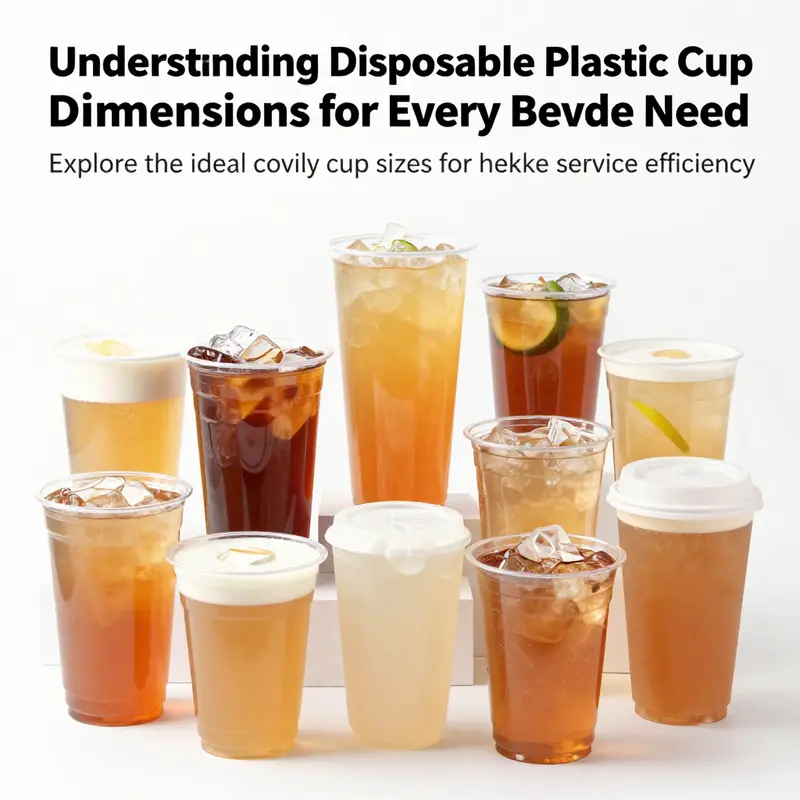
Disposable plastic cups are essential in the beverage industry, catering to a wide range of drinks in various settings. Understanding the dimensions and uses of each cup size can optimize service efficiency and enhance customer experience. From small cups suited for quick sips to large ones designed for indulgent drinks, knowing the specifics helps businesses meet their customers’ demands more effectively. This article delves into the various dimensions of disposable cups, examining small, medium, and large cup sizes, as well as cups designed for hot beverages. We will also discuss the importance of standardization in cup dimensions for compatibility across different beverage services, empowering businesses with the knowledge to make informed choices about their product offerings.
The Subtle Architecture of Small Sips: Unpacking the 8-Ounce Disposable Cup
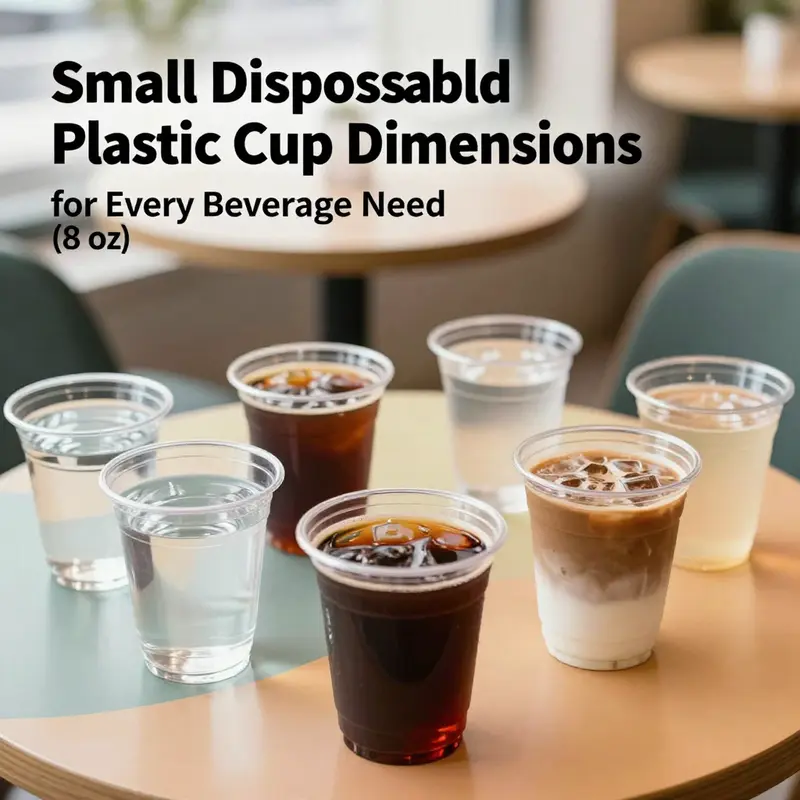
The 8-ounce disposable cup is more than a simple vessel. It embodies a precise set of decisions about geometry, material, and end-use that echoes across the ecosystem of single-use serviceware. In many ways, this compact cup acts as a test case for how dimensions govern function. It must be light enough to be comfortable in a customer’s hand, sturdy enough to hold a hot or cold beverage without warping, and yet compatible with lids, sleeves, and dispensing equipment that kitchens and shops rely on daily. The small size is not merely a minute version of larger cups; it is a distinct design challenge that balances ergonomics, cost, and practicality. When we examine an 8-ounce cup, we encounter a confluence of measurements that quietly determine everything from grip and sip to stacking and shipping. Height, top diameter, and bottom diameter converge to define the cup’s profile, its feel in use, and its fit within the broader system of containers and closures that service operators depend on.
The most often cited dimensions for an 8-ounce disposable cup place the height around 3.25 inches, roughly 8.26 centimeters. The top diameter typically ranges from about 2.2 to 3 inches, or approximately 5.6 to 7.6 centimeters. The bottom diameter tends to sit in a smaller band, roughly 1.5 to 1.85 inches, equating to about 3.8 to 4.7 centimeters. This combination yields a tapered form that is wide enough at the rim to accommodate comfortable sipping and lid placement, yet narrow enough at the base to promote stable stacking and compact storage. The numerical spread is not arbitrary; it reflects a negotiation among several pressures. If the rim is too wide, lids may not seal securely, and spill risk increases during transport. If the cup is too tall relative to its diameter, it can feel unwieldy and tip-prone, particularly when filled with hot beverages. If the base is too broad, stacking becomes awkward and shipping costs rise due to larger footprint per unit. Designers continually test these variables to achieve the sweet spot where everyday needs meet manufacturing realities.
The geometry of the 8-ounce cup also reveals an implicit hierarchy of use scenarios. For hot drinks, the lip thickness and wall stiffness must resist heat without turning the cup brittle or uncomfortable to hold. In that case, the top diameter often clusters near the smaller end of the range to keep the consumer’s hand a comfortable distance from the hot liquid, while still allowing a reasonably broad mouth for aroma and sipping. For cold beverages, a slightly larger rim diameter can feel more generous, enhancing the presentation of the drink and improving straw fit when needed. The bottom diameter, narrower than the top, is crucial for nesting and stacking into arrays or trays, a practical advantage for service counters that need to move many cups quickly without clutter. In other words, every inch of this tiny profile serves a purpose: it supports handling, preserves lid compatibility, and optimizes the value chain from production to point of sale.
The dimension set also crosses into the realm of standardization and interchangeability. A common reference point is the diameter-to-height ratio, which informs how a cup will carry and present a beverage. Operators rely on predictable fit with lids and sleeves, machines that fill and dispense, and even cup dispensers designed for high-volume service. The 8-ounce size often features a diameter-to-height relationship that keeps the mouth area comfortable for sipping while ensuring the vessel remains stackable among dozens or hundreds of similar cups. In practice, this standardization reduces the friction of daily operations. For a small business or event organizer, it means fewer moment-by-moment adjustments when swapping brands or suppliers. The customer’s experience benefits too: the cup feels familiar, the lid settles securely, and a hot drink closes with a steady seal rather than a spill.
To ground these dimensions in a concrete example, consider a widely used reference for 8-ounce cups with lids. In this particular setup, the cup’s height is 3.25 inches, the top diameter is 2.2 inches, and the bottom diameter is 1.5 inches. The numbers align closely with the midpoints of the ranges cited above, illustrating how manufacturers settle on a dependable spec that works across a broad spectrum of beverages and service contexts. This reference point isn’t just a random pick; it reflects a practical compromise among the need for sufficient mouth volume, a stable base for stacking, and a slim enough profile to fit into standard cup holders and car cups. For small operators who curate their own beverage offerings, such standardization matters. It means fewer surprises when a supplier changes material grade or when a new line is introduced. It also supports consistency in consumer experience: patrons know what to expect when they pick up a cold juice, a hot coffee, or a light sip of tea.
The 8-ounce format is frequently juxtaposed with the next layers of the cup family. A small step up to the 12-16 ounce category introduces broader diameter options, taller heights, and a different relationship to lids and sleeves. Yet the 8-ounce cup remains the most intimate and versatile option in many service contexts. Its compact form suits water stations, sampling at events, and compact counters where every inch of space counts. It is precisely this versatility that keeps the 8-ounce cup in steady circulation across fast-service environments, home-batching setups, and informal gatherings. Designers must therefore remain mindful of how even modest dimensional adjustments ripple through the supply chain. A seemingly minor shift in the top diameter at the rim can cascade into compatibility considerations with lids, straw apportionment, and dispensing equipment. Conversely, a well-chosen dimension set can streamline procurement, reduce waste, and speed service without compromising the user’s comfort.
Vendors and makers often point to the same goal: a cup that feels sturdy in hand, seals well with a compatible lid, and nests predictably for shipping and storage. Achieving this triad requires attention to tolerances and material behavior. Plastic cups, frequently molded from polypropylene or their equivalents, must tolerate rapid temperature shifts while preserving their shape. Wall thickness grows important, especially for hot beverages, to ensure warmth is retained without deformations that could compromise grip. The bottom is typically designed to provide a stable base on a flat surface and to resist bending when carried. The taper is the unifying feature that makes a small cup practical for mass handling; it enables efficient packaging, easier stacking for display, and compatibility with standard dispensing machines. The beauty of this design lies in its restraint: a few millimeters here and there, a smooth taper, and a reliable lip that meets lids with minimal fuss. It is a quiet triumph of engineering, one that customers feel in the effortless lift of a cup and the confident seal of a lid.
For readers seeking the tangible specifics behind these numbers, a common frame of reference is the type of product that aligns with 8-ounce cold or hot applications. A typical 8-ounce cup with dimensions in the vicinity of a 3.25-inch height, a 2.2-inch top diameter, and a 1.5-inch bottom diameter represents the kind of profile that vendors repeatedly ship and that venues repeatedly stock. This consistency is more than convenience; it is a practical backbone for an industry built on speed, hygiene, and predictable performance. It underpins the fit with standard lids designed for cold and hot beverages, ensuring that a customer’s first sip is smooth and satisfying rather than compromised by a misaligned seal or a misfit cap. The interplay of diameter and height also influences packaging decisions, the way cups are stacked for transport, and the way drinkware integrates with accessory products such as sleeves and stirrers. In short, the 8-ounce cup is a compact theater where every millimeter matters, and understanding those measurements offers a window into how the simplest serviceware sustains a complex ecosystem of production, distribution, and everyday use.
For those exploring packaging options or trying to picture the scale of dimensions in real life, an accessible reference point can be found in a widely available product listing. The example shows an 8-ounce cup with a height of 3.25 inches, a top diameter of 2.2 inches, and a bottom diameter of 1.5 inches. This concrete specification helps translators of design into practice—cafes choosing lids, event planners coordinating with suppliers, and home-based makers who assemble party beverages. It becomes easier to imagine how a small, well-proportioned cup can accommodate a full sip of coffee while still fitting onto a standard lid and into a cup holder. As with any survey of dimensions, the actual numbers must be interpreted in context; the ranges cited here reflect typical industry practice rather than a single universal standard. Yet within those ranges, the 8-ounce cup demonstrates how precise measurement enables reliable performance across countless quick-service scenarios.
To connect the practical with the tangible, consider this: the precise mechanism by which cups and lids communicate through size and tolerance is one of the unsung conveniences of modern food-service design. An 8-ounce cup’s tiny profile masks a network of decisions about heat resistance, user comfort, and logistical efficiency. The result is a dependable tool that helps servers pour, seal, and deliver with speed and consistency. In an industry where margins depend on turnover and waste, such fidelity to dimension is not a luxury but a necessity. The cup becomes a quiet workhorse, a thing of measured inches that quietly supports the human act of drinking. And with that understanding, it’s possible to appreciate how the smallest container can embody a larger truth: that in design, as in service, precision is the most accessible luxury.
For readers who want to explore related packaging options and see how dimensioning informs a broader range of products, a practical entry point is the catalog entry that highlights a family of disposable paper cups designed for hot drinking contexts. It demonstrates how a single product line can mirror the same principles of dimension, compatibility, and efficiency that define the 8-ounce plastic cup. 20-50-200pcs disposable paper cups kraft paper cups for hot drinking party supplies 8-10-12-16oz cups
External reference: For a broader look at how 8-ounce and other small-cup formats are represented in consumer packaging and supplier catalogs, see the practitioner-focused resource that documents a common 8-ounce plastic cup with lids. https://www.ebay.com/itm/SHOPDAY-8-oz-Plastic-Cups-with-Lids-200-Pack-Disposable
Measured Midrange: The 12–16 Oz Disposable Cup as a Flexible Workhorse in Beverage Service
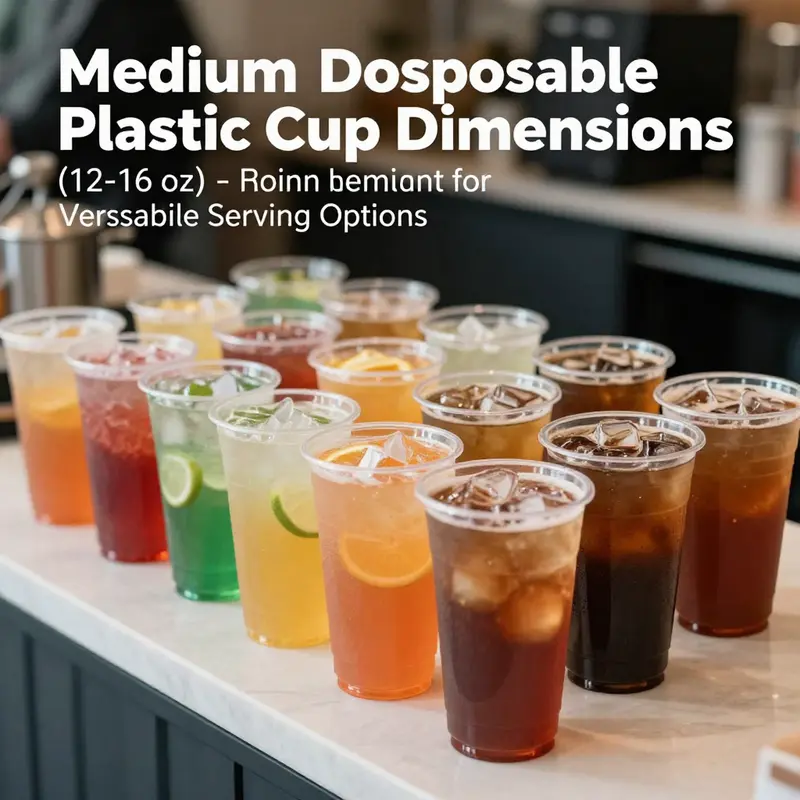
The 12 to 16 ounce disposable cup sits at the heart of many beverage operations, balancing portability with volume and fitting a wide range of drinks and service contexts. These medium cups typically hold about 355 to 473 milliliters, a capacity that aligns with everyday expectations at fast food counters, cafés, offices, and events. This size reduces the need for upselling based on container size and streamlines inventory, lids, sleeves, and dispensing workflows across drive-thru, counter service, and self-serve stations. The top diameter generally ranges from about 89 to 96 millimeters, and the height from about 105 to 130 millimeters, reflecting a balance between stability, grip comfort, and compatibility with lids and cup holders. Materials vary and include PP, PET, and PLA in some cases, each with advantages such as impact resistance, clarity, or compostable potential. The wall thickness also matters for heat retention and durability, influencing lid fit and overall performance. The 12–16 ounce format supports branding opportunities without overwhelming the customer and is commonly offered with bulk pricing, allowing businesses to achieve economies of scale while maintaining consistent inventory. It also participates in sustainability discussions through recyclable or compostable options in PET, PP, and PLA formulations, with a growing emphasis on recycled-content cups that reduce environmental footprint. In operation, this midrange cup acts as a stable bridge between smaller 8-ounce and larger 20–32 ounce variants, maintaining compatibility with standard cup holders, dispensers, and accessories while simplifying staff training and logistics. Overall, the 12–16 ounce cup remains a versatile workhorse for fountain drinks, iced beverages, and promotional contexts, supported by a broad supplier ecosystem and adaptable to regional preferences and regulatory considerations.
Sizing for Speed: Engineering Large 20–32 oz Disposable Cups for High-Volume Drink Service
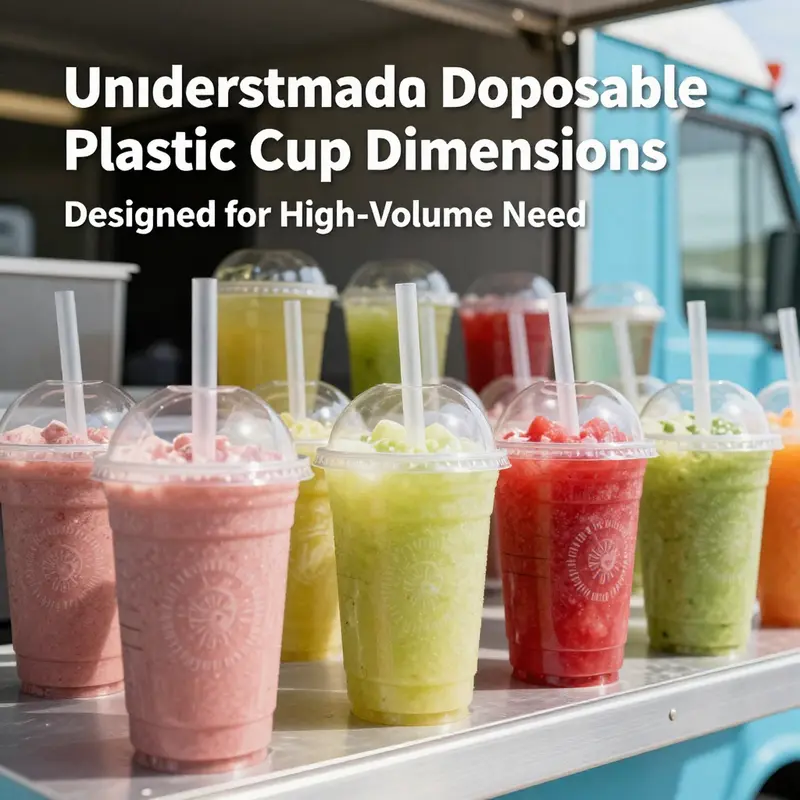
Large disposable cups in the 20 to 32 ounce range are not just bigger versions of smaller cups. They are purposefully engineered to balance payload, handling ease, and reliability in environments that move at a brisk pace. In high-traffic service settings, the pace of the line often determines customer satisfaction as much as the beverage itself. The dimensions of these cups—specifically the top diameter and overall height—are the primary levers that influence how quickly a server can fill, cap, and hand off a drink, as well as how well the cup travels from point A to point B without spill or breakage. The interdependence of size, material, and lid compatibility creates a system where every millimeter matters. When we look at the 20–32 oz category, we are examining a design space that must accommodate large servings while remaining compatible with standard dispensing equipment, lids, and cup carriers used across concessions, food courts, and event-based service.
The dimension range for 20 oz cups tends to place the top diameter around 3.5 inches and the height near 4.5 inches. For 32 oz cups, the top diameter typically sits around 4 inches with a height closer to 5.5 inches. In metric terms, these footprints translate roughly to a top diameter spanning about 89 to 102 millimeters and a height of around 114 to 140 millimeters. Even though these measurements may seem straightforward, they encode a broader set of design decisions. A slightly larger top diameter can improve the ease with which a drink is poured, mixed, or layered, and it can accommodate wider lids and straws more readily. A taller profile, meanwhile, can increase the capacity to hold volume while maintaining a manageable weight and center of gravity that keeps the cup stable in hands, on carts, or within a car cup holder. This balance—ample capacity without sacrificing handling—defines the practical essence of high-volume cup design.
Material choice adds another layer of complexity. In the large cup category, two materials often predominate: PET and PP. PET, or polyethylene terephthalate, is valued for its clear, crisp appearance and solid structural integrity. It resists cracking under pressure and maintains a clean, transparent surface that can showcase a layered beverage or a colorful mix of slush and syrup. polypropylene, PP, is prized for its resilience, particularly under pressure and during temperature fluctuations. It tends to offer excellent resistance to deformation and a robust barrier against the kind of squeezing and stacking that occur in busy service lines. Both materials are chosen not only for their intrinsic strength but also for their compatibility with reliable leakage resistance. The risk of leakage grows when beverages are tall, heavy, or carbonated, so these cups often incorporate reinforced sidewalls and a base geometry designed to resist bulging. Reinforced walls help prevent the cup from collapsing under the weight of thick beverages or when pressed by a lid that is pressed into place during busy service. The lid itself is a partner in the design, with matching top diameters and a secure fit to prevent spills during transport—an essential feature for customers who carry drinks across parking lots, through crowds, or into waiting lines.
Clarity and presentation matter, even for large cups. In many cases, beverage providers want the cup to serve as a visible canvas for branding or messaging, particularly when the drink itself is a focal point of a marketing moment. PET brings a level of clarity that helps a customer immediately recognize the beverage within—the layered hues of a smoothie, the gradient of a tea, or the froth atop a milkshake. PP, while not always chosen for its clarity, delivers dependable performance in demanding service environments and often pairs with printed labels or color bands that align with branding while preserving the ability to stack and transport efficiently. The choice between PET and PP thus captures a broader decision about whether the priority is visibility or rugged reliability under the stress of peak hour throughput.
The practical realities of service environments shape the finer geometries and reinforcement features that sit behind these seemingly simple measurements. A large cup must not only hold a generous volume; it must also be compatible with a lid design that seals effectively at speed. In many fast-service contexts, the top diameter is tuned to fit a standard lid that is quickly snapped into place. This standardization reduces the cognitive and manual load on staff, which translates into faster service and fewer errors. A wider top diameter can accommodate a larger sip, which is desirable for customers who want a bold, satisfying drink experience, but it must be counterbalanced by a stable base and sidewalls that resist flex. Conversely, a slightly narrower top may promote tighter lid fits and ensure that a drink remains secure in a crowded pickup area. Nearly all large cups incorporate a bottom diameter that remains narrower than the top, which aids in stacking, reduces material use, and maintains a steady center of gravity when the cup is filled. The typical bottom diameter for these sizes hovers well below the top, creating a slight taper that helps with handling and structural integrity.
In practice, what makes these dimensions workable in real businesses is the integration with related equipment and processes. The cups are designed to be compatible with an assortment of dispensing machines and cup dispensers found in convenience stores, stadiums, and concession stands. They are also intended to work with widely used straw diameters and standard ice dispersers for beverages that rely on a thick mix or chunked ingredients. A crucial yet sometimes overlooked aspect is how the cup’s geometry interacts with the hand that holds it. The surface texture, ribbing, and wall thickness all contribute to grip, reducing slips when a customer crosses a humid concourse or carries a drink along a hot outdoor path. In hotter months or high-energy environments, customers demand a reliable cup that stays comfortable to hold, even as condensation blooms along the exterior. The large cup category recognizes this reality and provides wall thickness and surface treatment that help maintain a comfortable tactile feel while resisting temperature-driven expansion and contraction that could undermine seal integrity or lid fit.
From a supply chain perspective, the 20–32 oz range sits at a point where volume discounts, branding opportunities, and customization align with practical deployment. Bulk purchasing is common, and manufacturers frequently offer options to customize the cups with branding elements, color schemes, or logos that align with an operator’s overall packaging design. The availability of large cups in a range of materials and thicknesses makes it possible to optimize for the specific beverage lineup. For operators who want a crisp presentation, a clear PET cup with a bright lid can showcase the drink with minimal obstruction. For those prioritizing resilience and cost efficiency, a PP cup with reinforced walls can handle high-volume service without compromising performance. Either way, the dimension choices are inseparable from the purchase decisions regarding lids, straws, and the dispensing equipment used to fill the cups. This interdependence is why many providers emphasize standardization—ensuring that the 20–32 oz cups can be paired with lids and accessories that are already part of the establishment’s repertoire.
The profiling of the large cup category is also shaped by practical examples that illustrate how a given diameter and height translate into real-world outcomes. In some supplier descriptions, you will see the range expressed in exact measurements for top diameter and height, and sometimes with bottom diameter as a secondary reference. A common example highlights a 20 oz cup with a top diameter around 3.5 inches and a height near 4.5 inches, while a 32 oz variant may present a 4 inch top with a 5.5 inch height. In many demonstrations, these cups are described as being made from PET or PP, with a note about their resistance to leakage and their ability to tolerate pressures that can arise from fizzy or densely packed beverages. The discussion of bottom diameters being smaller than the top helps explain why these cups stack neatly, how they support stable stacking during storage and transport, and how they contribute to cost efficiency by reducing storage space and allowing for quick replenishment during peak times.
For those planning events or managing large-scale concessions, the relevance of these dimensions extends beyond the cup itself. The entire system—cup, lid, straw, dispenser, and cup carrier—must function as a coherent unit. The right top diameter helps ensure that a lid forms a tight seal, the right height permits a comfortable grip and enough liquid to satisfy the customer, and the interplay of wall thickness and material choice guards against deformation, leakage, and spillage under the rough handling that happens when hundreds of cups are moved across a crowded service floor. In such settings, the capability to fill quickly, cap securely, and transport reliably becomes a competitive advantage. It is not merely about a larger container; it is about a container engineered to maintain quality, minimize waste, and support the rhythm of a busy service line.
In reflecting on examples of standardization in this category, it is useful to remember that some references point to broader contexts where a commonly accepted top diameter around the high 90s millimeter range appears as a baseline for many cold drink cups. An illustrative reference notes a standard polypropylene cup with a top diameter of 96 millimeters, a bottom diameter of 45 millimeters, and a height of 105 millimeters. These numbers capture a specific design choice that favors compatibility with a widely used lid profile and with a common set of dispensing and branding solutions pressed by many operators. While not every large cup will mirror these exact measurements, they provide a meaningful anchor for understanding how the 20–32 oz family fits into the larger ecosystem of beverage service equipment. The precise figures matter because every fraction of an inch can influence the fit of a lid, the risk of leakage, and the speed with which staff can move customers through a line.
To connect this discussion with practical resources, consider a page that showcases a disposable clear plastic cup suitable for events and everyday use. This example helps illustrate how a large cup in this category can balance visibility, capacity, and reliability in a real-world setting. See the page here: disposable clear plastic cup product page. In addition to cups themselves, the ecosystem around them—lids, straws, and dispensers—often follows the same logic of standardization and compatibility. The advantage of a standardized dimension set is that it reduces cognitive load for staff, speeds up the service process, and helps ensure a consistent customer experience across multiple locations or events.
As this chapter aligns with the broader article on disposable plastic cup dimensions, the emphasis remains on how dimension choices enable smooth, scalable service. Large cups are a fulcrum in the system because they directly affect how much beverage can be efficiently poured, transported, and consumed without friction. The 20–32 oz range embodies the trade-offs between volume and handling. The dimensional decisions—top diameter, height, and taper—must be harmonized with material properties, lid compatibility, and the demands of the service environment. In practical terms, operators who select these cups are choosing not only a container but a workflow. The right cup becomes a piece of a larger service design that supports speed, reliability, and a positive drinking experience for customers who expect both quantity and quality from a busy beverage operation.
External resource: https://www.alibaba.com/product-detail/Large-Disposable-Plastic-Cups-20-32-oz1600598979874.html?spm=a2700.galleryofferlist.normaloffer.d_image.4c2e2a22N9LbGd
Hot-Drink Cup Dimensions Unveiled: The 8-Ounce Benchmark in Heat-Resistant Plastic
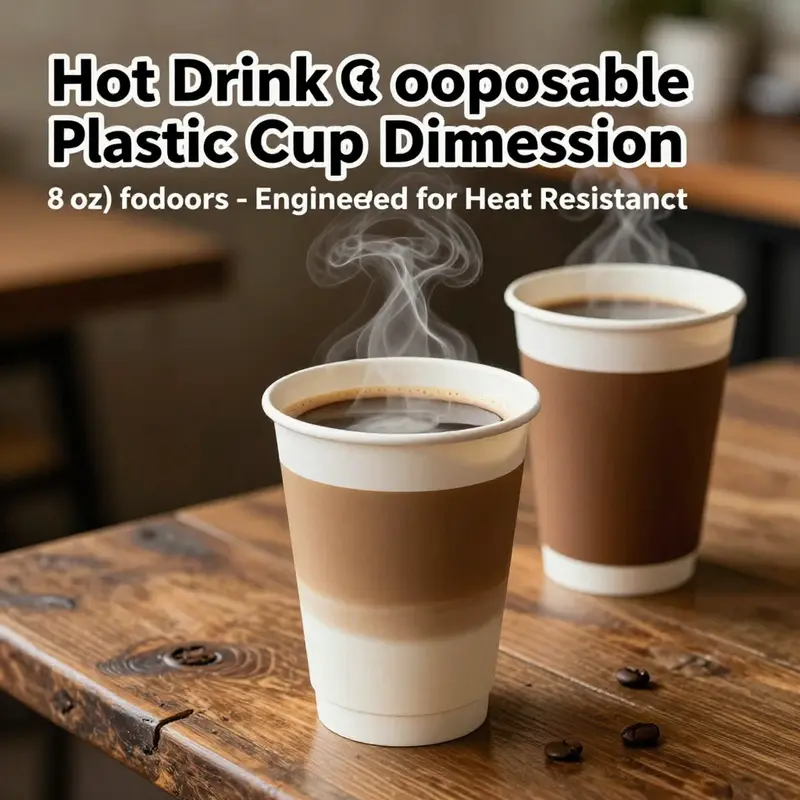
Behind every cup of coffee or tea served in a busy service counter lies a small, precise set of measurements. The 8-ounce hot drink cup is not simply a vessel; it is an engineered component shaped by the demands of handling, safety, and speed. In cafeterias and quick-service restaurants, the decision to use an 8 oz cup is a deliberate compromise among capacity, heat management, and ergonomic interaction. The geometry of that cup how wide the rim is, how narrow the base becomes, and how tall the body stands sets the pace for the entire service experience. A handful of millimeters here or there can ripple through the process, affecting how easily a barista fills, stacks, seals lids, and, crucially, how hot liquid is carried to the customer without spills or scalding. Consequently, this cup becomes a telling indicator of how a system translates quantity into quality, and how a simple beverage can travel from kitchen to customer with reliability and grace.
An 8 oz hot cup is typically defined by four numbers: capacity, top diameter, bottom diameter, and height. The standard capacity is 237 milliliters, commonly rounded to 8 fluid ounces. The top diameter around 80 millimeters meets the practical requirement that a lid with a matching seal can close securely while still allowing comfortable sipping. The bottom diameter near 56 millimeters narrows to provide stability on a flat surface and to enable nesting in a stack for efficient storage and transport. The height about 92 millimeters balances the amount of liquid with the hand reach and the lid placement. Together, these values yield a conical form that tapers inward from the rim toward the base, a geometry that supports efficient molding, strong wall integrity, and predictable filling processes. In practice, these figures are validated against a matrix of tolerances to ensure interchangeability across a fleet of cups produced by different manufacturers, so a lid designed for one batch will fit another without surprises.
Material selection matters just as much as the numbers. Hot cups must resist heat transferred from the beverage to the hand, so many options employ thicker walls or dual-layer designs that reduce heat flux and minimize surface sweating. The most common thermoplastic for such applications is a food-grade polymer specified for contact with hot liquids. The goal is a wall that remains rigid as steam builds inside, a rim that does not deform during sipping, and a surface that tolerates the thermal cycling from hot fill to cool drink soaked air. The result is a cup that can hold warmth for a reasonable window without becoming too soft or wobbly when grasped by the consumer. In safety terms, compliance with food-contact standards and quality certifications ensures that the material does not impart taste or odor and remains stable under the conditions typical of hot beverage service. When a specification sheet mentions heat resistance, it is usually referring to structural integrity during handling, as well as protection against leakage through seams and around the lid interface.
Height and diameter choices also influence the user experience. A top diameter of 80 millimeters is a practical compromise: wide enough to let steam escape and for comfortable sipping, yet narrow enough to fit most standard hot-lid designs used across venues. The lip of the cup often features a rounded interior to reduce splash while drinking, and wall thickness is chosen to support that lip geometry without causing discomfort during prolonged holding. The relationship between the top diameter and lid diameter governs not only spill resistance but also the ease of adding insulated sleeves or sleeves with gripping textures. For the barista and the service system, consistent dimensions translate into predictable dosing, stacking density, and reduced waste from misfit lids. The bottom diameter, at roughly 56 millimeters, is equally important for stability at the counter and in cup holders, where a wider or uneven base could compromise balance when a drink is hot and near full. Manufacturers regularly test these relationships in real-world scenarios, using accelerators and repeated fill cycles to validate durability under typical service conditions.
Even with a fixed 8 oz capacity, there is still room for variation that matters in practice. The height of 92 millimeters, for instance, must accommodate the beverage depth while leaving room for foam, crema, or milk, depending on the drink profile. Subtle shifts in height can alter how a cup sits inside a standard beverage carrier or a check-out counter’s cup dispenser. In the broader category of disposable cups, hot variants may be designed with extra wall thickness for better heat resistance or with an insulating layer that reduces heat transfer. While paper and plastic cups diverge in material properties, geometry often follows a common logic: keep the rim accessible, maintain a stable base, and ensure the cup can be stacked when empty without damage. The industry relies on standardized data sheets and quality-control protocols to ensure that one batch aligns with others, so customers receive a consistent product across multiple points of sale. In this sense, the 8 oz hot cup becomes a tangible example of how geometry, material science, and manufacturing discipline converge to deliver a reliable, safe, and user-friendly beverage experience.
Manufacturing tolerances and quality control play a central role in translating these numbers into reliable, brand-consistent products. The rim thickness, wall height, and taper angle are not arbitrary; they are defined by mold design and the behavior of the chosen material during cooling. In injection molding, wall thickness must be balanced against cooling rates to avoid warping, while the bottom diameter depends on the mold cavity fit and the ease of part removal. Surface finish, roundness, and top-edge bead geometry influence lid seal quality and user comfort. Quality control measures include leak tests, lid-fit tests, stacking tests, and thermal performance checks. Even small deviations in diameter or height can alter lid engagement; a top rim that is too narrow may fail to seal, while a rim that is too wide can impede stacking efficiency. Production lines often operate tolerance bands within a few tenths of a millimeter to ensure cross-site compatibility. Some facilities employ post-mold trimming or annealing steps to stabilize dimensions after cooling. Across batches, consistent tooling wear and controlled material characteristics help keep the catalog cohesive and predictable, reducing the risk of customer complaints about mismatched lids or inconsistent warmth transfer.
Within the wider ecosystem of hot beverage packaging, these dimension choices echo in alternatives that aim for sustainability or enhanced insulation. For readers curious about packaging options beyond plastic, this related resource demonstrates how dimensioning translates into paper-based cups designed for hot drinking and convenience. 20-50-200pcs-disposable-paper-cups-kraft-paper-cups-coffee-milk-cup-paper-cup-for-hot-drinking-party-supplies-8-10-12-16oz-cups. That page showcases how the same logic clear capacity, predictable top and bottom diameters, and compatible lids translates across materials and form factors, reinforcing the idea that a single dimension set can anchor the design of an entire family of cups across formats.
From a practical stance, engineers and designers calibrate tolerances to prevent mismatches that could cause leaks or heat loss. The 237 ml capacity is not an arbitrary number; it aligns with consumer expectations for standard drink sizes, with the height and base diameter harmonized to support ergonomic handling during the time a customer holds the cup, and with the top rim sized to offer a comfortable sip while accepting a typical lid profile. When you examine a cup through this lens, the slender 8 oz form emerges as a compact, highly engineered tool. It is easy to overlook the precision behind the rim curvature, the taper angle, and the wall thickness, but these features reduce spill risk, increase stacking efficiency, and improve overall service speed. In environments with relentless throughput, the precise geometry becomes a quiet backbone for reliability, quality control, and the consumer’s sense of safety when they sip a hot beverage.
Further technical specifications and safety certifications associated with hot beverage cups can be found through supplier data and industry references. For an external resource that documents 8 oz hot cups and their performance characteristics, see the supplier data sheet and product notes at Alibaba’s listing for an 8 oz hot beverage cup. https://www.alibaba.com/product-detail/8oz-Disposable-Printed-Logo-Hot-Beverage_1600572487450.html
Sizing for Service: How Standardized Cup Dimensions Keep Lids, Straws, and Dispensers in Sync
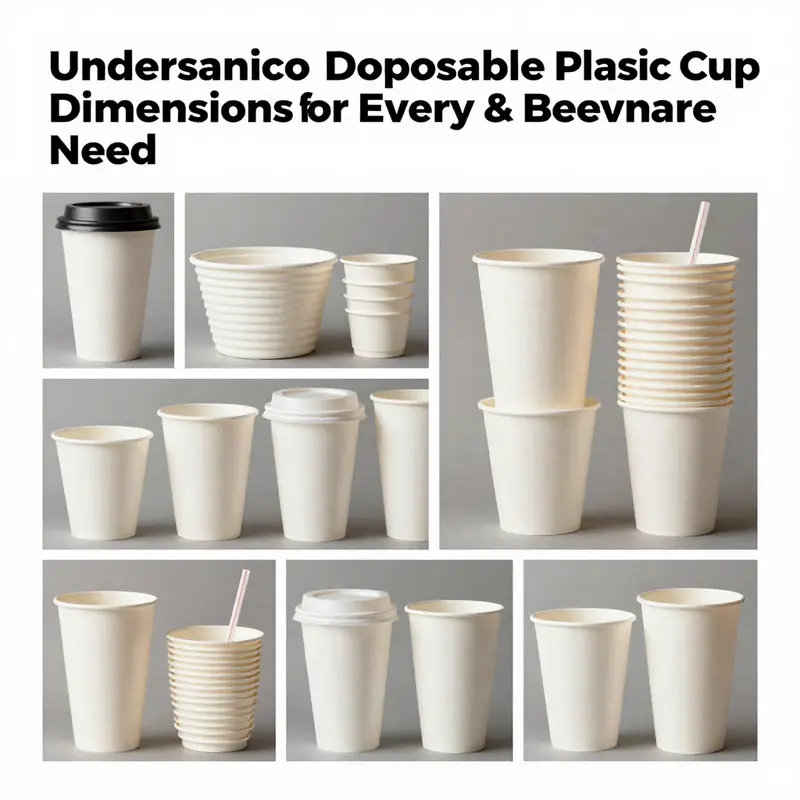
The rhythm of contemporary beverage service rests on an unassuming, often overlooked set of constants: the dimensions of the disposable cups that cradle every pour, sip, and slurp. These measurements—top diameter, bottom diameter, and height—are not merely numbers on a spec sheet. They become the language by which cups communicate with lids, straws, sealing machines, and the multiparty systems that move a drink from front counter to customer hand. In a world where speed, hygiene, and consistency determine satisfaction, standardized cup dimensions function as the quiet infrastructure of service. The industry has converged on practical, de facto norms that harmonize form with function, enabling a seamless exchange from vendor to consumer, across countless service points, from quick-service restaurants to busy cafes and vending nodes. This standardization is not about sameness for its own sake; it is about predictable compatibility that reduces waste, accelerates training, and preserves the integrity of beverages during handling and transport.
The most recognizable axis of standardization is the relationship between cup size and the diameter of the opening. For a mid-range serving—roughly 12 to 16 ounces, or about 350 to 475 milliliters—the top diameter commonly sits around 96 millimeters. This dimension is not arbitrary; it has emerged as a practical compromise that accommodates generous pours while leaving space for modest ice loads, foamed beverages, or layered drinks. The result is a cup that can sport a wide variety of ambient temperatures and textures, from fountain sodas to iced coffees, while still providing a stable fit for a universal lid and straw pair. In many testing and production environments, this 96 millimeter top diameter becomes a working standard because it aligns with a broad ecosystem of lids and straw diameters, as well as multiple dispensing and sealing mechanisms used across major service configurations. The convergence around 96 millimeters is more than habit; it is a calculated intersection of ergonomics, equipment tolerance, and supply chain efficiency.
Small cups, typically 8 ounces or about 240 milliliters, follow a parallel logic but on a more compact scale. A top diameter around 70 millimeters is common, balancing the need for a stable, easy-to-grip cup with the realities of compact storage and compact line flows. The hot-drink variants of similar volume—or those designed specifically for hot beverages—mirror this diameter while reinforcing wall thickness to resist heat transfer. The thicker walls common to hot cups are a deliberate design choice: they preserve temperature, resist external heat from handling, and contribute to a perception of sturdiness even as the cup becomes lighter in wall weight to keep overall costs down. These smaller cups illustrate how dimension choices ripple through the customer experience—from felt grip to the accuracy of a lid’s seal—and why consistency remains essential even when the product is small.
On the other end of the spectrum, the large, high-volume cups used for slushies, milkshakes, and thick blended beverages push the dimensional envelope higher. Top diameters in the range of about 98 to 107 millimeters—and sometimes up to 110 millimeters—accommodate the extra mass and viscosity of these drinks, while providing enough surface area for lubricated lids and the grips of wide-stem straws. Height becomes a balancing act here: tall forms must prevent tipping in crowded service environments yet remain compatible with display and storage shelves, as well as capping and dispensing hardware. A common large-cup height can extend to 150 millimeters or more, a dimension that interacts with cup carriers, beverage shakers, and the vertical clearances of dispensing lines. The union of a generous opening and a proportional wall height helps ensure that straws, lids, sleeves, and even cups used for cold drinks clear one another without collision, even in high-speed throughput.
These patterns extend beyond the simple geometry of volume. They shape how accessories are designed and how fleets of containers are managed in bulk. Lids, for example, are manufactured to fit a precise top diameter; a mismatch can introduce spill risk, air leakage, or compromised insulation. Straws are sized to pass through lid openings smoothly, and dispensing machines—whether an automated fill line or a hand-serve rapid-pour setup—rely on predictable cup dimensions to align with the nozzle geometry, sealing heads, and conveyance belts. The entire sequence—from empty cup loading through fill, lid application, sealing, and finally stacking for transport—depends on this shared dimensional vocabulary. When a chain or a vending operator can source cups, lids, and accessories from multiple suppliers without retooling machines or retraining staff, costs fall and reliability rises. In practice, standardized dimensions translate into faster replenishment cycles, fewer returns due to fitting issues, and a more predictable handling profile for employees and customers alike.
The standardization logic also extends to specialized applications that demand a calibrated approach to fit and measurement. In some segments, like smoothies or frappes, a cup’s internal volume must be matched with consistent fill lines and precise lid geometry to avoid spill risk during transport, while still leaving room for whipped toppings or syrup layers. In pharmaceutical or medical settings where calibrated volumes matter, compact 8-ounce cups—near 220 milliliters—are used with designs that permit accurate measurement in the product’s spatial geometry, reinforcing safety and traceability. For boba tea and other specialty beverages with oversized straws or unique slurry characteristics, the U-shaped cup geometry and a standardized 70 millimeter diameter have become a practical convention that helps ensure the lid and straw remain aligned throughout transit and consumption. Even here, standard dimensions support a degree of interoperability: a customer can expect the same fundamental fit whether the drink originated from a food service outlet, a cafe, or a vending machine, smoothing the customer experience across different points of sale.
Manufacturing and logistics sit at the core of why standards endure. Cups designed for heat sealing, often crafted from the same polymer family as cold-drink cups, must withstand the stresses of automated filling and lid application without deforming, tearing, or warping. A 96 millimeter top diameter paired with a robust bottom diameter—approximately 45 millimeters in some common configurations—and a consistent height of around 105 millimeters in the mid-range yields a predictable center of gravity, which helps automated equipment grip and move the cup reliably. This predictability reduces spillage and waste on crowded lines and in transport containers. It also streamlines packaging—manufacturers can pack more cups per carton when height and diameter conform to a known tessellation, enabling more efficient storage and shipment. The result is a supply chain that can flex across regions, facilities, and seasonal demand fluctuations while preserving the integrity of the product and the efficiency of service.
The value of standardization is not merely operational; it also touches consumer perception and experience. A customer who expects a consistent lid fit, a familiar straw diameter, and a reliable seal across different venues encounters fewer surprises. The mental model of the cup’s dimensions becomes part of the service design: staff can train quickly, equipment can adapt more readily, and customers can trust that the beverage they order in one location will behave similarly when they encounter it elsewhere. This consistency builds a sense of reliability, even as beverage menus and packaging options expand. In an era when many operators rely on a shared ecosystem of vendors and equipment, the ability to interchange lids, sleeves, and disposables across brands and suppliers is a crucial driver of efficiency and waste reduction. When a standardized cup meets a standardized lid and straw, the likelihood of mismatched components drops sharply, the need for rework falls, and the beverage’s presentation remains intact from the counter to the cup holder.
The boundary between standardization and customization is subtle and purposeful. There are niche applications—medical dosage cups, calibrated smoothie cups, or specialty formats used in particular regions—that still benefit from standardized dimensions, even as they introduce minor adjustments to wall thickness or rim geometry. In these cases, the broader framework persists: a defined top diameter, compatible bottom and wall dimensions, and a predictable height that supports both handling and display. This approach preserves the advantages of standardization while enabling targeted adaptations that meet specific operational requirements or regulatory expectations. Collectively, these practices have cultivated a resilient ecosystem in which disposable plastic cups function as interoperable components rather than isolated exceptions. The economy of scale, the reliability of supply, and the consistency of the customer experience all hinge on the shared language of cup dimensions.
For practitioners and researchers alike, the lesson is clear: standardization is a foundation, not a final form. It is the scaffold that supports innovation in lid design, straw technology, and dispensing automation, while also enabling sustainable improvements in waste management and supply-chain agility. In an industry that processes millions of beverages daily, the alignment of cup dimensions with equipment capabilities yields dividends in efficiency, safety, and hygiene. It allows facilities to standardize training, stock a limited range of compatible accessories, and reduce the complexity of inventories across locations. As beverage service continues to evolve—with new textures, temperatures, and presentation styles—these dimensional conventions will likely adapt, but the underlying principle will persist: compatibility emerges from shared measurements, and reliability is the quiet payoff of those measurements made practical in the real world.
For readers exploring the practical side of these standards, a concrete example of commonly referenced sizes can be found in vendor listings that illustrate the 70 millimeter diameter cup as a standard for smaller servings, with taller forms and broader openings feeding the needs of high-volume and specialty beverages. See an accessible reference here: disposable-clear-plastic-cup-outdoor-picnic-pet-cup-drinking-cup-for-parties-birthdays-weddings-camping-utensils.
External reference: industry-scale specifications and vendor examples of 70 millimeter diameter cups illustrate the material choices and tolerances that support this ecosystem, including practical details on wall thickness, heat resistance, and stacking stability. A concrete compilation of such specifications is available here: https://www.made-in-china.com/products-search/hot-search/Disposable-PP-Plastic-70-mm-Diameter-Cup.html
Final thoughts
In conclusion, understanding the dimensions of disposable plastic cups is vital for any beverage service provider, whether running a bubble tea shop, a food truck, or a large restaurant chain. Each cup size serves a specific purpose and caters to different beverage types, ensuring that your service efficiently meets customer needs. From the compact 8 oz cup to the generous 32 oz variant, having the right size can significantly enhance the overall experience for your customers. It’s also crucial to consider standardization in cup dimensions, as this facilitates seamless operation and ensures compatibility with lids and straws. By integrating these insights into your business practices, you can not only improve service efficiency but also stand out in a competitive market.