
Disposable split plastic cups have emerged as a game-changing solution for food service providers, specially designed to elevate both convenience and aesthetics for drinks and snacks. Whether you own a bubble tea shop, operate a bustling food truck, or coordinate corporate events, these cups are not just practical but also enhance the customer’s experience. In the chapters that follow, we will explore the functional design features that make these cups so user-friendly, analyze their economic advantages, and delve into the growing sustainability trends that align with modern consumer preferences. Each chapter builds upon the understanding of how these unique cups can be a vital part of your business strategy.
Split-Shape, Shared Experience: The Functional Design of Disposable Twin-Compartment Cups
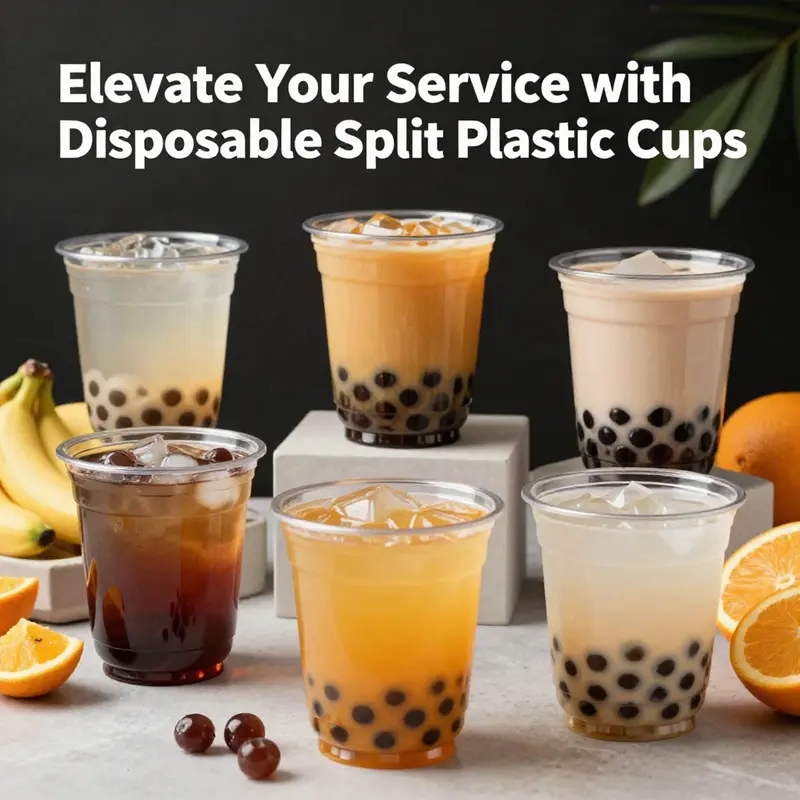
In the realm of on-the-go consumption, the tool that often disappears into the background is the cup. Yet a closer look reveals that the modern disposable split plastic cup is a carefully engineered object, shaped to align with how people eat, drink, and share in bustling service environments. Its genius lies not in spectacle, but in a balance of form and function that supports efficiency, portion control, and experience. The dual-compartment structure is more than a novelty; it is a practical solution that preserves flavor integrity, simplifies assembly lines, and tracks waste with a quiet economy. The cup becomes a micro-system where containment, separation, and user interaction intersect. When customers order a drink and a dip, or a layered beverage with a side sauce, the cup holds its ground, preventing cross-contamination of tastes while offering a convenient, single-item container. The consequence is a seamless handoff from kitchen to customer, a transfer that preserves speed without compromising quality. In this sense the cup embodies a philosophy of design that foregrounds activity—how products are picked up, shared, transported, and consumed in real-world settings—rather than mere aesthetics or theoretical purity.
At the heart of this philosophy is the dual-compartment structure. It is not simply two pockets placed side by side; it is an intentional separation that anticipates the needs of foodservice operators and diners alike. For a milk tea stall or a boba cafe, for example, one side can cradle a translucent drizzle of syrup, a creamy topping, or a fruit puree, while the other side holds the drink itself. The practical benefit is straightforward: reduced spillage during movement, and a guarantee that flavors do not mingle in the moment between preparation and enjoyment. Such partitioning also supports menu variety. A single cup can cater to a multi-component order—soups and dressings, sauces and salsas, or even mini-dessert pairings—without the need for extra disposable containers. This consolidation translates into quicker service, cleaner stations, and less disposable waste in the dining area. From a managerial viewpoint, suppliers and operators perceive the dual-compartment design as a tool for standardization. It lowers the cognitive load of assembly, since staff can orient to a consistent, predictable structure rather than juggling disparate packaging requirements for different components. The user experience mirrors this efficiency: a consumer grasps the cup, gives a gentle pull, and—like magic in a practical sense—two portions emerge that can be enjoyed separately or shared with a companion.
The nesting capability of these cups extends the utility beyond the dining moment itself. Empty cups collapse into a compact footprint, stacking neatly atop one another for storage and transport. This seemingly simple feature yields tangible savings: warehouse space is freed up, delivery routes become more predictable, and replenishment cycles tighten. In high-volume settings, every inch of shelf space matters, and the ability to nest reduces the frequency of reordering, minimizes handling, and lowers the risk of damage during transit. Nesting also supports sustainability agendas in subtle but meaningful ways. By reducing the volume of air and packaging material required to move and store empties, companies can shave off costs associated with warehousing, shrink-wrapping, and fleet logistics. The dialogue between design and logistics is most visible here, where a cup’s physical properties become a lever for broader operational optimization. As the cups await their turn to be filled and later retired to a recycling stream, their stackable geometry acts as a quiet ally in the background, enabling leaner operations without sacrificing the customer-facing experience.
Material choice sits at the intersection of clarity, durability, and safety. The primary materials—PET and HIPS—each bring distinct advantages to the table. PET renders the contents with high clarity, inviting customers to view the layers, colors, and textures within. That visual transparency is not merely aesthetic; it fosters trust. When a beverage shows its color and sheen through the cup, consumers are more likely to perceive freshness and quality. For beverages that rely on vibrant syrups or layered compositions, the see-through property becomes a critical marketing cue. PET’s lightweight nature also contributes to ease of transport, helping to keep energy costs and handling demands manageable in busy environments. On the other hand, HIPS emphasizes rigidity and impact resistance. In a setting where cups may be dropped, bumped, or stacked under pressure, the sturdiness of high-impact polystyrene resists deformation and reduces the likelihood of leakage or spill-related accidents. HIPS can support slightly thicker liquids or denser components, such as certain desserts or chunky toppings, without buckling. The choice between PET and HIPS is not simply about aesthetics; it is a calculation of expected use, temperature exposure, and the handling environment. Both materials are recognized for their food-grade safety profiles and their capacity to resist condensation and leakage under typical conditions. While neither material is a universal solution, their complementary attributes give operators a toolkit to tailor cup performance to the particular demands of their menu and service model.
Closely linked to the material conversation is the design of secure dome lids. A well-engineered lid does more than keep contents contained; it stabilizes the entire payload during transit and protects it from temperature fluctuations that threaten freshness. The dome lid creates an airtight or near-airtight seal, depending on the model, preventing spills when customers carry a drink through a crowded lobby or rush between stations. Airtightness is not just about leakage; it also preserves texture for toppings and the integrity of layered beverages. By maintaining a stable environment, lids support a more predictable drinking experience, reducing complaints about sloshing or clinging lids that pop off mid-walk. In time-sensitive environments, a reliable lid translates into fewer incidents, fewer customer service interruptions, and more confident handling by staff who move orders from the kitchen to pickup bays, to tables, and then to doors. The dome lid design can also be tuned to accommodate the dual compartments. A lid that accommodates a divider without compressing it, or one that seals both compartments individually, can further minimize cross-contamination and preserve the distinct flavors that the dual-chamber arrangement promises. Together with the underlying cup geometry, secure lids complete a closed system where function and safety reinforce the customer’s sense of control and trust in the product.
Texturing and ergonomics may seem like secondary considerations, yet they quietly affect everyday use. Some models incorporate a textured surface or contoured profile to improve grip, particularly when the cup is cold or wet from condensation. A tactile surface helps customers maintain hold with one hand, even when the beverage is tall or the cup is full. For younger users or customers with smaller hands, a better grip reduces mishaps and support staff calls for assistance at the point of purchase. The design language extends beyond grip to touch and perception; a slightly raised texture catches the eye, adds a premium feel, and signals sturdiness. Even within a disposable product, these small ergonomic details translate into smoother transactions and a more confident customer interaction, reinforcing the idea that the cup is designed to be easy to use in imperfect, real-world conditions.
Beyond practicality, the visual vocabulary of split cups serves a critical marketing function. Many models offer high printability, allowing for vivid logos, color schemes, and brand messages to be embedded directly onto the cup or lid. The marketing payoff is twofold. First, the cup becomes a moving advertisement, circulating within neighborhoods, offices, and homes as customers carry orders away from the point of service. Second, the ability to customize aligns packaging with seasonal promotions, event themes, or menu revamps without requiring separate marketing collateral. The printing surface becomes a canvas for stories—whether a playful motif that echoes a dessert lineup, a color palette that matches a brand’s identity, or a simple reminder of the business’s care for presentation and quality. The result is packaging that does more than hold product; it communicates values, reinforces a brand experience, and contributes to the overall perception of reliability and style.
Innovation in this space is not limited to conventional shapes. Variants such as heart-shaped, twin-cup configurations, and other novelty forms offer occasions for broader engagement, from romance-themed events to premium tasting experiences. These design variants broaden the range of applications, enabling a shared serving experience that is also visually distinctive. A heart-shaped configuration may be particularly appealing for date nights or gift occasions, while a twin-cup variant can spotlight collaboration or multi-item pairings. The appeal lies in the balance between function and presentation: the form signals a special occasion or a thoughtful pairing, yet the function remains the same—two compartments, one cup, shared convenience. For operators, these innovations can become a differentiator, providing memorable moments that support social media sharing and word-of-mouth marketing while staying anchored in the core utility of portion separation and easy transport.
The practical implications for foodservice operations extend well beyond the moment of purchase. Portion control and waste reduction are inherent to the dual-compartment design. By keeping sauces, dips, or toppings separate from the main beverage or dessert, operators can reduce the likelihood that customers will mix ingredients unintentionally, which often leads to dissatisfaction when flavors clash or when customers cannot control the final combination. This separation also supports better menu planning and cost control. When inventory is managed at the component level—sauces, syrups, toppings—suppliers and operators can better monitor usage patterns, forecast demand, and adjust portion sizes without retooling packaging for every menu item. The nesting capability compounds these advantages. Fewer pallets and less warehouse space mean more agile stock turnover, lower carrying costs, and less space wasted on bulky unused packaging. For a business that rotates promotions or experiments with limited-time offerings, the capacity to store large numbers of nested cups in a compact footprint is an operational luxury that translates into faster service, shorter queues, and a more scalable footprint during peak times.
Cost awareness anchors any discussion of disposable packaging. Bulk pricing for split cups benefits from the economies of scale and the reduced complexity of managing a single, multi-component vessel rather than multiple, separate containers. When a cup is ordered in large quantities, per-unit costs can fall within a favorable band, balancing the material choice, size, and any customization. Yet cost considerations are not the sole driver. The ability to select a cup that matches the service model—whether prioritizing clarity for visual appeal, rigidity for thick drinks, or a design that supports a particular marketing approach—allows operators to optimize overall cost of ownership. The trade-offs between PET and HIPS, the presence or absence of a lid, and the degree of printability all influence the final price and the perceived value of the packaging. Eco-conscious buyers may explore biodegradable or compostable versions, which tend to command a premium but align with broader consumer expectations around sustainability. In this context, the objective is not merely to minimize price but to maximize total value: ease of use for staff, clarity and appeal for customers, reliability during transit, and alignment with environmental goals.
Sustainability remains a dynamic dimension of the design conversation. While traditional PET and HIPS offer clear performance advantages, the market increasingly recognizes the importance of end-of-life considerations. Biodegradable or compostable materials appear as potential alternatives, though they may bring higher upfront costs and nuanced performance trade-offs, particularly in terms of shelf life, heat resistance, and stacking strength. The conversation thus encompasses not only how a cup functions during a single service period but how it behaves across the broader lifecycle—from supply chain emissions to consumer disposal. Forward-thinking operators weigh these lifecycle implications, often testing a mix of standard and eco-friendly options to determine which combination best harmonizes cost, performance, and environmental responsibility. In parallel, the market for customization and branding continues to expand, allowing organizations to differentiate themselves through packaging that communicates care for sustainability—without sacrificing the practicalities that keep lines moving and orders accurate. The result is a packaging ecosystem where design decisions are informed by a mesh of operational needs, customer expectations, and environmental considerations, rather than by isolated preferences of one stakeholder.
To help readers connect these design implications with concrete procurement choices, consider a practical pathway for customization that blends operations, branding, and cost. A dedicated supplier can tailor takeaway packaging supplies and disposable tableware for specific events or themes, offering a suite of options from core dual-compartment cups to themed lids and print-ready surfaces. This approach aligns with the idea that packaging is not merely a container but a logistics and marketing tool that harmonizes with the broader service model. For organizations exploring these possibilities, a useful starting point is to examine suppliers that provide customization capabilities, including branding, color matching, and the ability to adapt to seasonal campaigns. Such customization can extend beyond the cup itself to the lids, sleeves, and labeling, turning packaging into an integrated part of the customer journey. custom takeaway packaging supplies—disposable tableware for theme party. This linkage to practical sourcing reinforces the concept that intelligent packaging supports both operational fluency and brand storytelling, enabling a cohesive experience from counter to curbside to social feed.
The chapter’s final reflection returns to the central idea: a disposable split cup that is more than the sum of its parts. It is a system designed to be used quickly, handled confidently, and enjoyed fully, whether consumed solo or shared with someone else. Its dual compartments enable component separation without complicating the act of sharing, its nesting capability respects the realities of storage and logistics, and its material choices offer a spectrum of performance traits tuned to the context of use. The secure domed lid, the textured surface, and the potential for rich branding all contribute to a packaging experience that supports speed, safety, and satisfaction. As the market evolves and consumer expectations shift toward sustainability alongside convenience, the design language of these cups will continue to adapt—finding new materials and configurations that preserve the core benefits while addressing environmental concerns. In this ongoing dialogue between practicality and presentation, the disposable split cup stands as a compact exemplar of how thoughtful design can transform a humble everyday object into a reliable partner in the fast-paced dance of modern foodservice.
External reference for further technical details and sourcing: https://www.alibaba.com/product-detail/700ml-disposable-plastic-share-cups-frozen_1600549238665.html?spm=a2700.1.women-10102820010.12.1b1c5e2aLZwOuW
null
null
Shared by Design: Sustainability Trajectories for Disposable Split Plastic Cups

Disposable split plastic cups illustrate how convenience and sustainability must co-evolve. The two compartments make portion control practical, but also present challenges for end of life. The material choices, nestability, and the central partition determine both performance and environmental footprint. PLA offers compostable options where industrial facilities exist, but home composting is rarely feasible and composting infrastructure varies by region. Recycled content like rPET can reduce virgin resin demand and emissions, but compatibility with hot or cold contents and with existing recycling streams must be considered. The design for nestability lowers space requirements for shipments, reduces transport emissions, and supports warehouse efficiency, while preserving hygiene and ease of separation. Packaging engineers must balance thinner walls to reduce material with the need for rigidity and barrier properties. The end of life depends on local waste management: a cup designed for recycling must be accepted by local recyclers, while a compostable cup needs industrial facilities to deliver the intended outcome. Lifecycle thinking extends beyond materials to labeling and consumer communication. Clear end of life guidance reduces contamination and improves recovery rates. Standards from industry groups help align expectations across manufacturers and retailers, enabling more reliable sustainability claims. Economics plays a central role: bioplastics and recycled content can increase unit costs, but space savings and waste handling efficiencies can offset some of these penalties over time. Branded lids and decorations should be designed to minimize recycling disruption while preserving brand identity. The path forward is systemic: align material choice with waste infrastructure, invest in take-back and recovery programs, and design for modularity and reuse where feasible. The shared goal is to deliver cups that hold up under use, can be sorted efficiently after use, and reflect a credible commitment to environment and community. The chapter closes with a reminder that sustainability is a continuum of incremental improvements rather than a single breakthrough, and that the most effective improvements emerge from collaboration among designers, manufacturers, waste processors, regulators, and consumers.
Final thoughts
In conclusion, disposable split plastic cups offer a remarkable fusion of convenience, cost-effectiveness, and sustainability, making them indispensable in today’s food service environment. Their thoughtful design not only accommodates the diverse beverage offerings of bubble tea shops, restaurants, and event planners but also aligns with the growing demand for eco-conscious solutions. By integrating these cups into your operations, you can enhance customer satisfaction while effectively managing costs and reducing your environmental footprint. Embrace this innovative product to elevate your service and meet the expectations of modern consumers.