

In today’s food service industry, having reliable and versatile storage solutions is essential for maintaining the quality of ingredients and prepared dishes. The 5pcs Rectangle Glass Food Container Set is a fantastic option, particularly when sourced from wholesalers in China. Not only do these containers boast durability and a sleek design, but they are also competitively priced, making them an excellent choice for bubble tea shops, restaurants, food trucks, and catering services. This article delves into a detailed overview of the product, discusses pricing and minimum order quantities, and examines supplier capabilities in China to help you make informed purchasing decisions.
From Factory Floor to Kitchen Shelf: The Wholesale Journey of a Five-Piece Rectangle Glass Food Container Set
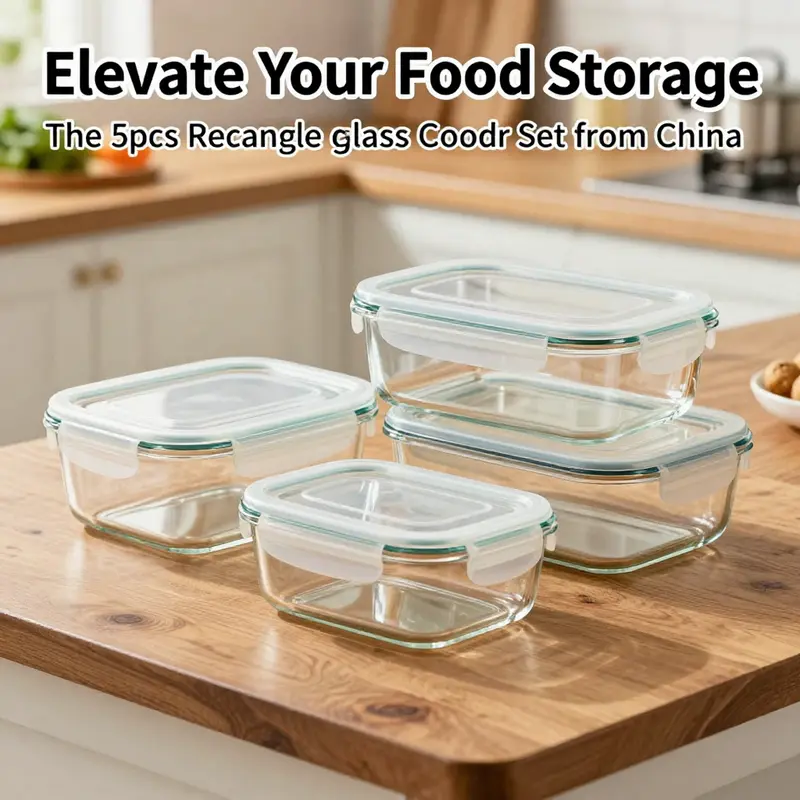
The wholesale story behind a five-piece rectangle glass food container set begins in the blueprints of modern kitchens, where durability, efficiency, and sustainability converge to shape demand. In China, a long-standing hub for manufacturing at scale, suppliers have refined a product category that answers a growing menu of consumer needs: reliable food storage that can withstand daily use, frozen storage, microwaving, and easy cleaning. The case of a five-piece rectangle glass set with lids illustrates how a seemingly simple item can embody the complexities of global sourcing, design optimization, and value packaging that wholesalers must navigate to keep shelves stocked and customers satisfied. At its core, this kind of set blends material science with practical design. The glass used is typically high borosilicate, chosen for its ability to endure rapid temperature changes, resist thermal shock, and resist corrosion from acids in foods. This makes the containers suitable for reheating leftovers in the microwave and for brief oven use, depending on the lid and seal materials. The material choice matters not only for performance but for consumer confidence. In a market where buyers scrutinize safety and durability, borosilicate glass carries a clear signal: a commitment to quality that aligns with the growing preference for long-lasting kitchenware that reduces reliance on disposable plastics. The wholesale narrative then expands beyond raw material to the entire lifecycle of the product—from the factory floor to the consumer’s daily routines. A five-piece set typically includes small, medium, and large rectangular containers with matching lids. The sizes are chosen to cover a spectrum of common storage needs: portion control for meal prep, space-saving for fridge organization, and convenience for transporting lunches or snacks. The rectangular form is not accidental; it is a deliberate choice to maximize space efficiency. In a crowded kitchen or a crowded apartment, every inch matters. Rectangular containers fit neatly in stacks within cabinets and align tightly in the refrigerator, creating a predictable system that stores more items in the same footprint. This spatial logic becomes a critical selling point for wholesalers who must differentiate their offerings in crowded marketplaces. The lids—often made of plastic or silicone—are integral to the perceived value of the set. A well-sealed lid protects flavors, prevents leaks during transport, and keeps the contents fresh. For wholesalers, the seal quality translates directly into customer satisfaction and repeat purchases. A leak-proof design is especially valued by families and professionals who transport meals, as it minimizes mess and preserves meal quality during travel. The lid design also influences care considerations. Many lids are designed for dishwasher safety, while others require hand washing to preserve seal integrity over time. This nuance matters in wholesale discussions, because retailers and consumers alike weigh convenience against longevity. The whole package—glass, lid, seal, and the way they fit together—speaks to a broader trend. Modern households seek versatility: containers that can function as meal-prep vessels, snack boxes, or portable portions for school or work. The shape and size variety in a five-piece set supports this flexibility. A key selling point in wholesale is the ability to customize. OEM and ODM options enable brands to imprint logos, modify lid colors, or adjust packaging to align with specific market strategies. In many regions, private-label strategies drive growth, enabling retailers to present a cohesive line that reflects their own branding while leveraging the proven performance of a robust glass storage system. It is here that wholesale dynamics in China become particularly compelling. The scale of production means suppliers can offer competitive pricing as volumes rise. The typical wholesale price range for similar sets often falls in a few decimal points of the margin that wholesalers expect. For buyers who order large quantities, cost per piece can drop significantly, and even modest adjustments in the MOQ—minimum order quantity—can unlock substantial savings. The most common MOQs for a basic five-piece rectangle glass container set hover around the thousand-unit mark, though some suppliers may be willing to negotiate for larger orders or advance customization. The economics hinge on a balance of fixed and variable costs: tooling for any customization, container and lid molds, packaging design, and the labor required for quality checks. Understanding this balance helps wholesalers forecast margins, set competitive selling prices, and decide when to pursue standard offerings versus bespoke configurations. The marketplace that connects these producers with buyers is intricate and efficient. Platforms hosting multiple vendors create a competitive environment where features such as lead times, customization capabilities, and after-sales support become differentiating factors. A wholesale buyer can compare raw material quality, glass thickness, lid materials, and sealing performance across suppliers, while also evaluating service levels such as sampling programs, branding options, and collateral packaging. This is where due diligence, audits, and certifications enter the conversation. Buyers who plan to distribute internationally must consider regulatory compliance and safety certifications that vary by destination. Borosilicate glass itself is a strong selling point because of its established performance under heat and cold. But when dimensions, lid materials, or labeling come into play, the chain of custody from factory to retailer must be documented. For many wholesalers, the journey begins with a sample order. A smaller test batch allows buyers to assess durability under real-world conditions: how the containers respond to a freezer-to-mheat cycle, how lids hold up after repeated use, and whether the seal remains reliable after dishwasher cycles. The feedback from these tests informs decisions about larger orders and customization. Price is, of course, a central pillar of the wholesale conversation. A typical range in the current market—though it can vary by supplier, material quality, and customization—offers a baseline for negotiations. Buyers can expect price declines as order quantities increase and as the supplier’s production capacity expands. The ability to customize often carries a premium, but the premium can be recovered through stronger branding, more attractive packaging, and the ability to command higher retail prices in certain markets. The environmental dimension is increasingly shaping wholesale choices. Glass storage sets present a persuasive alternative to single-use plastics, aligning with consumer demands for sustainability and responsible consumption. The market is receptive to the narrative that durable kitchenware reduces waste, supports recycling ecosystems, and aligns with circular economy principles. Suppliers frequently emphasize eco-friendly aspects in their marketing and product literature, highlighting the long lifespan of glass and the potential for recycling at the end of life. This eco-friendly framing resonates with global retailers who are building green assortments and want to demonstrate tangible commitments to sustainability in their catalogs. Of course, regulatory and consumer expectations differ across regions. In some markets, labeling, warranty information, and safety certifications become critical. In others, price competitiveness and quick lead times can trump certain features. Wholesalers who navigate this landscape well maintain a flexible approach: they source from multiple factories to diversify risk, negotiate pricing tied to order quantities, and seek suppliers who can deliver consistent quality across batches. The logistics of moving five-piece sets from factory floors in China to regional distribution centers worldwide require careful planning. Lead times vary depending on production capacity, current orders, and customization specifics. A typical scenario involves a supplier preparing production, quality checks, and packaging, followed by shipping arrangements that balance transit times with cost efficiency. Freight terms, incoterms, and destination port logistics all come into play, shaping total landed cost and delivery reliability. These considerations matter in wholesale decisions, because the margin between landed cost and retail price determines the scale and speed at which a retailer or distributor can grow its business. The product’s appeal—durable glass, space-saving rectangle shape, transparent visibility, and reliable lids—translates into practical value for stores and buyers who crave efficiency. A well-curated assortment of five-piece rectangle glass storage sets can support a broad array of merchandising strategies, from kitchenware sections in department stores to online catalogs targeting meal-prep enthusiasts and busy families. The packaging design accompanying these sets also matters. Retailers look for packaging that protects the product during transit while communicating value on shelves. The packaging may include a simple, bold presentation of the glassware’s benefits—microwave safety, dishwasher compatibility, and the environmental advantage of reusability. When a wholesale buyer can point to a credible supply chain, an established track record of on-time deliveries, and consistent product performance, the relationship with the supplier becomes inherently easier to sustain. The buyer’s role is often a blend of negotiator, planner, and quality advocate. They press for consistency in production tolerances, lid fit, and seal integrity. They also seek packaging and labeling solutions that align with their brand strategy, whether that means custom logos, color-matched lids, or distinctive packaging inserts that help explain product care to the end consumer. In the broader market, the five-piece rectangle glass container set is part of a family of durable, reusable kitchenware options that have seen rising interest due to both environmental concerns and the realities of modern life. The pandemic period, for example, reinforced the importance of meal-prep and home storage as a user preference, which in turn reinforced wholesale demand for reliable, long-lasting containers. The design language of these sets—clean lines, clear visibility, and modular stacking—speaks to a kitchen culture that rewards organization and simplicity. The wholesale ecosystem rewards suppliers who can translate this language into reliable, reproducible products at scale, while ensuring that every batch maintains the same performance characteristics. This is not merely about selling a product; it is about delivering a dependable storage solution that can be trusted not to leak, crack, or degrade under typical kitchen usage. The conversation around this product category also touches on the evolving expectations of foodservice operators who seek green, cost-effective, and durable storage options for takeout, catering, and in-house meal programs. A well-designed rectangular glass set can be an asset across multiple contexts: from back-of-house kitchens that require efficient stacking to front-of-house displays where visibility of the contents matters for consumer appeal. The capacity to customize packaging and branding adds another layer of value to wholesalers who aim to offer private-label lines. In practice, wholesalers often combine these sets with complementary items, like matching glass bowls or compatible lids that extend the usability across more meal occasions. This integrated approach helps retailers increase average order value and creates opportunities for cross-sell campaigns within a single product family. The wholesale journey is thus a careful balancing act: maintain high material and manufacturing standards, deliver competitive pricing through scale, and provide value-added options that allow retailers to differentiate themselves in crowded markets. The end consumer benefits from this orchestration, receiving a product that is not only functional but also aligned with a broader narrative about quality, sustainability, and thoughtful kitchen design. At the intersection of engineering, design, and commerce, the five-piece rectangle glass container set emerges as a telling example of how Chinese manufacturing continues to adapt to global demand. It demonstrates the capacity to combine material science with practical, everyday needs, all while supporting business models that hinge on capabilities like OEM/ODM customization, reliable supply, and scalable production. The story does not end with a single purchase; it extends into the retailer’s ongoing relationship with suppliers, through repeat orders, co-developed packaging schemes, and shared quality assurance processes. For buyers, the lesson is clear: a product that appears simple on the surface can carry a complex set of advantages—space efficiency, durability, reusability, and branding potential—that, when bundled with reliable logistics and responsive service, create a compelling wholesale proposition. The next steps in exploring this category involve careful supplier selection, sampling, and alignment on packaging and labeling requirements, all while keeping a steady eye on evolving consumer expectations and regulatory environments. This is the kind of wholesale opportunity that rewards a disciplined approach to sourcing and a nuanced understanding of how a well-made rectangle glass storage set can become a staple in homes across markets. To deepen the exploration, readers can examine related packaging and takeout solutions that illustrate how durable, reusable containers fit into broader strategies for sustainable consumer packaging and retail execution. Eco-conscious packaging options, for instance, underscore how a seemingly modest product line can support a retailer’s sustainability story while maintaining the performance and price points that drive volume. For more on related eco-friendly packaging options, see Eco-friendly takeout boxes for food packaging. External resources can provide additional context on market dynamics, certifications, and regional preferences, helping wholesalers calibrate their sourcing approach to specific markets and customers. For a deeper dive into product specifications and wholesale terms, further details are available on industry platforms that aggregate supplier information and sampling opportunities. This broader perspective helps wholesalers navigate the multiple layers of decision-making that characterize the modern supply chain—from raw material selection and factory capabilities to branding, packaging, and distribution logistics. The capacity to source reliably from a few capable manufacturers in China remains a cornerstone of success in this space, especially when combined with a clear value proposition, consistent quality, and a program for private-label customization. In sum, the five-piece rectangle glass storage set is more than a basic product; it is a conduit for a broader wholesale strategy that blends technical performance, space-saving design, sustainability messaging, and flexible production capabilities. When wholesalers align these elements with thoughtful packaging and a robust logistics plan, they can deliver not only a product that meets daily needs but also a credible and scalable business proposition that supports growth across markets. External reference: https://www.alibaba.com/product-detail/5pcs-Rectangle-Glass-Food-Container-Set_1601023586287.html
Seeing Through Scale: Wholesale Rectangular Glass Food Container Sets from China
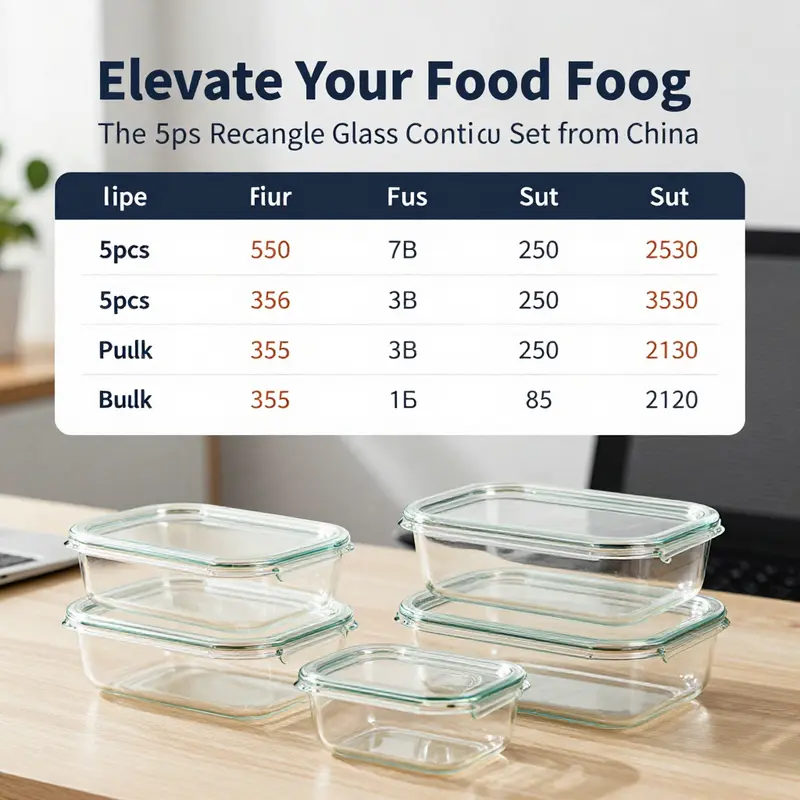
In China’s wholesale corridors, rectangular glass food container sets are a common sight for bulk buyers. These five-piece rectangle sets balance price, durability, and stackability for retailers and hospitality chains evaluating MOQs, lead times, and customization. Material choice matters: high borosilicate glass offers thermal tolerance and dishwasher resilience, translating into lower replacement costs over large inventories. Design emphasizes space efficiency; rectangular shapes improve packing and storage while lids with gaskets provide leak resistance. From a procurement perspective, suppliers present tiered pricing and MOQs that reward larger commitments, while allowing standard SKUs for smaller orders. Customization—logos, lid colors, and packaging—can differentiate offerings but adds lead time and cost. Certifications and QA processes build confidence for buyers managing safety and compliance. Logistics demand protective packaging and transparent timelines for production and transit. As with any wholesale deal, clear expectations, reliable supply cadence, and strong after-sales support are essential to sustaining a scalable program. In short, the five-piece rectangle glass set offers durability, versatility, and cost efficiency for bulk retailers and hospitality operations.
From the Factory Floor to the Family Fridge: Unpacking the Capabilities Behind a 5-Piece Rectangle Glass Storage Set from Chinese Suppliers
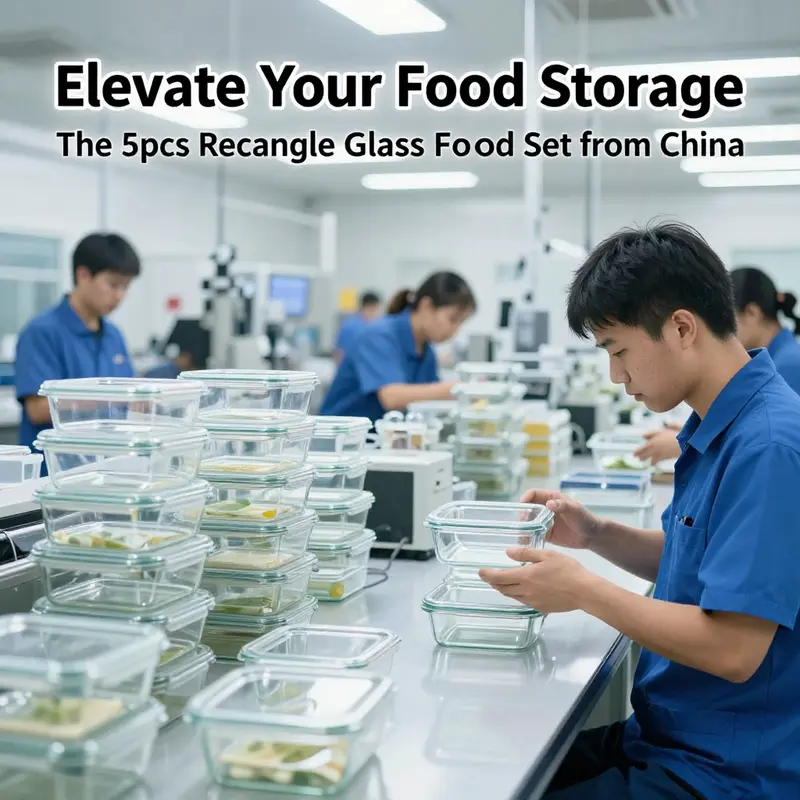
To understand how a five-piece rectangle glass food container set makes the journey from a Chinese factory to domestic kitchens across continents, it helps to look beyond the finished product and into the capabilities that shape it at every stage. The story begins with material science and design intent, but it quickly unfolds into a narrative about manufacturing discipline, supply chain orchestration, and the way wholesale producers align their processes with the needs of retailers, food service, and households. The five-configuration rectangle form, with its clear lids and seal, is not merely a product idea; it is the result of decisions taken across a spectrum of capabilities—from material selection to end-use certifications and from OEM/ODM collaboration to global logistics. In this chapter, we explore how Chinese suppliers articulate, implement, and continually improve these capabilities so that buyers seeking wholesale access can trust in consistent performance, scalable customization, and reliable delivery.
At the heart of these containers lies a material choice that reframes what is possible for home and commercial users alike. High borosilicate glass is prized for its heat resistance, chemical durability, and resilience under thermal stress. A container crafted from this glass performs across a broad temperature range, which is essential for a piece that is intended to be used in microwaves, refrigerators, freezers, dishwashers, and even ovens—though the latter is often subject to the lids’ compatibility. The chemical stability of this glass resists staining and odor absorption, a feature that matters when storing sauces, fruits, or marinated proteins. In a market where consumers increasingly expect long shelf-life and versatile reuse, the material science underpinning these five pieces becomes a meaningful differentiator. It reduces the risk that a simply stored curry or a citrusy dressing will leave lasting residues or flavors, and it makes thermal cycling less punishing, so a container can endure repeated transitions between hot and cold without clouding, cracking, or leaching.
The supplier’s production line translates these material advantages into tangible, repeatable products. A well-run factory for glass storage pieces operates with a carefully choreographed sequence: sourcing the high-purity borosilicate glass stock, cutting and forming the rectangular shapes with precision to retain uniform wall thickness, and then subjecting the pieces to annealing processes that relieve internal stresses. The result is a set with predictable dimensional stability, which matters when lids must seal snugly and stack efficiently in a cabinet or on a shelf. The lids themselves are often composed of a robust polymer cap—frequently polypropylene with a silicone sealing ring—that complements the glass body. This combination creates a seal that reduces air exchange, which in turn helps preserve the integrity of stored foods and minimizes spill risk during transport. The ability to engineer tight tolerances on both container and lid is a hallmark of a supplier able to offer wholesale volumes with consistent quality.
Quality control in this context is not a single checkpoint but a system of checks layered along the production line. Incoming materials pass through glass density tests, edge and corner inspections for chips or microfractures, and color or clarity assessments to ensure uniform appearance. The sealing components—silicone gaskets and PP lids—receive their own QC, checking for elasticity, gasket integrity, and uniform dimensions. Post-assembly, the finished sets go through thermal cycling, with cycles that emulate real-world use: heating and cooling to verify that the glass won’t crack under rapid changes, and repeated lid on/off actions to verify closure integrity. A certified quality management framework—often aligned with ISO standards—helps ensure traceability, non-conformity reporting, and corrective actions. In markets where safety standards like FDA or CE certifications carry weight, an OEM/ODM supplier who can demonstrate these credentials becomes a more robust partner for wholesalers who intend to export to the EU, North America, or other regulatory environments.
The capacity to support OEM and ODM engagement is a defining capability for suppliers serving wholesale markets. OEM—original equipment manufacturing—means the factory can produce containers that carry a buyer’s brand on the product or packaging. ODM—original design manufacturing—goes a step further, with the supplier contributing design input, technical drawings, or even complete concept iterations that a retailer can take to market with minimal internal development costs. For the five-piece rectangle set, this might involve customizing dimensions to suit different storage needs, such as a 1.3-liter main container with a 0.7-liter side piece and a 0.3-liter accent for sauces or nuts. The lids can be customized with color options or printed logos, while the silicone seal might be offered in different hardness grades or color variants to match a retailer’s branding palette. Some suppliers extend this collaboration to packaging design as well, offering secondary packaging that features brand-specific artwork, care instructions, and usage tips that can help end customers get the most from the product.
Customization within an OEM/ODM framework is not simply about aesthetics. It can affect functionality and user experience in meaningful ways. For example, through collaborative engineering, a supplier can optimize the glass thickness for a given price point, reduce weight to enhance handling or shipping efficiency, or adjust the shape to improve stackability and space utilization in retail displays. It can also involve compatibility considerations for microwave and oven use, ensuring lids are rated appropriately and that seals maintain performance even after repeated exposure to heat and detergents. Buyers who plan to market these containers across multiple regions may require different labeling conventions, including bilingual or multilingual instructions, safety warnings, or country-specific recycling symbols. A capable supplier will accommodate these needs through a structured approach to document control and artwork approvals, ensuring that a customer’s brand story remains coherent across markets while still leveraging production efficiencies in the factory floor.
The logistics and packaging aspects of wholesale supply are closely tied to the supplier’s ability to manage demand at scale. The wholesale model often entails relatively modest minimum order quantities (MOQs) that nevertheless necessitate reliable lead times, especially when a retailer is coordinating multiple SKUs or seasonal campaigns. For the five-piece rectangle set, it is common to see MOQs around the thousand-unit range, reflecting the economics of glass production, tool maintenance, and quality assurance. In practice, this means a supplier can accommodate a test order to establish supply chain fit, followed by larger runs if the product proves popular. The ability to accept small trial orders speaks to a broader capability: an integrated supply chain that can handle forecasting, production planning, and capacity management with a degree of agility that keeps wholesalers from having to absorb excessive stock risk. The supply chain is also expected to handle export packaging, which protects the glass during long sea or air shipments, as well as logistics coordination that includes documentation, customs clearance support, and communication with freight forwarders. The seamless integration of these elements—manufacturing precision, efficient packaging, quality control, OEM/ODM collaboration, and reliable logistics—together defines a supplier’s wholesale readiness.
Beyond the mechanics of manufacturing and shipping, reputable suppliers often emphasize safety and regulatory alignment to reassure wholesale buyers and their customers. A widely recognized standard in the food-contact space involves certifications such as ISO quality management, FDA compliance for food-contact materials, and CE marking for certain markets. When a supplier presents these credentials, it signals that the company has established processes to control quality, verify material safety, and maintain documentation that can be traced across batches. For wholesalers, this reduces the risk of recalls or regulatory issues that could disrupt supply or tarnish a retailer’s reputation. It also streamlines the onboarding process for retailers who themselves must present compliance assurances to their buyers or end consumers. The combination of material science, manufacturing discipline, design flexibility, and regulatory alignment makes Chinese suppliers a compelling option for wholesalers seeking reliable access to a versatile storage solution that can cross borders and adapt to diverse consumer preferences.
In practical terms, how does a buyer approach partnering with a supplier for a five-piece rectangle glass storage set? It begins with a clear specification brief. The customer defines the target capacities for each piece, the external dimensions, the thickness of the glass, the color options (if any), and the lid design. They specify the sealing material, tolerance guidelines, and whether the set should be dishwasher-safe and microwave-friendly, including any cautions about the microwave use of glass versus lid components. They outline branding requirements, including whether the product will be unbranded for private-label distribution or carry a brand mark, logo, or care instructions that must be printed or labeled. They provide packaging preferences—how the set should be boxed for wholesale distribution, whether inner separators or foam inserts are necessary, and if the packaging should carry sustainability messaging to appeal to eco-conscious consumers. The supplier then translates this brief into a technical file, refining the design through CAD drawings, material specifications, and a bill of materials. The BOM will enumerate the glass composition, thickness, lid materials, gasket type, and any surface treatments such as anti-scratch coatings or non-slip finishes if employed. With a validated design, tooling and molds can be prepared, and production planning can commence. For the buyer, alignment on these details reduces the likelihood of rework and accelerates time-to-market, particularly when orders hinge on seasonal campaigns or promotional events.
The market context for a wholesale glass storage set is shaped by consumer trends toward meal prepping, leftovers organization, and sustainable consumption. Families and small businesses alike seek durable, reusable containers that can withstand routine dishwashing without degrading or staining. The glass option provides an advantage over polycarbonate or other plastics in terms of chemical stability and resilience to odors. Yet, the plastics components—the lid, gasket, and any labeling—remain a source of ongoing consideration. Wholesalers must ensure that the gasket seals are reliable and that the lid’s mechanism remains easy to operate even after repeated cycles. They must also verify that materials do not degrade or interact with food when exposed to heat, oil, acid, or salt. The best suppliers address these concerns with robust testing protocols and transparent communication about limitations. Transparent documentation, including care guides and safety notices, helps retailers set accurate expectations with customers and reduces the risk of misuse that could compromise safety or performance.
As with any wholesale program, price points are a function of volume, customization, and the efficiency of the supply chain. The quoted range—often cited as a price per set depending on quantity—reflects the interplay of raw material costs, labor, tooling amortization, and packaging. For buyers, a wholesale price is not solely about the sticker price; it is about the total landed cost, including freight, insurance, export packing, and potential duties. The ability to negotiate clustered pricing for multi-SKU orders, seasonal promotions, or long-term supply contracts is a strategic advantage for wholesalers who want to stabilize margins while offering value to retailers. Some suppliers may offer tiered pricing, where the price per unit decreases with larger orders or where different configurations of the same five-piece set—such as a larger main container paired with smaller companion pieces—are bundled into a multi-pack. The configurability of the set, the range of sizes, and the flexibility in packaging and branding contribute to the overall value proposition for wholesale buyers who seek to differentiate their product assortments.
The end-to-end story of these five pieces is not merely about a set of containers; it is about the capacity to manage a complex supply relationship across borders. The supplier’s ability to coordinate design and production with international shipping, to provide precise and consistent product quality, and to support a buyer through the early stages of a product launch translates into a lower risk profile for wholesalers. For retailers, the benefit manifests as dependable availability, predictable lead times, and the freedom to focus on merchandising and customer engagement rather than supplier management. The wholesale ecosystem thrives when suppliers communicate clearly about capabilities, certifications, and lead times; when buyers have access to transparent information about materials, performance, and care; and when both sides collaborate to align product design with consumer expectations and regulatory requirements.
In closing, the capabilities that underpin a five-piece rectangle glass storage set—material integrity, precise manufacturing, robust quality control, flexible OEM/ODM collaboration, scalable logistics, and regulatory alignment—are interwoven elements of a single, coherent value proposition. They enable manufacturers to deliver a product that is not only functional and durable but also market-ready for retailers seeking dependable wholesale relationships. They empower buyers to pursue private-label or branded strategies with confidence, knowing that the supplier can adapt to evolving consumer needs, respond to demand fluctuations, and maintain consistent performance across batches. This is the backbone of wholesale enablement in the Chinese manufacturing landscape: a combination of rigorous process discipline, customer-centric design, and a logistics-ready supply chain that can bridge the distance from factory floor to family kitchen.
For readers who want to see a concrete illustration of how supplier capabilities are presented online, consider this example of a packaging product line that emphasizes eco-friendly materials, practical design, and straightforward usability. It demonstrates how suppliers communicate value through material choice, functional features, and family-friendly design. As you review supplier profiles and product specifications, this broader lens on capability helps translate abstract characteristics—such as heat resistance, seal integrity, and tolerances—into practical guarantees that wholesalers can count on when placing orders. For a real-world sense of how such capabilities are showcased on a wholesale platform, you can explore this resource with the anchor text eco-friendly takeout boxes for food packaging. eco-friendly-takeout-boxes-for-food-packaging-stylish-food-containers-safe-microwave-craft-paper-lunch-boxes-leak-grease-resistant.
The wholesale market for five-piece rectangle glass storage sets remains a dynamic space where material science meets manufacturing discipline and where brand-minded buyers seek partners who can deliver not just a product but a reliable, scalable experience. The Chinese supplier ecosystem, with its emphasis on high borosilicate glass, customizable form factors, and end-to-end supply chain capability, offers a compelling path for wholesalers who want to balance quality, price, and speed to market. The conversation between buyers and suppliers—about capacities, dimensions, seal designs, and packaging—occurs within a framework of quality systems and compliance, ensuring that every container that leaves the factory is prepared to perform, protect, and persist in the hands of consumers. And as the market continues to evolve with new consumer preferences and regulatory landscapes, the core capabilities described here remain the anchor that keeps supply resilient, adaptable, and ready to meet the needs of kitchens around the world.
External reference for further exploration on wholesale product detail and supplier capabilities can be found here: https://www.alibaba.com/product-detail/5-Pcs-Rectangle-Glass-Food-Container-Set_1601023586287.html
Final thoughts
In summary, sourcing the 5pcs Rectangle Glass Food Container Set from wholesalers in China presents an excellent opportunity for businesses in the food service industry to enhance their storage solutions. With robust construction, flexible pricing, and the ability to customize designs through OEM/ODM options, these products can meet various operational needs. By understanding supplier capabilities and pricing structures, businesses can confidently make purchasing decisions that will support their growth and customer satisfaction. Investing in these glass containers adds value to your storage strategy while maintaining professionalism in presentation.