
Container Safety Comes Down to Two Decisions
Two decisions carry most of the risk in a container order: whether your team reheats with the lid latched shut or vented, and which temperature rating you verify before the purchase order goes out. Brand name and unit price matter far less than either. A sealed container and an open one go through the same microwave in completely different ways, and a rating that looks generous on a spec sheet may not cover how your kitchen actually runs.
Four terms come up in every quote comparison, so here they are in plain language.
- Microwave-safe means the manufacturer has tested the container for microwave use, so it will not warp, melt, or release unwanted substances at the heat a microwave produces. It is the manufacturer’s own claim, which is why the paperwork behind it matters as much as the icon.
- Temperature rating is the maximum temperature a container is built to withstand, usually printed in °C and °F on the spec sheet, carton, or product page. If you are sourcing vessels for a central kitchen, our food storage bowls list their ratings up front, which makes side-by-side comparison quick.
- Lid-on reheating means the lid stays fully closed and latched during heating, trapping steam and pressure inside the container.
- Vented reheating means the lid is cracked open or a vent tab is flipped up, letting steam escape while the food still heats evenly.
The distinction matters to bubble tea shops warming tapioca toppings, restaurants sending staff meals upstairs, food trucks reheating during a busy service, and caterers moving hundreds of portions on a tight schedule. Each pushes containers to different limits, and the right spec follows from your workflow rather than from a generic “safe for hot food” label.
What follows compares lid-on and vented reheating, then the ratings worth confirming before you order.
Lid On vs Vented: What Changes Inside the Container
A clamped lid and a breathing lid build up moisture, heat and stress in the headspace above the food at very different rates. What happens in each case, and which lid styles your staff will actually handle:
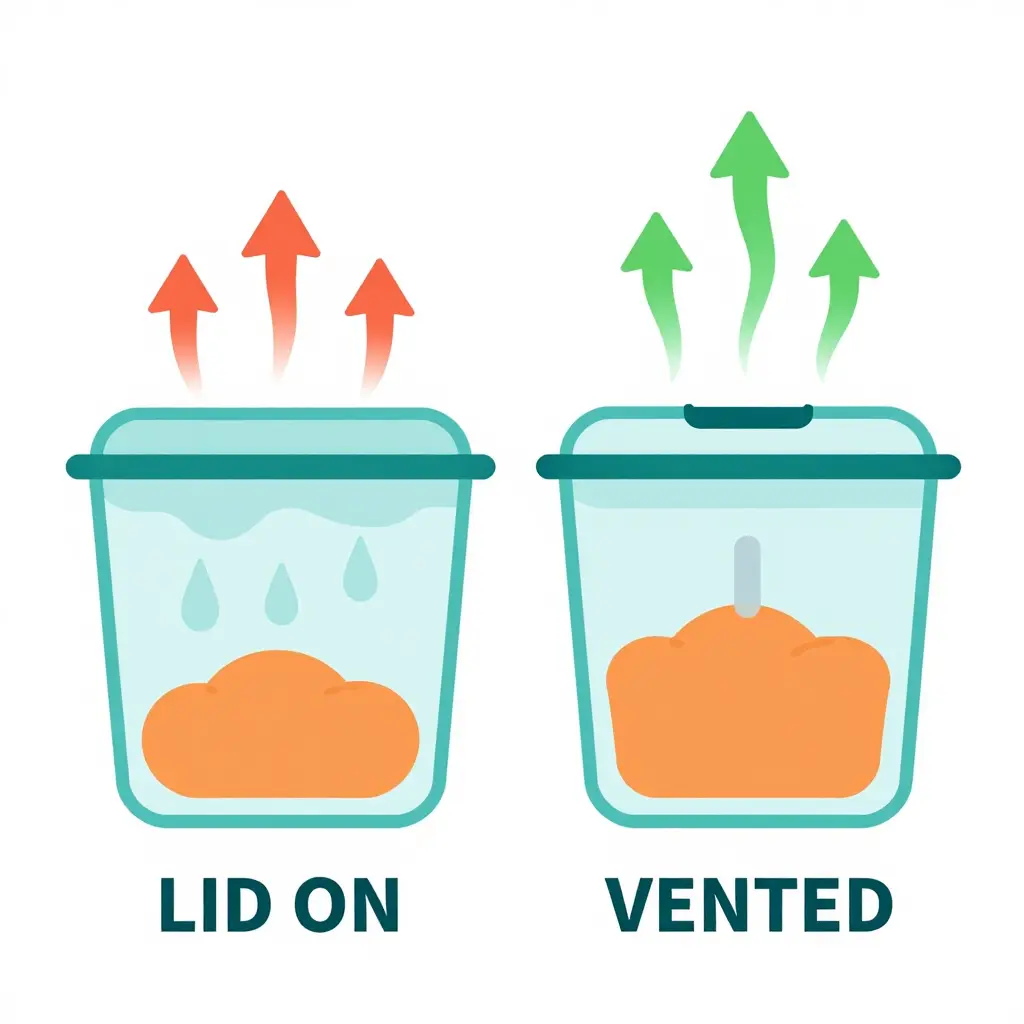
Sealed lid mechanics. A locked lid turns the container into a closed vessel. Steam from the food has nowhere to go, so it collects in the headspace and drives up both steam pressure and the temperature of the trapped air and vapour. That pressure pushes outward against every joint: rigid lids can pop off with a bang, soften and warp at the rim, and film seals can balloon or distort until the seal gives way. Condensation forms on the cold underside of the lid and drips back onto the food, which leaves it soggy.
Vented lid mechanics. A vented lid gives that vapour an exit. Steam escapes as it forms instead of stacking up, so headspace pressure stays low, the plastic sees gentler temperatures, and far less condensation collects on the lid interior. Less pooled moisture means less dripping, which keeps fried items crisper and stops sauces from thinning out.
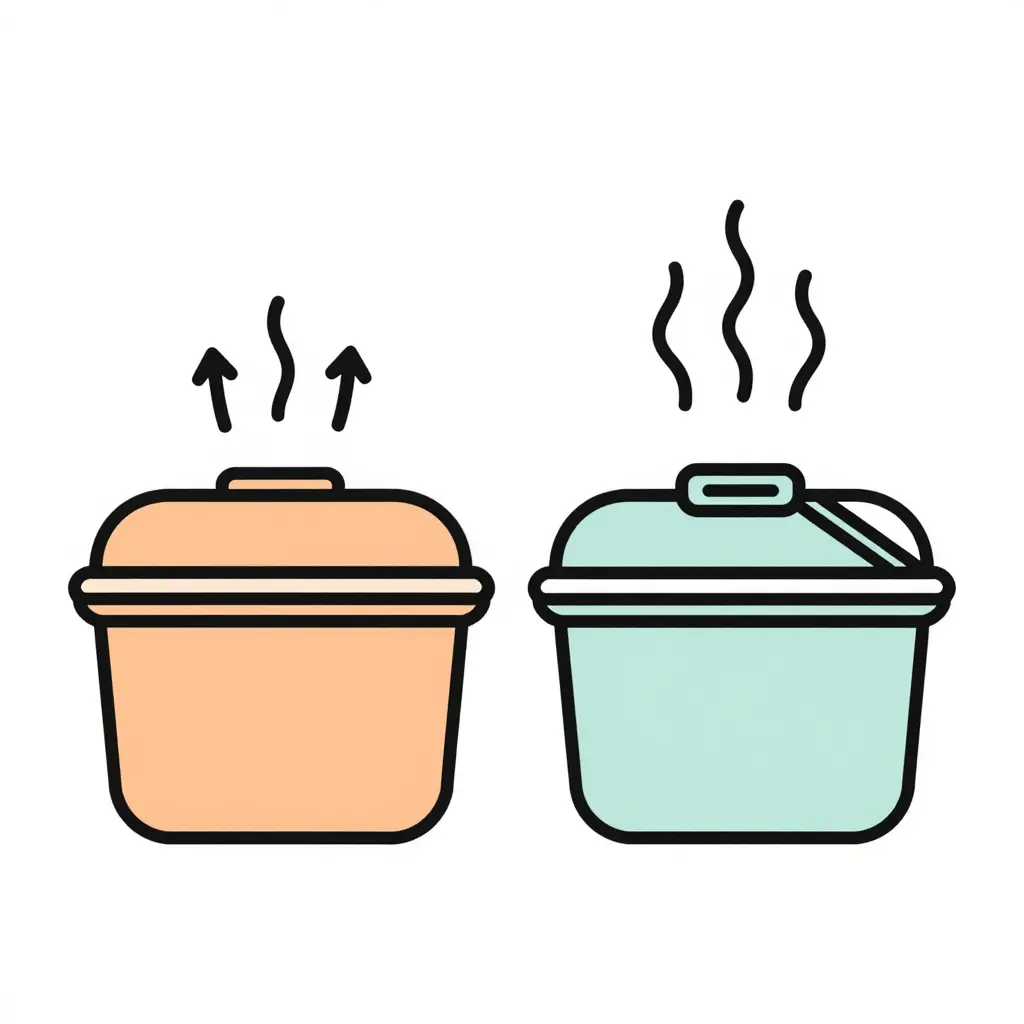
Rigid PP lids with vent tabs. The most common format in commercial kitchens. A small flip-up tab or snap-out plug opens a channel in an otherwise rigid polypropylene lid. Check that the tab is fully raised and clear before the container goes in.
Film seals with a peeled corner. Sealed trays travel well but seal completely. Lift one corner of the film and fold it back to create a controlled vent. Do not pierce a seal and call it vented: a pinprick will not relieve pressure fast enough.
Hinged clamshell lids. Clamshells either close fully or rest loose. The practical vent is to keep the hinge closed and unlatch one edge, or leave the lid slightly ajar. Browsing in-stock bowls and containers makes it easier to pair each format with a lid that matches how your team reheats.
Unless the lid is documented as rated for sealed microwave use, vent it.
Which Temperature Rating to Check Before Ordering
The temperature rating is the line on the spec sheet that decides whether a container survives a 90 °C curry or sags in the warming cabinet. Suppliers quote at least two different numbers for it, and the two are not interchangeable.
Two numbers that are not interchangeable
Maximum continuous service temperature (MCST) is the highest heat a container can take repeatedly, for the full length of a typical serving window, without warping, crazing or leaching. It is the everyday working ceiling.
Heat deflection temperature (HDT), by contrast, is a laboratory figure: the point where a test bar bends under a set load as it warms up. It comes from a short, controlled test, so it describes how a resin behaves under stress, not how your container behaves under a real portion of food.
If a supplier only quotes HDT, ask for MCST as well, and note which number the answer refers to. Treat the lower of the two as your working ceiling.
Why the microwave symbol alone is not a limit
A microwave-safe icon states suitability, not a number. It says the item can go in the microwave, but stays silent on minutes, wattage and the fat or sugar content of the food, both of which push surface temperatures above what a water-based test would show.
That is why “microwave-safe plastic containers” describes a category, not a guarantee for each SKU. Treat a symbol with no stated ceiling as clearance for brief reheating only, never for cooking.
The ratings you will actually meet
These are the ranges buyers see most often. Use them to start a conversation with your supplier, then confirm against the datasheet for the exact SKU you are ordering.
| Material | Typical max continuous service temp | What it means for you |
|---|---|---|
| PP homopolymer | ~100-120 °C | The default for hot food and reheating; rigid and reliable |
| Talc-filled or copolymer PP | ~110-130 °C | Stiffer and more heat-stable, good for heavier hot meals |
| CPET | ~200-220 °C | Dual-ovenable crystallised PET for bake-and-serve lines |
| Clear PET | ~60-70 °C | Cold and ambient only, ideal for chilled displays |
| PS | ~70-80 °C | Cold service and short ambient holding, not hot fill |
| PLA | ~50-55 °C | Compostable, but softens fast, so keep it cool |
| CPLA | ~90-110 °C | Plant-based and considerably more heat-tolerant than PLA |
| Bagasse or bamboo pulp | ~90-100 °C short term | Good for hot service, best for shorter holding times |
| PE-coated paperboard | ~70-90 °C | Coating softens with prolonged heat; fine for warm, not boiling |
A quick sanity check: clear PET and PS belong with your cold-drink cups, while bagasse and moulded pulp earn their keep as paper food trays for hot counters.
Body, lid, film: three ratings, not one
The body might handle 120 °C while the lid is a different grade, and the lidding film or seal is often the weakest link of all.
Before you commit to PP food containers for a reheating programme, ask for the rating of the body, the lid and any film or seal separately, in writing. A container is only as microwave-ready as its lowest-rated component.
Match the rating to your process, not to the dish name. Steam, oil and sugar all run hotter than water, so a rich or sweet menu needs margin: test a filled sample before the full order ships.
The quick-reference grid below gathers the same limits in one place, so you can match a material to the way your kitchen, van or venue reheats and holds food. If you are leaning toward plant-fibre packaging, our bamboo pulp product range is a good next stop once you have checked the limits.
Temperature Rating Quick Reference for Foodservice Containers
| Material | Typical maximum service temperature (°C) | Microwave safe | Lid-on reheating advised | Best suited for | Verify before ordering |
|---|---|---|---|---|---|
| PP homopolymer | 100-120 | Yes | Yes – vented | Hot meals, soups | Resin datasheet |
| PP copolymer | 90-110 | Yes | Yes – vented | Rice bowls, deli | Impact grade data |
| Talc-filled PP | 110-130 | Yes – rigid grades | Yes – vented | Bento, oven trays | Filler level |
| Clear PET | 60-70 | No | No | Cold drinks, fruit | Thermoform grade |
| CPET | 200-220 | Yes – dual oven | Not typical | Bake-and-serve trays | Oven certification |
| PS (GPPS / HIPS) | 70-80 | No | No | Cold desserts, salads | Grade check |
| PLA | 50-55 | Not advised | No | Cold cups, smoothies | Heat deflection data |
| CPLA | 90-110 | Yes – short cycles | Vented only | Lids, cutlery | Batch certificate |
| Bagasse or bamboo pulp | 90-100 | Yes – short bursts | Vented, lid loose | Hot entrees, bowls | Fibre and coating spec |
| PE-coated paperboard | 70-90 | Not advised | No – lid off | Hot cups, takeaway boxes | Coating type |
Values shown are typical industry ranges only; the supplier’s written specification always governs the final decision.
Verifying the Rating Before You Order
A single “microwave safe” line on a spec sheet tells you almost nothing on its own. What matters is the temperature rating before ordering, and that rating is rarely one number. The base and the lid are often moulded from different materials, which means they survive different heat loads. One email gets both figures in writing and saves a season of warped lids and leaking curry.
Ask for written maximum service temperature – body and lid, separately
Ask your supplier to state, in writing, the maximum continuous service temperature for the container body and for the lid as two separate figures. A verbal “it’s fine in the microwave” is not documentation. You want the number on letterhead or in a signed spec sheet, along with the resin or material grade it applies to. If the lid rating sits well below your hottest menu item, you already know the answer: lids come off before reheating, or you buy a vented version.
Confirm what the microwave symbol actually covers
The microwave icon on packaging usually certifies the base, not the closure. Ask directly whether the symbol applies to the container alone, the lid alone, or the assembled package. Ask how long the claim was tested for as well: a two-minute reheat and a nine-minute one are different worlds. A supplier who knows the product will answer without hesitation.
Request food-contact compliance documentation
Ask for the current declaration of compliance or food-contact certificate for the exact item and material, plus any migration test reports from a recognised third-party lab. Check the issue and expiry dates, that the item code on the document matches what you are ordering, and whether the paperwork covers hot, fatty and acidic foods, the three conditions that stress a plastic most. Keep a copy on file: auditors ask for it, and good food-contact compliance paperwork also protects you if a customer raises a concern.
Check whether a vented lid option exists
Before you settle on a SKU, ask whether the range includes a vented lid, a vented dome, or clip-on vent plugs. A vented lid lets steam escape during transport and reduces condensation dripping back onto food. If no vented option exists, plan your reheating instructions around removing or cracking the lid, and write that into staff SOPs.
Verify lid fitment and stack stability
Fit and stacking are physical checks, not paper ones. Request samples and confirm the lid seats with a firm, even click all the way around, with no lifting corners. Fill to your normal working level, tilt it, shake it, and check for seepage at the rim. Then stack loaded containers three or four high for the length of a typical delivery run and see whether the bottom unit deforms or the lids pop. On compartmented formats such as our meal and bento boxes, check that lids sit flat across every divider so steam does not channel between sections.
Run a sample test at the temperatures your menu actually reaches
Finally, test with real food at real temperatures. Measure your hottest items as they leave the kitchen, then reheat samples at that temperature and hold them for the length of your longest service window. Note whether the lid fogs, softens or lifts, and whether the base stays rigid when lifted one-handed. Small side items deserve their own check: a sauce or dip in a small volume can push past boiling point in a microwave, so review sauce portion cups against the same criteria rather than assuming the main container’s rating covers them.
| Check | What to request | Red flag |
|---|---|---|
| Body temperature | Written max service temperature | Only “microwave safe” stated |
| Lid temperature | Separate written figure | Same number quoted for both parts |
| Symbol scope | Confirmation of base, lid, or assembled | Symbol explained verbally only |
| Compliance | Declaration of compliance plus migration report | Expired or mismatched item code |
| Venting | Vented lid or plug availability | No venting option and no guidance |
| Fit and stack | Samples tested loaded and stacked | Lids lift, seams seep |
| Real-world test | Trial at your measured serving temperatures | Only ambient-temperature testing |
Work through the table once per candidate item and your shortlist will behave predictably in service, not just on the datasheet.
Pre-Order Checklist
Before you lock in a purchase order, run this eight-step check. A missed lid detail or an unread heat limit is expensive to fix once the containers are on your shelves.
- Confirm your hottest menu temperature, then note every reheating method your team actually uses.
- Request the written temperature rating for both the lid and the container base.
- Ask directly whether that temperature rating covers microwave reheating with the lid left sealed.
- Confirm vent tab availability so steam can escape safely during microwave reheating.
- Verify lid fit and closure strength after three minutes of full-power heating.
- Request food-contact and migration compliance certificates for the exact resin specified.
- Check carton counts, production lead times, and stock availability against your opening schedule.
- Approve a physical sample only after testing it with your real menu items.
If you want a head start, browse our microwave-safe lidded containers to see which stock items already carry published heat specifications, then bring this list to the supplier conversation.
Maximum Service Temperature at a Glance
Spec sheets are full of numbers, but they rarely sit next to each other. So we pulled published maximum continuous service temperatures for the seven materials you are most likely to be quoted on and plotted them on one axis. Values are typical manufacturer ratings for continuous use, not short-term peaks, and they are rounded because suppliers do vary by a few degrees.
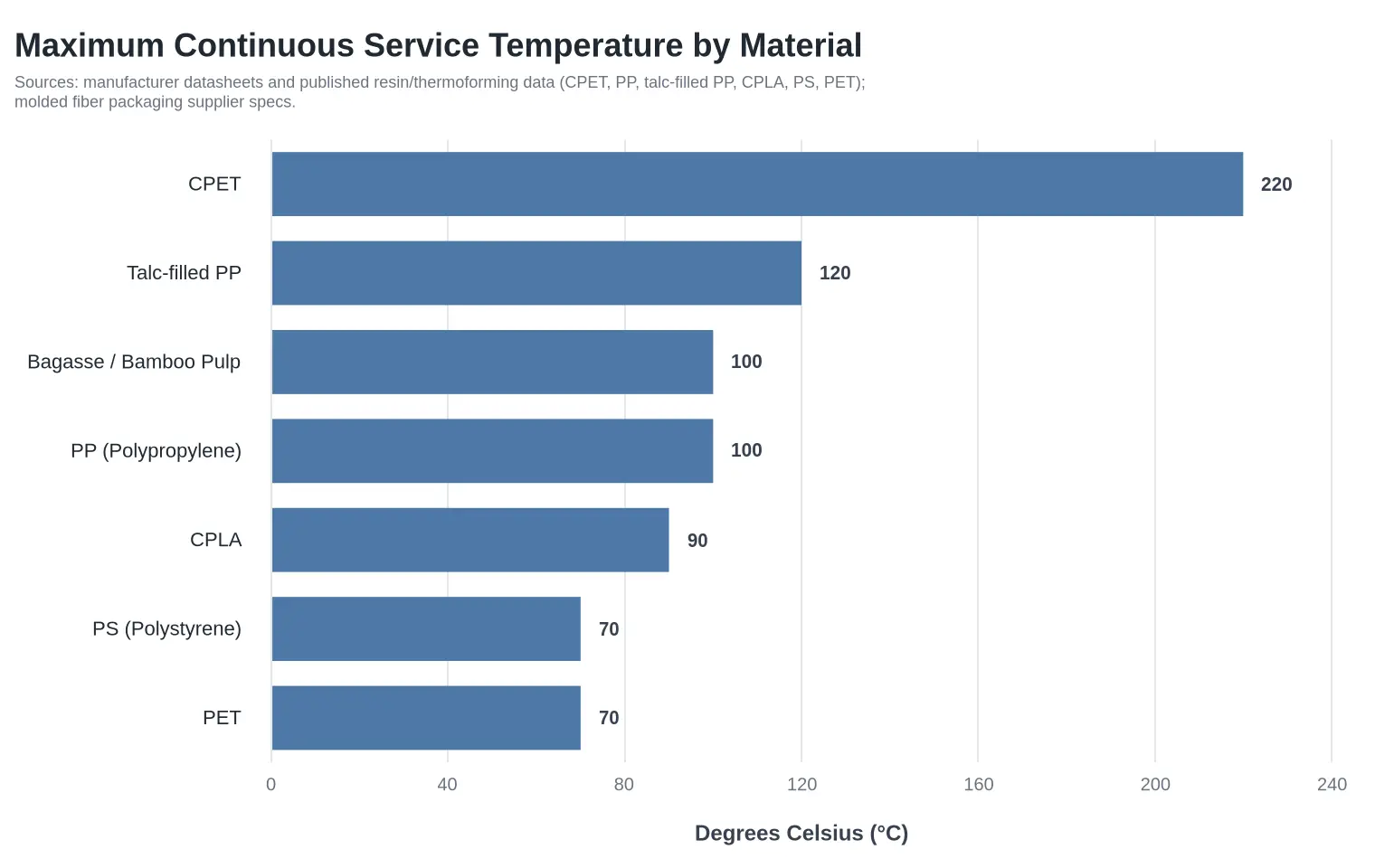
Sources: published resin and thermoforming datasheets for PP, talc-filled PP, CPET, PET, PS and CPLA, plus molded fiber supplier specifications for bagasse and bamboo pulp containers. Treat these as category benchmarks, then confirm the exact figure on the spec sheet for the SKU you are buying.
What the chart makes obvious
- CPET sits far above everything else at roughly 220 C, which is why it carries the ovenable reputation. Then comes a wide empty stretch down to the talc-filled PP band at about 120 C, and a tight cluster between 70 C and 100 C where most everyday containers live. If your menu includes a bake step or a hot-hold cabinet, that gap is the most important line on the page.
- Buying mistakes happen in the crowded cluster. PP, bamboo pulp and bagasse containers and CPLA all land within about 30 C of each other. That is close enough for a sales rep to swap one for another without flagging it, and close enough for a 95 C sauce or a reheated curry to push a borderline item past its rating.
Reading the chart against your own process
Do not compare these bars to the temperature of the food when it leaves the kitchen. Compare them to the hottest surface the container actually touches, for the longest time it touches it. A lid that steams up during a two-minute microwave cycle, a sauce ladled in at 92 C, a hot-hold drawer running all afternoon: each of those is a different test, and the weakest point is usually the lid or the closure rather than the base.
A quick way to use the chart: find your hottest process step in Celsius, add a safety margin of 10 to 15 C, and only then look for bars that clear it. If nothing at your price point clears it, change the process rather than the packaging.
Matching Container Formats to Your Operation
Every food business orders differently, and the rating you verify first depends on the format you serve in. In most sets one component takes the heat, another carries the structure, and the rest only have to survive being handed over at the counter. Our food storage containers for foodservice break down the same way, so find your operation below and check the part it names.
Bubble tea shops and beverage chains
Your order runs on portion cups for pearls and toppings, cold-drink cups, lids, sleeves and stirrers. The rating that matters most sits on the cup body, not the lid. Cold drinks live between 0 and 5 C, but tea shops constantly rinse, pre-heat and mix, so the body’s upper limit is what protects against warping, seam leaks and lids that suddenly refuse to snap shut. Sleeves add comfort and grip, never heat resistance, so do not count a sleeve as a safety margin. When you compare plastic cups for cold drinks, check the cup body rating first and the lid fit second.
Restaurants
Restaurants typically need meal and bento boxes, sauce portion cups and soup bowls in the same order. Here the container base carries the heat rating, because hot rice, fried items and oily sauces sit on it for the longest time. A lid softening slightly is annoying; a base softening is a leak in a guest’s bag. Sauce portion cups are a close second, since chili oil and hot dipping sauces push past what people assume. If you are building a to-go programme, start with your meal and bento boxes and confirm the base rating before you compare printing or dividers.
Food trucks and catering services
Food trucks and caterers move volume fast, so they lean on food trays, fast-food boxes and rectangular bowls. The tray or box body does the load-bearing here: it is stacked, loaded into warmers and carried between two places before anyone eats. Stacked trays pass heat and weight downward, so a body rated well below your holding temperature will sag at the corners while the lid looks perfectly fine. Rectangular bowls behave the same way when they hold stews. Browse fast-food boxes with the body rating as your first filter, then confirm the lid is vented where fried food needs to breathe.
Event planners and corporate procurement teams
Event work is about matching plate counts and hand-off logistics: plates, trays, cutlery and carriers. Here the plate and tray surfaces take the punishment, since hot canapes, sauced skewers and warmed entrees sit in direct contact while guests hold the rim. Cutlery and carriers are structural and load-bearing, so their limit is weight and grip rather than heat. Ordering one consistent rating across plates and trays keeps the buffet line predictable. Compare trays and plates in the same spec so nothing on the table behaves differently from the rest.
Quick reference
| Operation | Typical formats | Part to check first | Why |
|---|---|---|---|
| Bubble tea and beverages | Portion cups, cold-drink cups, lids, sleeves, stirrers | Cup body | Warps, splits or loosens the lid under rinsing and mixing heat |
| Restaurants | Meal and bento boxes, sauce portion cups, soup bowls | Container base | Holds hot, oily food longest; base failure means leaks |
| Food trucks and catering | Food trays, fast-food boxes, rectangular bowls | Tray and box body | Carries stacked weight and warmer heat |
| Events and procurement | Plates, trays, cutlery, carriers | Plate and tray surface | Direct contact with hot food while guests hold the rim |
Whichever category you buy from, read the rating on the part that touches hot food, then look at the rest of the set. Round formats such as round bowls follow the same rule, and your supplier’s spec sheet should show the number plainly rather than hiding it behind a colour name.
Reheating Practices That Protect Containers and Lids
A few habits during reheating keep lids sealing properly and help your takeaway meal boxes stay in service longer.
- Open the vent tab or peel back one corner of the film so steam has a clear escape route.
- Lift one edge of a rigid lid slightly to release built-up pressure before the container goes in.
- Check the lid’s temperature rating separately from the body rating, because the two parts are often moulded from different plastics.
- Run the microwave on medium power instead of maximum to soften heat spikes around the rim and seal.
- Pause halfway through and stir or rotate the contents so heat redistributes evenly.
- Do not stack sealed containers on top of one another while they reheat.
- Label vented lids clearly so staff remember to press them shut again before transport.
What Your Takeaway Packaging Is Actually Made Of
Material choice drives heat tolerance, so the same “microwave safe” claim can mean 70°C in one cup and 120°C in another. The doughnut chart below maps the material mix of single-use foodservice and takeaway packaging: how much of the market still runs on PP, PET and PS, and how quickly paper, board and moulded fibre are gaining ground.
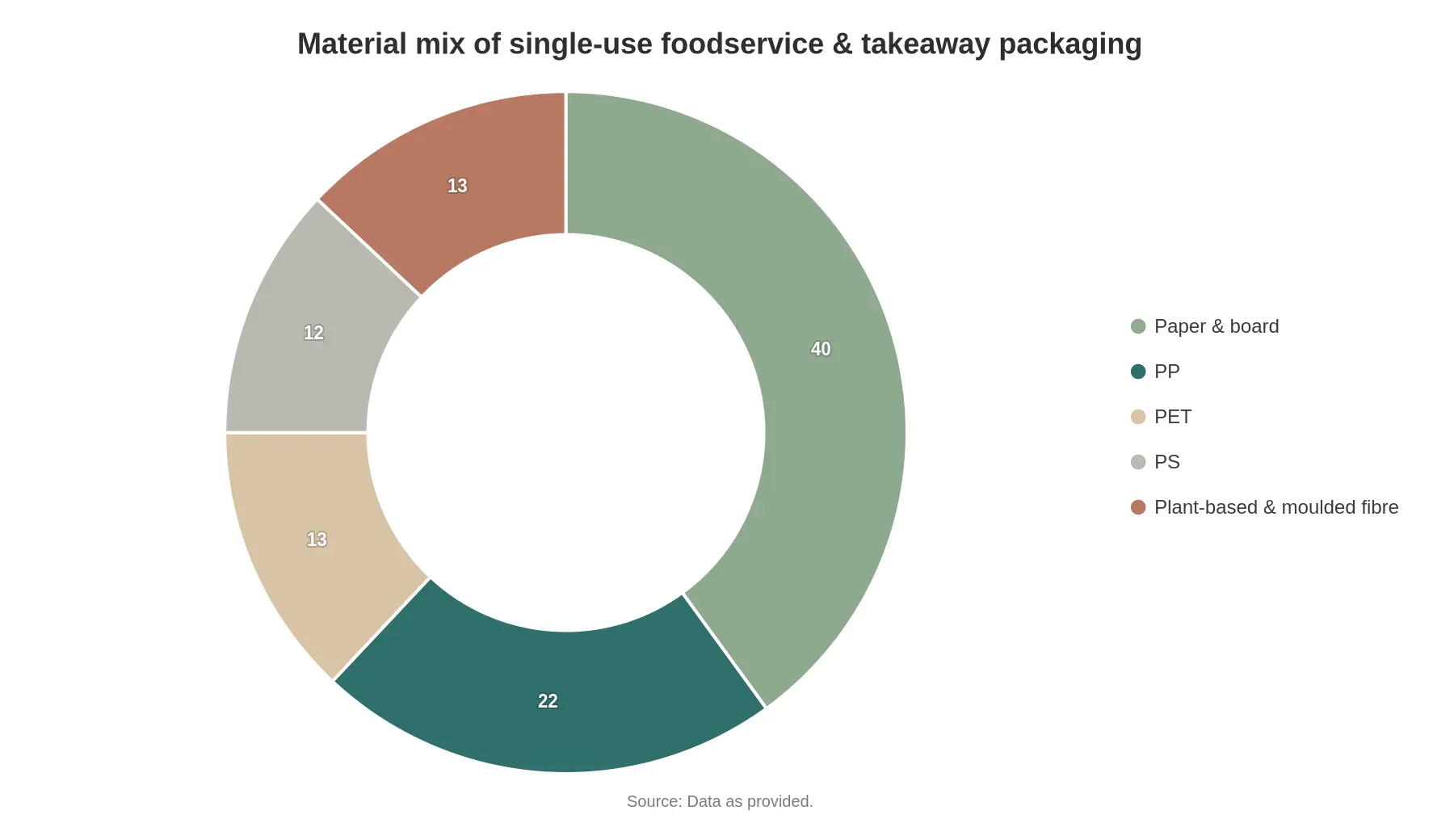
Paper and board hold the largest single share, so most of what arrives at your counter is already fibre-based. But the plastic slice (PP, PET and PS combined) is still roughly 47%, and that is where temperature ratings matter most. PP is the workhorse of microwave reheating because it holds shape well into the 100-120°C range; PET softens earlier and is better kept for cold or ambient service; PS is rigid but brittle under heat. Plant-based materials, including moulded fibre and bamboo pulp options, are the fastest-moving slice, which is exactly why you should read the printed rating rather than assume “eco” means “microwave safe”.
Footnote: Source – aggregated published industry estimates for single-use foodservice and takeaway packaging, rounded to whole percentages. Scope: rigid and moulded items only (cups and lids, tubs, trays, clamshells, bowls, cutlery) across European and North American markets; flexible films, carrier bags and napkins are excluded. Shares vary by region, sales channel and season, and represent a rounded composite rather than a single-source dataset – use as planning context, not as a procurement specification.
Frequently Asked Questions
The questions that come up most before a bulk order concern lids, heat ratings, material limits, and the paperwork worth keeping on file.
Is it safe to microwave plastic food storage containers with the lid on?
Only if the lid is labelled microwave-safe and vented. A sealed lid traps steam, which can warp the container, splash food and build pressure, so open the vent or leave one corner loose.
What temperature rating should a container have for microwave reheating?
Choose a container rated for at least 100°C (212°F), which matches boiling water and typical reheating loads. Ratings of 120°C or higher add a buffer for oily foods that heat faster; browse our microwave-safe bowls and containers for rated options.
Can PET or PS containers go in the microwave?
No. Standard PET and PS containers are not built for microwave heat. Clear PET softens near 70°C and PS around 70-80°C, so use them for cold or room-temperature service and switch to PP for reheating.
Does venting a lid change the container’s temperature rating?
Venting does not raise a container’s temperature rating; it only manages steam and pressure. The base material still sets the heat limit, so a vented lid on a non-microwaveable tub stays unsafe.
What documentation should I request from a supplier?
Ask for a written microwave-use statement plus a material datasheet listing the resin and heat deflection temperature. Request test reports or a declaration of compliance so your team can verify claims before ordering.
A Short Recap for Procurement Teams
Three points belong on the top page of your purchasing folder:
- Vent unless the lid is certified for sealed microwave use. If the lid rating does not explicitly cover closed-door microwaving, leave a gap so steam can escape instead of building pressure inside the container.
- Match the temperature rating to the temperatures your menu actually reaches. A container rated for 70°C is the wrong choice for a 95°C curry, so measure real serving heat rather than ambient kitchen temperature.
- Confirm both the body and lid ratings in writing before ordering. A spec sheet should state the material and heat tolerance for each component separately, because the lid is often the weakest link.
It also helps to buy from a supplier that thinks about the whole package, not just the cup. Ecocup Bowl manufactures and supplies disposable tableware, packaging paper and boxes, with a focus on safety, durability and eco-friendly practices, and supports specification changes and volume shifts.
You can start with our ready-to-ship in-stock boxes for fast replenishment, or explore the bamboo pulp product range when plant-fiber construction suits your menu better.