
Why Plastic Food Containers Crack at the Corners in Cold Storage
When plastic food containers fail in a freezer, they almost always fail at the corners. A hairline crack opens where the molded corner meets the wall, then runs across the sidewall until the container leaks or splits along a clean line.
The cause is not a random molding defect. It is how the resin responds to cold. Once a standard grade drops below its brittle-ductile transition, it loses the low-temperature toughness that lets it absorb a hit, and the stress concentrated at a molded corner becomes the easiest place for a crack to start.
This article covers the material science behind cold-storage corner cracking – how polymer structure, thermal contraction, and corner geometry interact in a freezer – and then gives a concrete recommendation on which impact grade to lock in before you order, so your next freezer program specifies a resin built to survive the cold. For the broader picture of how these containers behave across frozen and chilled workflows, see this guide on freezing plastic containers for food.
The Material Science Behind Corner Cracking
Every cracked corner comes down to the same thing: a polymer pushed past its limits at the worst moment. To see why corner cracking happens in cold storage, look at what the plastic is doing at the molecular level, not at the thermostat setting.
Polymer Chain Mobility: The Engine of Toughness
A plastic part is a tangle of long polymer chains. At room temperature, those chains carry enough thermal energy to slide, stretch, and rearrange when something strikes them. That movement is what lets a container flex and absorb impact energy instead of splitting.
As the temperature falls, the chains lose that energy. They move more slowly, then lock up, and the material has less room to deform. Cool it far enough and the plastic can no longer stretch on impact. It can only break.
The Brittle-Ductile Transition
That shift is the brittle-ductile transition: the temperature range where a polymer stops yielding and stretching and starts fracturing with almost no deformation. For polypropylene and similar food-container resins, that range often falls inside the temperatures a commercial freezer runs at.
Three terms matter when you specify a container:
| Term | Plain-Language Meaning |
|---|---|
| Brittle-ductile transition temperature | The point where a plastic flips from bending under impact to cracking under impact |
| Glass transition | The temperature where amorphous polymer regions change from rubbery and flexible to glassy and stiff |
| Low-temperature toughness | A material’s ability to absorb impact energy and resist fracture while cold |
Why Residual Stress Concentrates at Sharp Corners
Injection molding leaves stress behind. As molten resin fills the mold, different regions cool and shrink at different rates. Sharp corners cool quickly and act as geometric stress concentrators, so the frozen-in stress builds up right where the walls turn a tight radius.
Frozen Contents Push Back at the Same Points
Water expands by roughly 9% when it freezes. A high-moisture food load presses outward as ice forms, concentrating mechanical load on the walls and corners of the container. You can see how this plays out when freezing plastic containers food, and compare the results across high-impact resins.
Put the three together and you have the failure case: a material already past its brittle-ductile transition, residual stress crowded at the corners, and expanding ice pushing on those same points. A resin with genuine cold-storage performance is what keeps a shipment of split containers off the truck.
Low-Temperature Toughness: What It Is and How It Is Measured
Low-temperature toughness is a material’s ability to absorb an impact without fracturing when it is cold. It answers the question that matters before you place an order: when a filled container is knocked at -18 °C, will the corner flex and survive, or will it shatter? Cold storage takes away the molecular mobility that lets plastic stretch under stress, so a tub that feels tough on a warm loading dock can behave like glass in a freezer aisle.
How It Is Measured: From Impact Grade to Transition Temperature
Engineers measure it with notched impact testing, using the Charpy or Izod method. They cut a machined notch into a small polymer bar to concentrate stress at a single point, then strike it with a swinging pendulum across a range of temperatures. The energy the sample absorbs before it breaks is recorded at each temperature and plotted as a curve.
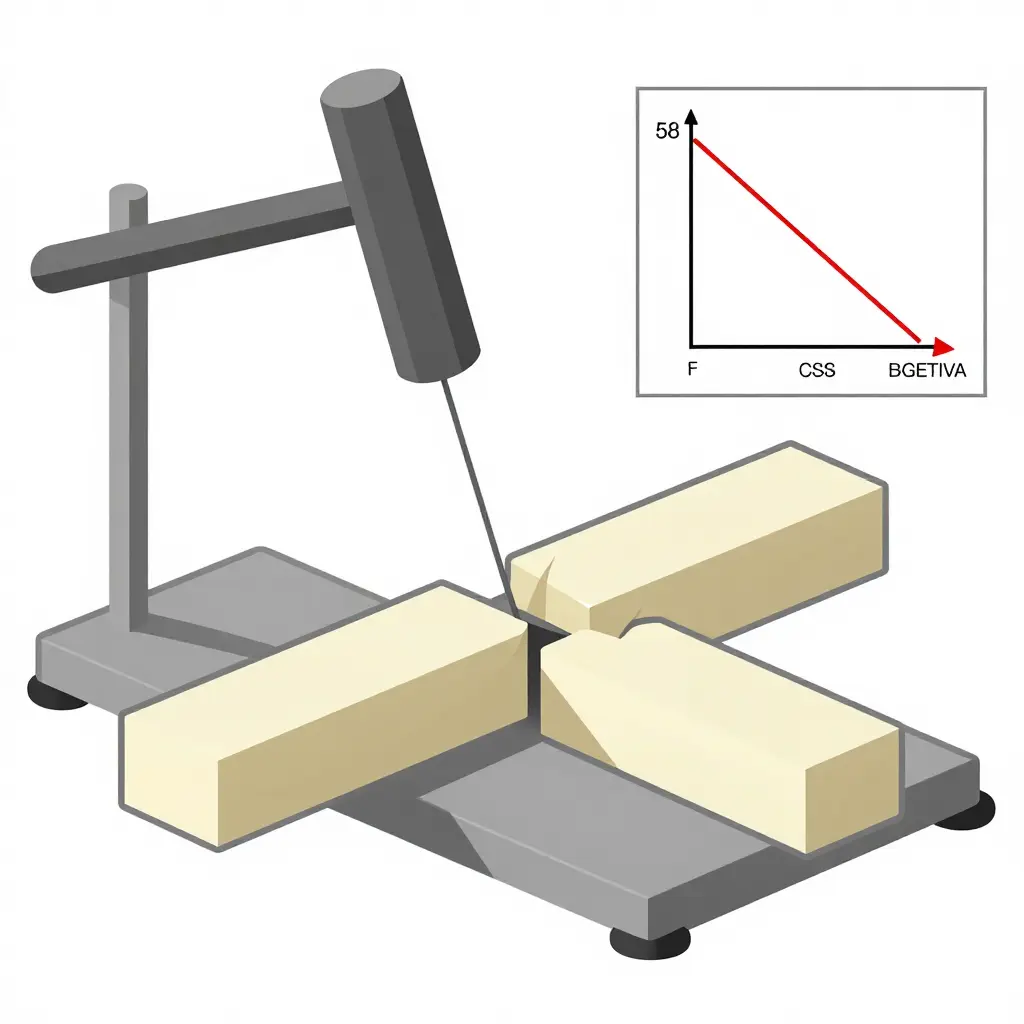
That curve looks like a cliff, not a gentle slope. Absorbed energy stays high and flat while the polymer is ductile, then falls sharply as it crosses the brittle-ductile transition, the temperature at which the material turns from tough to fragile. For a procurement manager, the curve is a spec sheet you can read directly: the grade you lock into production needs its transition comfortably below your coldest storage setpoint, with real margin, not a number that only clears the label rating.
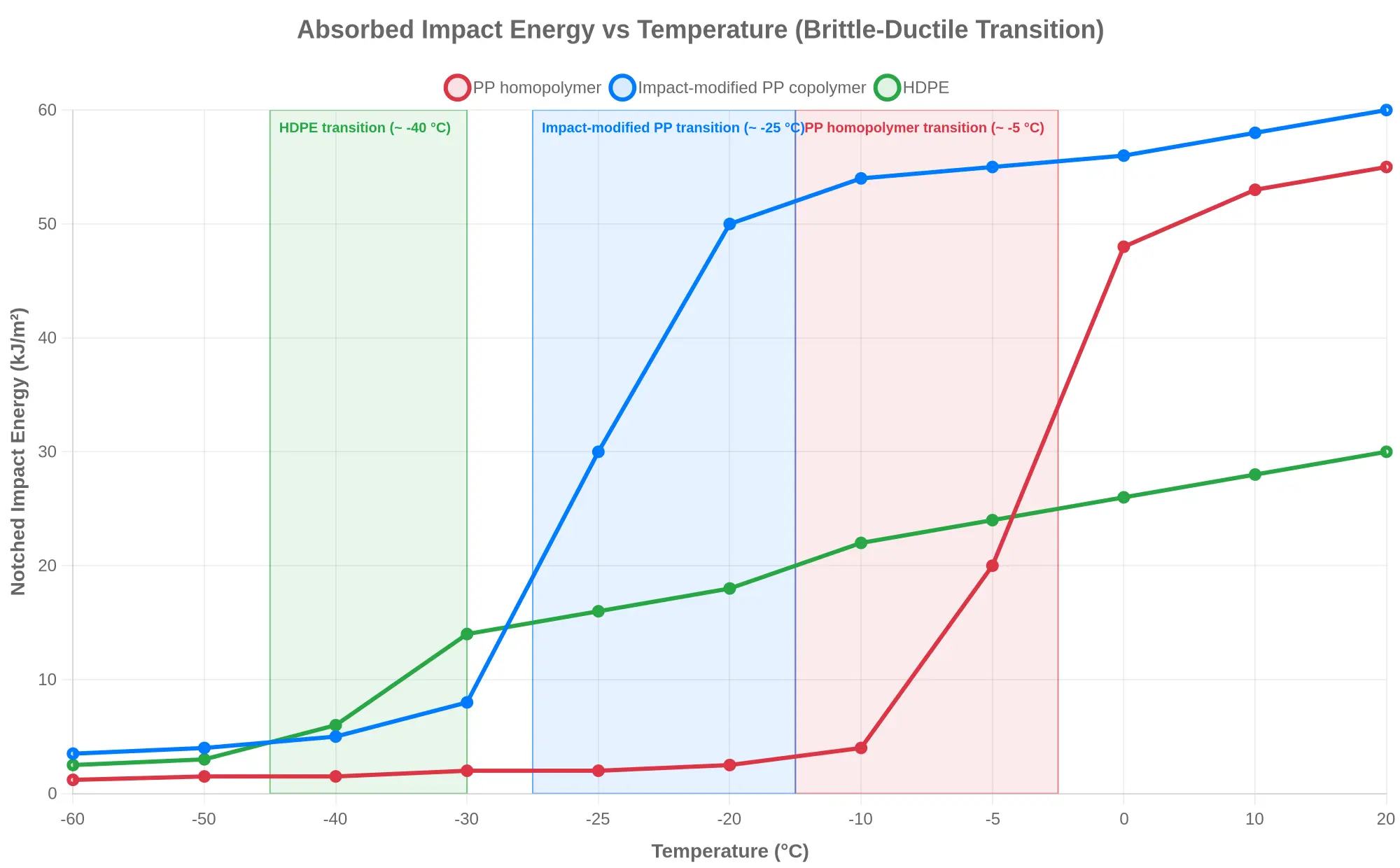
The chart separates three common polymer systems:
- PP homopolymer: transitions near -5 °C; a notch can crack it just below freezing.
- Impact-modified PP copolymer: rubber domains push the transition down to about -25 °C.
- HDPE: stays usable down to roughly -40 °C.
| Polymer system | Typical transition temp | Cold storage verdict |
|---|---|---|
| PP homopolymer | ~ -5 °C | Risky below freezing |
| Impact-modified PP copolymer | ~ -25 °C | Suitable for freezer |
| HDPE | ~ -40 °C | Deep-freeze capable |
What Determines Retained Toughness
Five factors decide how much toughness a container keeps below zero: base polymer chemistry, comonomer or rubber content, molecular weight, crystallinity, and part geometry. Sharp internal corners concentrate stress and crack first, which is why even a high-impact grade can fail at a tight radius where a rounder design holds.
In practice: specify a grade validated by a notched Izod or Charpy test at your real storage temperature, ask for that test temperature to be printed on the datasheet, and check corner radii before you commit. If you are balancing freezer performance against container design, it also helps to review how freezer-grade plastic containers are specified before you finalize the PO.
Impact Grade Reference for Cold-Storage Food Containers
| Impact Grade | Low-Temperature Performance | Failure Behavior at Cold | Recommended Cold-Storage Range | Typical Frozen-Food Uses | Relative Cost Index |
|---|---|---|---|---|---|
| Standard | Brittle below ~0 °C; high brittle-ductile transition (near 0 to -10 °C) | Clean, shattering brittle fracture at corners and lid rims; no yielding or elongation | Above 0 °C (chilled only); not rated for freezing | Refrigerated deli items, short-term chilled portions | 1.0 (baseline) |
| Medium-Impact | Retains moderate toughness to ~-18 °C; brittle-ductile transition shifted lower | Stress-whitening and occasional corner cracking under drop or impact load | 0 °C to -18 °C | Light-frozen trays, chilled-to-frozen combo packs, single-serve frozen sides | 1.2-1.3 |
| High-Impact | Good low-temperature toughness to ~-30 °C; broad ductile window | Ductile yielding; rare corner cracking, withstands routine handling drops | 0 °C to -30 °C | Frozen ready meals, entrees, bulk frozen portions, retail frozen entrees | 1.5-1.7 |
| Ultra High-Impact | Excellent toughness to ~-40 °C; lowest brittle-ductile transition temperature | Ductile deformation without fracture; survives drop and handling tests | -18 °C to -40 °C | Blast-frozen and deep-frozen foods, drop-test-critical export shipments | 2.0-2.5 |
Turning Material Science into Decision Criteria
The brittle-ductile transition and the impact grade only matter if they change what you write on the purchase order. The job is to turn a lab property into a number you can defend to your supplier and to your finance team.
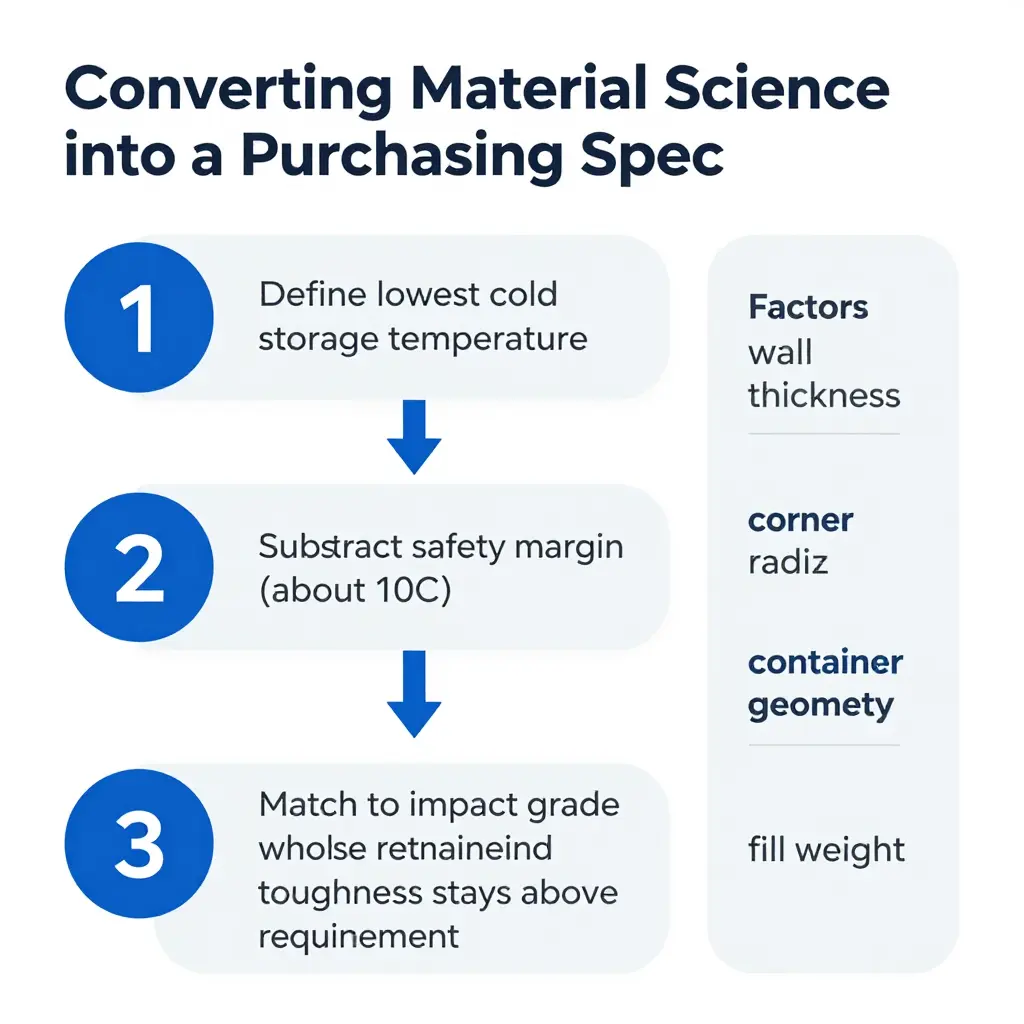
The three-step decision path
You rarely need a full thermal simulation to choose a grade. You need three defensible numbers, applied in order.
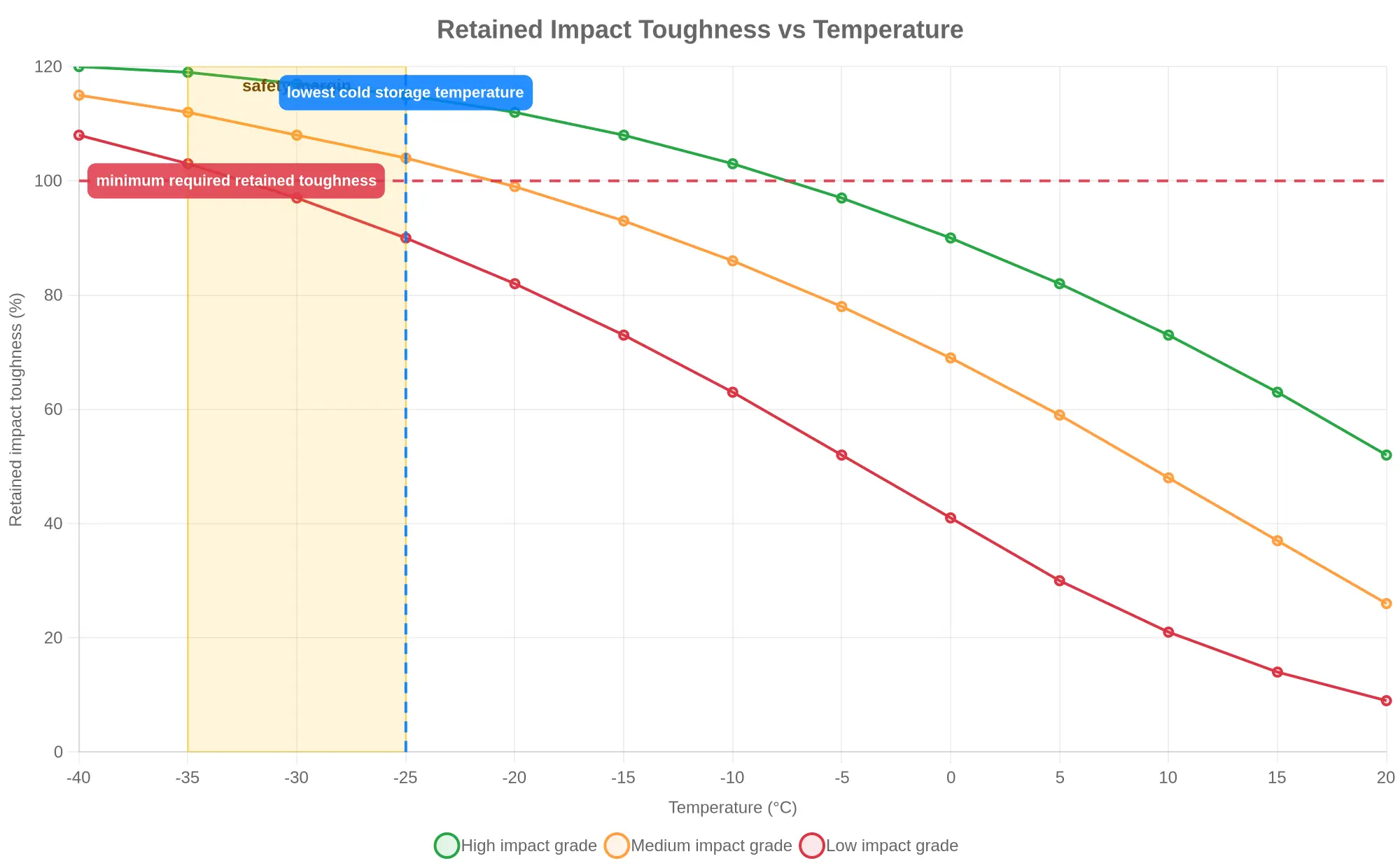
- Step 1 – Define the temperature floor. Establish the lowest temperature your plastic packaging food containers in the freezer will realistically meet. This is not the freezer setpoint; it is the worst-case surface temperature during blast freezing, door-open cycling, or a cold room drifting out of range. For most frozen programs, that floor sits between -18 °C and -25 °C.
- Step 2 – Subtract a safety margin. Real cold chains overshoot. Take roughly 10 °C off your floor so brief excursions, transport delays, or the cold pocket next to an evaporator never push the container past its brittle-ductile transition. A -25 °C floor becomes a design threshold of about -35 °C.
- Step 3 – Match the threshold to a grade. Choose the impact grade whose retained toughness still meets what your application requires at that design threshold, not at room temperature. A grade that is tough at 20 °C can be glass-brittle at -30 °C, and that is where cold storage failures begin.
Start step one by reading the resin codes and temperature ratings on your current containers – see our guide to plastic food container safe numbers.
The chart below shows why this matters: as temperature drops, retained toughness falls, and the grade you need is the one that still clears the required level at your design threshold.
Four design variables that move the grade you need
The resin sets the transition temperature; geometry sets the stress a container actually sees. When these four variables push stress up, step three calls for a tougher grade.
- Wall thickness. Thin walls carry less impact energy before yielding, and a 10-15% reduction can effectively cost you a full grade at low temperature.
- Corner radius. Sharp internal corners concentrate stress and are the leading origin of corner cracking. A larger radius spreads impact load and can let you hold a lower-cost grade.
- Container geometry. Deep, tall, or narrow profiles flex more under load, while ribbed or tapered designs stiffen the part. Geometry that resists bowing needs less toughness.
- Fill weight. Heavier fills add mass and momentum during handling and drops, raising the energy the walls must absorb. A 1 kg fill stresses corners far less than a 5 kg fill.
Pulling it together
Specify the grade at the design threshold, not the freezer setpoint, and write that temperature onto the drawing so every order is comparable. When requirements are extreme or margins are tight, it is worth checking whether a different material class solves the problem more cheaply than upgrading the grade – a fair comparison is laid out in glass vs plastic food containers.
Impact Strength vs. Temperature: Reading the Brittle-Ductile Transition
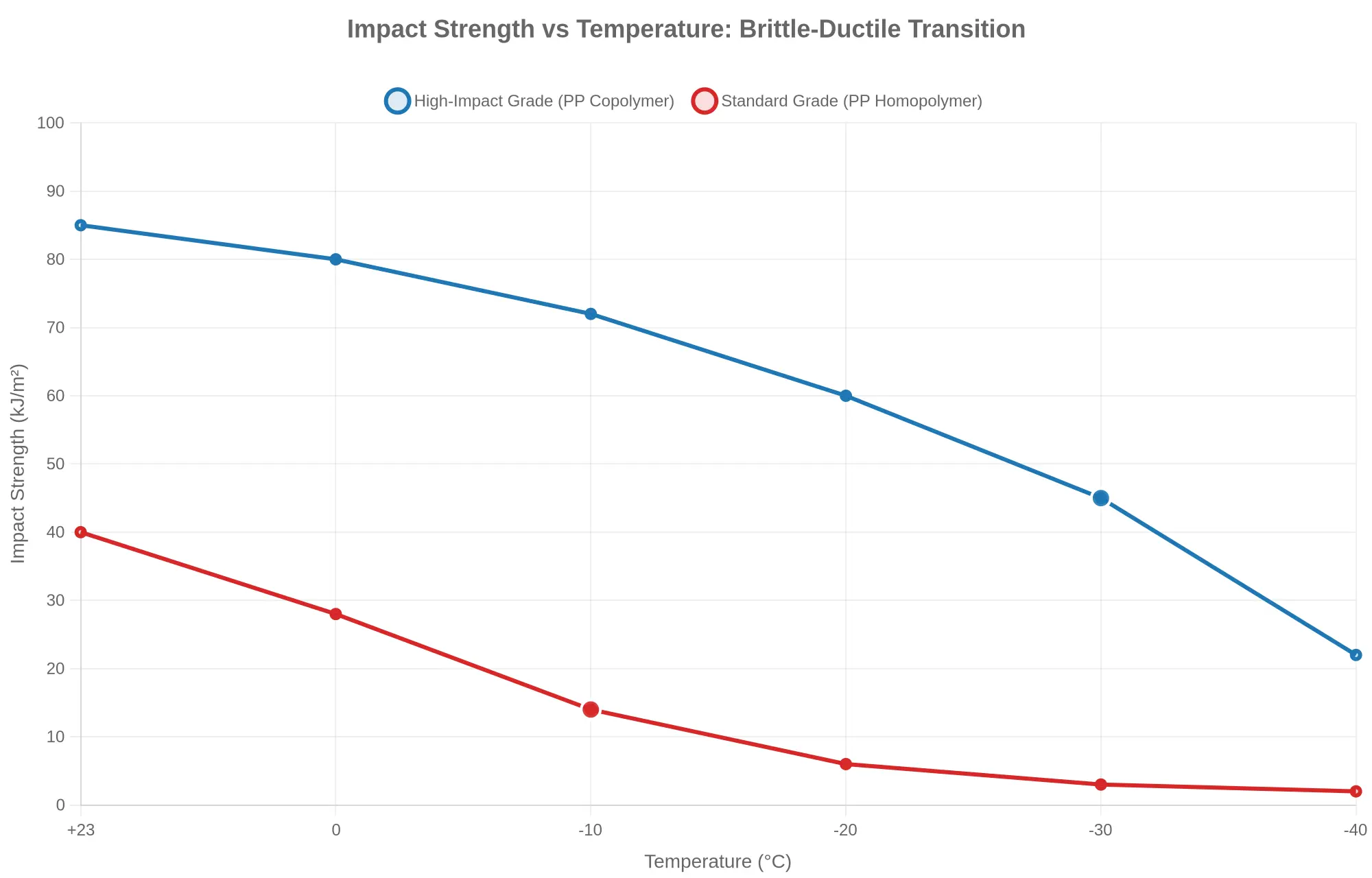
The chart below plots impact strength (measured in kJ/m²) against temperature, with the scale descending from ambient +23 °C deep into the freezing and sub-freezing range down to -40 °C. Two impact grades are plotted side by side to show the difference in cold-storage resilience.
How to read the curves:
- Standard Grade (red): holds reasonable toughness near room temperature but collapses to a fraction of its value by -10 °C. That is its brittle-ductile transition, the point where the material stops deforming and starts fracturing. Anyone specifying this grade for sub-freezing storage is inviting corner cracks.
- High-Impact Grade (blue): retains far more energy absorption across the entire range and only shows a steep decline near -30 °C. Its transition sits roughly 20 °C lower, which buys the safety margin that cold-chain handling demands.
The gap between the two curves widens sharply right where it matters most. To see how that translates into real-world freezer performance, explore our guidance on plastic food containers for the freezer.
Pre-Order Impact Grade Checklist
Before you place your next order for plastic packaging food containers in the freezer, walk through this sign-off list with your supplier. Confirming every line keeps corner cracking out of cold storage and ensures the impact grade you specify matches your handling environment.
- Confirm the minimum storage temperature (e.g., -20 °C / -4 °F) the container must survive without cracking, and get it in writing.
- Specify the required low-temperature toughness threshold as a notched Izod or Charpy value measured at your lowest cold-storage temperature.
- Verify the resin impact grade (standard, high-impact, or super-tough) and request the grade datasheet rather than a general material claim.
- Lock the container wall thickness in millimeters, including the minimum wall at corners and radii where stress concentrates.
- Define the corner radius to eliminate sharp 90-degree geometry that becomes a crack-initiation point in the freezer.
- Confirm the closure or lid type (snap-fit, press-in, tamper-evident) plus its cold-temperature retention and seal integrity.
- Record the fill weight and required top-load capacity so the container holds shape under stacked pallet loads.
- Agree on the expected handling drop height and set a clear pass/fail drop-test criterion at that height after cold storage – see how plastic food containers for freezer storage perform.
- Approve the format and geometry (round, rectangular, multi-compartment) against your filling and sealing line.
- Request a brittle-ductile transition temperature report to confirm the material stays ductile across your full cold chain.
- Ask for a pre-shipment sample that has been frozen and drop-tested to validate every specification above before you commit.

Which Impact Grade to Lock Before Ordering
The brittle-ductile transition (BDT) is the temperature band where a polymer switches from tough, yielding behavior to sudden brittle fracture. Every grade has its own band, and the specifier’s job is to choose one whose band sits safely below the coldest temperature the container will actually meet, including the drop it takes on the way to the shelf. Based on the checklist above, here is the recommendation for each service condition.
Mild refrigerated service (roughly 0 °C and above): use a standard impact grade. At these temperatures the polymer stays on the ductile side of its transition, so a mid-toughness grade delivers adequate corner strength without paying for rubber content you will never use. A stain-resistant liner formulation often pairs well here, as shown in these stain-resistant plastic food storage containers.
Light freeze with gentle handling (down to about -10 °C): step up to a medium-impact grade. A standard homopolymer is already at or near its transition by this point, which is where stress-whitening and the first corner cracks appear. Medium-impact resin moves the transition lower and keeps the corners ductile through chilled-to-frozen handling.
Standard frozen storage (about -18 °C, the industry benchmark): specify a high-impact grade, such as a high-impact PP block copolymer or high-impact polystyrene with elevated rubber content. This is the critical case. -18 °C sits at or near the transition band of ordinary grades, which is why corners crack first in the freezer. A high-impact grade pulls the transition well below the service temperature and buys the margin that keeps plastic packaging food containers in the freezer intact.
Deep-freeze or high-drop-handling applications (-30 °C to -40 °C, with case packing or mechanical drops): specify a super-tough, low-temperature impact grade. Here the drop matters as much as the storage temperature, so you need maximum transition headroom plus high notched impact energy.
| Service condition | Lowest service temp | Recommended impact grade | Why it holds up |
|---|---|---|---|
| Mild refrigerated service | above 0 °C | Standard impact grade | Service temperature stays above the brittle-ductile transition |
| Light freeze, gentle handling | about -10 °C | Medium-impact grade | Transition sits below the service temperature, so corners stay ductile |
| Standard frozen storage | about -18 °C | High-impact grade (block-copolymer PP or high-impact PS) | Pulls the transition band well below -18 °C for reliable corner toughness |
| Deep-freeze / high-drop handling | -30 °C to -40 °C | Super-tough, low-temperature impact grade | Maximum transition headroom plus high notched impact energy for drops |
Choosing the grade is only half the job; the other half is discipline. Before the press runs, write three things into the purchase order and the material specification: the selected grade, its notched Izod or Charpy value measured at the lowest service temperature, and the safety margin above the transition. Undocumented grades drift between production lots, and that drift is what triggers corner-cracking claims and returns. To see where grade selection is fixed during molding, review the plastic food container manufacturing process. And when you release tooling and order quantities, check the grade against the long unsupported spans of large rectangular plastic food containers – the most crack-prone geometry of all.
Frequently Asked Questions
Why do corners crack first instead of the walls?
Corners act as geometric stress raisers: the abrupt transition from wall to base concentrates mechanical stress at a single point. In cold storage, polymer chains lose mobility and the material shifts from ductile to brittle behavior, so the concentrated stress triggers corner cracking long before the flatter, more evenly loaded walls fail.
Does a higher impact grade always cost more?
Not proportionally. A higher impact grade carries more impact modifier and therefore a higher resin price per kilo, but total part cost also depends on wall thickness, part weight, and cycle time. A tougher grade frequently lets you thin the walls, and that material saving can offset the resin premium.
Can a container rated for refrigeration also be used in a deep freezer?
Not automatically. Refrigeration sits near 0-4 °C, while a deep freezer runs at -18 °C and below. Many polymers cross their brittle-ductile transition between those two ranges, so a container rated only for refrigerator temperature may shatter in a deep freezer. Specify low-temperature toughness validated at your true service temperature, and review how cold-storage performance is assessed before you order.
How does corner radius affect cracking?
A generous corner radius spreads stress across a larger area and lowers the stress concentration factor. Sharp, tight radii create crack-initiation hot spots. Enlarging the radius, combined with adequate low-temperature toughness, is one of the most effective ways to suppress corner cracking.
What testing evidence should a supplier provide?
Request ASTM D256 (Izod) or ASTM D6110 (Charpy) impact data measured at or below your service temperature, a brittle-ductile transition curve if available, and drop-test results on filled, frozen containers. Datasheets should explicitly confirm the impact grade and its tested temperature range, not just a generic “freezer safe” label.
When should I switch impact grades for a new product?
Switch when the service temperature falls below the current grade’s ductile transition, when the design has sharp corners or thin walls, or when drop heights and handling loads increase. Validate the change by drop-testing frozen samples before committing a full production order.
Conclusion: Define the Temperature, Then Lock the Grade
The root cause of corner cracking is material science, not guesswork. Cold storage pushes plastic past its brittle-ductile transition, where impact energy that would merely flex a container at room temperature instead concentrates at the corners and fractures them. The variable you control is the impact grade you specify: choose one rated for the lowest temperature your product will realistically meet, then apply a working margin below that figure to absorb handling shocks, temperature swings, and transit abuse.
The sequence is the same every time. Document your lowest storage temperature, subtract a safety margin, then match that number to a verified impact grade and lock it into the purchase order before manufacturing begins. Doing it once prevents returns, leaks, and damaged pallets later.
Our containers pair material testing with recyclable design and dependable B2B support. Align your plastic packaging food containers in the freezer to a defined impact grade and you protect both the product and the brand: specify the right grade at the start and cold-chain performance stops being a gamble.