
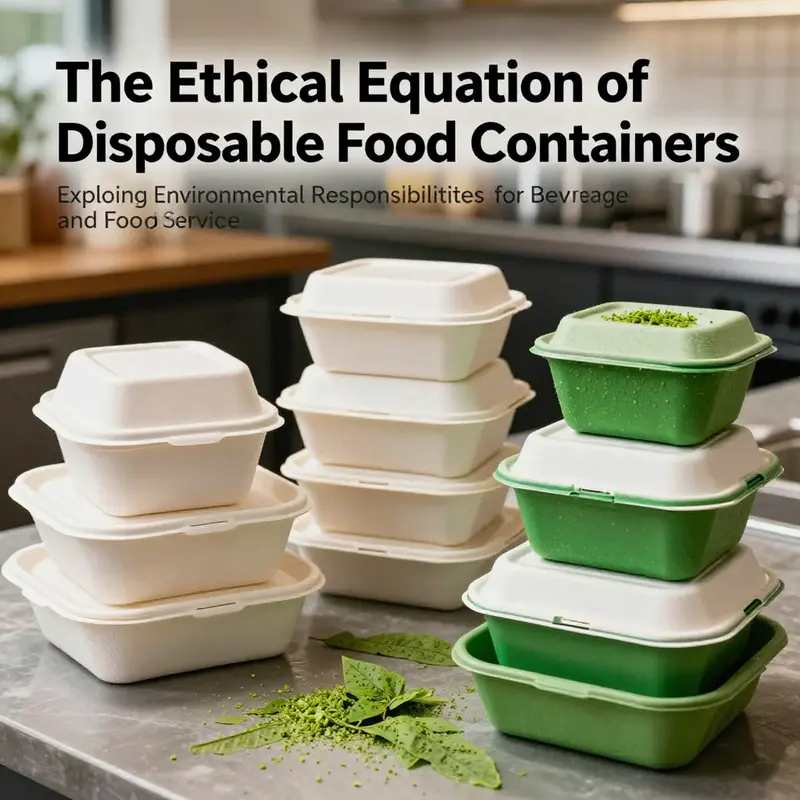
How do disposable food containers impact businesses and the environment? In a world where convenience meets ecological concerns, the urgency for ethical practices in disposable container use emerges. This article will delve into the significant aspects of this matter, drawing upon insights from The Economist. From environmental implications and corporate accountability to consumer behavior and policy considerations, we will explore how every stakeholder—bubble tea shops, restaurants, catering services, and procurement teams—plays a vital role in shaping a more sustainable future. Each chapter will contribute critical perspectives that urge us to rethink our approach to disposables and inspire a shift towards ethical consumption and corporate responsibility.
Rethinking Convenience: The Ethical Lifecycle of Disposable Food Containers
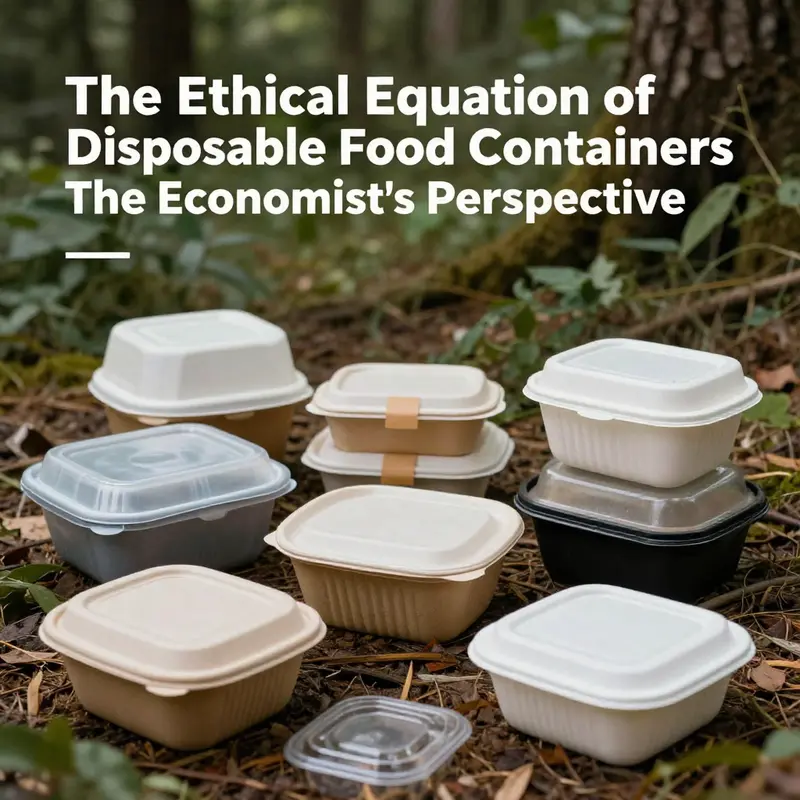
The Economist has long urged readers to weigh convenience against consequence, and the ethics of disposable food containers sits squarely at that intersection. In kitchens, takeout windows, and delivery hubs around the world, single-use packaging promises speed, sanitation, and predictable portions that many people rely on daily. Yet the same systems that enable rapid meals also channel waste into a planetary throughput that may outpace our capacity to absorb it. When a culture prizes convenience at any cost, the cost may be financial and social, but it can also be ethical in its consequences for people, ecosystems, and the complex interdependence that undergirds global life. The Economist’s perspective, applied to packaging choice, asks not for a simple switch from plastic to paper but for a rethinking of design, responsibility, and the long arc of outcomes that follow from what we store, transport, and discard.
To begin, the lifecycle of a disposable container is not a straight line from cradle to grave but a complicated trajectory that defies naive assumptions about recycling. The conventional wisdom has often been that recycling closes loops and reduces waste, yet the truth is more tangled. A substantial share of what is marketed as recycled material never becomes higher-value product; it is downcycled into lower-grade materials or, in many instances, incinerated for energy, with emissions that contribute to air pollution and climate effects. When energy and transportation costs are tallied, the net environmental benefit can be smaller than commonly assumed. The broader ethical implication is uncomfortable: recycling, in practice, can function as a public-relations veil for consumption patterns that continue to generate waste.
A stark dimension of that reality is the geography of responsibility. The economic logic of global waste flows shifted in the late twentieth century, and today waste often travels far from the places where it is produced. Shipping containers that carry consumer goods in one direction may, after use, become freight for waste to distant shores—landfills or informal recycling sites in regions with weaker regulatory regimes or limited municipal capacity. The ethical argument is not that shipping waste to other regions is categorically wrong, but that exporting harm to less affluent communities under the banner of recycling constitutes a form of moral outsourcing. When polluted rivers and soils, pollution-laden air near waste hubs, and microplastic contamination enter the food chain, the consequences cascade back through the supply web and into human bodies via seafood and other pathways. The question is whether multinationals, governments, and citizens should tolerate a system in which the burden of disposal is externalized as a cost of convenience for the global middle class.
This ethical critique dovetails with concerns about resource depletion and carbon footprints. The production of disposable containers—many with fossil-fuel plastics or energy-intensive coatings—consumes significant quantities of non-renewable resources. Even when claims of biodegradability or compostability are marketed, conditions in real-world environments seldom match ideal lab scenarios. Exposure to heat, moisture, and mechanical stress can prevent breakdown, leaving residues that persist in land and water ecosystems for years. The ethical frame shifts when we view the problem through climate justice: the communities most affected by waste disposal sites are frequently low-income or marginalized, bearing disproportionate health and environmental risks. Here the issue blends ecological science with questions of social equity, urging a distribution of burdens that aligns more closely with fairness than with mere convenience for a few.
What is ethically demanded, then, is not solely a materials improvement but a rethinking of how we design for use and reuse. The Economist has urged a transition away from throwaway culture toward a more mindful consumption posture, recognizing that product design shapes behavior as much as consumer choice does. If packaging is engineered to be readily disposable without regard to end-of-life processing, it tacitly endorses a system that externalizes impact. The ethical remedy might be to elevate the responsibility of manufacturers for the entire lifecycle. Extended producer responsibility (EPR) models place accountability for end-of-life management back on those who produce the packaging, incentivizing innovations that reduce material use, improve recyclability, or promote durable reuse. Yet even the best post-consumer solutions cannot absolve the broader obligation to avoid wasteful patterns in the first place. The ethical critique, therefore, asks for a dual approach: smarter design and more disciplined consumption.
A practical and moral pivot lies in embracing design for restraint. This means reimagining the packaging system around minimal material use, modularity, and compatibility with local recycling infrastructures. It also means acknowledging that certain packaging traits—such as extraordinary lightness or elaborate coatings designed to prevent grease or leaks—often come at a price. The same traits that enable convenience can undermine the very systems that would allow a circular economy to function. In some contexts, reusables—durable containers that are cleaned and refilled—offer a pathway to decouple dependence on virgin materials from everyday foodservice. The idea is not to demonize single-use solutions in all contexts, but to create a blended system in which reuse is viable at scale, supported by infrastructure, incentives, and public trust. It is a shift that requires coordination across urban planning, municipal recycling programs, and private-sector packaging design.
Labeling and transparency emerge as crucial ethical levers. Consumers deserve honest information about what happens to their packaging after disposal and how to participate in responsible choices. Greenwashing remains a persistent problem—corporate claims about environmental benefits that do not translate into real-world improvements—eroding trust and hampering progress. Clear, evidence-based labeling about recyclability, compostability, and actual end-of-life pathways helps align consumer behavior with environmental outcomes. Yet even with better labeling, the moral burden cannot rest solely on consumers. Businesses and policymakers must create enabling conditions: reliable collection, standardized materials, and predictable processing capacity that can handle diverse streams of packaging waste. The Economist’s critique of inconsistent enforcement and weakly policed regulations underscores the point that moral responsibility cannot be outsourced to labeling alone; it must be reinforced by governance and accountable industry practices.
In this light, the ethical conversation also touches on the risk of false economies. A seemingly cheaper option today may incur higher social and ecological costs tomorrow. The long-term accounting of waste includes not just direct disposal costs but the externalities that arise when ecosystems are degraded, when fisheries are impacted by microplastics, and when communities bear health risks from pollution. The ethical calculus thus widens from price per unit to a broader assessment of social and environmental costs embedded in every packaging choice. That broader view invites a normative question: should humanity prioritize convenience if it means compromising the natural systems that sustain life, including the health of workers in packaging and food sectors and the resilience of low-income communities affected by waste management decisions? The Economist’s stance implies a sustainable answer must go beyond technocratic tinkering and reflect a moral imagination that respects ecosystems and the rights of non-human life to exist without being treated merely as inputs.
Crucially, the discussion is not just theoretical but a call for systemic transformation. A truly ethical approach to disposable containers would integrate three strands: redesign the materials to minimize harm at every stage; expand use of reuse models where feasible; strengthen governance by making producers responsible for outcomes, mandating clear disclosures, and aligning incentives with long-term ecological health rather than short-term sales. This triad does not simply replace old habits with better ones; it reframes the culture of packaging around stewardship, transparency, and shared accountability. The ethics of disposable containers, as The Economist frames it, is a microcosm of a broader challenge: how to align the efficiencies of a global supply chain with the moral economies of a finite planet.
The practical steps to sharpen moral clarity are clear. Encourage material science that reduces the environmental footprint from cradle to cradle, not just through claims of biodegradability but through demonstrable reductions in energy use, emissions, and resource depletion. Foster urban systems that support robust recycling and safe disposal while avoiding the temptation to rely on distant, unevenly regulated destinations for waste. Invest in public education that helps consumers distinguish genuine sustainability from marketing slogans, reframing choice as participation in a system rather than mere personal preference. Finally, cultivate a narrative of responsibility that binds corporations, governments, and citizens into a cooperative enterprise. The ethical imperative is not to sanctify one form of packaging over another, but to insist on a design and governance framework that reduces harm at the source and distributes burdens more equitably across geographic and economic lines.
To bring these reflections back to the heart of the article—how the ethics of disposable food containers shape a broader social contract—we must imagine not just a better packaging protocol but a better social contract around consumption and waste. The Economist’s perspective invites us to see packaging as a test case for whether modern societies can balance convenience with care, efficiency with equity, and growth with planetary stewardship. If we succeed in reconfiguring the rules that govern packaging, we take a step toward a food system in which the benefits of modern life do not come at the expense of others’ health, dignity, or future opportunities. If we fail, we risk normalizing a pattern of waste that erodes the ecological systems that sustain all forms of life, including our own.
Supplementary note for readers seeking further exploration: consider examining the practical implications of alternative packaging forms and their end-of-life processing in local contexts, acknowledging that the feasibility of reuse or composting varies by city, climate, and infrastructure. The example of eco-friendly takeout packaging can serve as a touchstone for broader discussion about how design choices align with ethical commitments. For a deeper look at how material choices intersect with end-of-life realities, see the broader literature on disposal and recovery that underpins these arguments and fosters a more honest dialogue about what true sustainability requires.
Accountability by Design: Corporate Duty in the Move Toward a Circular Food-Container Era
The ethics of disposable food containers rests on a stubborn contradiction: the same systems that promise convenience and hygiene often deliver waste, pollution, and social inequity. The Economist’s framing of the current regime—where materials are poured into a fast-clip economy that rarely returns value to the ground it came from—summons a question that political rhetoric sometimes glosses over: what do corporations owe to the communities that bear the consequences of their packaging choices? The 2025 report, “Designing the un-throwaway world,” reminds readers that less than 9 percent of global plastic waste is recycled, a figure that crystallizes a systemic failure rather than a mere failure of individual behavior. It is not enough to celebrate better recycling tech or slicker waste sorting; the core of the ethical problem lies in design, responsibility, and the incentives that shape them. If packaging is the outward sign of a company’s values, then corporate accountability must extend from the drawing board to the end of life, and beyond to the social and environmental systems that are affected along the way.
To read this landscape properly, one must imagine a continuum that stretches from product design to consumer culture, to municipal waste management, to the financing and governance of recycling facilities. In that continuum, corporations sit at a pivotal crossroad. They are not mere suppliers of containers; they are stewards of materials, embedders of risk, and, crucially, designers of incentives. The ethical framework that The Economist advances begins with the recognition that packaging choices have externalities that extend far beyond the checkout counter. Each decision about material, thickness, coating, and shape alters the likelihood that a container will be recycled, composted, or repurposed. It can also shift the burden onto particular communities, often those least able to bear it, when waste facilities cluster near low-income neighborhoods or when pollution from production sites travels across borders via air and water flows. In this sense, accountability is not a philanthropic nicety but a matter of climate justice and public health.
Corporate accountability cannot be reduced to voluntary pledges or CSR press releases. The report warns against the performative aspect of corporate social responsibility—where a company signals virtue to secure a “social license to operate” without making transformative changes. Real accountability demands binding standards that apply across the entire lifecycle of packaging: from raw material sourcing and manufacturing energy use to design for recyclability and the end-of-life system that returns the material to circulation. It requires transparent supply chains, verified data on material composition, and third-party auditing that can withstand public scrutiny. In practice, this means that companies should be prepared to disclose not just the carbon footprint of their products but the full cascade of impacts: the energy intensity of production, the water use in growing and processing base materials, and the fate of the packaging once it leaves the consumer’s hands.
A crucial instrument in achieving that longer horizon is extended producer responsibility, or EPR. The idea is simple in principle: make manufacturers financially and operationally responsible for the end-of-life management of their products. In theory, EPR aligns incentives toward circular design, because costs shift from municipalities and taxpayers to the entities that create the packaging in the first place. In practice, the challenge is to translate that principle into enforceable policy, with clear performance standards, robust reporting, and consequences for noncompliance. The Economist notes that while some jurisdictions have begun to roll out bans and taxes on problematic items—polystyrene being a familiar example—enforcement is uneven and the risk of greenwashing remains high. Without credible verification and meaningful penalties, corporate promises risk becoming empty gestures that merely reposition waste elsewhere rather than reducing it.
If accountability is to be more than rhetoric, it must intersect with material science and industrial design. The debate over what constitutes a truly recyclable or compostable container cannot be settled by marketing claims alone. The real-world performance of so-called eco-friendly disposables often falls short of expectations because the waste system itself is fragmented. A container may be labeled as biodegradable, but if it can only decompose in industrial composting facilities that are scarce or geographically distant, the label becomes a misalignment with practical outcomes. Likewise, a material may be marketed as recyclable, but the infrastructure to collect, sort, and process it efficiently may not exist in many places. The ethical implication is clear: design decisions must anticipate end-of-life realities, not merely project ideal conditions.
The Economist’s analysis pushes readers to consider not just what materials do in theory but what systems permit them to do in practice. This is where the tension between convenience and responsibility becomes most acute. The globalization of food delivery and takeout has, in effect, externalized the weight of waste management onto overwhelmed municipal systems and disproportionately burdened communities near waste facilities or along shipping corridors. If we are to move away from a throwaway culture, the responsibility should be collective, not isolated to consumers who are asked to recycle or reduce usage while the appetite for single-use packaging remains structurally embedded in supply chains. Corporate accountability, in this sense, becomes a condition of political reliability as much as ethical duty: a company that designs for circularity will also need to engage with policymakers and with the public to align incentives, investments, and expectations.
One striking implication of this accountability framework is the case for substitution toward materials and designs that close the loop. Sugarcane pulp and bagasse, for example, offer opportunities to replace conventional plastics with bio-based alternatives that can be composted under suitable conditions. Yet even these options require careful scrutiny. The true environmental benefit depends on the availability of appropriate composting streams and on whether the life-cycle footprint—energy use, water consumption, and land-use changes—outweighs the benefits of switching away from fossil-fuel-derived polymers. The mantra “better materials” must be paired with “better systems,” because a clever material that cannot be processed responsibly in the real world hardly justifies its higher resource costs. The point is not to fetishize one material over another but to demand that choices be evaluated through a holistic lens that includes end-of-life logistics, not just production efficiency.
To connect these ideas with practical choices, it helps to examine how firms are integrating sustainability into their strategic calculus. Some corporations treat circularity not as a public relations project but as a core driver of innovation. They are pursuing designs that minimize material use without compromising safety, creating packaging that is easier to separate into mono-material streams, and adopting coatings that resist contamination during recycling. They are also adopting standardized labeling and traceability, so downstream processors can accurately identify material streams and do their jobs more efficiently. This is where the call for transparency becomes not merely a governance ritual but a technical necessity. When stakeholders can see exactly what a container is made of and how it will be disposed of at scale, markets can function more effectively, prices can reflect true costs, and the public can trust that claims about sustainability rest on verifiable facts rather than hopeful marketing.
The practical ethics of design also invites a candid reckoning with over-packaging and the downstream consequences of consumer expectations. The industry has often rewarded more packaging as a way to maintain product integrity in transit or to convey brand value, but that logic has to bend toward accountability. Reducing extraneous packaging, adopting minimalist yet functional designs, and shifting to packaging that protects the contents without compromising end-of-life performance are not merely efficiency wins; they are ethical imperatives when the social costs of waste are so concentrated and so visible. In this light, corporate decisions about container size, rigidity, and aesthetic can be read as moral choices—choices that either exacerbate waste streams or contribute to their deceleration.
The internal economics of packaging must also reflect this ethical recalibration. The lifecycle costs of a container extend beyond its purchase price. Energy, transportation, cleaning and processing costs, and end-of-life handling all feed into a total cost of ownership that societies must bear collectively. When companies internalize some or all of these externalities through EPR schemes, pricing signals move toward sustainability. If the financial and reputational costs of waste become a factor in decision-making, firms are less likely to optimize for short-term margins and more likely to pursue redesigns that deliver lasting value. This is not only a market correction; it is a moral adjustment that reframes what it means to be a responsible corporate citizen in a world where waste is a shared liability.
For readers seeking concrete references to how design choices translate into real-world outcomes, consider the broader ecosystem of packaging types and the supporting infrastructure that makes circularity possible. Some organizations and suppliers are experimenting with packaging that pairs form with function in ways that simplify end-of-life processing. For instance, there are solutions built around mono-material layers, easier separation, and clearer labeling that helps municipal facilities sort streams more efficiently. In parallel, the development of industrial composting networks and better collection systems matters as much as material science itself. The Economist’s critique of greenwashing also nudges readers to demand more than glossy narratives; it calls for verifiable progress, credible metrics, and enforceable commitments that can withstand political and market pressures.
This is why the internal ecosystem—the suppliers, designers, retailers, and recyclers—must be coordinated through a shared framework. When a company commits to design-for-circularity, it should also commit to disclosure—of materials, processing methods, and end-of-life outcomes. The public, regulators, and investors can then assess how genuine these commitments are. The internal capacity to measure, report, and improve must become a standard feature of corporate governance. In practical terms, that means establishing benchmarks, third-party verification, and a timetable for progress that is transparent and ambitious. The ethical objective is not merely reduced waste in the sense of fewer kilograms; it is a deeper transformation of how resources circulate, who bears the costs, and who benefits from the innovations that redefine takeout culture.
As readers reflect on these considerations, a broader narrative emerges: the ethics of disposable food containers cannot be disentangled from questions of power, equity, and governance. If packaging is the interface between producers and consumers, then corporate accountability must extend across the supply chain and into the halls of policy-making. The push toward a circular economy requires collaboration that transcends competitive boundaries, a shared commitment to minimize harm, and a willingness to reallocate risk and reward toward sustainable outcomes. In this sense, the chapter does not merely describe a set of reforms; it contends for a reimagined social contract in which the consequences of packaging decisions are shared by corporations, governments, and communities alike. The hope is not that every container will be perfectly recyclable tomorrow, but that the trajectory of packaging innovation will be guided by transparent accountability, credible evidence, and a collective aspiration to reduce waste without compromising health, dignity, or opportunity for people around the world.
For readers who want to explore a concrete example of how packaging design and policy intersect in the real world, one can look to the growing emphasis on alternatives that prioritize end-of-life compatibility and supply-chain clarity. The field is not static; it evolves as markets, technologies, and governance structures adapt to the realities of waste management. Some practitioners are betting on designs that minimize material diversity, simplify sorting, and improve compatibility with existing recycling streams. Others are testing supply chain collaborations that align incentives across producers, retailers, and waste processors. The underlying ethical premise remains constant: accountability must be integrated into every stage of the packaging lifecycle, and success should be measured not simply by consumer convenience or corporate reputation, but by the tangible reduction of harm and the restoration of value where it has historically been squandered.
In closing, the ethic of disposable container design is ultimately a question of collective responsibility. It asks whether markets can be steered by binding standards and transparent reporting, whether CSR can evolve from self-patrolling to externally verified accountability, and whether innovation can be aligned with the public good rather than short-term profits. The Economist’s analysis challenges business leaders to confront these questions with courage and rigor, to move beyond slogans, and to participate in a systemic shift toward a circular economy where the true cost of packaging is paid in a manner that respects communities, ecosystems, and future generations. The dialogue between design, policy, and ethics is not merely an academic exercise; it is a practical roadmap for reforming a global habit that, in its current form, treats waste as an inevitability rather than a solvable problem.
For readers seeking to connect the broader discussion with actionable steps, one can consult industry resources that explore alternatives and pathways toward sustainable packaging. This linked resource offers a perspective on practical, scalable options for eco-conscious packaging while illustrating how design choices translate into real-world outcomes. eco-friendly disposable packaging options.
External reference for further context on the ethical framework discussed here: https://www.economist.com/leaders/2025/07/22/designing-the-un-throwaway-world
Beyond Convenience: Consumer Habits, Accountability, and the Economist’s Ethics of Disposable Food Packaging
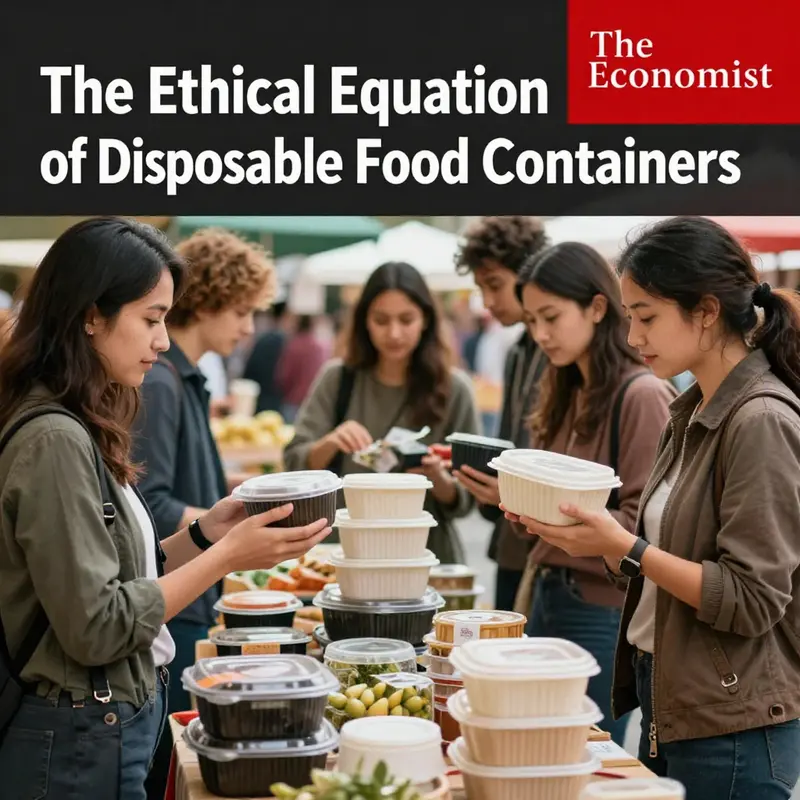
To understand the ethics of disposable food containers through the lens of The Economist is to trace a line from micro-level choices to macro-level consequences, from a single takeout bag to the climate, the coastline, and the balance sheets of cities. The story is not merely one of plastic versus paper or one of invention versus waste. It is a negotiation among convenience, hygiene, costs, and responsibility, with consumer behavior sitting at the heart of that negotiation. In markets that prize speed and predictability, packaging is the unglamorous infrastructure that makes delivery possible. Yet infrastructure carries a moral weight. The Economist has long argued that the true cost of a package extends beyond the price paid at the till or the kitchen. It includes the energy embedded in production, the emissions stitched into transport, and the long, slow work of waste management, landfilling, and environmental remediation. When we speak of the ethics of disposable containers, we must name the parties involved: households, workers in the supply chain, restaurants and retailers, manufacturers, and policymakers who set the rules under which all these actors operate. The chain of accountability, in turn, must extend from the consumer who chooses a bag versus a reusable container to the firm that designs packaging and the state that taxes, labels, and sometimes bans certain materials. The ethical argument is not purely about preferences but about outcomes: who bears the costs, who reaps the benefits, and who bears the risks of pollution, disruption, and resource depletion long after the meal is eaten and the wrapper is discarded.
In this framing, consumer behavior emerges as both a barometer and a driver. A growing awareness about environmental harms does not automatically translate into proportionate action. There is a familiar cognitive lag, a gap between stated concern for the planet and the daily rituals of ordering lunch, tearing open a plastic sleeve, and disposing of packaging in a way that feels immediate and familiar. The research landscape suggests that this gap is especially pronounced among groups that rely heavily on food delivery—such as college students navigating budgets and schedules, millennial workers juggling errands, and urban households pressed for time. To move through this gap, the ethical project must do more than admonish. It must illuminate, design, and enable better choices. The Economist’s ethic, in practice, is a call for transparency, design that nudges toward lower impact, and accountability that does not let price signals mask deeper externalities.
One of the most instructive angles is to examine how packaging choices conflate ease with responsibility. Disposable containers deliver hygiene and convenience: they reduce washing, enable fast service, and allow food to travel with less risk of cross-contamination. But these benefits come with a suite of costs that are often not visible to the consumer at the moment of purchase. The production of single-use plastics and other non-recyclable materials depends on fossil fuels and energy-intensive processes, tying packaging to carbon footprints and climate considerations that affect communities far from the table. The environmental cost is not abstract; it shows up in microplastics, in soil and water systems, and in the long-term health of ecosystems that sustain biodiversity and human livelihoods. From a social justice perspective, climate and pollution burdens frequently migrate toward low-income communities and regions with fewer amenities for waste processing and higher exposure to pollution. The ethical calculus, therefore, is not simply about preference but about distributional effects: who bears the environmental risk and who stands to gain from less visible, diffuse harms.
The cultural dimension is equally important. The Economist has highlighted how packaging norms become self-reinforcing: a society accustomed to convenience normalizes a posture toward disposable waste, while governments vary in the rigor of enforcement, and brands vary in the honesty of how they present environmental benefits. Greenwashing—where companies claim benefits that do not withstand real-world testing—undermines public trust and stalls progress. In practice, this means that even well-intentioned consumers can be misled by marketing that oversells recyclability, biodegradability, or compostability. A transparent labeling regime, coupled with credible third-party verification, can help recalibrate consumer expectations and reduce confusion. The ethical imperative then extends beyond the consumer to the corporate and the regulatory: design packaging that truly minimizes harm, be explicit about trade-offs, and bear responsibility for end-of-life outcomes, not just the point of sale.
Yet the path toward ethical packaging is not a straight line from better materials to better society. The materials question—bioplastics, compostable options, or recyclable formats—often devolves into a suite of practical questions: how do these materials perform under real-world conditions, how do they fare in existing waste streams, what do they cost, and what are their actual life-cycle impacts? Answering these questions requires a rigorous, nuanced approach rather than sweeping assertions about one material being categorically superior. In some cases, alternatives labeled as eco-friendly may fail to decompose in municipal composting facilities or may require specialized infrastructure that does not exist in many cities. In others, the production of certain alternatives may entail significant energy use or water consumption that offsets the supposed environmental benefits. The ethical challenge, therefore, lies in choosing systems that are robust across contexts and capable of delivering genuine reductions in harm, rather than simply offering a flashy label. The Economist’s analytic voice has long urged policymakers and the public to demand this sort of verifiable impact from packaging innovations, recognizing that the question of ethics cannot be reduced to a single material or a single practice.
Another essential thread in the narrative is the responsibility of producers to reimagine how they design, market, and end-life their products. Extended Producer Responsibility (EPR) models place the burden of end-of-life management on manufacturers, aligning incentives with durability, reuse, and responsible disposal. The logic is straightforward: if companies are financially and legally responsible for the afterlife of their packaging, they will have stronger reasons to minimize waste, reduce over-packaging, and invest in design principles that enable recycling, reuse, or safe composting. The ethical case for EPR is not merely about shifting costs; it is about aligning economic incentives with societal welfare and ensuring that the waste system does not become an inescapable externality tucked away in a municipal budget rather than in the corporate balance sheet. When a company bears the cost of disposal, it has stronger incentives to minimize waste, eliminate surplus packaging, and innovate around materials that fit existing waste-management capabilities. The Economist’s emphasis on transparency—clear labelling, honest communication about end-of-life options, and rigorous testing of environmental claims—helps to prevent greenwashing and to create a public sphere where consumers can make informed judgments without being misled.
Still, policy instruments have to be carefully calibrated to avoid unintended consequences. Bans on problematic containers, taxes on high-particulates packaging, or mandates for recycled-content are all tools in the policy toolkit. The difficulty lies in enforcing these rules in a sprawling, intricate economy where oversight must contend with loopholes, cross-border supply chains, and fast-changing market dynamics. The ethical critique in this space is not anti-innovation; it is anti-cost-shift. It calls for a regime in which the price signals that accompany packaging choices reflect their real costs, including environmental externalities, health risks, and social impacts. It also demands that governments support the transition with investment in waste infrastructure, curbside recycling, and municipal composting where suitable. Without robust infrastructure and credible enforcement, even well-intended policies risk becoming paper promises that do little to alter everyday behavior.
In this context, consumer behavior matters precisely because it is the entry point for systemic change. If households consistently choose ways to minimize waste and demand greater accountability from brands, the market will respond with better packaging, lower over-packaging, and clearer information about disposal options. The Economist’s framework suggests that the road to greener behavior lies not in guilt but in value alignment. When consumers understand the real costs of disposability and the long-term benefits of responsible innovation, they will reward products and brands that demonstrate genuine environmental performance. This is not a call for abstinence from takeout or for ascetic living; rather, it is a call for a more truthful economics of packaging, where convenience remains available but the side effects are internalized, priced, and mitigated.
The empirical puzzle is not simply whether people say they care or whether they recycle; it is whether packaging ecosystems—designers, manufacturers, retailers, and waste managers—can align quickly enough to keep up with changing expectations. The cultural normality of disposable containers—tolerated because it “works”—must be replaced by a culture of mindful consumption and shared accountability. That shift requires more than slogans; it requires better products, clearer information, and a framework in which the costs and benefits of each packaging choice are transparent and comparable. The chapter’s ethical core is not about preaching restraint; it is about enabling wiser choices through design, policy, and public understanding. When a restaurant or delivery service adopts packaging that reduces waste without compromising hygiene or safety, when a consumer chooses a container with a verifiable end-of-life option, and when a regulator ensures that the terms of recycling or composting are credible, the system moves toward a balance where convenience and responsibility can coexist.
A practical example—though not a commercial endorsement—illustrates the kind of innovation The Economist expects: packaging systems that couple modular design with clear disposal pathways, reducing contamination in recycling streams while preserving the integrity of the food experience. Such a design can lower the energy and water use associated with cleaning and reusing containers, lowering the overall lifecycle footprint. It can also include modularity that allows for reuse in a controlled setting or for easier sorting at end-of-life facilities. The ethical strength of this approach is that it treats waste as a resource with value rather than as an externality to be managed at the margins. It also encourages a more collaborative relationship among stakeholders—cities, companies, and citizens—in which responsible choices are normalized, measured, and rewarded.
The journey toward a more ethical capitalism of packaging does not privilege one solution over another in a vacuum. It requires a holistic view that considers context, infrastructure, and social equity. In some environments, the most ethical path might be to reduce packaging altogether, or to promote reusable systems where feasible. In others, separating and upgrading waste streams could yield better outcomes. The broad moral lesson is consistent: the value of convenience should be tethered to a respect for resources, a recognition of environmental limits, and a commitment to fairness across generations and geographies. This is the ethical horizon that The Economist argues for—a world where the everyday decisions surrounding a takeout container contribute to a broader social contract about consumption, waste, and stewardship.
For readers seeking to connect these reflections to ongoing debates, one can explore how the discourse around sustainable packaging is evolving in global markets and policy arenas. See discussions on the rise of sustainable food packaging and the interplay between consumer choice and regulatory frameworks in credible analyses of the policy landscape. As the article’s argument unfolds, the practical takeaway is clear: ethical packaging is not an impediment to modern life but a condition for sustainable modern life, with the potential to harmonize convenience with responsibility. It invites consumers to see their orders not merely as commodities but as signals in a broader conversation about how society values resources and how much waste it is willing to absorb for convenience. Such a reframing can help reset expectations, rebuild trust, and accelerate the shift toward packaging designs that perform well in the real world—where waste is managed responsibly, and the life cycle of a container is tracked, measured, and improved over time.
Internal link for further reflection: eco-friendly takeout boxes for food packaging. This link points to a practical exploration of how safer, more efficient designs can be integrated into everyday dining while maintaining hygienic standards. It serves as a starting point for imagining how packaging can evolve without sacrificing the user experience or the reliability of delivery services. At the same time, the broader ethical framework requires robust data, transparent reporting, and policy instruments that align incentives with true environmental costs and social welfare. Only then can consumer behavior become a powerful lever for change rather than a blind conduit for profit and waste. External voices in this conversation remind us of the urgency and the scale of the project. See, for instance, the sweeping analysis of how sustainable packaging is reshaping business models and regulatory expectations in the evolving global market, a resource that complements this chapter’s inquiry (external link): https://www.economist.com/business/2024/03/15/the-rise-of-sustainable-food-packaging.
From Convenience to Responsibility: Policy, Ethics, and the Economics of Disposable Food Containers
The ethics surrounding disposable food containers sits at the intersection of everyday convenience and long view accountability. In policy circles and in the broader public discourse, the central tension is not merely about whether a container can be discarded more easily than cleaned, but whether the system behind that ease distributes costs and benefits fairly, and who ultimately bears the costs if the consumption patterns remain unchecked. The Economist has long tracked this tension, noting how much of modern life depends on single use packaging even as the visible waste streams expand. The chapter that follows treats policy as a moral instrument as much as an economic one. It asks what a society owes future generations, what responsibilities rest with producers and retailers, and how to design incentives that align private choices with public welfare without sacrificing essential functions like hygiene, food safety, and the efficiency of urban life. The aim is not to prescribe a single perfect technology or a lone policy tweak but to sketch a coherent path where ethics, economics, and governance reinforce each other in practical, workable ways.
Economically, single use containers often appear cheaper up front. A restaurant or a delivery platform can avoid the capital costs of washing infrastructure, labor for handling returns, and the energy required to sterilize and reuse. Yet the tally of costs does not stop there. Waste management agencies must collect, transport, sort, and eventually treat or dispose of vast volumes of packaging. Clean-up operations, litter removal, and the environmental damage produced by leakage into soil and waterways create externalities that society must absorb. When these externalities are counted, the long term cost advantage of disposables increasingly looks like a mismatch between private accounting and social accounting. Reusable takeaway containers, by contrast, require investments in durable materials, a logistics backbone for cleaning and redistributing, and a stable system to ensure returns and hygiene. The initial hurdle is real: capital expenditure, a network of service providers, and consumer routines that may resist reusing after years of convenience-driven habits. But the potential savings emerge gradually as the system scales: reduced raw material extraction over time, lower waste processing burdens, and a diminished environmental footprint when the lifecycle is designed for durability and circularity.
A cost–benefit framework helps illuminate why policy matters. When policymakers model the net welfare of reusable systems, they must account for the embedded energy and water use of washing processes, the emissions from transporting soiled items for cleaning, and the capacity of local treatment facilities to recycle or safely dispose of the packaging at end of life. If washing and reprocessing prove efficient, if water use is managed through closed-loop systems, and if energy sources are cleaner than the energy embedded in producing virgin plastics or paper, reusable containers become economically attractive over time. Yet the picture is not uniform. Urban centers with dense delivery networks and high waste collection efficiency may realize gains quicker than regions with limited municipal services. Similarly, communities already burdened by pollution from production or waste disposal sites face the brunt of any misalignment between private gains and public costs. Here the ethical dimension sharpens: climate justice and environmental justice are not abstract ideas but practical realities that shape the fairness of transitions.
Ethics enters through the lens of justice across generations and across communities. Plastic and other disposable materials are not neutral products; they are carriers of externalities that can outlast the immediate transaction. A container that escapes a bin and enters a river or a park can cause harm that persists long after the meal is forgotten. The intergenerational lens asks whether today’s consumer convenience should be funded by the environmental debt of those who come after us. It also asks about the spatial distribution of burden. If low-income neighborhoods face a higher incidence of waste sites, air and water pollution, and degraded ecosystems, then policies must counteract that disproportionate exposure. The ethical case for reform strengthens when one considers the cumulative effects of every plastic wrapper in a city’s landscape: the microplastics that infiltrate soil and water, the long tail of degradation into ecosystems, and the uncertainty about when or whether certain materials will safely disappear from the waste stream.
To translate ethics into practical policy, one must address the design and disclosure of packaging. The claim that a material is biodegradable or compostable often sounds reassuring, but real-world conditions prove more complicated. The conditions for industrial composting differ from home composting, and not all jurisdictions have robust facilities or incentives to collect and process compostable packaging. In practice, many so-called eco-friendly disposables fall short of their reputation, leaking resources back into the waste stream without meaningful environmental benefits. The Economist highlights this pitfall and underscores the need for transparency in labeling and for clearly defined end-of-life pathways. Without accurate information, consumers cannot make informed choices, and producers cannot be held to accountable standards. A transparent labeling regime becomes a cornerstone of policy design because it helps align consumer decisions with environmental outcomes and allows regulators to monitor progress with credible benchmarks rather than vague assurances.
Policy instruments to mediate these tensions come in several shapes. Extended producer responsibility, or EPR, stands out as a mechanism that assigns responsibility for the end-of-life management of packaging to its originator. When producers bear some portion of the cleanup costs and system-management tasks, incentives align toward reducing waste and improving product design. EPR can drive investments in materials that are easier to recycle, more durable, or better suited to reuse systems. It can also encourage standardization of packaging so that waste streams are easier to sort and process. Complementary taxes on single-use plastics can raise the price of disposables, nudging consumers toward reusable options while signaling to markets that the social cost of disposables is higher than private accounting reveals. Subsidies and subsidies-like credits for reusable systems can help overcome initial capital hurdles, especially in places where curbside recycling is underdeveloped or where washing infrastructure is scarce. These policy tools are not a panacea; their success depends on careful calibration to avoid regressive effects on low-income households or unintended distortions in food prices or service quality.
Integrating these policy tools into a broader macroeconomic and social policy framework matters as well. Food security and affordability should not be jeopardized during transitions to more sustainable packaging. Policies must be designed to protect vulnerable populations, ensuring that the move away from disposables does not translate into higher food costs or reduced access to safe, hygienic takeout. A coherent policy package might couple EPR with targeted subsidies for reusable system operations, investments in municipal processing capacity, and public information campaigns that explain how to participate in reuse programs. Behavioral determinants deserve particular attention. The psychology of choice often privileges convenience over sustainability, and even well-intentioned consumers can drift toward disposables when time is short or when reuse routines seem onerous. Nudges, defaults, and shared norms can nudge households and businesses toward more sustainable behaviors without coercive mandates. These interventions should be designed with input from communities, recognizing cultural and logistical differences that shape how people manage waste and reuse containers.
The ethical imperative here extends beyond national borders. A global market for food delivery, increasingly coordinated through digital platforms, creates spillovers that traverse jurisdictions. A policy approach that only looks at domestic waste streams may miss emissions embedded in international supply chains or the environmental footprint of imported packaging. Global standards for packaging design, material disclosure, and end-of-life processing can help ensure that the burden of disposables is not exported to distant communities with weaker regulatory regimes. The Economist’s global perspective on plastic waste and the price of convenience underscores the importance of policy coordination and cross-border learning. The chapter argues for a framework where national policies are interoperable rather than fragmented, enabling firms to optimize packaging choices across markets while respecting local environmental constraints and social priorities.
Design plays a central role in turning policy ambition into real-world outcomes. If a reusable system relies on durability and reliable collection, it must also ensure safety and hygiene. The lifecycle of RTFCs requires robust cleaning protocols, reliable transport networks, and accountability for losses and breakages. The policy agenda should encourage innovations in material science that reduce the energy intensity of washing and recycling, without compromising safety standards. Standards bodies can facilitate interoperability, ensuring that containers returned for reuse are compatible with multiple washing streams and can be repurposed across different menus and service models. When design choices prioritize durability and reparability, they reduce the per-use environmental cost and build resilience into the system. In parallel, transparency about the environmental performance of different packaging options—through life-cycle assessments and credible certifications—gives businesses and consumers a common language for evaluation. A critical outcome is not merely lower waste but a culture of mindful consumption that values resource stewardship as an ingredient of everyday life.
The ethics of packaging is ultimately a story about responsibility in the supply chain. It asks which actors are accountable for the misalignment between private rewards and public costs, and how accountability can be operationalized without stifling innovation or compromising service quality. Producers must design for end-of-life, retailers must communicate clearly, municipalities must provide efficient waste systems, and consumers must engage with reuse programs. When these roles are matched with credible metrics and enforceable standards, the system moves from a patchwork of ad hoc experiments to a coherent transition with measurable benefits. The underlying message is not that disposables must vanish tomorrow, but that societies should cultivate a policy environment where convenience is no longer the only metric of success. Environmental integrity, public health, and social equity become visible components of decision making, influencing how packaging is produced, used, and finally disposed of or reincorporated into new products.
To read the broader economic and policy discourse on this topic, observe how the discussion of plastic waste intersects with the price of convenience and the drive toward sustainability in global markets. For further reading, see The Economist article on plastic waste and the price of convenience: https://www.economist.com/finance-and-economics/2023/09/15/plastic-waste-and-the-price-of-convenience. Additionally, one example of practical pathfinding in packaging design and reuse systems can be explored through resources describing eco-friendly disposable packaging options that emphasize multi-compartment functionality and reusability in real-world settings, such as the concept of eco-friendly disposable 3-compartment packaging. These references illustrate how design choices, when coupled with supportive policy and consumer engagement, can move the needle on both environmental outcomes and the integrity of public health and social equity. The path forward blends economics, ethics, and engineering into a shared project of responsible innovation rather than a mere ledger of tradeoffs. The goal is a packaging ecosystem that preserves the benefits of convenience while internalizing the costs of waste, turning disposal into a genuine byproduct of smarter systems rather than a symptom of misaligned incentives.
Final thoughts
In navigating the ethical landscape of disposable food containers, stakeholders across the industry must prioritize environmental sustainability. By recognizing the weight of their decisions—whether in corporate practices, consumer choices, or policy advocacy—the journey towards more responsible packaging begins. As businesses, food trucks, catering services, and event planners evaluate their use of disposables, a commitment to accountability and innovation in eco-friendly alternatives can pave the way for a thriving future where convenience aligns with care for our planet.