
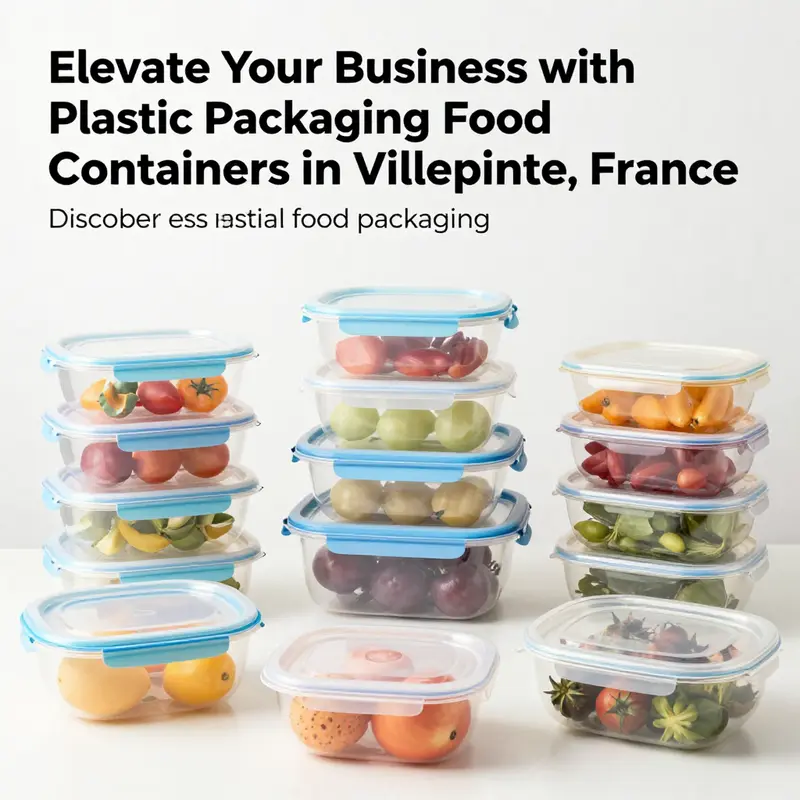
Plastic packaging food containers are integral to the food industry in Villepinte, France. With the increasing demand for efficient, reliable, and attractive packaging solutions for various business sectors—from bubble tea shops to catering services—understanding the landscape of these products is crucial. Each chapter will guide you through the most common types of plastic food containers, regulatory compliance that ensures safety, trends towards sustainable options, effective sourcing channels, and the broader impact of these solutions on the local food industry.
Sustainable Packaging in a Dynamic European Trade Hub

Villepinte, a major logistics and exhibition hub in the Île-de-France region, orchestrates a complex choreography of producers, distributors, retailers, and researchers who rely on plastic food packaging containers to preserve safety, quality, and consumer appeal. The packaging landscape here is driven not only by performance and cost but also by speed, reliability, and the ability to scale during large events. In practice, containers must balance barrier properties, readability, and ease of use with ongoing commitments to sustainability and circular economy principles.
Two polymers—polypropylene (PP) and polyethylene terephthalate (PET)—are common workhorses in Villepinte’s food-contact applications, offering clarity, toughness, and temperature resilience for a broad range of foods. For fresh produce and ready-to-eat meals, HDPE or LDPE variants provide robust moisture barriers and impact resistance. Where display and single-serve formats are essential, rigid polystyrene may still be encountered, though the shift toward recyclability and lighter weight has accelerated substitution with more recyclable materials. The design language often emphasizes stackability, labeling convenience, and compatibility with cold-chain handling.
Sustainability considerations increasingly shape material choice and packaging architecture. Regulators and industry bodies promote recyclability, recyclability scores, and, where feasible, the use of recycled content or biobased materials such as PLA. The transition is gradual and context-dependent, requiring careful evaluation of regulatory compliance, consumer safety expectations, and supply chain realities. In parallel, end-to-end lifecycle thinking—from source to disposal—drives brands and exhibitors to highlight transparency, recyclability pathways, and responsible end-of-life management.
Regulatory frameworks at the European and national levels govern migration limits and safety standards for food-contact plastics. EU Regulation 1935/2004, its amendments, and guidance from agencies like EFSA and ANSES provide the backbone for compliance. The practical implication is that packaging must not introduce harmful substances into food or mislead consumers, and manufacturers must document compatibility and safety across intended uses. In Villepinte and similar hubs, compliance is a baseline expectation that supports credible packaging programs and trusted supplier relationships.
Ultimately, the Villepinte packaging ecosystem serves as a living testbed for balancing performance, safety, and environmental stewardship. It showcases how digital sourcing, standardized specifications, and collaborative innovation can drive better outcomes for exhibitors, researchers, and consumers alike, while supporting the broader European push toward sustainable, transparent, and resilient food systems.
Navigating Compliance: Regulations and Standards for Plastic Food Packaging in Villepinte, France
Villepinte’s role as a logistics and exhibition hub places it at the intersection of production, retail and regulation for plastic food packaging. Manufacturers, packers and retailers who operate here must meet a layered set of rules. These rules protect food safety, limit hazardous migration from materials, enforce traceability, and push packaging toward greater circularity. The result is a practical compliance landscape shaped by EU directives, national law, and international standards. Understanding how those pieces fit together helps local businesses design, source and use plastic food containers responsibly.
At the European level, food-contact safety is built around a clear legal backbone. The regulation commonly cited in France and across the EU requires that materials intended to come into contact with food must not transfer their constituents to food at levels that endanger human health. Specific migration limits, authorized substances, and conditions of use are all defined within that framework. For businesses in Villepinte, this means selecting plastics, additives and inks that are on permitted lists, and being prepared to demonstrate compliance through documentation and testing. Food safety authorities in France use these EU rules when evaluating packaging used in catering, retail prepack, or industrial food processing.
Overlaying food safety, recent European policy shifts seek to curb plastic waste and accelerate circular economy goals. The Single-Use Plastics Directive and the broader EU plastics strategy target the most pollution-prone items. Member states, including France, translate these directives into national law. The French Anti-Waste and Circular Economy Act requires changes in product design, restricts certain single-use items, and establishes obligations for labelling and extended producer responsibility. For plastic food containers in Villepinte, the practical consequences are tangible: some single-use designs are phased out, reusable or recyclable design features are encouraged, and manufacturers face new responsibilities for end-of-life collection and financing.
Compliance in practice involves several essential steps. First, material selection must align with food-contact rules. Common polymers such as polypropylene (PP), polyethylene (HDPE, LDPE) and polyethylene terephthalate (PET) remain widely used because of their performance and established safety profiles. Yet manufacturers must ensure that any additives, colorants and processing aids are authorized and do not exceed migration limits for the intended food type and temperature. Second, documentation must be robust. Declarations of compliance, migration test results, and formulation data must be available and traceable to batches of material and finished containers. Third, labelling and instructions should reflect legal requirements and user safety—this includes microwave instructions, temperature limits, and statements about suitability for food contact where relevant.
French authorities expect traceability across the supply chain. Businesses operating in Villepinte should keep records linking finished containers to raw material suppliers, manufacturing lots, and test certificates. Traceability supports rapid corrective action if a safety concern arises. It also helps with regulatory reporting, particularly under extended producer responsibility schemes. These schemes require producers to account for the waste generated by their packaging and to fund collection or recycling programs. The administrative burden can be significant, so early planning pays off.
Testing and third-party verification are central to demonstrating compliance. Migration testing replicates conditions of use to measure the transfer of chemicals into food simulants. Specific migration limits are applied to key substances. When manufacturers claim compostability for biobased plastics, they must reference recognized standards and perform biodegradation and disintegration tests under defined conditions. International standards provide the basis for such claims. ISO standards on biodegradation and classification are used to validate compostable labels. Conformity to these standards helps avoid misleading environmental claims and ensures that compostable packaging behaves as intended in industrial or home compost settings.
Beyond lab safety and biodegradability, design for recyclability is an increasing regulatory focus. The AGEC law in France and EU guidance push designers to consider recyclability from the start. This includes using single polymer constructions where possible, avoiding problematic additives, and designing lids, seals and labels to be compatible with common recycling streams. Villepinte companies that invest in eco-design reduce the risk of non-compliance with upcoming eco-design requirements and improve the circularity profile of their packaging.
Operationally, small and medium businesses in Villepinte should adopt practical compliance workflows. Start with a compliance matrix that maps material, intended use, temperature range and target market. Next, create a documentation package for each SKU: material declarations, migration tests, intended-use statements and label mock-ups. Establish supplier agreements that require timely certificates and ensure access to formulation data. Set up batch traceability and a system to preserve certificates for regulatory audits. Finally, plan for end-of-life: know which recycling streams accept the chosen polymer, and include that information in supplier communications and customer-facing materials.
For packaging claimed as compostable or biodegradable, rigorous care is required. Compostability claims must be backed by valid certification and testing, not marketing. ISO standards cover biodegradation and compostability terminology and test methods. These standards help confirm that materials degrade within expected timeframes and do not leave harmful residues. If a packaging item is presented as industrially compostable, the manufacturer should ensure local composting facilities accept the material. In Villepinte, where commercial and municipal compost systems vary, a claim without practical end-of-life solutions risks regulatory scrutiny and consumer confusion.
Retailers and food service operators in Villepinte face their own compliance tasks. They must verify that containers used for hot food, chilled products or takeaways match stated performance. They should ask suppliers for documented evidence of suitability for the intended food contact conditions. When offering packaging alternatives—reusable, recyclable, or compostable—operators should ensure that communication to customers is accurate and aligned with local waste collection practices. Incorrect labelling, or unsupported environmental claims, can trigger enforcement action.
Practical sourcing in Villepinte benefits from local relationships and industry events. Suppliers familiar with French and EU rules can provide compliance-ready packaging. Trade exhibitions also connect buyers with manufacturers and laboratories that understand migration testing and eco-design. For small caterers or retailers seeking ready-to-use containers, a relevant example of available items is a transparent sauce container with lids that suits portioning and short-term storage (https://ecocupbowl.com/product/disposable-sauce-box-sauce-cups-transparent-conjoined-plastic-box-sauce-container-box-with-lids-kitchen-home-supply/). When choosing such items, buyers should request declarations of compliance and verify the product’s declared use conditions.
Finally, authoritative references support technical decisions. For standards on biodegradability and compostability, consult the official ISO catalog entry for guidance on test methods and classification. This resource explains relevant ISO standards and how they apply to claims about environmental performance: https://www.iso.org/standard/85393.html. Aligning product design and claims with these standards reduces regulatory risk and enhances market acceptance.
Compliance in Villepinte is thus a practical exercise in matching material choice, testing and documentation with legal and environmental expectations. Businesses that plan from material selection through end-of-life will find it easier to demonstrate safety, avoid restricted items, and respond to audits. Clear records, validated claims, and supplier cooperation form the backbone of responsible packaging operations here. By building those systems, Villepinte’s food economy can meet both the strict safety standards and the growing demand for more sustainable packaging solutions.
How Villepinte Is Shifting Plastic Food Containers Toward Circular, Low-Impact Designs

A practical transition to sustainable plastic packaging is unfolding in Villepinte, France. The town’s role as a major logistics and exhibition hub places it at the crossroads of supply chains and innovation. That positioning accelerates adoption of alternative materials, recycling solutions, and design choices that reduce environmental impact while meeting strict food-safety requirements. This chapter examines how local industry, regulatory drivers, and practical constraints shape sustainable plastic food containers used across restaurants, retailers, and food processors in the Villepinte area.
Local demand is driven by two clear forces: regulation and consumer expectation. European rules on food-contact materials require traceable, tested components and set migration limits that packaging makers must respect. French authorities also publish specific guidance on chemical risks. Businesses in Villepinte respond by prioritizing materials that either meet established food-grade criteria or can be validated through accepted testing regimes. Simultaneously, end customers ask for packaging that looks and feels responsible. That combination pushes buyers away from single-use virgin plastics and toward materials or systems that claim lower life-cycle footprints.
A range of material strategies has emerged. Some suppliers switch to biobased polymers such as polylactic acid (PLA). PLA is attractive because it derives from renewable feedstocks and can be certified compostable under appropriate standards. In Villepinte, PLA often replaces conventional clear containers for salads, desserts, and chilled meals. Its transparency and printability match retail needs while signaling eco intent to consumers. Other companies favor lightweight PET or recycled PET (rPET) for clear trays and clamshells. Recycled PET retains barrier and strength properties while offering a lower carbon footprint than new PET when supply chains are well controlled.
Beyond material choice, design changes contribute to impact reduction. Lightweighting reduces raw material per unit. Stackable geometries cut transportation volume. Multi-part designs are simplified to make separation and recycling easier. Barrier layers are minimized or replaced with mono-material constructions so containers do not become non-recyclable composites. Many Villepinte suppliers now prioritize mono-material trays and lids, even when doing so requires subtle reengineering of oxygen or moisture barriers.
Recycling and recovery are critical to make these choices meaningful. The Île-de-France region has been a focal point for pilot projects that recover post-consumer plastics and reprocess them into food-contact-grade resin. Technologies such as advanced sorting, washing, and decontamination steps allow more post-consumer streams to be fed back into packaging production. Local companies invest in mechanical recycling upgrades and work with third-party recyclers to validate the safety of rPET and other recycled polymers for food use. In parallel, chemical recycling is being assessed where mechanical routes cannot restore material quality.
Certification and traceability underpin market confidence. Suppliers seek third-party verification for compostability or recycled content claims. They also maintain traceability systems that show the origin of feedstocks and the processing chain. For food operators, adherence to EU food-contact legislation provides legal reassurance. Many Villepinte purchasers now require supplier dossiers that include migration testing, compositional declarations, and end-of-life instructions. Those documents help food handlers choose packaging that fits both safety and sustainability goals.
Operational realities in Villepinte shape what is practical. Catering firms and fast-casual outlets need containers that perform under heat, cold, and transport stress. They require leak resistance, stackability, and reliable lids. For that reason, some businesses prefer rPET or carefully screened polypropylene blends rather than compostable polymers that can lose structural integrity with heat. At the same time, many smaller takeaways adopt compostable cups or sugarcane-based fiber boxes where performance under typical use is adequate.
Small-format containers deserve special mention. Sauce pots, portion cups, and condiment tubs are ubiquitous in quick-service operations. Replacing these requires both suitable materials and compatible sealing. Many Villepinte suppliers now offer recyclable clear sauce cups made from mono-material plastics that balance barrier performance and recyclability. For buyers seeking ready-to-use options, a local retail supplier lists a range of clear disposable sauce pots and lids designed for food use, providing a practical bridge between convenience and circularity: disposable sauce box sauce cups.
Economic incentives and public policy also matter. French and regional programs fund trials for recycling infrastructures and support companies that invest in eco-innovation. Extended Producer Responsibility schemes create financial motivators for manufacturers to design for recycling. In Villepinte, some exhibitors and logistics operators work with municipal authorities to pilot collection streams that segregate food-contact plastics, enabling higher-quality recycling feedstocks. These collaborations help lower the cost of switching to recycled materials and validate new collection workflows.
However, challenges remain. Compostable plastics require appropriate industrial composting facilities to deliver environmental benefits. Where municipal collection does not include commercial composting, compostable items may contaminate recycling streams. Mixed-material packaging still causes sorting problems and frequently ends up in refusals. Food residue also complicates recycling. Successful recovery often demands improved consumer and operator sorting at point of discard. Training staff in quick-service outlets on how to separate trays, lids, and food waste reduces contamination and increases recycling yields.
Food safety presents another constraint. Any recycled polymer destined for food contact must be demonstrably decontaminated. Testing regimes and regulatory reviews set the bar high. Small processors may lack the resources to carry out comprehensive migration testing, so they rely on certified suppliers. This reliance fosters supply chains where validated rPET and rPP resins are centralized in the hands of a few processors who can shoulder compliance costs. That centralization speeds adoption but can also create supply bottlenecks if downstream demand grows faster than recycling capacity.
Communication and labeling play a central role in adoption. Clear, consistent labeling telling customers how to dispose of packaging improves recovery rates. Villepinte food service operators increasingly display disposal guidance alongside menu items. Retailers use visible marks to indicate recycled content or compostability. Transparent communication reduces confusion and helps ensure materials follow the intended end-of-life stream.
Finally, systems innovation complements material changes. Reusable container schemes are being trialed in the region for takeaway meals. These systems rely on logistics networks, washing infrastructure, and deposit schemes. Villepinte’s exhibition calendar helps accelerate such pilots since large events concentrate catering demand and provide testing grounds for returnable programs. When combined with lightweight recyclable single-use containers, reusable schemes offer a layered approach to reducing plastic waste.
The path forward in Villepinte is pragmatic. Stakeholders balance food safety, cost, and performance while pursuing lower-impact materials and better recovery. That balance drives a mixed landscape: compostable items where appropriate, rPET and mono-material plastics for demanding applications, and investments in sorting and recycling to close loops. As regional policy and infrastructure evolve, Villepinte’s role as a logistics and trade hub will continue to shape practical solutions that can scale across Paris and beyond.
For practitioners seeking deeper guidance on eco-innovation in packaging and regional support programs, the Paris Île-de-France Regional Development Agency provides authoritative resources and case studies. Visit ADEME for detailed reports and implementation tools: https://www.ademe.fr
Sourcing Plastic Food Containers Near Villepinte: Practical Channels, Compliance, and Local Logistics

Sourcing plastic food containers around Villepinte: practical channels and what buyers need to know
Villepinte sits within a dense logistics and trade ecosystem east of Paris. That position shapes how food businesses, retailers, caterers, and meal-prep operators source plastic packaging. Instead of a single supplier model, procurement typically relies on a mix of digital marketplaces, trade events, regional distributors, and direct manufacturer partnerships. Each channel brings distinct advantages for lead time, customization, regulatory paperwork, sustainability options, and cost control. Understanding how they interlink helps buyers secure the right containers while meeting EU food-contact rules and local delivery expectations.
Online B2B platforms act as the first discovery layer for many buyers. These platforms let procurement teams filter suppliers by country, material, certifications, and minimum order quantity. They are useful for comparing technical specifications side by side. For example, buyers can filter for containers made from PET, PP, or HDPE, or search for compostable options based on industrial standards. The platforms also surface manufacturers across nearby EU countries, which matters for shorter lead times and simpler customs procedures. When using these marketplaces, request full compliance documentation up front. That includes declarations on food-contact legislation, test reports for overall and specific migration, and statements about additives that might be restricted in the EU.
Industry trade shows and regional exhibitions form another vital channel. Trade events hosted in and around the Paris region bring together packaging suppliers, converters, and design studios. They are the best places to inspect material clarity, lid fit, and sealing performance in person. For operators with a curated menu or branded takeout range, trade events also speed up sampling and negotiation. A single face-to-face meeting can collapse weeks of email exchanges into concrete sample tests and production timelines. Buyers should plan visits with clear technical questions: thermal tolerance, stackability, sealing types, and recyclability classification. Carrying back a set of test samples to your kitchen or packing line will reveal whether a container withstands handling and reheating, and whether it fits existing shelf or cooling racks.
Regional distributors and wholesalers supply many local businesses that need rapid replenishment. These partners stock a range of standard sizes and often offer small-case quantities. They can be the fastest channel when speed matters. Distributors typically provide local delivery across Île-de-France and can handle order consolidation for multiple sites. They also simplify returns, exchanges, and urgent reorders. When relying on distributors, confirm their traceability systems. Ask how they handle batch tracking, expiry or shelf-life labeling, and whether they keep material safety data available for food-safety audits.
Direct sourcing from European manufacturers makes sense for high-volume, custom, or proprietary designs. Manufacturers in neighboring EU countries often offer injection-molding or thermoforming capabilities. The benefits include tighter control over material formulations, custom lid geometry, and branded embossing. Direct contracts can include tooling investments and defined production runs. Yet direct sourcing increases the need for robust quality assurance. Buyers should budget for initial sample validation, pilot runs, and independent third-party testing. Include acceptance criteria in the contract, such as dimensional tolerances, seal integrity under defined temperature ranges, and permissible rates of aesthetic defects.
Local converters and small-scale packaging shops can bridge the gap between wholesale and bespoke production. These firms often convert bulk film into trays, seal preformed containers, or apply barrier coatings. They are useful for short runs, co-packing, or applying local labeling and printing. Work with converters when you need finished, shelf-ready units and want minimal handling between production and distribution.
Across every channel, two procurement priorities must dominate: regulatory compliance and sustainability. EU food-contact legislation requires documentation for all materials that touch food. Buyers should expect a materials declaration referencing relevant EU rules and, when applicable, national guidance. For many foodservice applications, testing for migration of specific substances is routine. Some buyers now ask for certifications that demonstrate reduced chemical migratory risk, such as independent lab reports and supplier quality certifications.
Sustainability is not optional for many customers and buyers. Demand for recyclable PET and mono-material PP containers has risen. Some operations prefer bio-based polymers for cold foods and single-service items. Others focus on designs optimized for recycling streams, such as clear PET with removable labels. When evaluating sustainability claims, request proof: mass balance statements, recycled content certificates, or independent compostability test results if the item is marketed as biodegradable. Also confirm local recycling compatibility; a material technically recyclable may not be accepted in every municipal stream.
Practical procurement steps streamline sourcing and reduce risk. Begin with a short list of acceptable materials and the intended service conditions. Define required thermal tolerance, sealing method, and stacking load. Use sample approval checklists that cover physical fit, leak tests, microwave or oven withstand (if applicable), and labeling adhesion. When you receive samples, run them through your full handling chain: filling, sealing, storage, transport, and reheating. That will expose weak points that laboratory tests might miss.
Negotiate lead times and minimum order quantities early. Smaller food operators will benefit from distributors or converters that offer split-case purchasing. Larger buyers should factor tooling amortization and negotiate phased deliveries. Ask suppliers about buffer inventory options near Villepinte. Proximity matters; local warehousing reduces stockouts for seasonal demand spikes. Look for suppliers who can ship palletized loads to the local logistics hubs serving Villepinte with reliable lead times.
Quality control must become a contractual deliverable. Require incoming inspection reports, batch traceability, and corrective action procedures. Agree on acceptable packaging defects and a process for handling nonconforming lots. Consider random third-party tests for migration and mechanical strength on initial production runs. These precautions protect food safety and brand reputation.
Cost considerations extend beyond unit price. Calculate the landed cost including transport to Villepinte, customs if applicable, storage, and potential waste management fees for non-recyclable products. Factor in the total cost of ownership: replacement frequency, breakage rates, and disposal costs. Often, a slightly higher-priced, more durable container will prove cheaper over time.
Finally, align sourcing choices with your operational model. Quick-service kitchens need containers that stack, seal fast, and tolerate rapid filling lines. Retail prepackers prioritize crystal-clear clamshells with tight seal performance for shelf life. Meal-kit providers seek stackable, oven-safe trays for final-assembly reheating. Knowing your end-use narrows the supplier field and speeds up approvals.
For buyers who want a hands-on starting point, inspect local product pages that showcase common formats, such as sauce pots and sample clamshells, to compare dimensions and lid styles before requesting custom quotes. One practical reference for such formats is this disposable sauce box product page. For a concentrated supplier directory to identify verified European manufacturers and distributors, consult a regional industry listings portal: https://www.europages.com
Selecting the right sourcing channel near Villepinte blends strategic choice with operational realism. Use digital platforms to scope options, trade events to validate performance, distributors for speed, and direct manufacturers for scale. Combine regulatory diligence with sustainability verification and practical sample testing. That integrated approach reduces surprises and secures packaging solutions that perform reliably in kitchens, on shelves, and during delivery.
Rethinking Freshness and Footprint: The Role of Plastic Packaging in Villepinte’s Food System

Villepinte, now recognized as a vital logistics and trade hub on Paris’ eastern fringe, sits at a crossroads where transportation efficiency, retail dynamism, and consumer demand intersect. In this environment, plastic food packaging containers occupy a quiet but indispensable role. They are more than disposables or shipping aids; they are the interface between safety, product quality, and the speed of service that shapes the daily lives of restaurant patrons, supermarket shoppers, and home cooks. The city’s surrounding networks—warehouses, food processors, caterers, and retail outlets—rely on packaging that can protect, present, and preserve across the chain from the moment a product leaves a production line to the point of purchase and, in many cases, beyond to the home freezer or lunchbox. This reliance has grown in step with Europe’s broader packaging trends, where the balance between performance and responsibility drives material selection, design, and end-of-life outcomes. The Villepinte ecosystem thus offers a microcosm of how plastic packaging informs operational efficiency, consumer trust, and regulatory compliance in a densely interconnected food market.
At the practical level, the common materials in Villepinte’s packaging mix reflect both performance needs and regulatory realities. Transparent polypropylene and polystyrene containers are widely used for ready-to-eat items such as salads, hot or cold side dishes, and sealed meals. Their transparency allows shoppers to inspect contents without opening the package, an attribute that complements the fast-moving dynamics of urban food retail and quick-service dining. The heat tolerance of these plastics supports a range of food items, from chilled entrées to microwave-ready portions, enabling a smoother transition from display to plate. Yet the choice of material is never purely about visibility or temperature. It also concerns stacking efficiency, seal integrity, and compatibility with labeling and traceability requirements that help keep product information accessible to both staff and consumers. Sealed takeaway boxes with lids are another staple in Villepinte’s market, serving households for short-term storage and schools or offices for lunch provisions. These containers are typically designed for food-grade safety, take into account EU packaging standards, and emphasize stackability to make the most of storage and transport space. For fresh produce and everyday groceries, HDPE or LDPE bags and trays provide moisture resistance and cushioning against minor impacts during handling. In a city and region where logistics costs are as consequential as taste and texture, packaging choices that reduce bulk, protect integrity, and minimize damage become strategic levers for efficiency and waste reduction.
All of these material choices occur within a tightly regulated framework. In France, as in the rest of the European Union, plastic food contact materials must comply with the general provisions of EC No 1935/2004, which establish a framework ensuring that materials intended to come into contact with food do not pose a health risk or cause unacceptable changes in the safety or quality of food. The regulation is complemented by migration limits that govern the transfer of substances from packaging into food. Updates in recent years, including specific restrictions related to certain substances such as bisphenols and phthalates, shape not only what can be used but how these substances are controlled and reported throughout the supply chain. Within Villepinte’s network, manufacturers and packaging suppliers align with these rules, adopting compliance processes that encompass material testing, validation of migration limits, and documentation designed to support recalls or market withdrawals if necessary. At the national level, French authorities such as ANSES provide risk assessment guidelines, while DGCCRF oversees consumer protection and market surveillance. The confluence of EU-wide standards and national enforcement creates a consistent baseline that helps Villepinte’s food operators maintain product safety and consumer confidence even as they pursue new packaging innovations.
Beyond safety, the packaging conversation in Villepinte is also increasingly about sustainability. The European push toward a circular economy has amplified the call for recyclable, reusable, and biodegradable materials, as well as designs that optimize end-of-life outcomes. In practice, this has meant a growing interest in materials that can be efficiently separated and processed in local or regional recycling streams. Some stakeholders are exploring bio-based alternatives such as polylactic acid or other biopolymers, while others emphasize the use of recycled content or more easily recyclable formats such as PET or certain multilayer structures that can be disassembled for recycling. The emphasis is not merely on the material itself but on systems: how packaging is labeled for recyclability, how it is collected, and how it is processed in municipal or private waste streams. Consumers in Villepinte, like elsewhere, increasingly expect packaging to be more than a barrier between food and environment; they want packaging to be part of a responsible lifecycle. In practice, this means collaboration among producers, packaging converters, distributors, and waste managers to close product loops and minimize the environmental footprint of a takeaway meal or a prepacked product from the moment it leaves the plant to the moment the consumer disposes of it.
The local procurement landscape in Villepinte reflects this dual demand for performance and sustainability. Purchasers frequently turn to a mix of channels to source plastic food containers that meet both functional requirements and regulatory standards. Local trade shows and industry events, such as the annual presence of international food expos in the Villepinte corridor, provide a concentrated view of the available packaging options and the latest developments in safety-compliant designs. Online marketplaces also play a role, enabling buyers to compare specifications, certifications, and lead times across a wider set of suppliers. For those seeking more tailored packaging solutions, specialist packaging firms in the Île-de-France region offer design support, customization, and material optimization that can align with specific menu concepts, portion sizes, or branding requirements. In this context, the supply chain becomes a collaborative space where performance, safety, and sustainability are co-optimized rather than pursued in isolation.
Within this evolving landscape, a notable tension persists between the desire for advanced functionality and the imperative to minimize environmental impact. For example, containers that are particularly robust for hot foods or for long display life may rely on barrier properties or multilayer constructions that complicate recycling. Conversely, simpler single-material designs can support higher recycling rates but may fall short in terms of mechanical performance or heat resistance. Villepinte’s operators navigate these trade-offs by assessing the end-to-end implications of packaging choices—how a container protects quality during transport and storage, how it supports efficient stacking and handling in busy kitchens and supermarkets, and how easily it can be processed by local recycling facilities after use. In regions where cold chain integrity is essential, packaging design becomes part of the broader temperature management strategy. The choice of a container can influence energy use in refrigeration, the likelihood of leakage, and even the pace at which a customer can complete a purchase, all of which have tangible effects on cost and service quality.
An important dimension of Villepinte’s packaging narrative is the way procurement channels and regulatory expectations intersect with consumer awareness. For instance, as retailers and foodservice operators report increasing interest in sustainable options, packaging suppliers respond with material substitutes and design tweaks that maintain performance while reducing environmental burden. This dynamic is evident in the shift toward recyclable or compostable materials where feasible, the push for clear labeling that communicates recyclability or compostability to end users, and the development of lightweight yet sturdy designs that minimize material usage without compromising safety. The broader European policy environment, including movement toward stricter oversight of packaging materials and more explicit migration restrictions, pushes suppliers to invest in better testing, more transparent supply chains, and stronger traceability. Villepinte’s market thus embodies a practical synthesis of safety, efficiency, and responsibility, where each packaging decision reverberates through the cold chain, the retail floor, and the consumer’s waste bin.
For readers tracking how this translates into on-the-ground practice, consider the following thread running through Villepinte’s food packaging ecosystem. First, there is a continuous emphasis on compliance with EC No 1935/2004 and its migration limits, with regular testing and documentation woven into production and distribution workflows. Second, there is a growing adoption of environmentally friendlier options that balance performance with recycling or biodegradability considerations, recognizing that end-of-life outcomes matter to both public authorities and customers. Third, the purchasing process in this region frequently blends in-person sourcing with digital sourcing, leveraging trade events and online marketplaces to compare options across price, lead time, and environmental credentials. Finally, the role of design is increasingly critical. Containers are no longer judged solely by how well they hold a portion, but by how easily they can be separated, recycled, or repurposed, and how well they contribute to a transparent, traceable supply chain that satisfies labeling and safety requirements.
The chapter’s synthesis echoes a broader reality: Villepinte’s food packaging sector is a living example of how regulation, technology, and consumer expectations shape a complex system. The city’s packaging choices influence product quality and safety as much as they influence operational efficiency and environmental outcomes. The result is a market that values resilient materials, clear compliance pathways, and adaptable solutions that keep pace with shifting demands—whether a neighborhood bistro introduces a new ready-to-eat menu, a regional retailer expands its prepacked fruit lines, or a logistics operator optimizes cold-chain packaging for maximum shelf life. In this sense, plastic packaging in Villepinte functions not merely as a protective layer but as an enabling technology for a dynamic urban food economy, one that strives to deliver freshness with a lighter footprint and to do so within a regulatory framework that supports public health and consumer confidence.
As an example of the ongoing evolution within the packaging ecosystem, consider the broader supply chain collaboration required to bring these options to market while still aligning with European standards. Packaging decisions require input from materials scientists, food safety officers, logistics planners, and sustainability officers. Each stakeholder contributes to a shared objective: reliable performance across diverse use cases, from quick-service counters to prepackaged retail aisles, while ensuring that compliance records, migration testing, and end-of-life considerations are traceable and robust. The Villepinte market thus offers a compact lens through which to observe how flexibility, safety, and stewardship converge in practice, shaping choices that ultimately influence the quality, safety, and environmental profile of the food arriving at doors across the region.
For those seeking practical illustrations of the packaging options discussed here, a representative example of the eco-conscious packaging landscape can be found in one of the region’s broader supplier platforms, which highlights the potential of multi-compartment, takeout–ready solutions designed for fast food contexts. The option described here demonstrates how a single packaging format can address portion control, spill resistance, and consumer convenience, while still enabling recyclability in suitable streams. Such designs illustrate how Villepinte’s operators are balancing the need for robust performance with the momentum toward more sustainable packaging strategies. This balance will continue to shape the city’s food supply chain and its role in France and Europe as a whole.
External resource for regulatory context and safety considerations: https://efsa.europa.eu/en/topics/focus/plastics-food-contact-materials
Final thoughts
In Villepinte, the integration of plastic food packaging containers significantly influences the food industry, from enhancing visual appeal to ensuring compliance with strict safety regulations. As businesses adopt more sustainable practices, understanding the variety of packaging options and sourcing methods will not only satisfy consumer demand but also contribute positively to environmental goals. This evolving landscape presents an opportunity for food service providers to innovate and stand out in a competitive market.