
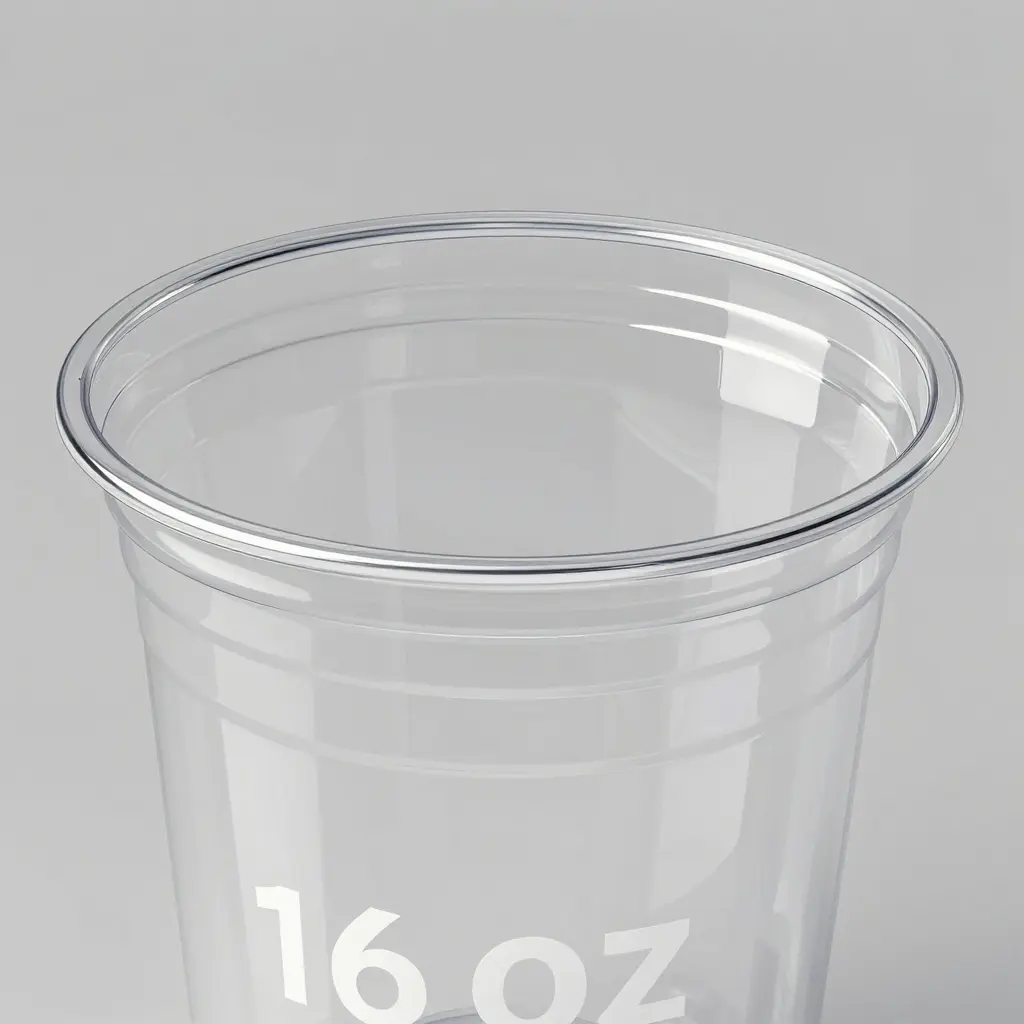
Why Rims Crack When Lids Are Snapped On
A 16 oz clear cup rim looks like a minor feature, but it behaves as a thin-walled ring. That one property accounts for most of the cracking that shows up once a snap-on lid goes on.
The Rim as a Thin-Walled Hoop
To seat a lid, the skirt has to flare over the rim bead while the lid’s inner wall presses against the inside of the rim. That outward pressure loads the rim as a ring in hoop stress – the circumferential stress carried around the rim. For a thin wall, hoop stress scales roughly as sigma = pD / 2t. Raise the pressure (p), thin the wall (t), or increase the diameter (D), and the rim moves closer to yield. Every snap puts strain energy into a section with very little material to absorb it.
Where the Loads Actually Come From
Snap-fit closure loading is rarely a single, clean force. Several effects usually stack up:
- Over-insertion force. Operators press past the designed snap point, turning a controlled interference into an axial crush.
- Tight lid undercut. An oversized undercut increases radial interference, which raises
pand hoop stress with it. - Insufficient rim wall thickness. A thin wall leaves less material to spread the load around the section.
- Stress concentration at the flange corner. The sharp transition where the rim meets the sidewall pushes local stress well above the nominal hoop value.
Bending, Not Just Hooping
The lid’s lip grips the rim from above and outside, so the load is not purely radial. Radial interference comes with bending: the rim’s outer edge is opened in tension while the inner corner goes into compression. The flange corner is the worst case, because it acts as a geometric notch that multiplies the local stress.
Environmental Stress Cracking Finishes the Job
A rim that survives the snap can still fail days later. Where residual stress remains, environmental stress cracking (ESC) can start at the rim edge, the site of highest local strain. Oils, cleaning agents, and other chemicals the cup contacts, along with moisture that drives hydrolysis, accelerate slow crack growth at that edge. That is why a cup can pass a bench test and then crack on a shelf in a warm warehouse.
The Failure Chain
Rim cracking is a chain rather than a single event: hoop stress builds, the corner concentrates it, and thermal history plus environmental exposure decide whether a microcrack spreads. The same closure-loading problem shows up on other thin-wall containers – see this analysis of closure loading on thin-wall screw-cap containers. Choosing the right PET grade and rim geometry breaks the chain before it starts.
| Failure Driver | Mechanical Effect | Mitigation |
|---|---|---|
| Over-insertion force | Axial crush + bending | Snap-point control, operator training |
| Tight lid undercut | Higher radial interference p |
Tolerance-match lid to rim |
| Thin rim wall | Low t, high hoop stress |
Increase wall section |
| Sharp flange corner | Stress concentration | Radius the corner |
| Thermal history | Differential shrinkage, residual stress | Control melt and mold temperatures |
| Moisture / chemicals | Hydrolysis and ESC at the edge | Dry resin, barrier packaging |
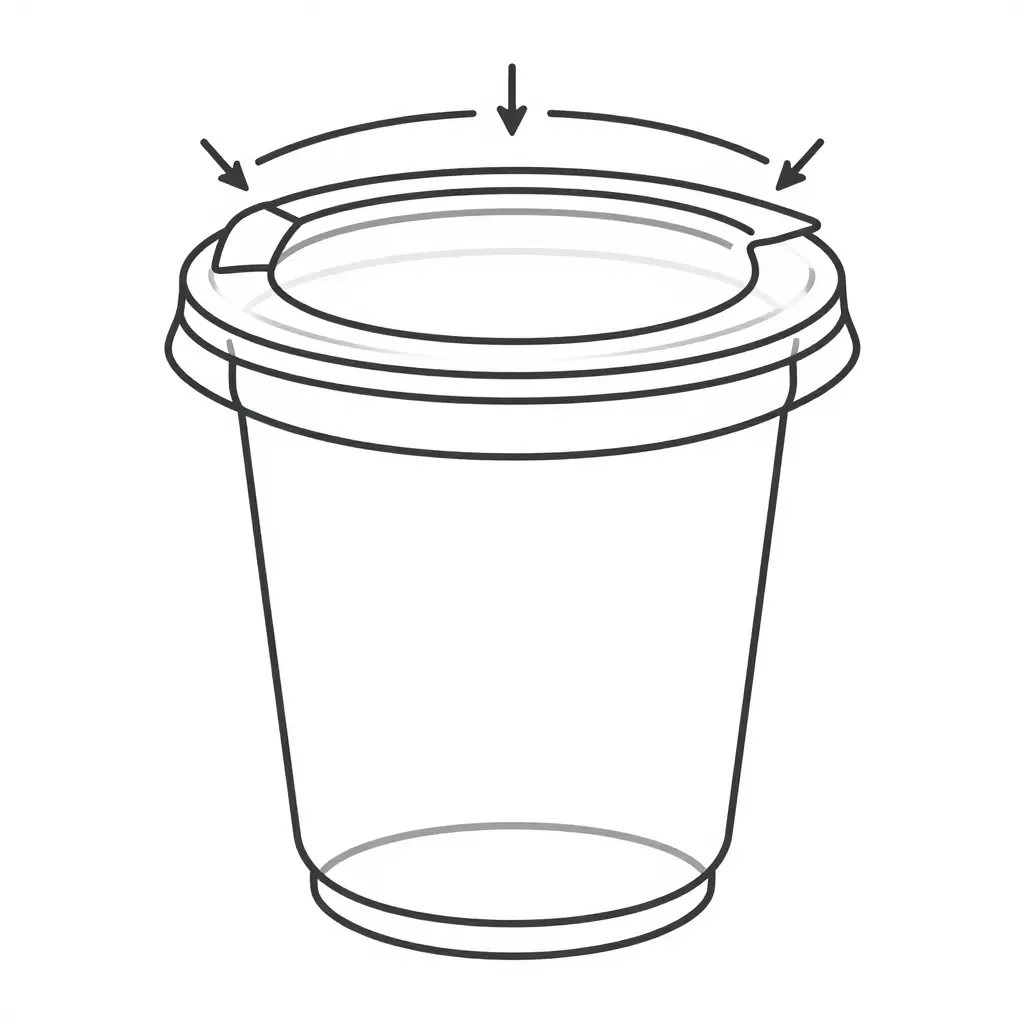
The diagram traces the load path that begins the moment a lid is snapped onto the cup. Two forces reach the rolled rim at the same time:
- Hoop stress (radial arrows). The lid presses the rim outward from inside while the skirt grips it from outside. The resulting hoop stress runs around the full circumference.
- Rim bending (downward arrow). Where the undercut engages the flange, the rim is levered downward, concentrating bending at the thin point of the rolled lip.
When hoop stress and bending combine at the same stress riser, the rim becomes the weak point in the container, and repeated snap-on and peel-off cycles drive microcracks until the lip splits.
Factors That Determine Whether a Rim Survives the Snap
When a lid snaps over the rim of a 16 oz clear plastic cup, the lip takes a fast, localized strain. Whether it recovers or tears depends on several material and geometry variables. The ones that matter most:
- Intrinsic viscosity (IV). Higher IV means longer chains and more entanglement, so the rim stretches under snap load instead of fracturing.
- Wall-thickness uniformity. A single thin spot acts as a stress concentrator, and the rim fails there rather than at its average thickness.
- Copolymer versus homopolymer resin. PET copolymerized with CHDM crystallizes more slowly and stays tough, while a fast-crystallizing homopolymer can turn glassy and brittle at the rim.
- Mold temperature and gate location. A cold mold, or a gate placed far from the finish, locks in orientation and weak weld lines where the rim is thinnest.
- Rim corner radius. A large, well-blended radius spreads the snap stress across the lip; a sharp corner concentrates it and starts the crack.
- Lid interference fit. Too much interference turns ordinary seating into a high-strain event that can exceed the rim’s elastic limit on the first snap.
- Moisture during filling and storage. Residual moisture drives hydrolysis that lowers effective IV, and humid storage plus temperature swings can crack rims days after filling, not only at capping.
No single variable decides rim crack resistance, so resin, tooling, and process settings are best judged together. Teams weighing the trade-offs often find that the cup body’s own thin-wall clarity and rigidity trade-offs also shape what the rim can survive.
When 16 oz clear cup rims crack under a snapped-on lid, the PET grade is one of the few variables fully under an engineer’s control. Intrinsic viscosity (IV) sets molecular weight, and with it stiffness and toughness, while the comonomer system tunes crystallinity and ductility. In a customized clear plastic cup, the table below maps common grades against the rim properties that matter for snap lids.
PET Grade Selection Matrix for 16 oz Clear Plastic Cups
| PET Grade / IV Range | Typical Comonomer Type | Relative Stiffness | Rim Crack Resistance | Clarity | Recommended Use for Lid-Snap Systems |
|---|---|---|---|---|---|
| Low IV (0.68-0.72 dL/g) | Homopolymer, none | Low | Poor | Excellent | Not recommended; avoid tight snap lids on thin rims |
| Mid IV (0.72-0.76 dL/g) | Homopolymer, none | Moderate | Fair | Excellent | Light-duty snap lids, low-stress or thick rims |
| High IV (0.78-0.84 dL/g) | Homopolymer, none | High | Good | Very Good | Best choice for high-retention snap lids |
| IPA-modified copolyester (0.74-0.78 dL/g) | Isophthalic acid (IPA) | Moderate-High | Good to Very Good | Very Good | Balanced option for medium-retention lids |
| PETG (0.70-0.75 dL/g) | CHDM | Low | Excellent (ductile) | Excellent | Premium snap-fit and flexible, crack-resistant rims |
| High-IV plus chain extender (0.80-0.86 dL/g) | Homopolymer + chain extender | Very High | Excellent | Good | Demanding multi-snap lids on thin-wall rims |
Grade choice does not act alone. Melt temperature, mold temperature, stretch ratio, and rim wall geometry all interact with the selected grade, and any of them can decide whether a rim survives repeated snaps.
Which PET Grade to Specify
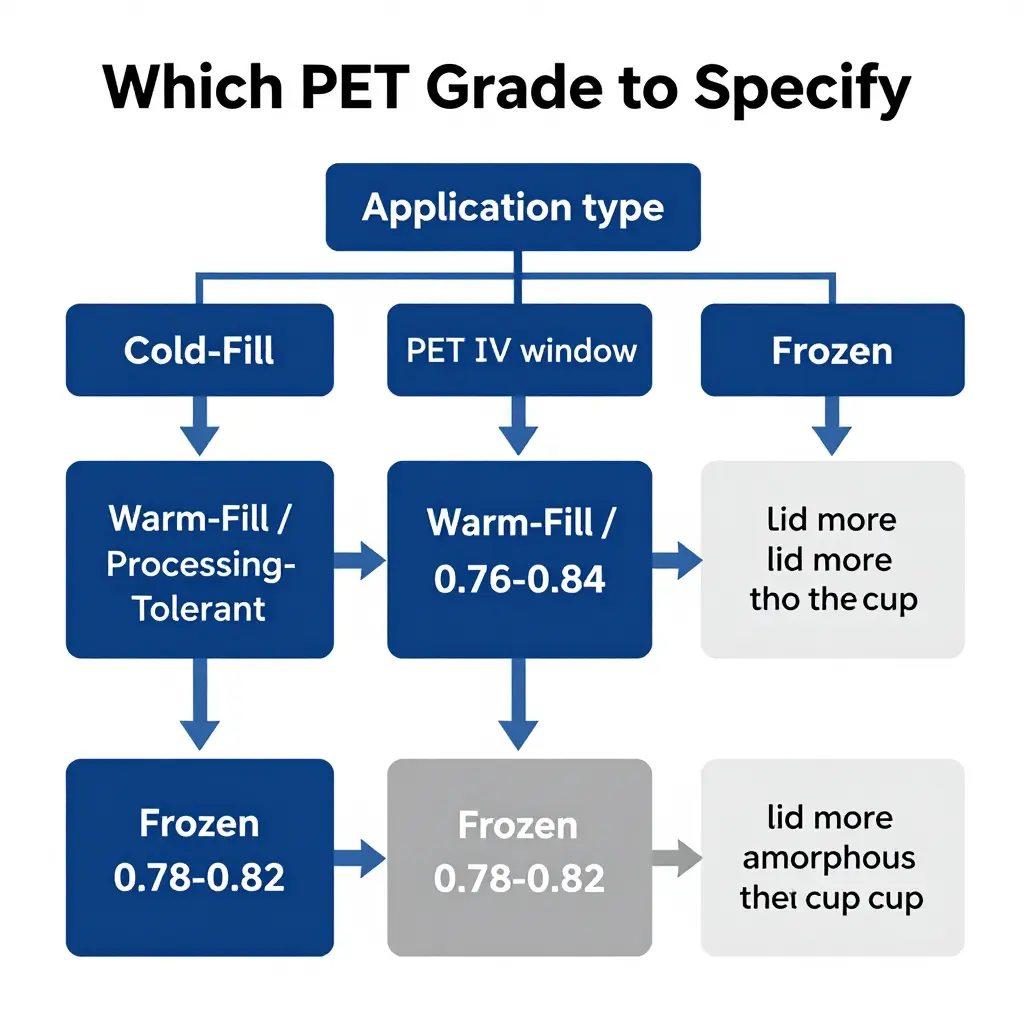
Rim cracking under a snap lid is often a grade mismatch rather than a mold defect. The rim fails when the snap stress exceeds its local strain tolerance, and the resin is one of the few things that can be changed without retooling. The framework below covers the base spec and the three main service conditions.
Start with the cup body: specify an IV window, not a number
A snap-fit rim has to flex locally without yielding permanently, and IV is what gives it room to do that. IV tracks molecular weight: longer chains absorb snap stress by stretching rather than fracturing. Below roughly 0.74 dL/g the rim loses much of its ductility and tends to crack; above roughly 0.84 dL/g melt viscosity and cycle time rise without a useful gain in toughness.
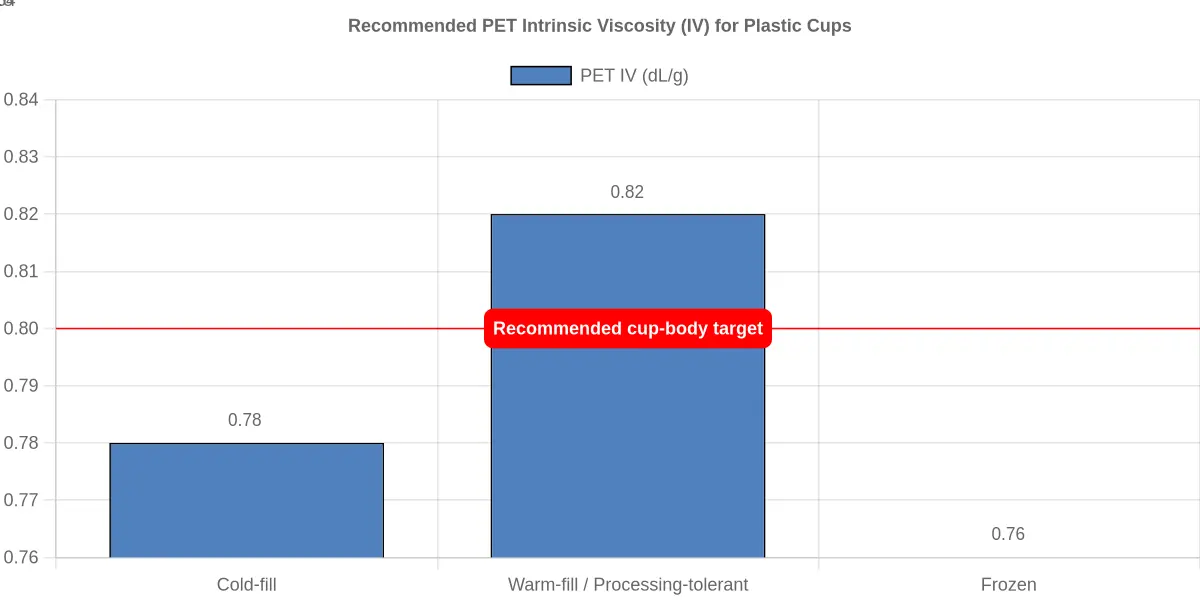
For snap-lid cups, specify the cup body at IV 0.80 +/- 0.02 dL/g (ASTM D4603), with a 2.8 +/- 0.3 mol% CHDM comonomer target. That comonomer level keeps the polymer slightly amorphous, which helps clarity and leaves the rim ductile.
Put it in spec language your supplier can quote directly: “PET, IV 0.78-0.82 dL/g, comonomer 2.8 +/- 0.3 mol% CHDM, IV tolerance window +/- 0.02 dL/g.” For the matching body geometry, review these 16 oz container specifications before locking your drawing.
| Application | Recommended IV (dL/g) | Comonomer target | Lid grade note |
|---|---|---|---|
| Cold-fill | 0.76 – 0.80 | 2 – 3 mol% CHDM | More amorphous than cup |
| Warm-fill / processing-tolerant | 0.80 – 0.84 | Low, high crystallinity | Higher-melting, heat-set lid |
| Frozen | 0.78 – 0.82 | 3 – 5 mol% CHDM | Flexible, low-modulus lid |
The lid should not mirror the cup grade
For a snap to work, one part has to yield before the other. If the cup and lid share the same high-modulus grade, the snap force concentrates at the weakest geometry – the rim – and it cracks. A more compliant lid deforms, rides over the rim, and survives repeated cycles. That is why the lid should not mirror the cup: keep it in a more amorphous, lower-modulus grade such as PETG, or a low-modulus PET copolymer at IV 0.70 – 0.74 with 28 – 32 mol% CHDM.
Cold-Fill Applications
Iced drinks and ambient service put almost no thermal load on the rim, so the constraint is mechanical. Target IV 0.76 – 0.80 dL/g and pair a rigid, high-clarity rim with a soft PETG lid. That is the most cost-effective balance for this service.
Warm-Fill and Processing-Tolerant Applications
Warm fills push the rim toward stress relaxation and creep, so it needs thermal headroom. Step up to IV 0.80 – 0.84 dL/g with a low-comonomer, higher-crystallinity recipe and a heat-set lid.
Frozen service inverts the logic: crystallinity and brittleness rise as temperature falls, so a stiff rim becomes a liability. Choose IV 0.78 – 0.82 dL/g with more CHDM (3 – 5 mol%) to keep the rim ductile at -18 °C. These notes on resin behavior under freezing explain how comonomer content drives low-temperature toughness.
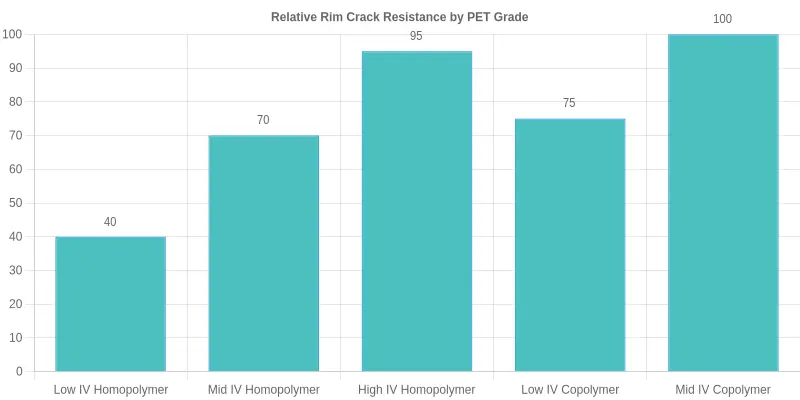
The chart indexes relative rim crack resistance across five PET grade configurations. As intrinsic viscosity (IV) climbs, the rim can absorb more of the deformation energy that builds up when a lid snaps over it. High IV Homopolymer (95) and Mid IV Copolymer (100) sit at the top of the range, while Low IV Homopolymer (40) is the most prone to stress cracking.
Why higher IV and comonomer content help
Rim cracking comes down to strain resistance. When a lid’s retaining bead flexes the rim outward, the polymer in that thin, cold-stretched section has to stretch and recover without splitting. Two molecular variables decide how well it manages that:
- Intrinsic viscosity (IV). Higher IV means longer chains and more entanglement, which raises resistance to brittle fracture – the reason the homopolymer ranking climbs from Low IV to High IV.
- Comonomer content. A comonomer such as cyclohexanedimethanol (CHDM) disrupts crystallinity, which raises toughness and slows crack growth. That is why Mid IV Copolymer (100) edges out even High IV Homopolymer (95) in a comparable processing window.
How to apply the ranking
The indexed values depend on your resin supplier, finish geometry, wall thickness, and lid interference fit, so read the chart as a directional ranking, not an absolute spec.
| Grade Configuration | Relative Crack Resistance (indexed) | Typical Use Case |
|---|---|---|
| Low IV Homopolymer | 40 | Low-stress, non-lid applications |
| Mid IV Homopolymer | 70 | General cups with moderate lid fit |
| High IV Homopolymer | 95 | Snap-lid cups needing high stiffness |
| Low IV Copolymer | 75 | Balance of clarity and toughness |
| Mid IV Copolymer | 100 | Best rim toughness for tight lids |
If 16 oz clear cups are cracking exactly where the lid bead grips, moving up the IV scale or toward a copolymer grade is usually faster than changing lid tooling. This plastic containers for the food industry reference guide covers how material and finish choices interact across a wider range of products.
Practical rules for grade selection
- Push IV up before you push wall thickness up. A higher-IV grade often buys more rim toughness than adding material, and it keeps cycle times and weights reasonable.
- Consider a copolymer for the tightest lid fits. When lid interference is aggressive, the comonomer balance pays off in less crack initiation.
- Validate with your own resin. Confirm the ranking using your actual grade, finish, and lid before locking a specification.
Before committing a PET grade and cutting production tooling, prove that the cup rim and lid survive real handling. The checklist below turns the material and geometry variables into measurable pass/fail gates.
-
Verify the IV certificate. Ask the resin supplier for the intrinsic viscosity (IV) certificate and confirm the value falls in the 0.76-0.84 dL/g window that gives the rim its strength. Reject any lot whose IV drifts below spec, since lower molecular weight weakens the rim exactly where the lid bites.
-
Measure rim wall thickness. Using a micrometer or optical gauge, measure rim wall thickness at four quadrants (0, 90, 180, 270 degrees) and confirm uniformity within +/-0.05 mm. Thin or eccentric rim walls are the most common cause of crack initiation during snap-on.
-
Run a snap-force test. Fixture the cup in a rigid holder and seat the matching lid with a calibrated load cell, recording peak snap force and any audible cracking. Compare the result against your target retention window, then re-test after 24 hours to capture stress-relaxation effects.
-
Check environmental stress crack exposure. Fill the assembled cup with the actual product and any cleaning agents it will meet, then hold it at elevated temperature for 48-72 hours. Inspect the rim for crazing or hairlines that signal the grade is too stress-crack sensitive for your application.
-
Confirm lid-to-rim compatibility. Validate the specific lid you plan to ship against the finished rim before freezing the design; a quick review of dome lid compatibility can prevent late-stage tooling rework.
These tests give you the evidence to choose a grade with confidence. Skip them, and you risk a resin that cracks on the first snap and forces late tooling changes.
Frequently Asked Questions
Do all 16 oz clear plastic cups crack when lidded?
No. Cracking is a stress-management failure, not something every cup does. A snap lid puts a stress concentration at the rim; if that stress stays below the material’s yield point and the geometry spreads it out, the rim keeps working. Cracking shows up when snap force, rim thickness, corner radius, and the chosen PET grade fall out of balance.
Does a thicker rim always prevent cracking?
No, and over-thickening often makes things worse. A heavier rim increases the stiffness mismatch with the lid, so the snap has to bend further and concentrates stress instead of relieving it. A larger radius and a slightly thinner, more compliant rim usually work better than more material.
Does recycling content affect crack resistance?
Yes. Regrind and recycled PET in food containers typically carry a lower intrinsic viscosity (IV) and shorter molecular chains, which cuts elongation at break. Above roughly 25-30% PCR, a rim can become noticeably more brittle unless the blend is compensated with a higher-IV virgin grade.
Does temperature change the required PET grade?
Yes. Cold or ambient filling can use standard bottle-grade PET. If the cup sees hot product or hot-fill, it needs a higher heat-deflection grade and careful hot-fill material considerations to avoid rim deformation and stress cracking.
How do I diagnose whether cracking is a resin or tooling problem?
Run the same resin across multiple molds and the same mold across multiple resin lots, then read the pattern:
| Symptom | Likely Cause | Corrective Action |
|---|---|---|
| Cracks only from one cavity | Tooling: sharp corner, cold mold | Increase radius, raise mold temp |
| Cracks across every mold | Resin: low IV or excess regrind | Specify higher PET grade, cut PCR ratio |
| Cracks appear days after lidding | Residual/orientation stress | Re-tune snap force and cooling |
Specifying for Reliable Rim Performance
Rims crack under snap-on lids because the bead concentrates stress exactly where the polymer is thinnest and least oriented, and a stiff, low-comonomer material cannot absorb that localized strain before it yields. For 16 oz clear plastic cups, a copolymer PET grade with an intrinsic viscosity around 0.78-0.84 dL/g balances the toughness and stress-crack resistance the rim needs against clarity and processability. Keep comonomer content high enough for impact strength, but not so high that the rim softens during lid application.
Treat the IV range and comonomer level as a starting specification, then confirm the final choice with drop, top-load, and lid-retention tests before committing to full production. ecocupbowl.com supplies food-grade cups and packaging and can help confirm a resin choice for your line; matching the cup to its lid and complementary packaging keeps the assembly consistent.