
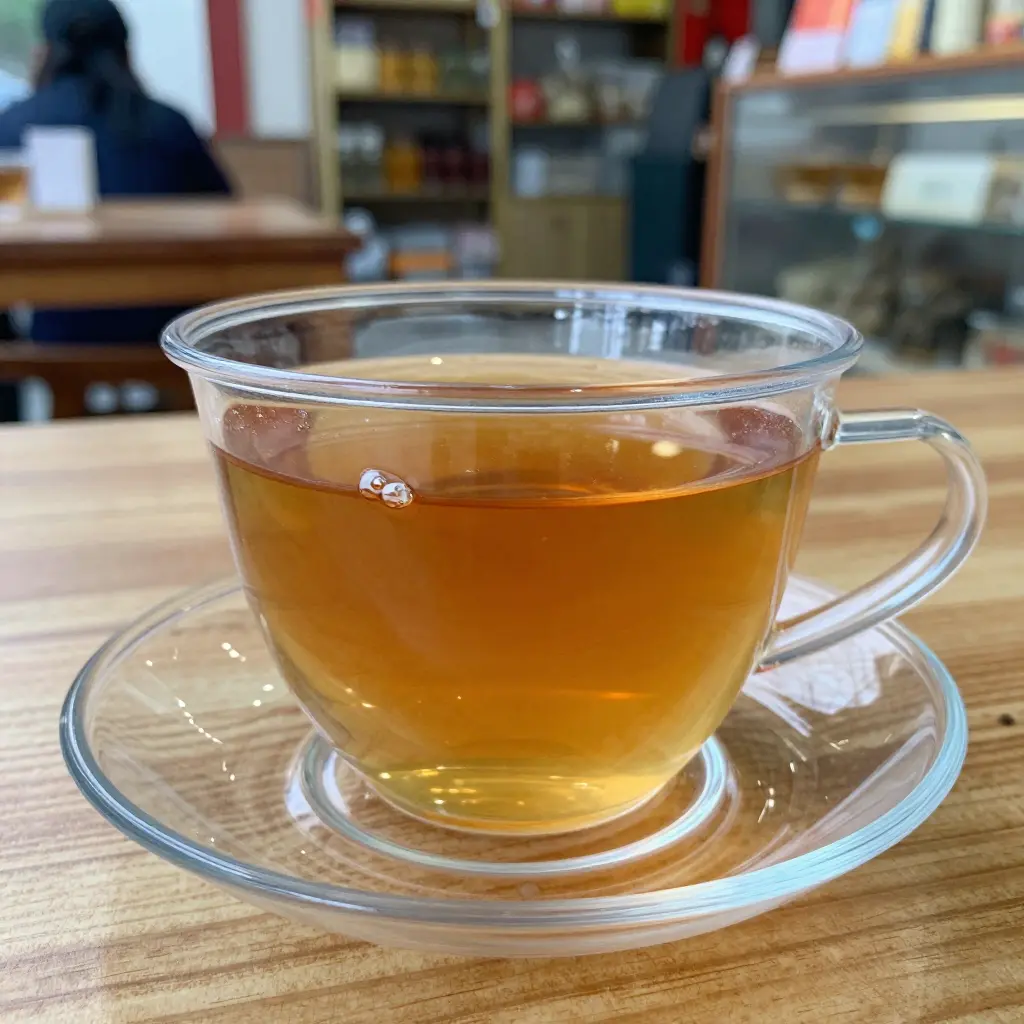
Why Does a Clear Plastic Tea Cup Rock on Its Saucer?
A customer pours hot tea into a clear plastic cup, sets it on the saucer, and the cup tilts and settles unevenly, sloshing tea across the saucer. Every lift feels unstable. For a cafe, caterer, or wholesaler, that wobble turns into complaints and returns on the next bulk order.
The rocking is usually not a manufacturing defect. It is a thermal and mechanical fit problem, and fit problems can be designed out before a unit leaves the factory floor.
Almost every rocking cup traces to one of two causes:
- Heat-induced warping of the cup base. Hot tea heats the thin base. The polymer softens and expands unevenly, so the flat footprint turns into a slight dome or twist and the base touches the saucer on one edge.
- A mismatched base-to-saucer diameter fit. If the base diameter and the saucer’s seating diameter are not specified as a matched pair, even a flat base will find a rocking point at the rim of the recess or on the saucer’s high spot.
If you are a B2B buyer, procurement manager, or product engineer specifying clear plastic tea cups and saucers in bulk, rocking is a variable you control through the specification. The rest of this article covers the base diameter tolerance to set before you order, so the cups sit flat and keep the tea where it belongs.
The Thermal Cause: How Hot Tea Warps the Cup Base
Hot tea at roughly 80-95 °C sits directly on the base, which in most clear drinkware is the thinnest molded section of the part, commonly 0.4-1.0 mm against a rim and heel that may be two to three times thicker. The short conduction path and small thermal mass let the base reach the liquid temperature within seconds, while the heel and rim stay tens of degrees cooler. That temperature difference starts every later distortion.
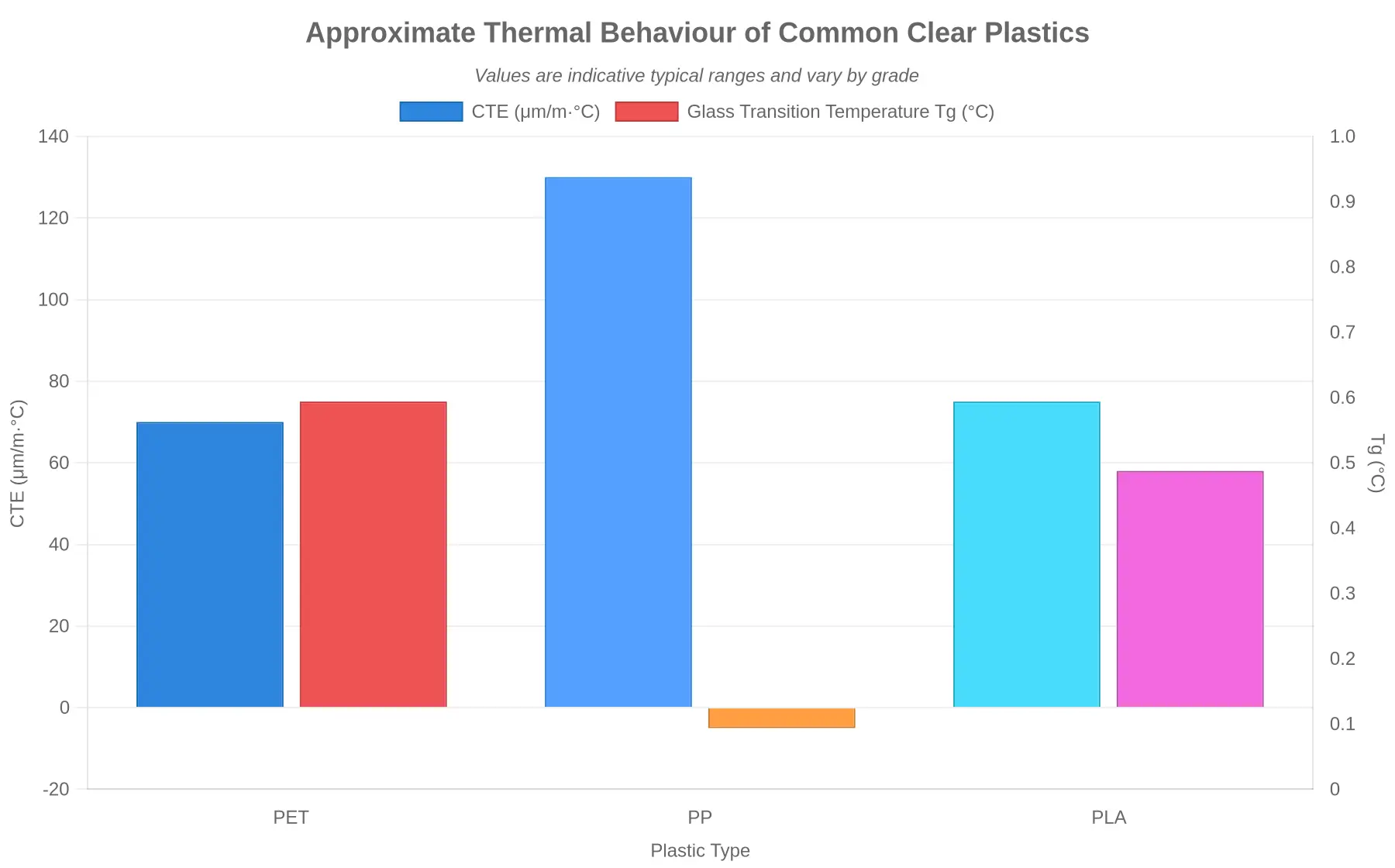
Localized thermal expansion follows the standard strain relation ΔL = α · L · ΔT. For a 60 mm base in PET (α ≈ 70 µm/m·°C) heated 60 °C above ambient, the base wants to grow roughly 0.25 mm across its diameter. In a free, unconstrained sheet that strain is harmless. Held in place by a cooler, stiffer rim, the in-plane mismatch has nowhere to go and converts into out-of-plane curvature: the base bows.
How much bowing a cup tolerates depends on how far the polymer sits from its glass transition temperature (Tg) and softening range. PET transitions near 75 °C, PLA near 55-65 °C, and PP has a Tg close to 0 °C but a heat deflection temperature of roughly 90-105 °C. As those thresholds are approached or crossed, the elastic modulus can fall by one to two orders of magnitude, so the base loses stiffness just as thermally induced stress peaks.
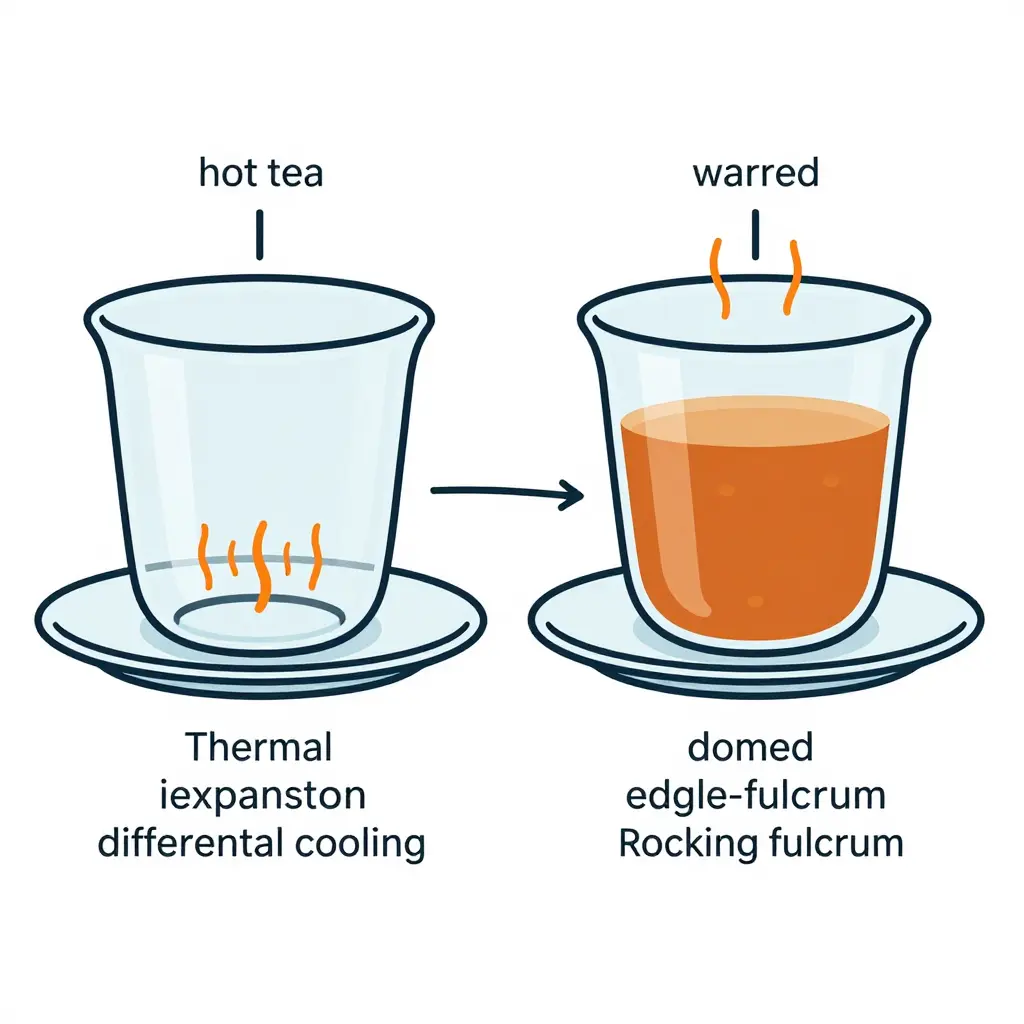
Cooling adds the second half of the mechanism. The thin base sheds heat faster than the thick heel, and when one face cools before the other, the two surfaces contract at different rates. The resulting differential shrinkage is locked in as residual curvature, the same bimetal effect that governs thermally formed sheet. Depending on which surface cools first, the base settles into a dome (center raised) or a cup (center lowered). A dome is more common because the upper, tea-contacting face stays warm longest and shrinks last.
The Three Mechanical Factors
- Thermal expansion: CTE-driven in-plane strain that the surrounding geometry prevents from relieving.
- Differential cooling: an uneven thermal gradient between the thin base wall and the thicker rim and heel, during both heating and cooling.
- Stiffness loss at temperature: the modulus falls as the polymer approaches Tg or its softening range, removing the resistance that would otherwise hold the base flat.
| Material | Typical CTE (µm/m·°C) | Tg (°C) | Softening / HDT (°C) | Warp risk with hot tea |
|---|---|---|---|---|
| PET | 60-80 | 70-80 | 70-80 | High |
| PP | 100-180 | -20 to 0 | 90-105 | Moderate (HDT-governed) |
| PLA | 60-85 | 55-65 | 55-65 | Very high |
Indicative ranges only; values shift with grade, crystallinity, nucleating agents and molding conditions.
Why Warp Creates a Rocking Fulcrum
Once the base domes, the contact changes. Only the outer edge touches the saucer instead of the full annular face. That edge line acts as a fulcrum, so an off-center load, a tilted saucer, or table vibration becomes visible rocking. A 0.2-0.4 mm lift at the center is often enough to make it obvious.
The engineering consequence matters more than the physics: warping eats the fit tolerance you assumed you had. A base made to the nominal diameter behaves like an oversized one once it domes, because contact narrows from the face to the edge. Wall-thickness uniformity, gate location, packing pressure, and post-mold annealing all reduce residual stress before the part reaches a saucer. These are the same variables that govern how plastic food containers are manufactured.
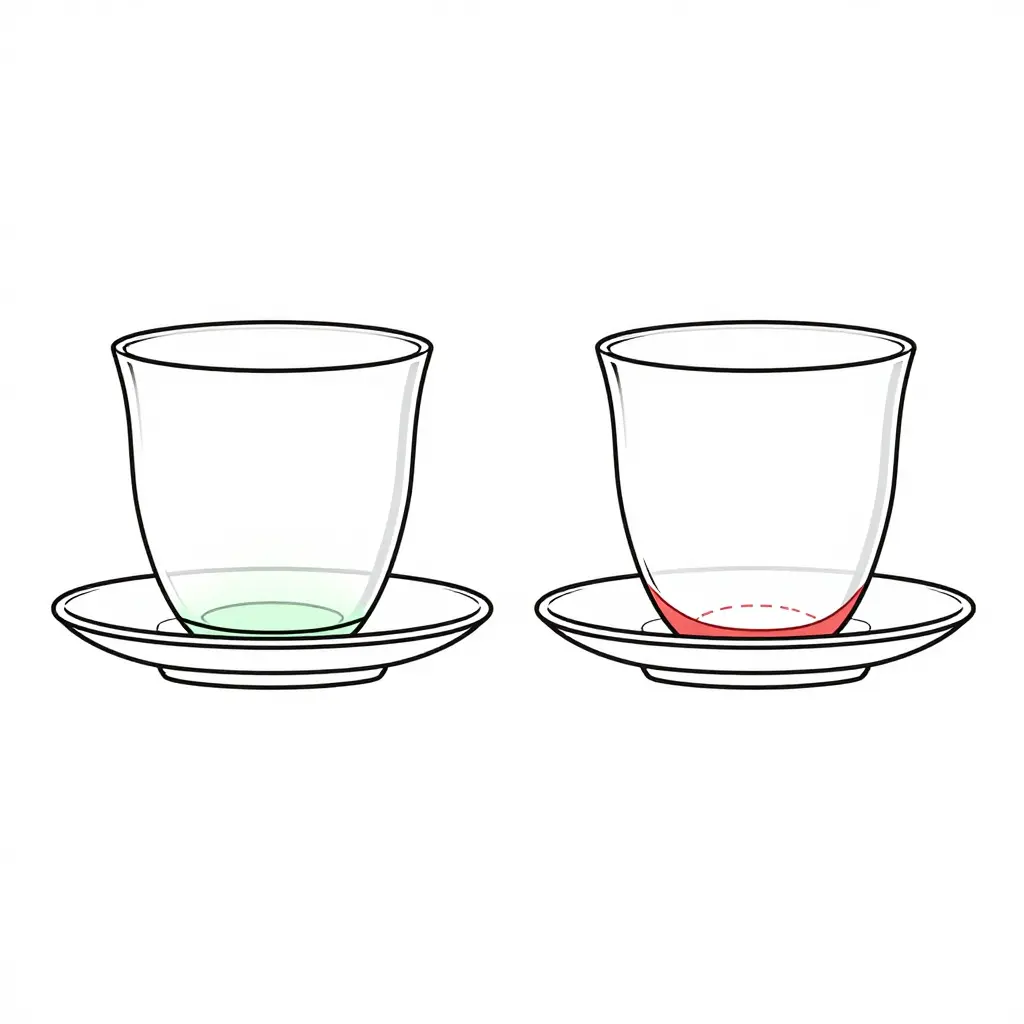
Schematic cross-section of a clear plastic tea cup base resting on a saucer. Left (a): a flat base makes full, even contact along the saucer surface. Right (b): after hot tea is poured, the base bows upward, lifting the center so only the outer rim touches the saucer. The curved red gap between the base center and the saucer is the clearance that lets the cup pivot and rock.
The Fit Cause: Why Base-to-Saucer Diameter Mismatch Triggers Rocking
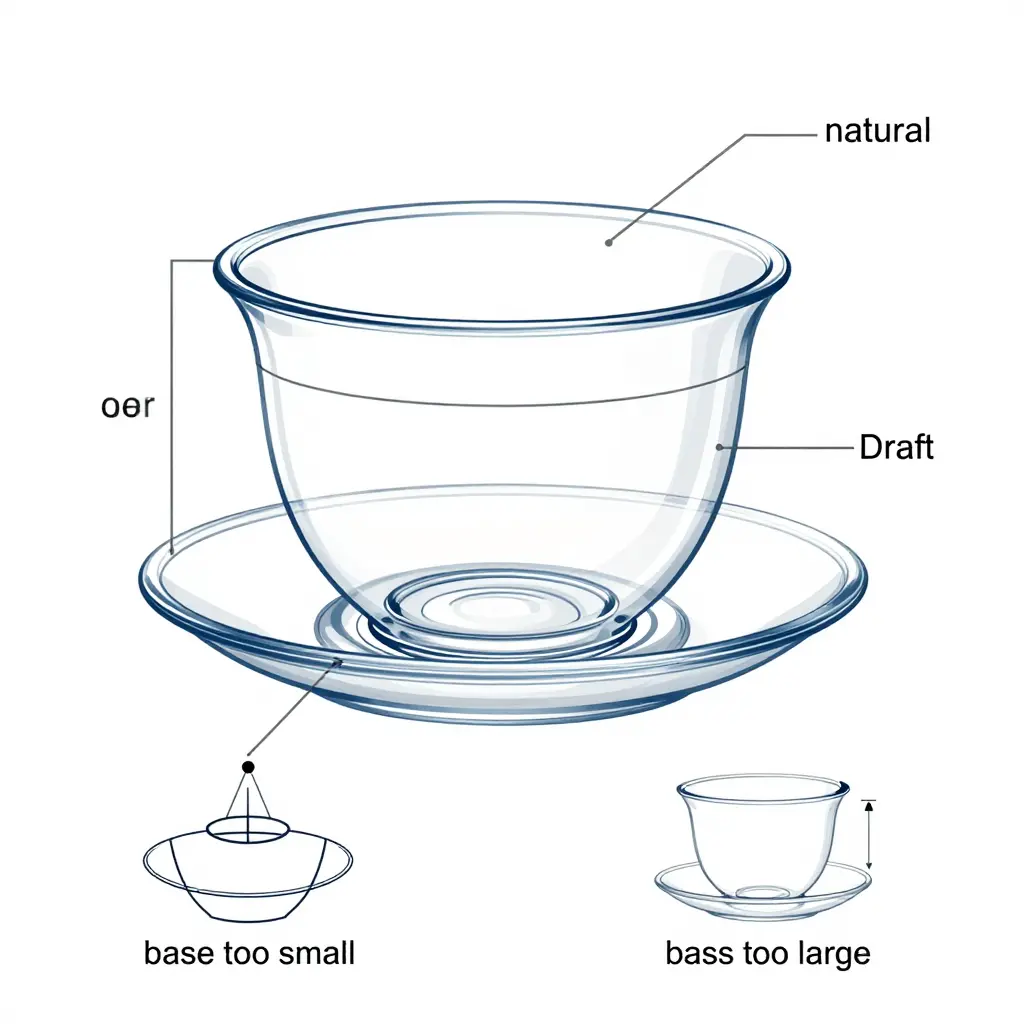
Rocking on a hot drink is rarely a material problem alone. What decides stability is the relationship between the cup base diameter and the saucer’s inner contact ring, the raised bearing band the cup actually sits on. The dimension that matters is not the base itself but the effective contact diameter: the circle where base and ring meet. When that circle is narrow, the cup has little moment arm to resist tipping, and even a 0.2 mm warp becomes visible motion.
Too small a base
When the base diameter is smaller than the saucer’s contact ring, the cup rests near the center on a tiny footprint. The effective contact diameter shrinks toward zero, so a stir, a clink, or a brushed hand acts as a lever. With no moment arm to resist, the cup rocks.
Too large a base
Oversize bases push contact onto the saucer’s shoulder or rim instead of the bearing band. The load concentrates on a thin annular edge rather than spreading across the ring, and the cup pivots on that edge. It feels like wobble even though the cup looks properly seated.
Base flatness: draft angle and heel radius
Flatness controls how much of the base actually touches. The draft angle (the taper molded into the sidewall for release) leaves the base slightly convex or conical, so contact can shrink to the innermost rim of the base. The heel radius, the rounded corner where the base meets the wall, cuts the true bearing area further. Both pull the effective contact diameter inward, away from the saucer ring, magnifying any temperature-driven deformation.
Tolerance stacking
The cup and saucer are separately molded, so their tolerances (base OD, ring ID, draft, wall shrinkage) stack. Base OD at maximum plus ring ID at minimum opens an unexpected gap; ring ID at maximum produces edge loading. Hot liquid then adds thermal expansion and stress-relief warp, which move each dimension the same way.
How an unstable contact becomes visible rocking
- Hot liquid warms the base, expanding it and releasing residual molding stress.
- The base distorts, and the effective contact diameter shifts off the saucer’s ring.
- Weight transfers onto a smaller edge or point of the base.
- The offset center of gravity lets the cup pivot, and customers see it rock.
Translate it into tolerances
For B2B sourcing, specify base OD and saucer ring ID as a paired control with a defined maximum difference, cap base flatness (draft angle and heel radius), and require a hot-fill rocking test instead of a cold-fit check. This is tolerance control during molding, and it works only if the base geometry is locked before the tooling is cut.
Setting the Right Base Diameter Tolerance Before You Order
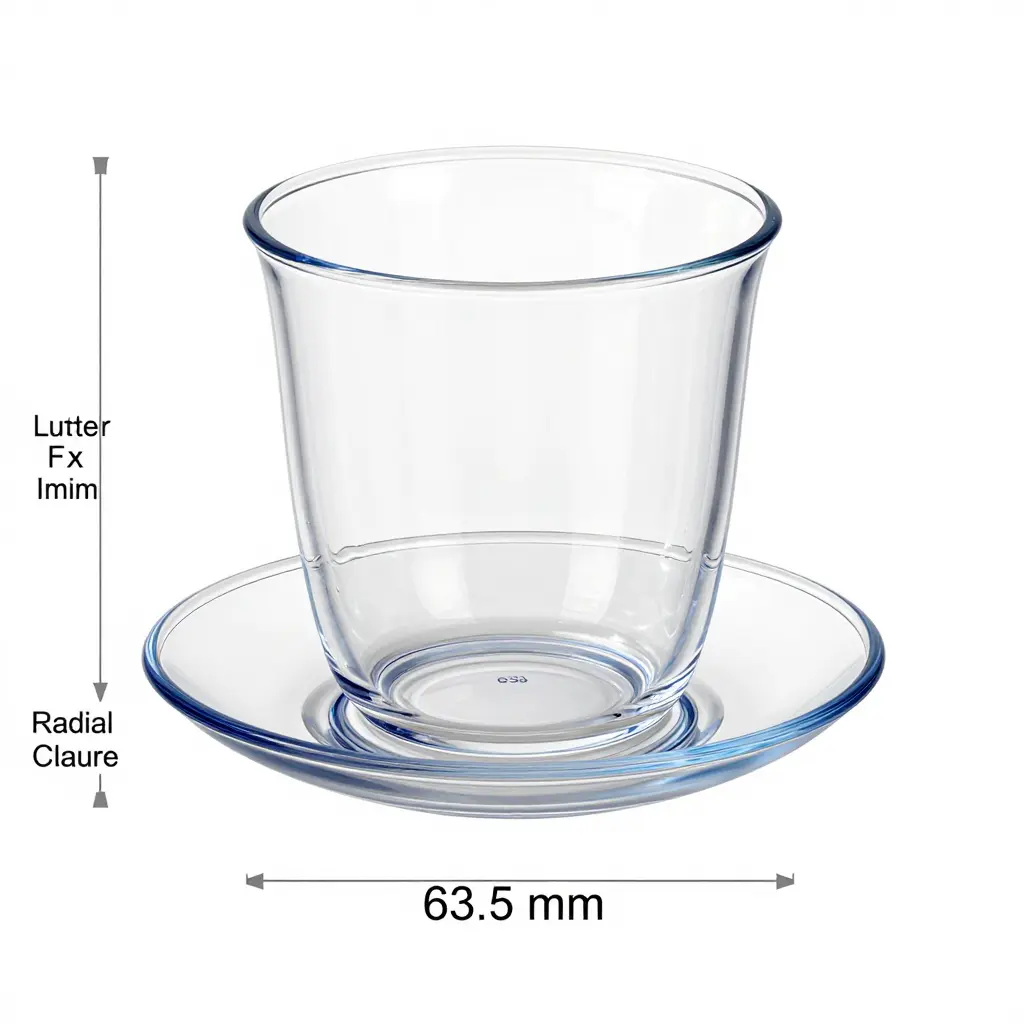
Base diameter tolerance is the permissible variation, the upper and lower limits around a cup’s nominal base diameter. Specify it as a nominal value plus a band. For a 63.5 mm nominal base, a practical band is +/- 0.4 mm, so every accepted base measures between 63.1 mm and 63.9 mm.
The tolerance means nothing in isolation. It has to be matched to the saucer’s contact-ring tolerance, the raised inner ring the base rests on. Set the ring at the same nominal with a +0.3 / -0.2 mm band, and require 60-75% radial contact overlap between the ring and the base heel. Below roughly 50% overlap, the cup pivots on the ring edge once hot tea warps the base.
Three related parameters belong in the same specification:
| Parameter | Recommended specification |
|---|---|
| Base diameter | 63.5 mm +/- 0.4 mm |
| Saucer contact-ring diameter | 63.5 mm +0.3 / -0.2 mm |
| Contact overlap | 60-75% of ring width |
| Base flatness tolerance | 0.2 mm TIR across the base heel |
| Concentricity (base to rim) | 0.3 mm max |
| Radial clearance / engagement | 0.3-0.6 mm total (0.15-0.3 mm per side) |
Flatness matters most. A warped heel defeats any diameter match, so hold the base flat to 0.2 mm total indicator reading. Keep base-to-rim concentricity within 0.3 mm so the cup stands level, and target 0.3-0.6 mm total radial clearance: enough to seat easily, not enough to slop.
Copy this into your RFQ: “Base diameter: 63.5 mm +/- 0.4 mm; saucer contact ring: +0.3 / -0.2 mm; base flatness: 0.2 mm TIR; base-to-rim concentricity: 0.3 mm max; radial clearance: 0.3-0.6 mm; contact overlap: 60-75%.”
Verification method: measure at the base heel, not the rim, with a go/no-go gauge or a calibrated digital caliper. A go/no-go gauge settles acceptance in seconds on the line and removes operator judgment. If you want to see how these dimensions are held during production, the molding controls behind every tolerance are worth a look.
Base Diameter Tolerance Reference Table
The values below reflect typical production capability for thermoformed clear plastic tea cups in the 6-9 oz range. Treat them as a starting point for your RFQ and cross-check them against the tooling notes from any plastic food container manufacturing process partner before you lock a purchase order.
| Parameter | Nominal Value | Recommended Tolerance | Effect on Rocking if Out of Spec | Verification Method |
|---|---|---|---|---|
| Base outer diameter | 58.0 mm | +0.00 / -0.30 mm | Oversized base bridges the saucer shoulder and rocks; undersized base lets the cup shift, so the heel catches and tips | Go/no-go ring gauge plus calibrated digital caliper at three points 120 deg apart |
| Base flatness | 0.15 mm max across contact ring | 0.10 mm TIR | A cupped or wavy base forms a single high spot that pivots once hot tea softens the rim, producing a steady rock | Dial indicator on granite surface plate or profile projector |
| Base-to-saucer radial clearance | 0.50 mm per side | +0.20 / -0.10 mm | Too tight binds during thermal expansion and tips the cup; too loose lets it slide and wobble across the well | Feeler gauge or plug gauge checked against the saucer well |
| Contact overlap percentage | 65% of base circumference seated | 55% minimum | Below 55% the cup rests on too few points, so any warp from hot liquid triggers rocking | Pressure-sensitive film or ink-transfer contact test |
| Draft angle at the heel | 3 deg per side | +/-0.5 deg | Low draft binds the heel under expansion and levers the cup up; high draft shrinks the contact ring and destabilizes it | Optical comparator or CMM on a sectioned sample |
State each row as a measurable limit, not a target, so a supplier cannot quote a nominal that drifts outside the rocking-safe window.
Material and Geometry Choices That Reduce Thermal Rocking
The rocking you feel when a hot cup settles onto a saucer comes from two moving tolerances: how far the base distorts as it absorbs heat, and how much flat bearing area the saucer can still present afterward. Tightening the base diameter specification holds only if the material and the molded geometry keep the base from moving in the first place.
Material selection sets the ceiling on heat resistance
Material choice fixes the ceiling on dimensional stability. Amorphous PET (APET) gives excellent clarity at the lowest unit cost, but its glass transition sits near 70-78 C, so the base can begin to creep within seconds of touching a hot saucer. Standard PLA is similar, with a glass transition near 55-60 C; only crystallized or stereocomplex grades push heat deflection into the 110-140 C band, at a higher price and with notably brittle edges. Polypropylene is the pragmatic hot-fill choice: homopolymer PP holds shape to roughly 95-105 C, and clarified grades buy back usable transparency at moderate cost. Where clarity drives the purchase and service stays cold, PET stays the most economical and flattest-sitting option, as covered in our review of clear plastic tumbler cup designs. For hot beverage programs that cannot compromise on stiffness, specify a heavy-duty clear cup engineered for hot-fill service.
Base wall thickness: stiffness scales with the cube
Bending stiffness rises with the cube of section thickness, so a base that goes from 1.2 mm to 1.6 mm gains roughly 2.4 times the resistance to deflection. Mass matters too: a thicker base carries more thermal inertia, so the contact face reaches saucer temperature more slowly and differential expansion during the pour stays smaller. The penalty is in the process. Thick sections cool more slowly, which lengthens cycle time and amplifies shrinkage differentials, sink marks, and locked-in stress. A practical target for PP tea cups is 1.2-2.0 mm of base thickness, with the base-to-sidewall ratio held within about 1.5:1.
Geometry: heel radius, draft and base ribbing
- Heel radius: the junction where the base meets the sidewall is a stress riser. A sharp heel concentrates cooling stress and warps first; enlarging the internal radius to 1.5-3 mm spreads that stress over a longer arc, though oversizing it reduces the flat bearing ring that actually contacts the saucer.
- Draft: 1-3 degrees per side is the baseline. Insufficient draft raises ejection drag and residual stress, which relaxes into warp after the part leaves the mold.
- Base ribbing: radial ribs add section stiffness without mass, but ribs on the bearing face cut contact area and turn a ring contact into point loads, which makes rocking worse. Recess the ribbing inside a flat perimeter ring instead.
| Material | Heat deflection (approx.) | Clarity | Relative cost | Stiffness | Best-fit service |
|---|---|---|---|---|---|
| APET | 60-70 C | Excellent | Low | High | Iced and cold drinks, up to 55 C |
| Standard PLA | 55-60 C | Excellent | Medium | High | Cold service, up to 45 C |
| PP homopolymer | 95-105 C | Fair, hazy | Low to medium | Medium | Hot tea up to about 90 C |
| Clarified PP | 100-110 C | Good | Medium | Medium | Hot tea 90-100 C |
| Heat-resistant PLA | 110-140 C | Good | High | High but brittle | Near-boiling fill |
Procurement guidance by serving temperature
Match the material to the actual fill temperature, not the menu description. Below 55 C, APET or standard PLA gives the best clarity per dollar. Between 60 C and 85 C, use clarified PP and accept the modest clarity loss. From 90 C to 100 C, homopolymer PP with a thicker base and a generous heel radius is the reliable specification. Above 100 C, request heat-resistant grades and check the heat deflection figure on the resin datasheet rather than the marketing name. If hot and cold service share one cup, standardize on PP and accept the reduced transparency, or run parallel specifications so the optical and thermal requirements are both protected.
Base Deflection vs. Tea Temperature
Thermal warping does not behave the same way in every cup. Whether the base stays flat or lifts off the saucer depends on how closely the molded base diameter matches the saucer’s seating ring. The table below lists base deflection (in millimeters) against tea temperature (20-95 C) for two parts from the same production run: one with a tight, matched base-to-saucer fit, and one mismatched and out of tolerance.
| Tea Temperature (C) | Tight matched fit – deflection (mm) | Mismatched fit – deflection (mm) |
|---|---|---|
| 20 | 0.02 | 0.08 |
| 35 | 0.04 | 0.18 |
| 50 | 0.07 | 0.33 |
| 65 | 0.10 | 0.50 |
| 80 | 0.13 | 0.68 |
| 95 | 0.16 | 0.90 |
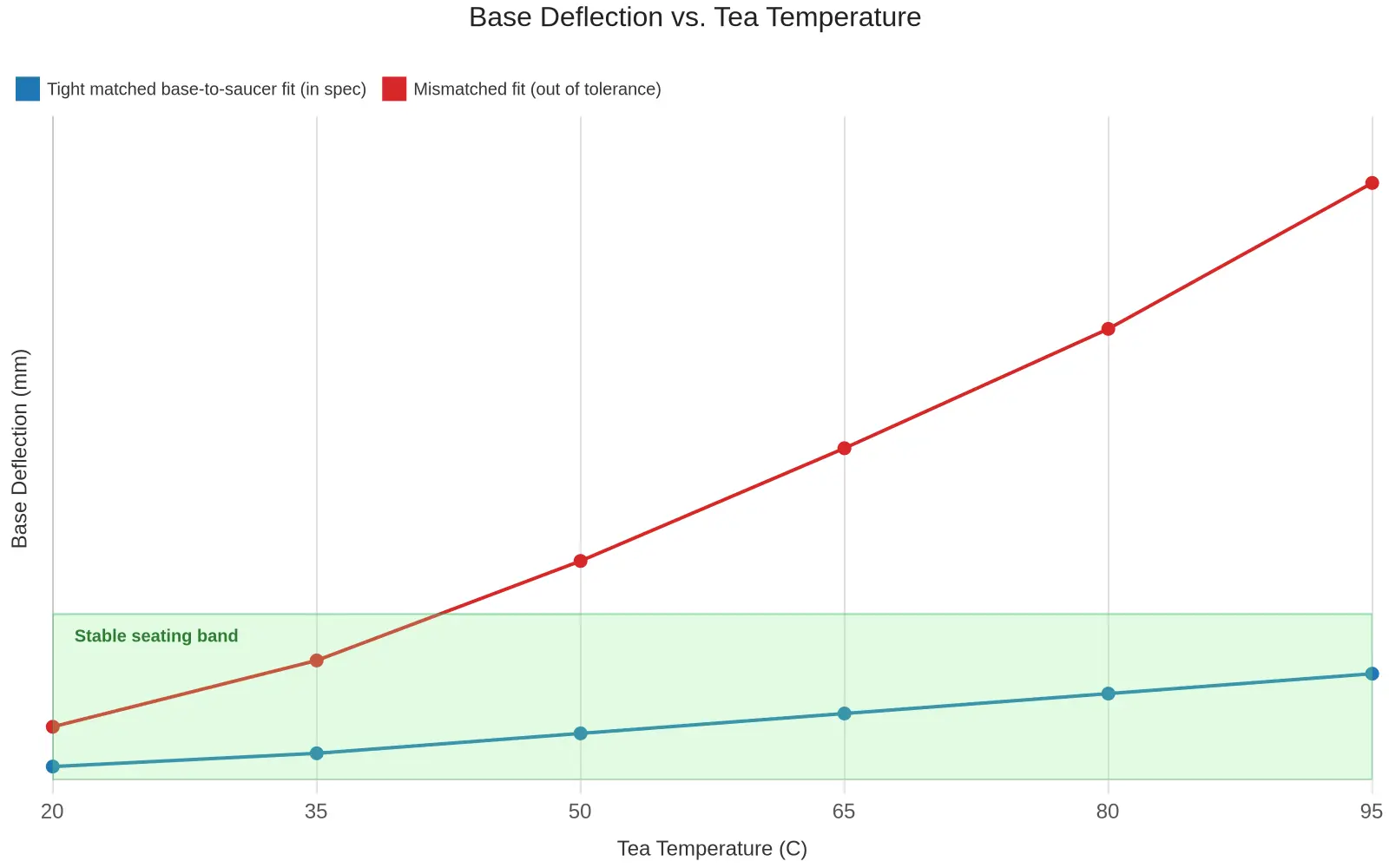
Tighter tolerance control keeps the deflection curve inside the stable seating band; the mismatched part crosses it and starts to rock.
Both curves climb as the tea heats up, but the mismatched part rises roughly five to six times faster and leaves the safe seating band well before the cup reaches a typical serving temperature. Holding the base diameter inside a defined tolerance band, rather than letting it drift across a loose range, is what keeps a hot cup planted on its saucer instead of pivoting on a warped rim. The same precision-first discipline that governs tolerance control in our plastic food container manufacturing runs applies directly to clear tea cup bases, where a few tenths of a millimeter decide whether the part rocks or stays seated.
Pre-Order Specification Checklist for Buyers
Before committing to a bulk order, run through this checklist. It turns the “rocking cup” problem into measurable specifications, and it pairs with broader guidance on choosing clear plastic drinkware for hot beverages.
- Confirm the base outer diameter and the base diameter tolerance for every clear plastic tea cups and saucers line item (for example, 60.0 mm +0.0/-0.3 mm).
- Specify the base flatness limit (a maximum gap of 0.10 mm against a flat plate) so the base sits flush before any heat is applied.
- Define the required radial clearance between the cup base and the saucer contact ring, giving thermal expansion room instead of a tilt point.
- State the maximum serving temperature the cup must survive (for example, 95 C / 203 F) plus the dwell time at that temperature.
- Request a first-article inspection (FAI) report with dimensions, material certification, and photos for sign-off before mass production.
- Confirm the material grade (for example, clarified PP or food-grade PET) and that it is rated for hot-fill duty.
- Define a sampled go/no-go acceptance test: lot quantity, gauge type, pass/fail limit, and the base diameter tolerance applied to each sampled cup.
- Lock the packaging method so clear plastic tea cups and saucers are never stacked under load in transit.
Work through these points with your supplier before pricing is finalized. A ten-minute specification review costs far less than a container of cups that wobble as soon as hot tea is poured.
Conclusion: Control the Base Diameter Tolerance, Eliminate the Rock
Hot tea does not create the rocking problem. It exposes two failures that are already there. The first is thermal warping: heat softens the base, and residual internal stress from uneven cooling during molding lets the bottom distort just enough to lose stable contact with the saucer. The second is base-to-saucer fit mismatch: when the base diameter and the saucer’s recess or flat are not engineered to a matched tolerance, small dimensional variation produces a pronounced wobble once the cup is loaded with liquid.
Before placing a bulk order for clear plastic tea cups and saucers, specify a defined base diameter tolerance and verify it against pre-production samples. Put the tolerance in writing on the purchase order, request dimensional inspection reports, and confirm the fit under hot-fill conditions during sampling. Treating the base diameter as a controlled specification rather than a loose reference dimension removes rocking at the source instead of managing complaints after the fact.
As a disposable tableware manufacturer, we help procurement teams turn fit and thermal requirements into measurable tolerances, then hold production to them batch after batch. Whether you are sourcing clear plastic disposable cups or a full cup-and-saucer program, our engineering support can scope tolerances and keep your supply consistent. Define the tolerance up front, verify it before committing volume, and the rock disappears.