
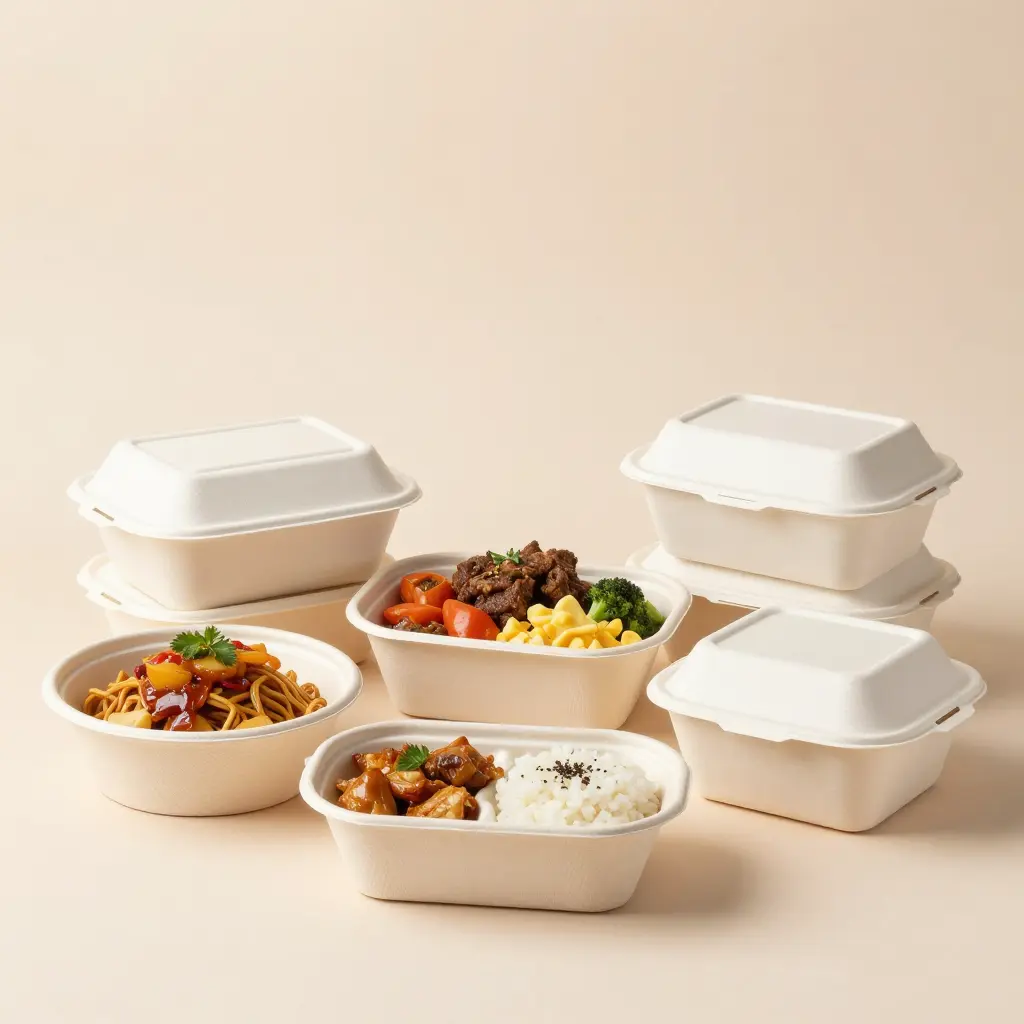
In most takeaway kitchens the box is chosen before the cost is. Someone reaches for a size that looks about right, the kitchen fills it with whatever the menu produces, and the price per order lands wherever that choice left it. For bubble tea shops and beverage chains, restaurants, food trucks, caterers, event planners and corporate buyers, that order of operations is where money leaves the business without appearing on any invoice. Buy food grade disposable takeaway boxes that way and give away cost per order creeps up order after order, without any single invoice showing the size of it.
Why a Mismatched Box Costs You Twice
You pay twice for a box that does not fit its contents. The first charge is material: extra board, extra coating, extra lid surface nobody needed. The second is everything that travels with that volume, including the labour to fold, fill, tape and stack a larger box, and the freight to move more air across the country.
Three numbers make this manageable.
Give away cost per order is what you spend on an order and get no value back for: the packaging itself, plus any extra food added to make the box look full.
Fill weight is the actual weight of the food or drink a box is designed to carry, measured after cooking, portioning and any sauce or topping.
Box footprint is the length and width of the box base, the space the container occupies on a shelf, in a bag or on a pallet.
Matching the three is easier when you compare a standard range of in-stock takeaway boxes side by side.
The rest of this guide covers how to weigh fill weight in your own kitchen, how to read box footprint against that weight, and how to lock a size that protects both margin and presentation.
Why Box Footprint and Fill Weight Drift Apart
Footprint and fill weight usually get fixed once, at launch, and then left alone while everything around them changes. Menus shift, suppliers substitute, portion habits creep, and the two numbers drift apart. That gap is where give away cost accumulates.
Four drivers that pull the numbers apart
Inherited box sizes. Most ranges, including many meal and bento box formats, are carried over from a previous menu instead of being recalculated against current portion yield, so the buyer keeps paying for board weight and cavity volume no current dish fills. Material cost climbs; protection does not improve.
Bulk standard stock sizes. Standard sizes are convenient to buy in volume, so they become the default even when they sit outside the ideal fit. Freight volume suffers first: every oversized carton adds case cube and takes pallet positions that could have carried saleable stock.
Recipe-level fill weight variation. The same dish rarely weighs the same across variants, because sauce loads, garnishes and topping density all change how much cavity it needs. A box matched to the heavy variant leaks portion on the light one; matched to the light variant, it overfills and strains the seams.
Sizing for the heaviest possible portion. Designing around the worst-case build protects against the occasional outlier, and every typical order pays for that insurance in permanent headspace, looser packing and a portion yield that is hard to defend at the till.
| Driver | Cost the buyer absorbs | Operational signal |
|---|---|---|
| Inherited sizing | Excess board weight per unit | Cavity volume larger than typical fill |
| Bulk stock convenience | Higher case cube, fewer units per pallet | Freight cost per unit creeps up |
| Recipe variation | Portion leakage on light builds | Inconsistent fill across the same SKU |
| Worst-case sizing | Paid-for headspace on every order | Low fill density in the packed box |
The compounding effect across a trading month
One order with a little unused cavity looks harmless on its own. Across a trading month, that headspace is paid for on every order, in board, in freight and in the portion that never reaches the customer. It compounds because nothing in the ordering routine flags it, so the invoice still looks normal.
The only way to catch it is to measure.
Read the table left to right: footprint tells you how much shelf and delivery-bag space a box eats, fill weight tells you what it can honestly hold. If you need compartmented formats, compare a few two-compartment bento box options side by side before locking a size.
Starting-point ranges only – always verify these ranges against your own portioning, scoop sizes and lid clearance before committing to a full order.
| Box format | Footprint dimensions | Usable internal depth | Recommended fill weight range (g) | Typical portion yield | Give-away cost indicator |
|---|---|---|---|---|---|
| Small square snack box | 100 x 100 mm | 40 mm | 90 – 140 g | 1 snack portion | Efficient |
| Square lunch box | 130 x 130 mm | 50 mm | 180 – 260 g | 1 light lunch | Balanced |
| Single-compartment fast food box | 170 x 110 mm | 60 mm | 260 – 350 g | 1 burger plus side | Balanced |
| Two-compartment bento box | 200 x 150 mm | 45 mm | 300 – 400 g | Rice plus 2 sides | Balanced |
| Rectangular meal box | 220 x 160 mm | 65 mm | 400 – 550 g | 1 full mains | Efficient |
| Wide shallow rectangular box | 260 x 190 mm | 40 mm | 350 – 450 g | 1 mains plus salad | Over-spec |
| Large sharing box | 300 x 220 mm | 70 mm | 900 – 1,300 g | 3 – 4 sharing portions | Efficient |
| Paper bucket or bowl (contrast case) | 120 mm top diameter | 110 mm | 600 – 800 g | 1 noodle or rice bowl | Balanced |
If your fill weight sits at the top of a range, check the headspace before you reorder: anything under about 10 mm of clearance means the lid will press on the food, so step up one footprint rather than compressing the portion. If it sits at the bottom of a range, lift the portion slightly or drop to the next size down, because a box that is two-thirds empty costs you the same per unit and reads as poor value to the customer.
Measuring Fill Weight for Reliable Box Footprint Decisions
Footprint decisions only hold up when they rest on real numbers, and the number that matters is fill weight taken from the plated portion. Raw ingredient weights tell you what went into the kitchen, not what leaves it: rice absorbs water, sauces add volume, garnish changes the shape of the pile. Weigh what you serve, then size the box around that.
- Select the three best-selling items from each menu category, so the numbers reflect the orders your kitchen runs most often.
- Portion each item exactly as it would be served, including garnish, sauce and any side that travels in the same box.
- Weigh each portion on a digital scale accurate to one gram, taring the container first so the reading reflects food only.
- Repeat each portion five times, noting the highest and lowest readings you see.
- Record the average and the spread for each item on a simple sheet your team can read at a glance.
- Match that average and spread to a footprint in the food-grade disposable takeaway boxes range that holds the portion without pressing or rattling.
The spread matters more than the average because it describes your worst-case order, not your tidy middle one. An item that averages 320 g but swings from 285 g to 355 g needs a box that clears 355 g without pressing the lid down onto sauce, and holds 285 g without letting the portion slide around. An average hides that range; a spread exposes it. A tight spread lets you size the box close to the average and protect your give away cost per order. A wide spread means portion control needs work before a change of box is worth making.
Re-weigh whenever anything upstream moves: a new rice or protein supplier, a new scoop or ladle, a revised recipe card, a new hire on the line. Put a quarterly review into the routine, repeat the six steps after any menu change, and write the date and batch beside each figure, so an old measurement cannot steer a new box decision.
Give Away Cost per Order: Why Box Footprint Is the Quiet Budget Leak
Every takeaway order hides two costs that never show up on the customer’s receipt: the box itself, and the food you pile in so the box looks properly filled. Get the footprint wrong and you pay both on every ticket. Sell the same 550 g noodle or rice dish in a box designed for 750 g and the gap has to go somewhere, either into extra product or into empty air that makes the portion look thin.
The chart below holds the dish constant and varies the footprint five ways. The packaging figures are estimated illustrations, not market quotes, but the pattern they show holds up in real kitchen maths. The total order cost series assumes what most kitchens do with the extra room: add food until the box looks presentable. Hold fill weight constant and packaging is the only cost that moves between the five.
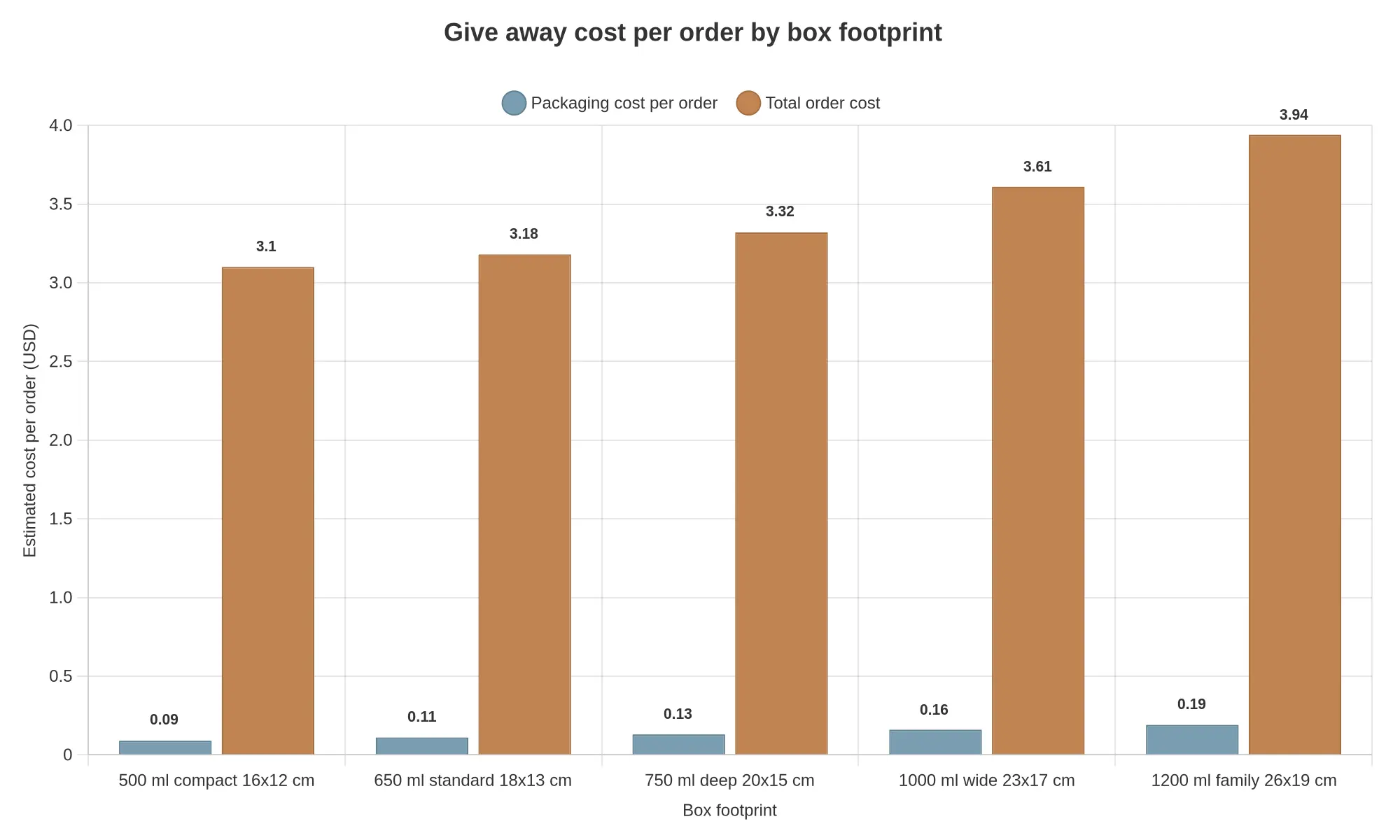
Each step up in footprint adds only a few cents of packaging, but total order cost rises faster, so the smallest footprint that still presents the dish well is usually the cheapest per order.
How to read the two series
- Packaging cost per order climbs gently, from about $0.09 at the 500 ml compact footprint to roughly $0.19 at the 1200 ml family size. On its own, that spread is small enough to dismiss.
- Total order cost is where the money sits. Moving from the compact to the family footprint adds roughly $0.84 per order, and most of that gap is not cardboard, it is the food added to justify the larger cavity.
- The sweet spot tends to be the footprint one size above your tightest fit: the dish looks generous without every order turning into a giveaway.
Turning the chart into a menu decision
Start from fill weight per dish, then choose the footprint that holds that weight at a fill line of roughly 80 to 85 percent of the internal height. Anything roomier and you are either overfilling or under-presenting. Run the exercise separately for hot meals, cold items and sharing formats, because a rice bowl and a fried snack basket behave very differently in the same footprint.
At high daily volumes, two or three footprints work better than six: fewer sizes means less stock confusion and faster packing at the counter. The stock-ready options in our takeaway boxes range show how the common footprints line up against typical fill weights.
Run the numbers on your own best-selling dish before your next packaging order. A few cents of footprint discipline, multiplied across a thousand orders a week, is money that stays in the business instead of leaving in the box.
Quick Verification Checklist Before You Lock a Box Size
Work through this with your supplier or packing team before you commit to a format. It takes a few minutes and keeps the decision tied to real portions instead of round numbers on a spec sheet.
- Confirm the measured fill weight range is covered by the box format. Weigh a handful of actual servings rather than trusting the nominal recipe, because scoops and portions drift over a busy shift.
- Check the box holds the portion without visible headspace. Empty air at the top reads to customers as a short fill, and you end up paying for volume nobody uses.
- Make sure the lid closes cleanly without compressing the food. A lid that presses down squashes product, pushes sauce toward the seams and generates avoidable complaints.
- Verify the footprint fits your standard delivery bag or tray configuration. A box that will not nest into your current setup slows packing and wastes space you already pay for in transport.
- Test that the box stacks without collapsing under load. Stack three or four filled boxes the way a rider or caterer would carry them, then confirm the corners and base hold their shape.
- Choose a format that is available as in-stock food grade disposable takeaway boxes rather than a special order. Stocked items keep lead times short, spare you minimum order surprises and let you scale up without a new tooling conversation.
- Confirm the material suits the food’s moisture and oil level. Coated board handles saucy and fried items, while bamboo pulp or uncoated formats suit drier baked goods and snacks.
- Check the per-order packaging cost stays within your target give away allowance. Divide the unit price by orders per case and compare it with the allowance you have set, so a slightly larger format does not eat your margin unnoticed.
Worked through in order, these checks turn fill weight, footprint and pack cost into a single decision, which is how give away cost per order stays predictable as the menu grows.
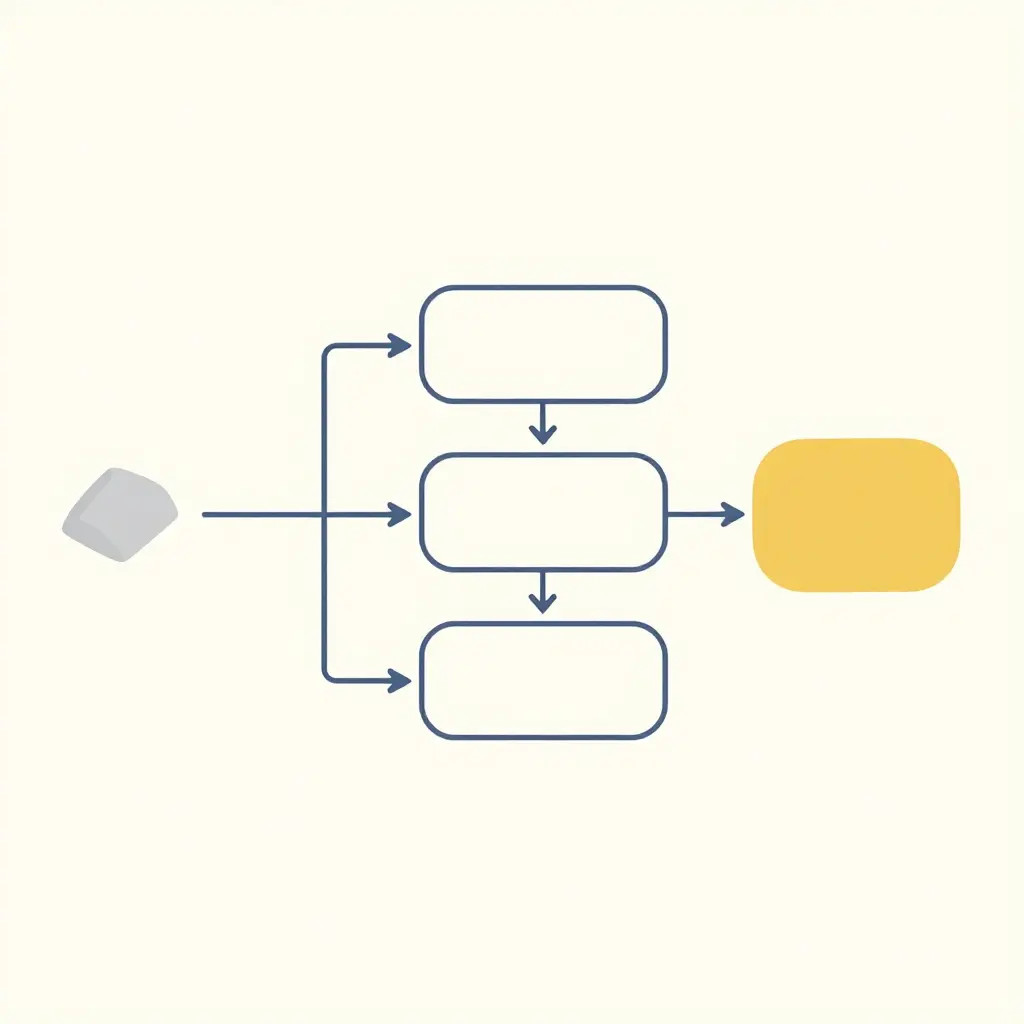
How to read it: a single measured fill weight enters from the left, gets checked against your recommended fill range, then splits into one of three footprint verdicts. The matched branch is highlighted, because it is the only route where the portion looks generous and give away cost stays in line. Use it as a last visual check before you finalise a fast food box specification with your supplier.
Buyer-Segment Guidance: Turning Fill Weight into Footprint for Your Operation
Fill weight and footprint only turn into decisions once they are tied to the way you plate, pack and hand over food. The four cases below translate give away cost per order into the daily buying habits of each audience.
Bubble Tea Shops and Beverage Chains
Pair drink formats with compact snack and bakery boxes. Many beverage-led orders carry a small food add-on: a pastry, a sandwich, a slice of cake, a rice roll. That add-on is where packaging cost drifts. Pack a single pastry in a clamshell built for a two-item combo and you pay for empty space, so the add-on stops contributing margin and starts lifting give away cost per order, while the slack lets the item slide and arrive crushed. Size the add-on box to the measured weight of the item itself and keep the footprint deliberately tight. Our compact bakery and sushi boxes are built around that narrow footprint, so the snack rides alongside the cup instead of competing with it.
Restaurants
Line up meal boxes and bento formats against measured portion spreads across the menu. A menu rarely runs at one portion size, so a single box rarely fits the whole list, and the air gets subsidised by the low-volume dishes: salads, small plates, a half portion of rice. Your lightest sellers become your most expensive packaging items, and cost per order climbs with nothing visible changing on the plate. The fix is internal. Weigh ten representative portions of each dish, record the grams, sort the results into two or three bands, then match a box to each band, so a full rice entrée, a protein-and-two-sides bento and a light starter each sit in a container with minimal headspace. Use paper food trays for shared or platter-style items where a deep box is the wrong shape entirely, and drop any size that no band needs.
Food Trucks and Catering Services
Favour footprint-consistent boxes that stack and travel well, and standardise on fewer sizes to simplify purchasing. Space in a truck or a catering van is fixed, so a footprint that changes between sizes costs you a shelf, a run or a stack. Wide, shallow boxes waste shelf area and slide in transit, tall boxes tip on a tight turn, and a long size list turns purchasing and par levels into guesswork, with each size needing its own lid and its own storage slot. Cut the range to two or three sizes that share the same base footprint, so they cross-stack, take the same lids and load in the same orientation. Footprint-consistent meal bento boxes are the easiest place to start: a shared base lets you reorder in fewer SKUs and pack a flat of mixed menu items without repacking.
Event Planners and Corporate Procurement Teams
Match box formats to per-guest fill weight for plated or buffet service, and keep one spare smaller format for lighter menus. At event scale, a small sizing error multiplies by the guest count. A format calibrated for a hot buffet main will under-fill for a lighter lunch or afternoon tea menu, so you pay for empty volume several hundred times over and the presentation loses density. Build the order around a per-guest fill weight for each service style, plated, buffet or grazing, and hold one smaller format in reserve for the lighter menus and the dietary-alternative plates. Confirm both formats in a sample run before the event, so the box you approve is the box that arrives on the day.
What Makes Up Give Away Cost Per Order
Before you renegotiate a box quote, it helps to know which parts of an order eat the budget. Most operators assume the container is the whole story. In practice a typical food order is packed with six or seven small line items, and each one adds to your give away cost. The doughnut chart below breaks a typical order into those components. It covers packaging only, before any extra product added to fill space, so the shares describe the packaging part of give away cost rather than the food top-up.
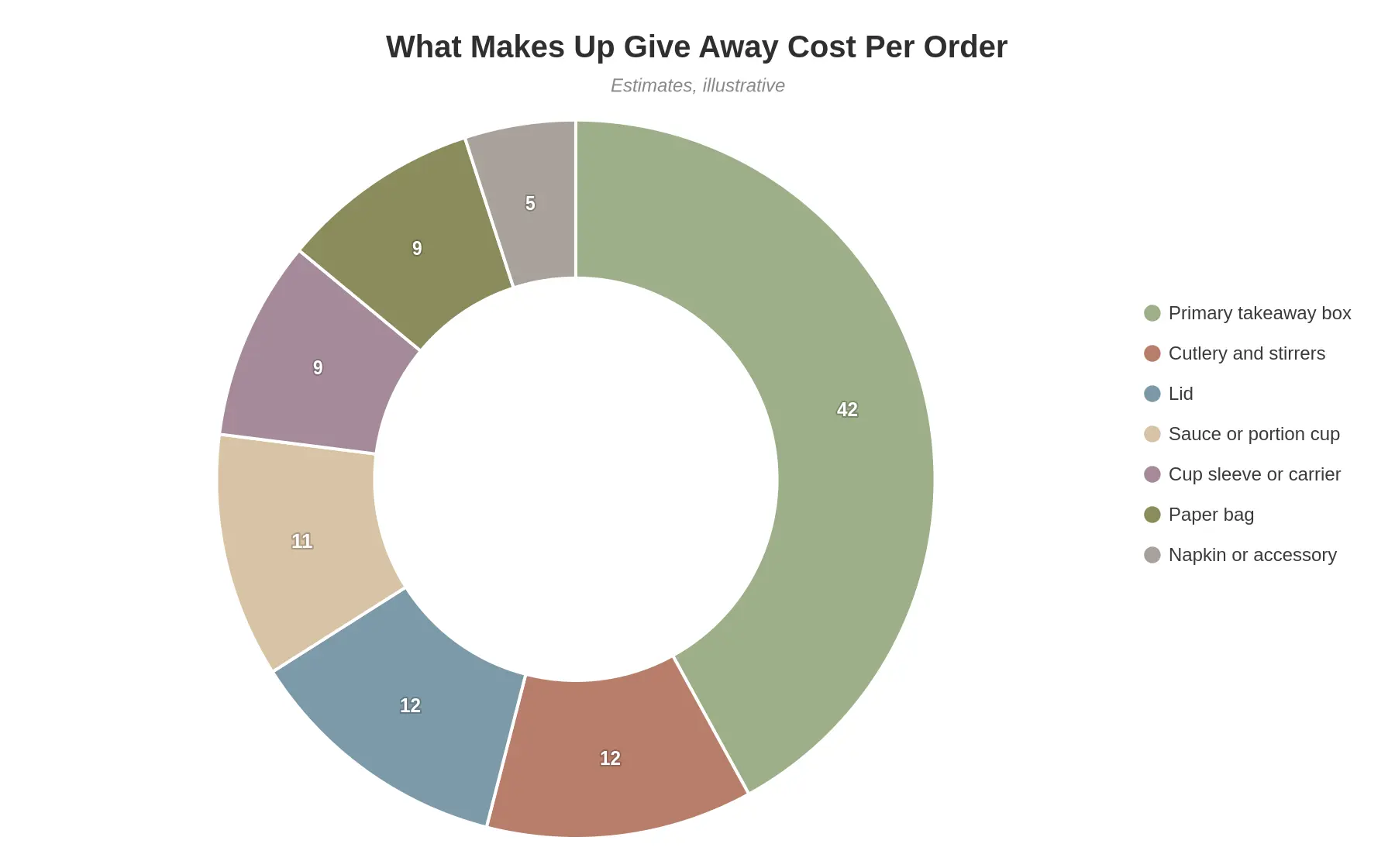
The primary takeaway box is the largest single component of give away cost per order, and the most controllable, which makes it the most useful lever for cost control.
All figures below are estimates for illustration, based on a mid-volume quick service or beverage operation spending roughly $0.28 on packaging per order. Your own numbers will move with volume, material choice and spec weight, so treat this as a starting framework rather than a quote.
| Component | Estimated share of give away cost | Estimated cost per order |
|---|---|---|
| Primary takeaway box | 42% | $0.118 |
| Cutlery and stirrers | 12% | $0.034 |
| Lid | 12% | $0.034 |
| Sauce or portion cup | 11% | $0.031 |
| Cup sleeve or carrier | 9% | $0.025 |
| Paper bag | 9% | $0.025 |
| Napkin or accessory | 5% | $0.014 |
| Total | 100% | $0.281 |
The box is the biggest single line at 42%, about as much as cutlery, lids, cups and sleeves added together, which is why matching fill weight to footprint pays back fastest; our food-grade takeaway boxes are a practical place to compare footprint options by portion size. The smaller items are death by a thousand cuts: cutlery, lids and cups together take just over a third of the spend, and they are usually easier to trim through default settings than to win back in negotiation.
A quick way to use this: pick the three largest segments, work out what a 10% cut on each would save per order, then multiply by your monthly order count. That calculation usually tells you whether the next project is a box redesign or a cutlery policy change.
Material Choice and Construction: The Variables Behind a Footprint
Once the fill weight and footprint match is settled, the next decision is what the box is actually made of. Footprint sets the floor plan; board thickness and wall construction decide how much that floor plan can safely carry. Two boxes can share identical dimensions and behave completely differently under a 900 g portion of rice and curry, so treat material as a load-bearing decision, not a cosmetic one.
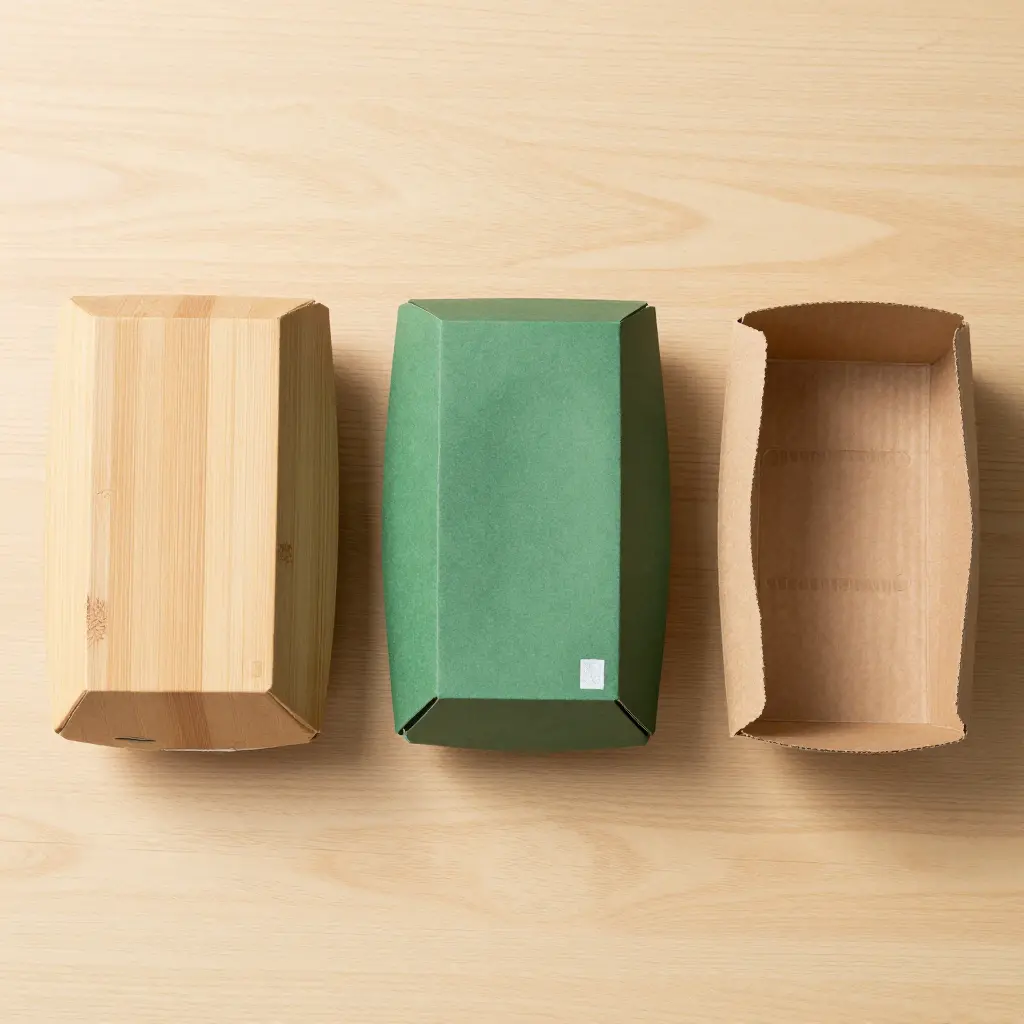
Board weight and caliper come first: a 300-350 gsm single-wall coated board is light and prints beautifully, but it flexes under load and bows at the base if the footprint runs wide. Wall construction comes next: a doubled or rippled wall adds stiffness without enlarging the footprint, which matters when your tray or bag space is fixed. Then the base and corner geometry, where folded corners leak strength and a pressed or moulded body holds its shape.
| Construction | Typical material | Practical load, 1,000 ml footprint | Best suited to |
|---|---|---|---|
| Single-wall coated board | 300-350 gsm, PE or water-based coating | 400-500 g | Dry bakes, light snacks, low-sauce items |
| Moulded bamboo pulp | 1.5-2.5 mm fibre wall, uncoated or coated | 600-800 g | Saucy, oily and hot foods |
| Double-wall corrugated | 3-4 mm B or C flute | 1,000-1,500 g | Heavy mains, stacked catering loads |
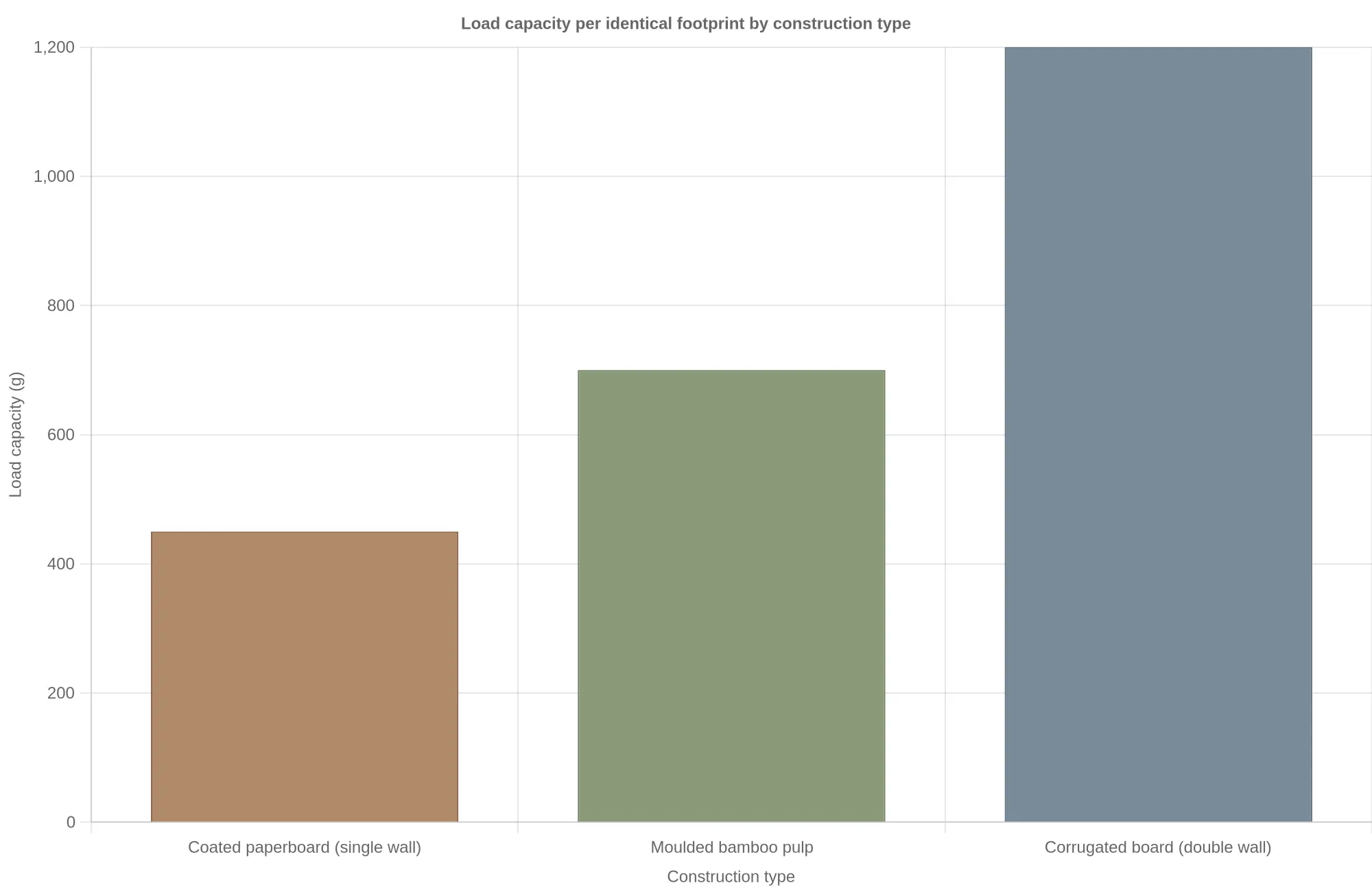
Treat those figures as indicative start points from supplier test data, then verify with your own worst-case portion at service temperature.
Why moisture and oil push buyers toward pulp and coated formats
Sauces, braises, fried snacks and bubble tea-adjacent desserts attack the weakest point of any paper box: the fibre where liquid meets wall. Uncoated board wicks moisture, softens at the base seam and collapses exactly when the order is heaviest, which is why buyers handling these menus move to moulded fibre or coated formats that resist penetration long enough to survive a 30-minute delivery. Bamboo pulp products are a common answer, because the dense fibre wall handles heat and grease without a plastic film, which also simplifies disposal messaging on your packaging. Coated board, applied well, is cheaper per unit, but its performance depends heavily on coating coverage at the score lines.
When corrugated earns its extra cost
Corrugated is the right call when fill weight climbs past roughly 800 g, when boxes are stacked in a catering trolley, or when a single order travels more than a few kilometres on a bike. The extra spend buys stiffness and stackability, which cuts crush losses and returns per order. Below that threshold it usually adds cost and cube volume without changing what the customer gets.
Supply-Side Discipline: Keeping the Match Repeatable
Material and footprint decisions only pay off if supply supports them. A few habits keep the plan workable:
- Standardise on two or three footprints across the menu. Fewer sizes mean simpler packing stations, one lid or sleeve family, and less training for new staff. Mid-size and rotation items should be forced into the existing options before a new tool is approved.
- Buy stock formats rather than special orders wherever fill weight allows. Stock sizes ship from inventory, carry shorter lead times and survive demand spikes; custom tooling is best kept for genuine signature items.
- Check case cube and freight volume, not just unit price. A slimmer footprint that nests tightly can cut pallet positions and container cost per unit far more than a small unit-price saving somewhere else.
- Confirm repeatability across seasons. Ask whether the size holds its dimensions, board grade and coating through summer humidity and winter dry air, and whether the same specification will still be available in twelve months.
For operators running fast-turnover menus, standardising around proven fast food boxes keeps the size set tight while the contents change with the season. On the supply side, it helps to work with a manufacturer that produces disposable tableware, packaging paper and boxes in-house, with stated positions on food-contact safety, durability and eco-friendly practice. That combination matters less as a slogan than as a sourcing hedge: consistent board sourcing, tested load performance, fewer format surprises between reorders, which is what finally protects your give away cost per order.
Frequently Asked Questions
How does fill weight differ from gross box weight?
Fill weight is the net amount of food inside the box, the portion your kitchen actually scoops. Gross box weight adds the packaging to that food, so it counts the empty container, the lid and any sauce cup tucked inside. Price give away cost per order against fill weight, and use gross weight for freight, storage and courier limits. When you compare food grade disposable takeaway boxes, check both figures on the spec sheet.
Does a larger box ever lower give away cost per order?
Yes. A larger box cuts give away cost per order when it removes a whole unit from the pack, such as one family-size container replacing two small ones. The box price rises, but lids, carrier bags and packing time fall, so the cost per order drops. Compare total cost per order, never cost per single piece.
How often should fill weight be re-measured?
Re-measure fill weight whenever a recipe, scoop size or ingredient supplier changes, and again at every seasonal menu swap. On high-volume lines, weigh ten portions per shift and log the results. Audit every item once a quarter, so drift shows up in your numbers before customers notice it in the box.
Can the same box footprint serve both hot and cold menus?
Yes, one box footprint can carry both hot and cold menus when the material and coating suit both. Vented lids and grease-resistant linings handle hot fried items, while tight-sealing lids keep cold desserts and salads steady. Test the same footprint with both menus stacked and carried before you commit to a single size.
What should I do when a portion sits right on the boundary between two box sizes?
Pick the larger size and set a fill line instead of squeezing the portion into the smaller box. A portion pressed against the lid looks generous, then crushes, leaks and invites complaints. If the larger box pushes cost per order too high, trim the portion by a few grams or reshape the item so it sits cleanly inside the smaller footprint.
Do eco-friendly materials change the weight a footprint can carry?
The load depends on the material and wall structure, not on the box footprint alone. A moulded bamboo pulp box and a corrugated board box of identical size hold different loads. Stack a loaded box three high for thirty minutes and check the base before you lock in a supplier.
Closing Summary: Measure, Match, Then Choose
The order of the steps is what makes the rule work, so it is worth repeating: weigh the portion first, read the box footprint against that measured spread, and only then pick the smallest box that holds the portion comfortably. Nothing in that sequence is complicated. It only asks that the decision starts with the food rather than with whatever size is already on the shelf.
Fill weight is the starting measurement, not an afterthought. Footprint should be read against the spread a portion actually makes, not against a rough visual impression. And a box that is comfortably full protects the product and the spend at the same time.
Held consistently across a full trading period, that discipline keeps give away cost per order steady, because every centimetre of unused space stops being paid for thousands of times over. It is worth setting a few of your current stock sizes beside the portions you measured this week and noting where the two disagree; our food grade disposable takeaway boxes are grouped so a size review can be worked through in one sitting. Margin control and packaging that protects the product are not competing aims. Measured portioning is what allows both to hold.