
Corner Locks and Why They Decide Saucy Order Outcomes
A corner lock on a disposable food box is the tab-and-slot joint at each corner: a tab on one wall panel passes through a die-cut slot in the adjacent panel, and the interference fit between them holds the walls at a fixed angle so the lid seats and the base stays square. What decides whether that joint works is the cut dimension. Appearance tells you nothing.
Corner-lock pop-open, the failure that dominates saucy orders, is mostly a tolerance problem. Gravy and other high-moisture dishes raise the vapour pressure inside the closed box and leave a film of sauce on the tab-slot interface, so friction drops at the same moment the weight of the food loads the corner in shear. Board of adequate caliper with a sound coating will still open at the corner if the tab is cut short of the slot, or if the slot is punched wide enough that friction is all that holds it. No material specification compensates for a joint with no designed interference.
Tab tolerance is the number that decides procurement. It covers tab length, tab width and the clearance between tab and slot, and it belongs in the purchase order as a measured range with a stated sampling frequency, because “standard lock” is not a specification. Buyers who treat corner-lock geometry as an engineering dimension rather than a packaging detail end up with leak-proof takeout boxes that hold their corners through a full delivery cycle, bag compression and lateral stacking pressure included.
How Corner Locks Fail Under Sauce Load
A corner lock is a friction-and-geometry joint, not a seal. Dry, it holds because the tab passes through the slot with a designed clearance and a small amount of interference at the fold shoulder. Wet, that geometry changes while the load on it rises. Four mechanisms run at the same time, and each one makes the next worse.
Hydrostatic and sloshing pressure
Sauce behaves as a liquid mass. Hydrostatic pressure rises with fill depth and acts normal to the inside of the wall panels, bowing them outward. During hand-carry and vehicle transit that steady load turns cyclic as the sauce sloshes, so the panels are pushed and released many times per delivery. Every outward deflection distorts the slot, opening it along one axis and closing it along the other, and the tab walks further out of engagement until retention load approaches zero. A fit that felt snug at packing is loose once the box is carrying a moving fluid.
Moisture and grease uptake: caliper swell
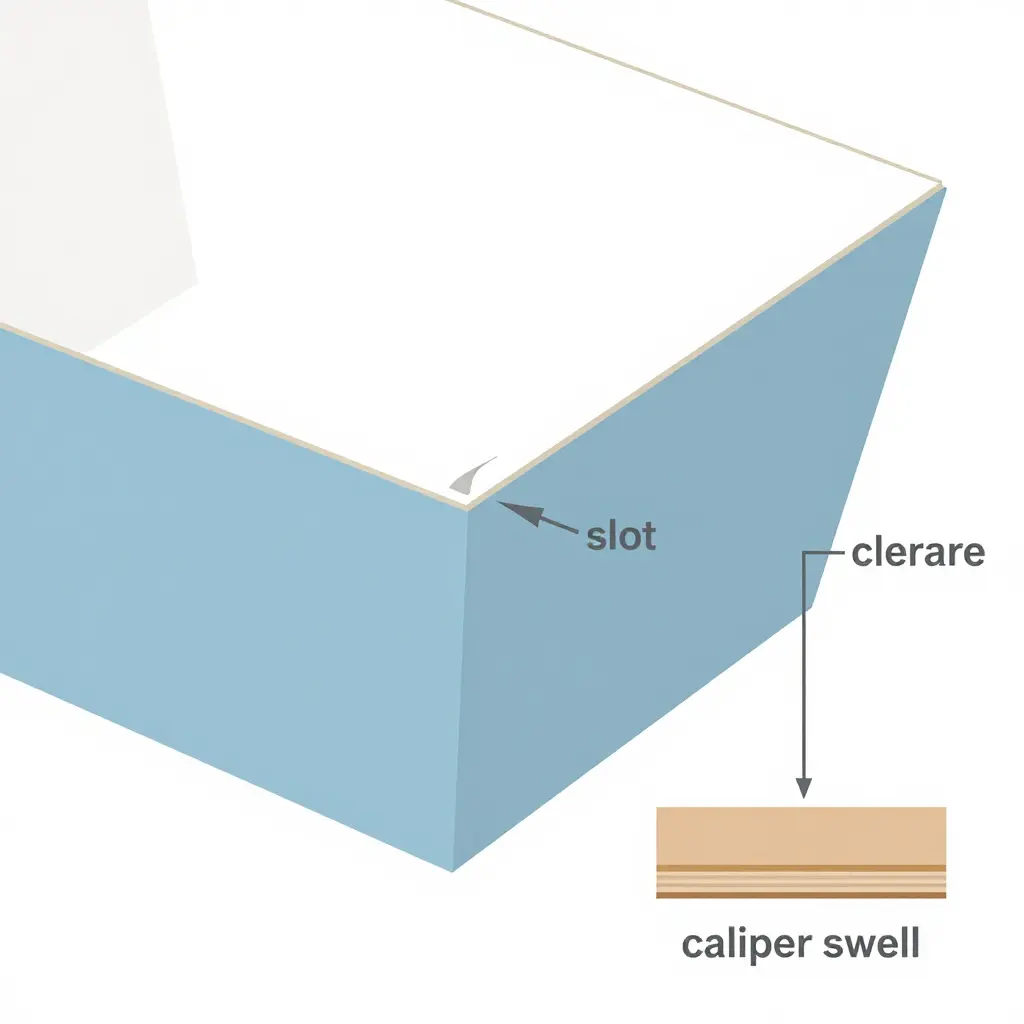
Cut edges and uncoated board faces wick water and oil quickly. Fibre swelling adds caliper within minutes of filling, and it does not happen evenly: the tab, with two exposed cut faces, thickens faster than the panel around the slot. The clearance cut for dry board becomes hard interference, the tab can no longer seat to full depth, and engaged depth falls even though the tab is physically larger. A tab tolerance measured on dry board is the wrong number for a saucy order.
Compression set and fatigue at the fold line
Stacking load concentrates at the corners, and the tab fold line is the least supported hinge in the assembly. Under sustained vertical load the crease compresses and takes on permanent compression set: spring-back decays, the tab’s return angle relaxes, and the hook that should sit under the slot lip no longer catches it. Load-and-unload cycles at that crease speed the process up, so retention falls with every case stacked above.
Coating-driven slip
A grease-resistant coating or a thin sauce film lowers the coefficient of friction at the tab-slot interface. Friction was carrying a real share of the joint’s retention load; once the interface is lubricated, the tab slides out under a fraction of the force that held it dry. Clearance has to be tightened to make up for the friction that is no longer there.
For bulk buyers comparing stocked takeaway boxes, the conclusion that matters is this: sauce exposure, dwell time and stack height are fixed by the menu and the delivery route. Tab tolerance is the one variable you control, and it decides whether the joint survives them.
Inside the Corner Lock: Where Clearance Actually Lives
The schematic below isolates the two-dimensional relationship between the locking tab and the die-cut slot in a folding box wall. Four features matter: the tab, the slot it enters, the fold line the panel hinges on, and, picked out in a single accent colour, the clearance gap between tab edge and slot wall.
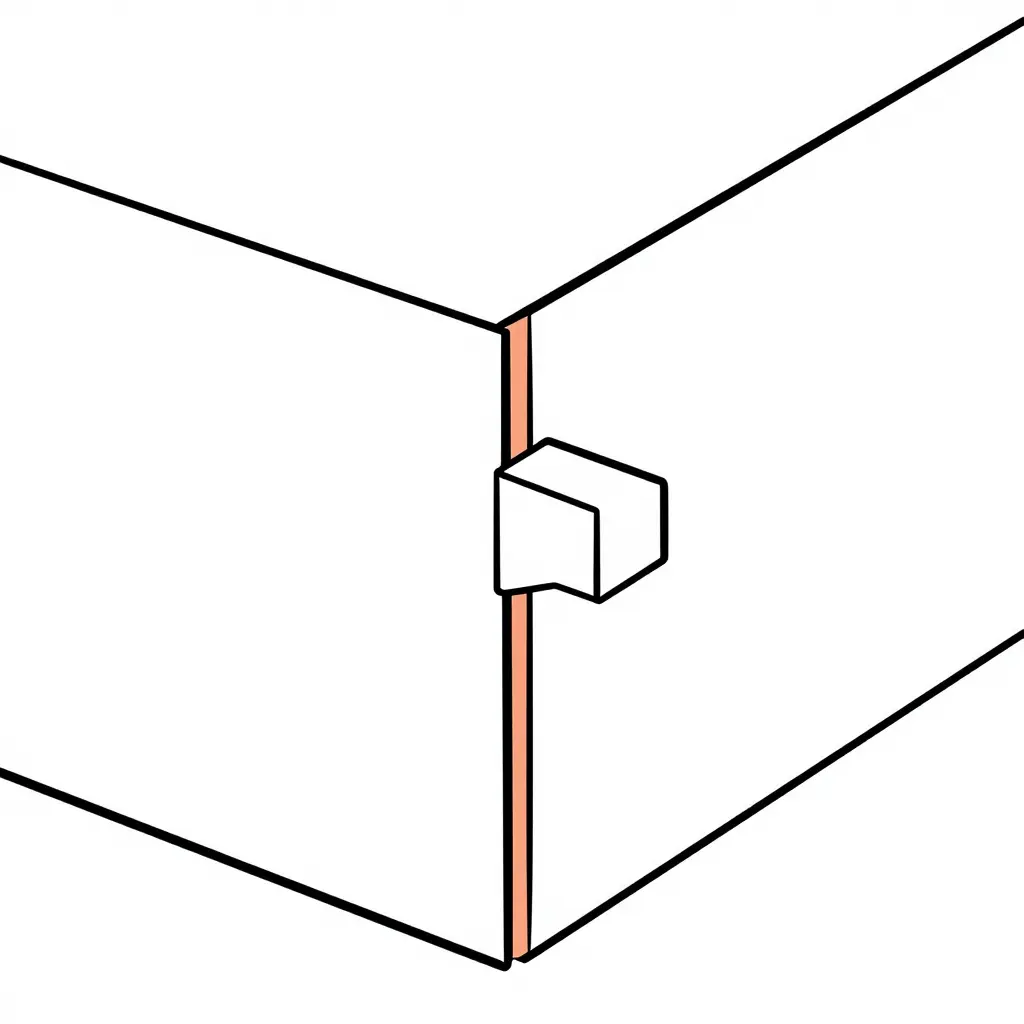
That narrow band is where a corner pops open on a saucy order. Too tight, and the tab will not seat without tearing the board or crushing the flute; too loose, and sauce-film lubrication plus the outward hydraulic push of a filled box lets the tab walk back out of the slot. The gap is what a tolerance figure describes, which is why a number quoted without a board grade, a coating and a fill weight is not a specification. Read the diagram against the paper stock you are buying; our in-stock takeaway boxes list board weights you can compare before fixing a tab clearance.
Four Failure Signatures to Look For
Every one of these defects traces back to a measurable tab tolerance or caliper value, so inspect a filled sample against the spec sheet before releasing a bulk order.
- Tab riding above the slot: a tab cut at the upper tolerance limit, plus normal caliper variance, will not seat fully, so the lock rides proud and releases under load.
- Corner gap with visible sauce film: sauce bleeding into the corner seam means the tab is undersized against the slot by more than 0.3 mm, which leaves a capillary path that wicks liquid outward.
- Tab tip folded or crushed: a deformed tip means the tab is longer than the slot was cut for, or the board is heavier than the cutting die was set for, so the tip is forced through instead of seating.
- Wall bowing at the mid-panel: mid-panel curvature points to caliper too light for the sauce payload, which distorts corner geometry and pulls the interlock out of tolerance.
Treat these as go/no-go checkpoints. One signature on a filled test box is grounds for a tolerance change request, not a packing technique fix. Confirm tab gap and caliper on stocked takeaway boxes before the next bulk order.
The Four Tab Tolerance Numbers That Matter
Four cut dimensions form the lock, and getting any one of them wrong turns a box that felt tight in the warehouse into one that hinges open the moment sauce shifts weight onto the wall. These four numbers are what tab tolerance means in practice: the engineered gap between what the die cuts and what the folder needs. Ordering fast-food boxes with corner locks against a written tolerance spec is the cheapest way most buyers have to stop pop-open complaints.
Tab depth – the length of tab that passes through the slot and sits behind the slot wall, measured flat on the blank before folding. Saucy formats generally want 6-8 mm of engaged depth on 300-400 gsm board, rising to 10 mm and beyond on heavier loads; the construction table below runs from 11 mm to 16 mm. Too tight and the tab bottoms out against the slot end, crushing the flute and tearing the board on insertion. Too loose and retention load collapses, so the panel lifts as soon as sauce pressure pushes outward.
Tab width – the lateral dimension of the tab, which sets the shear area that resists pop-open. Most bulk takeout specs sit between 12 mm and 20 mm, and roughly 15 mm suits 500-1,000 ml formats. Under 12 mm, stress concentrates at two points and fold cracking appears along the score. Over 20 mm the tab is stiff enough that it will not seat without tearing the board.
Slot length – the cut opening the tab enters, and the dimension that carries almost the whole lateral clearance budget. Nominal slot length is tab width plus 0.8-1.2 mm, no more. Cut it short and interference buckles the tab or splits the liner; cut it long and the tab slides free, killing pre-load so the lock walks open in the bag.
Board caliper – sheet thickness, which decides how much material the lock has to bite into. Food-grade solid board runs 0.4-0.5 mm at 300-400 gsm, while E-flute and micro-flute run 1.5-3.0 mm. Thinner board needs tighter clearances because there is less edge to grip; heavier caliper needs more room or the folds crack.
Why the four tolerances stack up
Tolerance stack-up is where a clean drawing turns into a leaking box. Each die-cut adds about ±0.3 mm of positional variation, each glue-and-fold pass adds up to ±0.5 mm of registration drift per panel, and caliper itself varies by roughly ±5%, which is about ±0.02 mm on 0.45 mm stock. Across a two-corner blank those errors accumulate, so a nominal 1.0 mm slot clearance can close to zero by the time the final panel folds.
Then the sauce arrives. Caliper swell, moisture taken up through the coated board, thickens the sheet by several percent within minutes of contact with a wet dish, and it eats the clearance you designed in. That is why a corner lock that passed a dry test will bind or tear on a curry. Set clearance against swollen caliper, never dry caliper.
| Dimension | Nominal range | Too tight | Too loose |
|---|---|---|---|
| Tab depth | 6-8 mm (11-16 mm on heavy constructions) | Slot-end crushing, board tearing | Low retention load, wall lift |
| Tab width | 12-20 mm | Fold cracking at the score | Hard seating, tearing on insertion |
| Slot length | Tab width + 0.8-1.2 mm | Tab buckling, liner split | No pre-load, lock walks open |
| Board caliper | 0.4-0.5 mm solid, 1.5-3.0 mm flute | Binding, fold cracking | Sloppy fit, poor grip |
Specify all four numbers on the purchase order and ask for a dry-fit and a wet-fit sample before the bulk run.
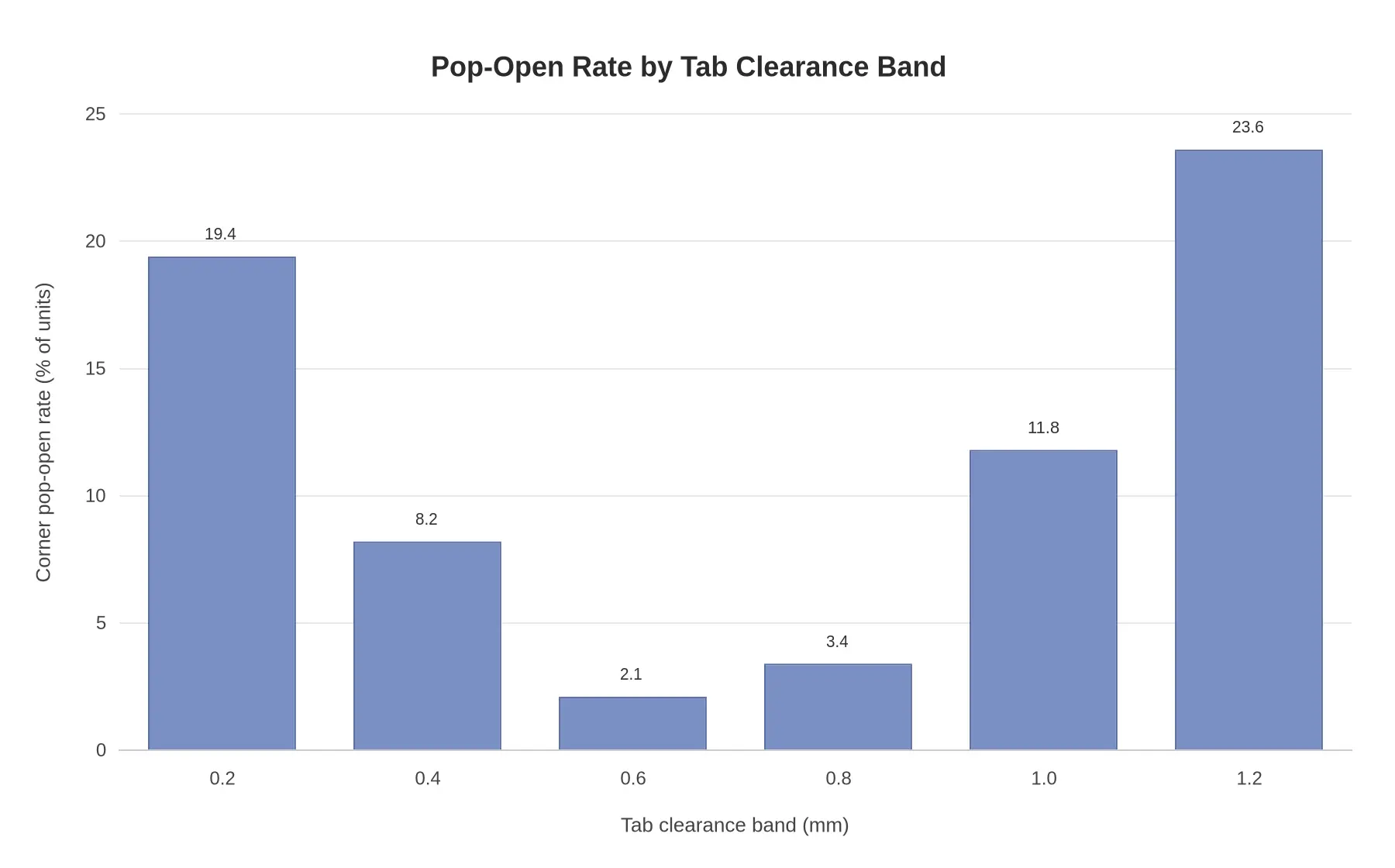
Corner pop-open rate measured on sauce-loaded boxes rises at both the tightest (0.2 mm, 19.4%) and loosest (1.2 mm, 23.6%) tab clearance bands and is lowest across the 0.6-0.8 mm mid-band (2.1% and 3.4%), which supports specifying a mid-range tab tolerance window.
The shape of that distribution is worth reading closely, because it describes a failure mode most buyers never think to specify. Tabs set too tight fight the board score line and split it; tabs set too loose never build enough interference to lock, so a sauce-heavy load finds the gap on the first tilt. Only the middle of the range gives the corner enough grip to hold without stressing the board, which is why the 0.6-0.8 mm window is the one to write into the purchase order. If you are still matching boxes to your menu, these stock takeaway boxes are a practical place to start the comparison.
Matching Tab Tolerance to Sauce Load and Board Grade
Thin sauce (broth glazes, light soy dressings, low-viscosity chili oil). Set tab depth at 6-8 mm with a clearance of 0.30-0.40 mm. A 300-350 gsm coated solid kraft board holds this band reliably, because the PE or PLA layer slows wicking at the score line and keeps fibre from swelling into the clearance. Uncoated kraft absorbs moisture at the lock and expands by roughly 0.10-0.15 mm, so the same tab needs the wider end of that range to avoid a press-fit that splits the score. Single-portion formats built to this specification are listed under fast-food boxes.
Thick sauce (teriyaki, curry paste, chili crisp, gravies). Move to a tab depth of 9-11 mm with 0.40-0.50 mm clearance. The board grade that holds it is 350-400 gsm coated solid kraft, or an E-flute corrugated sheet with a coated liner. Corrugated construction adds caliper and stiffness, but the exposed flute edge crushes under pressure, so clearance must not drop below 0.40 mm or the compressed flute jams the lock instead of seating it.
Sauce plus rice or noodles. Retained weight and condensing steam raise both peel force and panel swell. Specify 12-14 mm tab depth with 0.50-0.60 mm clearance on 400-450 gsm double-coated (PE or PLA) solid kraft, or on BC double-wall corrugated where total load exceeds roughly 900 g. Uncoated solid kraft is unsuitable at this tier, since condensed steam softens the tab wall and drops the lock below its design interference. Multi-compartment saucy formats are catalogued under meal bento boxes.
Sauce plus stacking in a delivery bag. Vertical load and road vibration ratchet an under-toleranced lock open, so set 14-16 mm tab depth with 0.60-0.80 mm clearance plus a positive locking lip. Use 450 gsm or heavier coated solid kraft where die-cut dimensional accuracy matters most, or double-wall corrugated where compression strength dominates. Corrugated cut tolerances run about ±0.3 mm, so budget clearance at the top of the range for that construction.
Tab Tolerance Reference Table
Match your box construction and board caliper first, then check the tab and slot geometry. Target Clearance here is end clearance, calculated as slot depth minus tab depth, so a negative figure means the slot is cut shallower than the tab: the tab bears on the slot end and pre-loads the joint. That is a different measurement from the lateral gap discussed above. Retention Load is the pull force, in newtons, at which an assembled corner lock pops open during testing, and Saucy-Order Suitability translates that force into a practical hold time for wet, heavy dishes.
| Box Construction | Board Caliper | Tab Depth | Slot Depth | Target Clearance | Retention Load | Saucy-Order Suitability |
|---|---|---|---|---|---|---|
| Coated kraft board | 0.42 mm | 12.0 mm | 11.7 mm | -0.30 mm | 18 N | High: 60-90 min sauce hold |
| Uncoated kraft board | 0.35 mm | 11.0 mm | 10.6 mm | -0.40 mm | 12 N | Moderate: 30 min, dry to light sauce only |
| Corrugated board (E-flute) | 1.50 mm | 16.0 mm | 15.4 mm | -0.60 mm | 35 N | Very high: 2 kg loads, 120 min |
| Double-coated solid board | 0.75 mm | 13.0 mm | 12.7 mm | -0.30 mm | 30 N | Very high: 90+ min, hot plus sauce |
| Grease-resistant lined board | 0.45 mm | 12.0 mm | 11.7 mm | -0.30 mm | 20 N | High: oily and creamy sauces, 60 min |
Treat every figure here as a starting specification and confirm the final tab depth, slot length and clearance with a physical sampling run on your own sauce-heavy dishes before you commit to a bulk order. Our corrugated food packaging range is a practical place to begin that trial.
Confirming Tab Tolerance Before You Place a Bulk Order
Tab tolerance is the specification most often left off a bulk packaging order, and it is the one that decides whether corner locks hold on a saucy dish. Work through the six checks below in this order before you release any purchase order.
-
Request a tolerance drawing. Ask your supplier for a dimensioned drawing that states tab length, tab width, slot depth and board thickness with explicit upper and lower limits. Reject any drawing that lists only a single nominal figure, because a nominal value gives you nothing measurable to inspect or dispute at goods-in.
-
Verify board caliper and moisture content. Measure caliper with a micrometer at three points per sheet across a sample of at least 10 boxes. Board caliper usually varies by about ±5%, which is roughly ±0.02 mm on 0.45 mm stock; a receiving window of ±0.05 mm leaves margin for measurement and handling. Confirm moisture content sits between 6% and 8%, since board above 9% loses stiffness and the tab compresses under load.
-
Run a sauce-loaded hold test. Fill five assembled boxes with the heaviest sauce on your menu, typically 180 to 250 g per portion, and hold them at 55 to 60 °C for 45 minutes. Inspect every corner lock at 15-minute intervals and record the first sign of tab movement, wicking or corner separation.
-
Measure retention load. Pull each closed tab with a calibrated force gauge at a 90-degree angle and record the peak load in newtons. Set your minimum acceptance value at the lowest figure your own hold test produced, and reject any lot where a single sampled box falls below it.
-
Confirm tab depth after a forty-eight-hour swell. Re-measure tab depth on boxes conditioned for 48 hours at 30 °C and 75% relative humidity, since fibre board swells once it absorbs sauce and steam. Tab depth must still exceed slot depth by at least 0.3 mm after conditioning, not merely on the day of delivery.
-
Lock the tolerance range into the purchase specification. Transfer the verified limits onto your specification sheet and attach the approved tolerance drawing as a controlled document. Require the supplier to sign the specification and to resubmit samples for re-verification whenever board grade, caliper or coating changes.
State tab tolerance in the purchase order as a range, for example “tab depth 7.8 to 8.2 mm, ±0.2 mm”, never as a single nominal number. A nominal figure lets the supplier drift anywhere inside their own process window and leaves your receiving team with no contractual basis to reject an out-of-spec lot. Write the range, the test method and the sampling plan directly into the PO, and reference the approved drawing so the requirement is enforceable. Buyers who specify this way can evaluate a documented corrugated product range on comparable, verifiable numbers instead of re-testing every delivery.
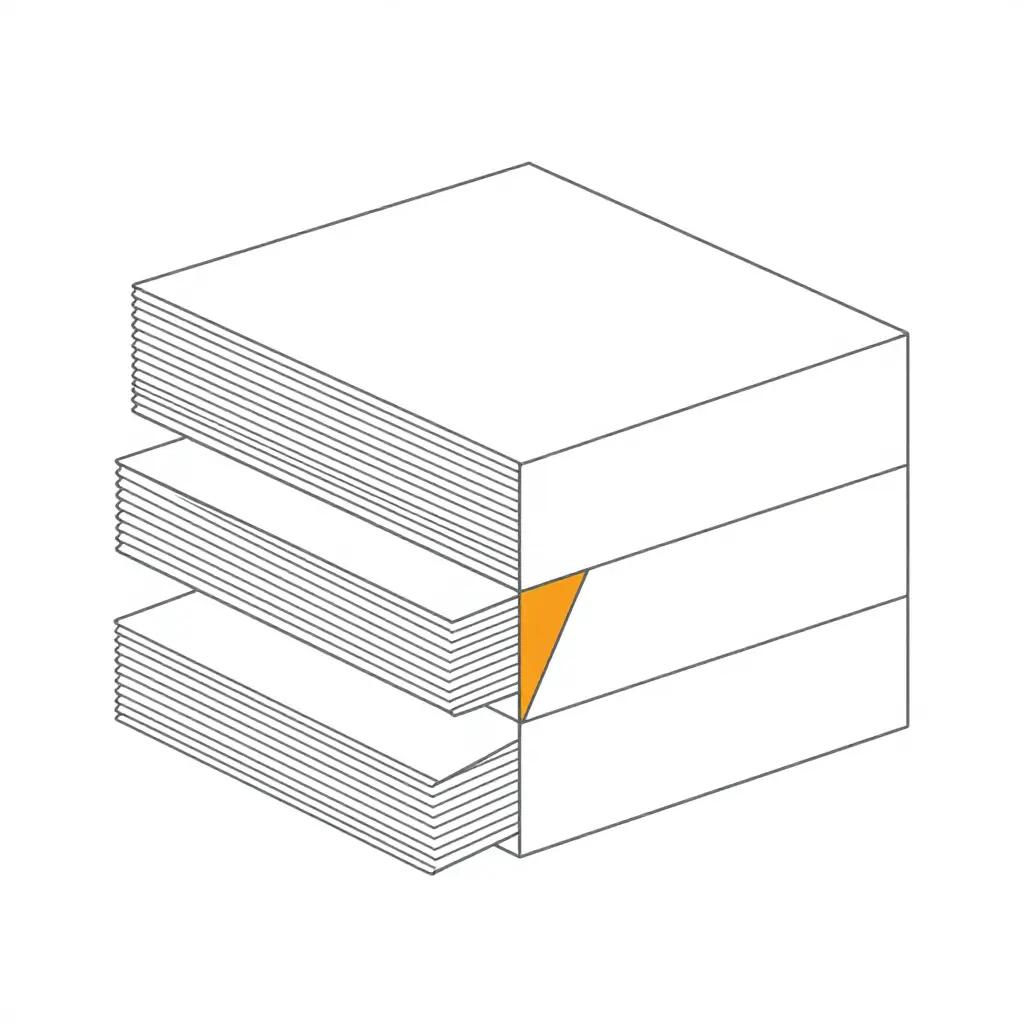
Read the section left to right: three thicknesses ride on top of each other, and the highlighted band is what is actually left over once the tab sits in the slot. That leftover is the clearance your sauce is betting against.
Frequently Asked Questions on Corner Locks and Tab Tolerance
What is the minimum tab depth I should specify for saucy orders?
For sauce-bearing dishes, the tab should extend at least 6 mm (0.24 in) below the lid shoulder so it stays engaged when the box flexes. Raise that to 8 mm for gravies, curries and anything over 200 g of liquid per portion, since the added mass puts more lateral load on the corner. Tabs under 5 mm leave too little locking surface and are the most common cause of corners lifting in transit. Ask for the tab depth to be printed on the dieline drawing before tooling is approved.
Does a tighter tab tolerance always stop a box from popping open?
No. A workable target for tab-to-slot clearance is 0.30-0.50 mm, with a tolerance band of ±0.10 mm. Pushing clearance below 0.10 mm creates an interference fit that bows the panel and can fracture the water-based or PE coating along the fold; once that coating cracks, moisture from the sauce wicks into the board and the friction grip drops sharply. Because paperboard caliper typically varies by around ±5% within a single lot, an interference fit will not seat consistently across a carton run. Specify a clearance range rather than chasing zero.
How does sauce temperature affect corner-lock retention?
Sauces held above 60 °C drive the relative humidity inside a closed box past 80%, and uncoated paperboard can lose 20-30% of its stiffness within 30 minutes at that condition. A softer tab wall bends instead of snapping behind the slot shoulder, so the corner releases at lower load. Coated board (PE at 15-18 gsm or PLA at 20 gsm) slows the moisture uptake and holds retention closer to its dry value. If your kitchen plates at 70 °C or above, order a sample lot and re-test retention at that temperature rather than at ambient.
Do corrugated boxes need a different tab tolerance than solid board?
Yes, because the tab has to be sized against caliper and flute structure, not against one universal number. On 350-400 gsm solid board with 0.4-0.5 mm caliper, an 8 mm tab with 0.4-0.6 mm clearance works, while E-flute corrugated at roughly 1.5 mm takes a 12-16 mm tab where the load is heavy. Clearance on corrugated should run looser, 0.5-0.8 mm, because flute height varies across the sheet. Tabs should also run parallel to the flutes so the locking edge does not crush the medium; you can review board options in the corrugated product range when specifying this.
How can I test tab tolerance without lab equipment?
Run three simple bench checks on 10 boxes per lot. First, fill each box with 60 °C water, close it, invert it for 60 seconds, and count corners that release. Second, clip a 5 kg digital hanging scale to the lid edge and pull perpendicular; a properly sized lock should hold to 15-25 N before opening. Third, drop the filled box from 30 cm onto a hard floor three times and inspect all four corners. Record the failure count and compare it against the next delivery before you accept the shipment.
Writing Tab Tolerance Into the Next Order
Three figures belong in the purchase order, in this order of priority. Each one closes a different failure path, and none of them covers for the other two.
| Priority | Specification figure | Typical set point | Pop-open risk it removes |
|---|---|---|---|
| 1 | Target tab-to-slot clearance | 0.6-0.8 mm | Binding or slack engagement under steam and sauce heat, the direct cause of corners lifting |
| 2 | Minimum tab depth | 8 mm engaged depth; 10 mm on three-compartment and heavier loads | Short tabs that slip out of the slot once sauce weight pushes the wall outward |
| 3 | Board caliper at working moisture | Caliper measured at 8-9 percent moisture content, stated in mm | Undersized board that expands and softens in a hot bag, changing clearance after packing |
1. Target clearance comes first because it governs fit at the moment of closing. A 0.6-0.8 mm clearance lets the tab seat fully without force and still holds when the board swells; a sample approved at low humidity will not reproduce that fit in a steamed environment.
2. Minimum tab depth follows, because depth is what resists the peeling load of a filled box. Sauce shifts weight to the corners, and a tab shorter than 8 mm has too little bearing surface to hold the wall square.
3. Board caliper at working moisture is the figure buyers most often leave out. Quote caliper at 8-9 percent moisture rather than at the mill’s dry baseline, so incoming lots do not arrive thinner than the sample that passed the clearance test.
Applying all three to stock box formats gives a single tolerance baseline across base-and-lid sizes, and pairing that baseline with matched sauce portion control keeps fill volume inside the corner load the tabs were specified to carry. Standardizing the three figures across a packaging range removes per-SKU requalification and leaves every supplier, die cutter and quality inspector with one measurable acceptance standard.