
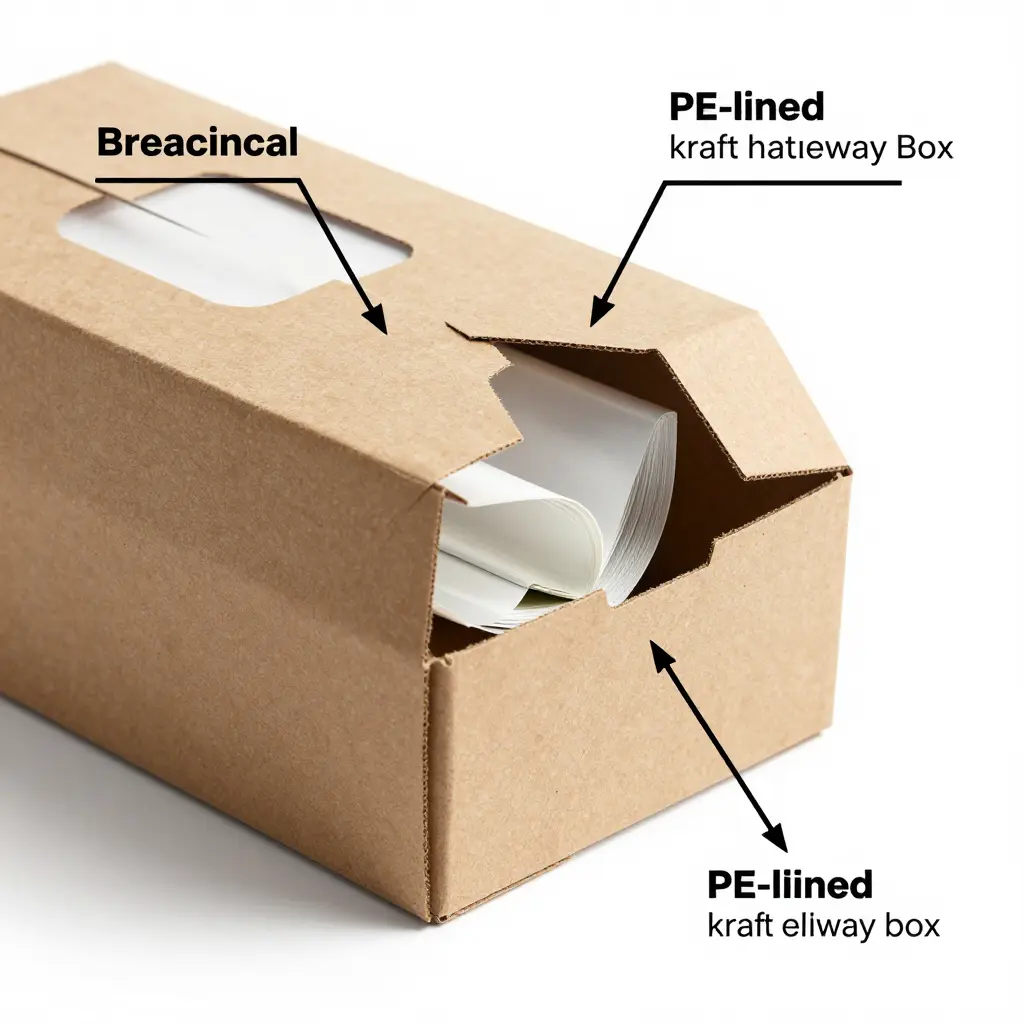
PE Lining and Fold Integrity in Kraft Takeaway Boxes
PE (polyethylene) lining carries the grease and moisture barrier in PE lined kraft takeaway boxes, and the failure that shows up most often in the field is film lifting and delamination along fold lines and corners. Whether the coating stays continuous through creasing, folding, heat, oil and moisture depends on lamination bond strength. Three terms are used here in a specific sense:
- PE extrusion coating: A continuous polyethylene layer applied to kraft board by extrusion, forming the functional barrier.
- Film lifting at folds: Localized separation of the PE film from the paper substrate at creases and corners, often initiating delamination.
- Lamination bond strength: The measured force required to separate the PE layer from the kraft substrate, expressed as a specification value.
Why the PE Film Lifts at the Fold
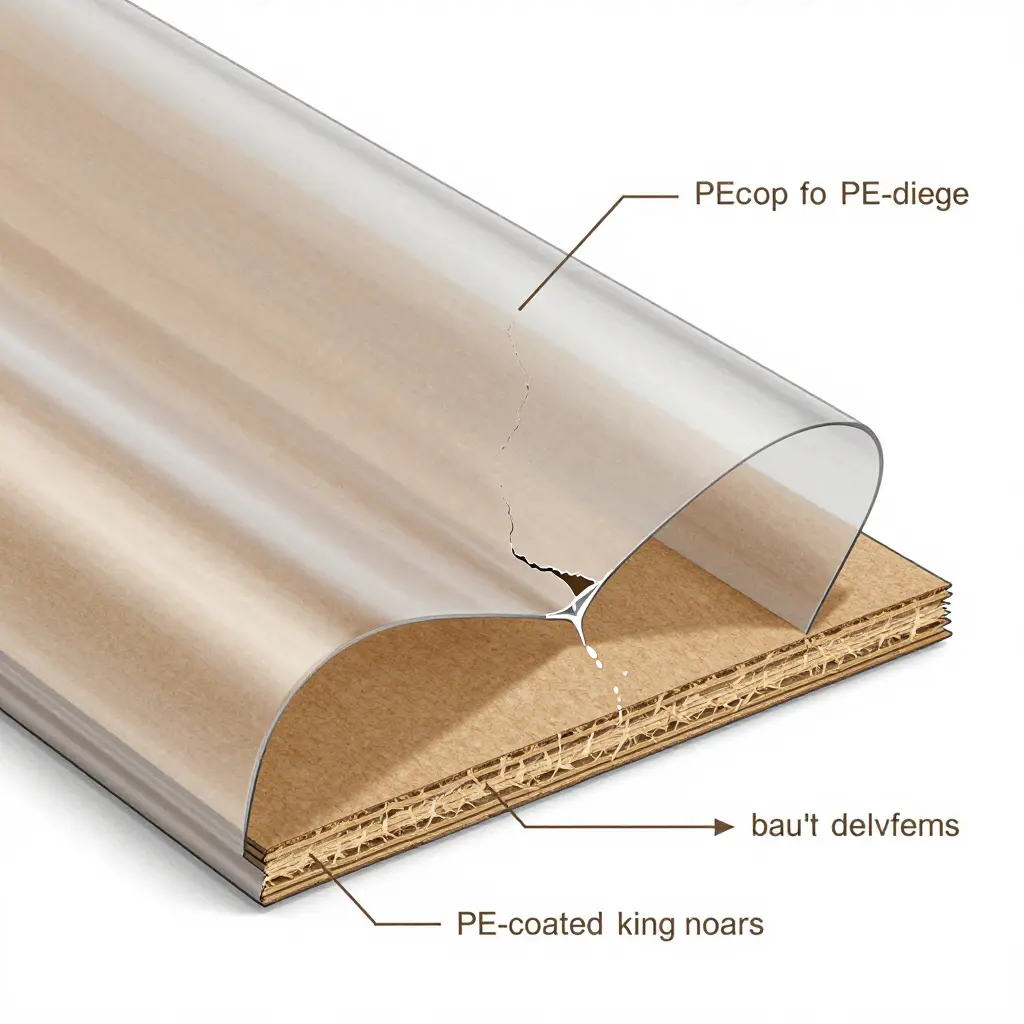
Film lifting at folds is a mechanical failure of the coating interface, not a cosmetic defect, and the sequence runs the same way most times.
Fibre Strain and Coating Starvation
Creasing stretches and compresses kraft fibres far more than it does the PE layer. At a tight fold radius the coating is pushed past its elongation limit and cracks along the crease line. Because the film spans the fold instead of following the fibres into it, coating weight per unit area falls at the crease, and the anchoring layer can be starved exactly where mechanical stress peaks.
Heat, Pressure and Contraction
Heat and pressure in the folder-gluer temporarily soften the PE. As the board cools, contraction pulls the softened film away from the fibre surface, and a marginal bond becomes a measurable lift.
Moisture and Surface Keying
Exposed fibre edges at cut lines admit moisture; the board swells and shears the interface, widening micro-cracks. Open, porous or dusty board surfaces reduce mechanical keying of the extrusion coating before the box is even folded.
Verifying the Bond
The practical control point is lamination bond strength: specify a minimum peel value and verify it before ordering PE-lined kraft takeaway boxes.
Most fold lifting comes from two or three small process drifts stacking up until the bond at the crease gives way, so work through these eight causes before blaming the resin batch or the box design.
- Insufficient coating adhesion: resin never fully bonded, so the fold shears it loose.
- Over-tight crease radius: a sharp fold stretches the film beyond its elastic limit.
- Low coating weight at the crease: thin PE lacks the mass to bridge the bend.
- Board porosity or dust: loose fibres starve the interface, so adhesion starts weak.
- Inadequate corona or primer treatment: low surface energy stops the resin from wetting out.
- Excessive heat-sealing pressure: the melt is squeezed thin, leaving a starved bond line.
- Moisture pickup before conversion: trapped vapour expands at the crease and pushes film up.
- Mismatched film-to-board elongation: board flexes further than PE, so the bond fatigues.
Six of the eight are converting-line settings rather than material choices, which is why a bond strength figure alone will not hold a box together. It has to be paired with a crease radius, a coating weight and a moisture limit your converter can hold run after run. When comparing PE-lined takeaway and bento boxes across suppliers, ask for crease geometry and pre-conversion moisture data alongside the peel value, then test a folded sample rather than a flat one.
What “Film Lifting at the Fold” Actually Looks Like
The defect is easier to read in cross-section. The schematic is a flat 2D slice through a PE-lined kraft board: the thick band is the fibre board, and the thin dark line on top of it is the polyethylene coating.
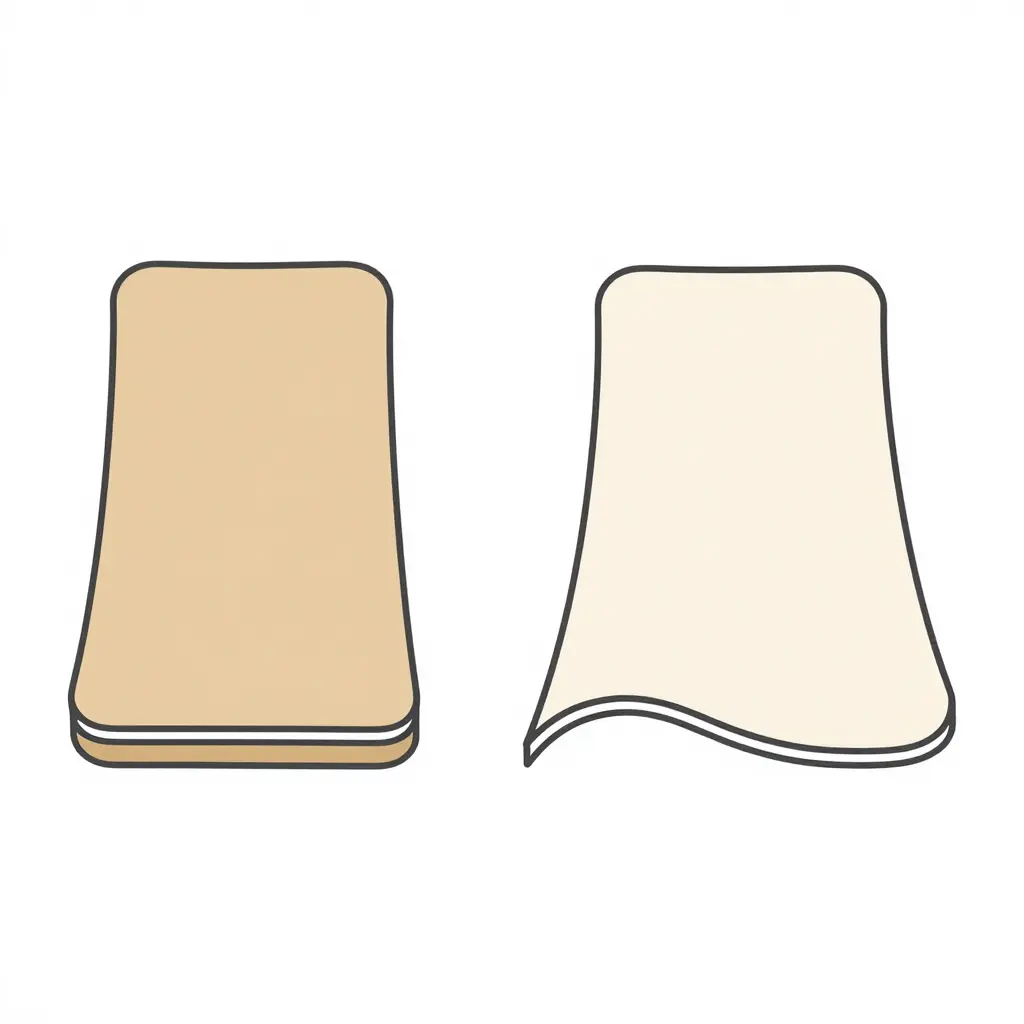
On the left the board is flat and the film sits flush against the fibre surface, so the interface reads as a single continuous line. On the right the same board is bent: the fibre layer follows the radius, but the PE film – thin, stiff and dimensionally stable – resists compression on the inside of the bend. Rather than shrinking with the board it arches slightly and peels away, opening a wedge-shaped gap that is widest at the crease and closes again a few millimetres along the panel.
What the cross-section shows
- The separation starts at the crease, not at the panel edges. Lifting is a local hinge effect, which is why it appears as a bubble or a white line on the fold rather than as general delamination.
- The gap is an interface failure, not a coating failure. The film is intact in the diagram; it has let go of the fibre surface, which points to insufficient lamination bond strength rather than to a resin problem.
- Tighter radii make it worse. The sharper the crease, the shorter the distance over which the film must absorb the bend, and the higher the peel stress concentrated at the interface.
A milky streak or a film bubble at the score line is this gap seen from the outside. It is also why fold lifting usually traces back to the specification – the bond strength was never set for the radius the box is actually folded at – more often than to a machine fault on one shift. If you are specifying kraft takeaway boxes with a PE lining, check the PE-lined fast food boxes you are considering against the crease radii your filling line and your customers actually produce.
Lamination Bond Strength Values and How They Are Measured
Write lamination bond strength into the specification as a number and a method. For PE-coated and PE-laminated kraft board the T-peel test is the usual reference: 15 mm wide strips peeled at 180° and 300 mm/min, with the average force reported in N/15 mm. Publish the conversion as well – 1 N/15 mm equals roughly 170 gf/25 mm – because some mills and QC sheets still report gf/25 mm, and mismatched units cause false passes.
Name the reference standard in the contract: GB/T 2791 for T-peel of flexible laminates and ASTM F904 for comparative bond strength. Require the test report to state test direction, machine direction or cross direction, since fibre orientation and coating weight distribution shift peel values, and to state conditioning (23 ± 2 °C, 50 ± 5 % RH) before testing.
Set acceptance limits by format rather than one catalogue-wide figure: 2.5 N/15 mm minimum on flat areas of hot or greasy formats, with dry bakery and chilled formats allowed down to 1.5 N/15 mm (see the matrix below); 3.5-5.0 N/15 mm as a robust target for fold-heavy formats such as fast food boxes; and a peel figure measured across the crease rather than on a flat coupon. Be careful with percentage-loss clauses: the four constructions charted further down lose 40% to 61% of their flat peel once creased, so a clause written as “no more than 20 % loss” will fail every sample. Specify PE-to-PE heat seal strength and Cobb water resistance alongside bond strength, because adhesion alone does not predict leakage, and state substrate and coating weight on the certificate so suppliers stay comparable.
PE lamination bond strength specification matrix for kraft takeaway boxes
Bond strength decides whether the PE film stays put when the box is folded, hot-filled and then stacked in a delivery bag for 40 minutes. It is also the line most often missing from a purchase order, which is why a weak laminate turns up on the first production run rather than in the samples.
The matrix gives two figures per format. Minimum bond strength is the absolute floor: below it the film will lift at the fold on a normal machine run. Recommended target is what belongs in the specification and on the COA, with headroom for flute cracking, score-line stress, grease attack and condensation. Peel values are quoted in N/15 mm, board weights in GSM, and every row names the standard and the peel direction, since machine direction (MD) usually tests stronger than cross direction (TD) and TD is where film lifting starts.
| Box format and load type | Typical board / PE weight | Min bond strength (N/15 mm) | Recommended target (N/15 mm) | Test method and direction | Acceptance note |
|---|---|---|---|---|---|
| Light bakery and sushi boxes, dry or chilled | 300-350 GSM kraft, 15-20 micrometre PE | 1.5 | 2.0-2.5 | ASTM F904 T-peel, 180 degree, 300 mm/min, MD + TD | No visible lifting after 180-degree fold |
| Fast-food boxes such as burger clamshells and chip cartons, hot and greasy | 300-350 GSM, 20-25 micrometre PE | 2.0 | 3.0-3.5 | ASTM F904 T-peel, 180 degree, 300 mm/min, TD as governing value | Folds held 24 h at 60 C show no edge lift |
| Meal bento boxes, hot fill at 75-90 C, multi-compartment | 350-400 GSM, 25-30 micrometre PE | 2.5 | 3.5-4.0 | ASTM F904 plus heat-seal check at 140 C / 2 s, TD samples from compartment corners | No lifting at corner folds after 4 h at 60 C / 90% RH |
| Corrugated heavy-duty boxes, stacked to 10 kg | E-flute with 350 GSM liner, 30-40 micrometre PE | 3.0 | 4.0-5.0 | ASTM F904 T-peel, MD + TD, samples cut across score lines | No film separation at score under full stack load |
| Windowed pastry and dessert boxes | 300-320 GSM, 18-22 micrometre PE | 1.5 | 2.0-2.5 | ASTM F904, 180 degree peel, TD, film-to-board at window aperture | No lifting around the window aperture after fold |
| Noodle and sauce-heavy pails or tubs | 350-400 GSM, 30-35 micrometre PE | 2.5 | 3.5-4.0 | GB/T 8808 or ASTM F904, TD + MD, with TAPPI T559 grease kit | Kit 7 grease hold, no seam wicking after 2 h at 70 C |
How to use the numbers before you order
- Sample the fold, not the flat sheet. Ask the converter to cut peel specimens across the score line and from compartment corners. A flat-sheet result of 3.5 N/15 mm can fall below 1.5 N/15 mm once the board has been creased and the film stretched over the fold.
- Specify TD as the governing value. Cross-direction peel typically runs 20-35% lower than machine direction, and it is the direction that fails first on a folder-gluer.
- Fix the test conditions. Condition samples for 24 h at 23 C / 50% RH (ASTM D618 or ISO 291) and record peel speed, since a 300 mm/min T-peel reading is not comparable with a slower pull.
- Treat the target as a purchase-order requirement. Write it as “minimum 3.0 N/15 mm TD, ASTM F904” plus a retest frequency per lot, and ask for the raw bond values in the COA rather than a pass/fail tick.
For lighter formats, a 2.0 N/15 mm target usually survives hand folding and chilled display. Once hot food, oil or stack weight enters the picture the film needs a thicker PE layer and a stronger bond, because heat softens the adhesive interface while grease works along the score and lifts the film from underneath. A quoted box sitting below the minimum column for its format is at the point where film lifting at the fold begins, and no amount of good folding practice downstream recovers it.
Seven Checks to Complete Before You Confirm a PO
Turn the bond strength acceptance criteria into a sequence any buyer or QA engineer can run the same way twice, and keep evidence for every step.
- Obtain the technical data sheet and the lot-specific certificate of analysis before reviewing any quotation.
- Request the peel test report and confirm the standard, units, test direction, and conditioning parameters stated.
- Test folded samples yourself at 90 and 180 degrees, recording peak and average peel values.
- Run a 24-hour grease and water hold test on folded corners under realistic service temperatures.
- Condition samples at elevated humidity, then retest bond strength to simulate tropical or steam-heavy delivery conditions.
- Apply an agreed AQL sampling plan to the delivered lot, inspecting folds, seams, and liner continuity.
- Approve the order only after a pilot production run passes every criterion in your checklist.
If a single step fails, ask for a revised lamination specification in writing rather than a verbal reassurance. Only a documented retest on a pilot run shows whether the film survives folding, steaming and stacking in service. When you are still shortlisting suppliers, put the PE-lined kraft takeaway boxes you are evaluating through these same seven checkpoints so every quote is judged on identical evidence.
What the Bond Strength Numbers Actually Tell You
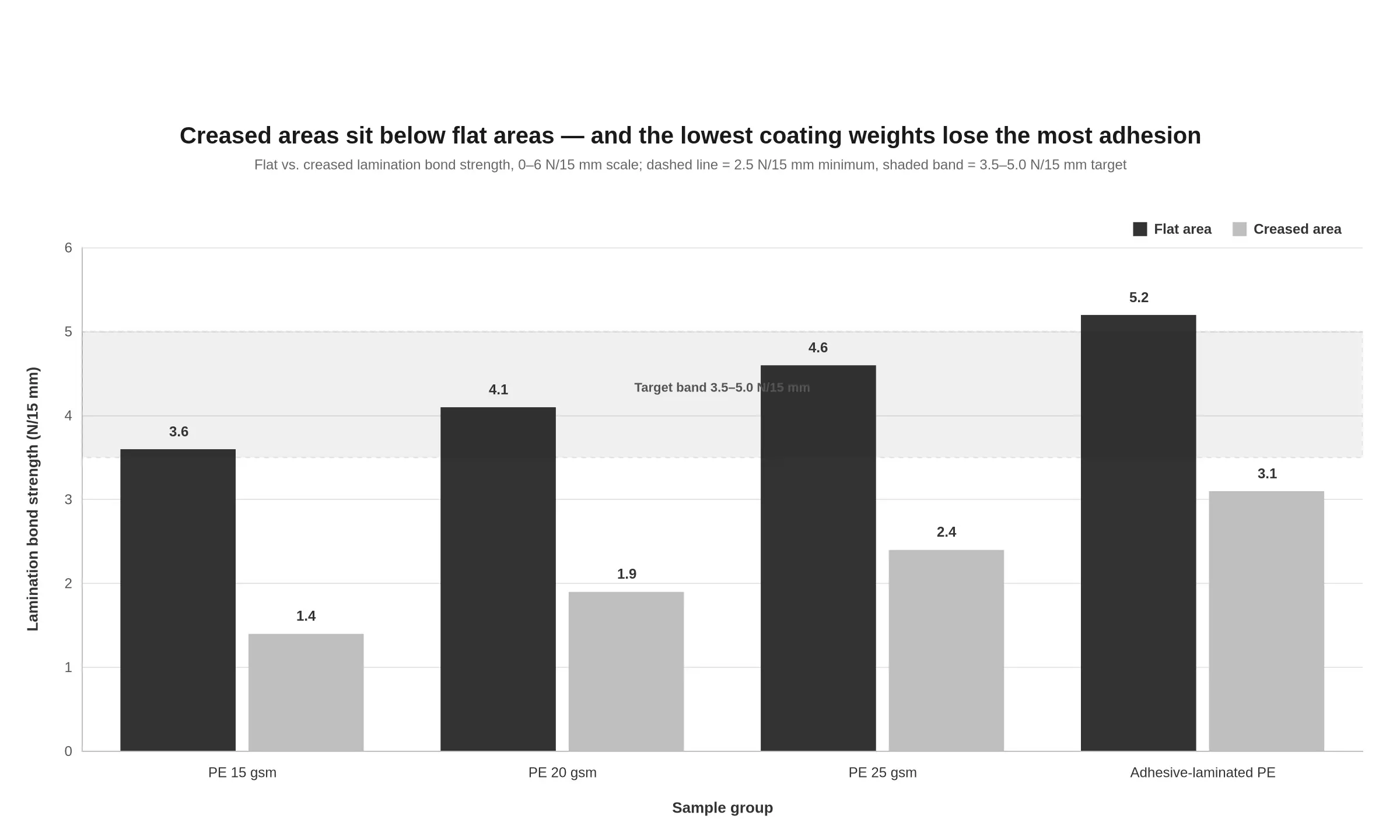
A flat-panel peel value is easy to quote and nearly meaningless on its own. The fold line is where a PE lining is really tested: the film is stretched, compressed and partly delaminated in a single pass on the folder-gluer. The chart gives both values for four constructions.
What the four constructions show
- Every creased bar is shorter than its flat counterpart. The loss is 2.2 N/15 mm on each of the three extrusion coatings and 2.1 N/15 mm on the adhesive laminate. It barely varies between constructions; what varies is the starting value, and therefore whether the sample still clears the floor once it has been creased.
- Light coating weights fail first at the crease. PE 15 gsm lands at 1.4 N/15 mm on the fold, well under the 2.5 N/15 mm floor for hot and greasy service, while PE 25 gsm reaches 2.4 N/15 mm, one-tenth of a point short. The thinner the film, the less polymer there is to absorb fold strain, and the sooner lifting, whitening or a peeling lip appears under a hot, saucy load.
- Construction matters as much as grams. The adhesive-laminated sample keeps 3.1 N/15 mm after creasing: above the floor, though below the 3.5-5.0 N/15 mm target band, because the adhesive layer redistributes stress differently from an extrusion coating.
Quick reference values
| Sample group | Flat area (N/15 mm) | Creased area (N/15 mm) | Crease loss |
|---|---|---|---|
| PE 15 gsm | 3.6 | 1.4 | -2.2 |
| PE 20 gsm | 4.1 | 1.9 | -2.2 |
| PE 25 gsm | 4.6 | 2.4 | -2.2 |
| Adhesive-laminated PE | 5.2 | 3.1 | -2.1 |
Specify the creased-area value, not the flat one, and ask for it at the tightest fold radius the box will actually run through. For heavier, greasier menus that push you toward thicker linings, PE-lined kraft takeaway boxes can be supplied with crease-test data alongside the sample.
Writing Bond Strength Into the Purchase Order
Translate the technical requirement into a clause the supplier can be audited against. Usable wording: “PE coating weight 18-22 g/m²; lamination bond strength minimum 3.0 N/15 mm machine direction and 2.5 N/15 mm cross direction, T-peel to ASTM F904 at 300 mm/min, specimens conditioned 24 h at 23 °C/50% RH.” Naming coat weight, direction, standard and conditioning closes the loophole that lets a converter test only the strong axis.
Require a certificate of analysis per lot and a sealed reference sample retained for twelve months. Set AQL by defect class: 1.0 for critical grease-leak lifting at the fold, 2.5 for cosmetic lifting, applied under ISO 2859-1 level II, where a 200-piece lot samples 32 units. Match order quantities to available in-stock box formats and replenishment lead times before fixing sampling into the contract.
On failure, specify one confirmatory retest at doubled sample size, then lot rejection, with a root-cause and corrective-action report inside ten working days. Ask four questions before award:
- Which coating line and resin grade, and how is coat weight controlled in-line?
- Is the surface primed or corona treated, and at what dyne level?
- What are the crease depth and tooling specs for the fold lines?
- Will you release peel data with every lot?
Request folded samples from the fast-food box range to verify creasing.
The Five-Stage Verification Sequence at a Glance
Before a single carton of PE-lined kraft boxes leaves the warehouse, the film-to-board bond has to prove itself in a fixed order (see diagram): incoming roll or sheet sample, peel test, fold and crease test, grease and water hold test, then release or hold. Treat it as a gate system. Nothing advances until the stage before it passes.
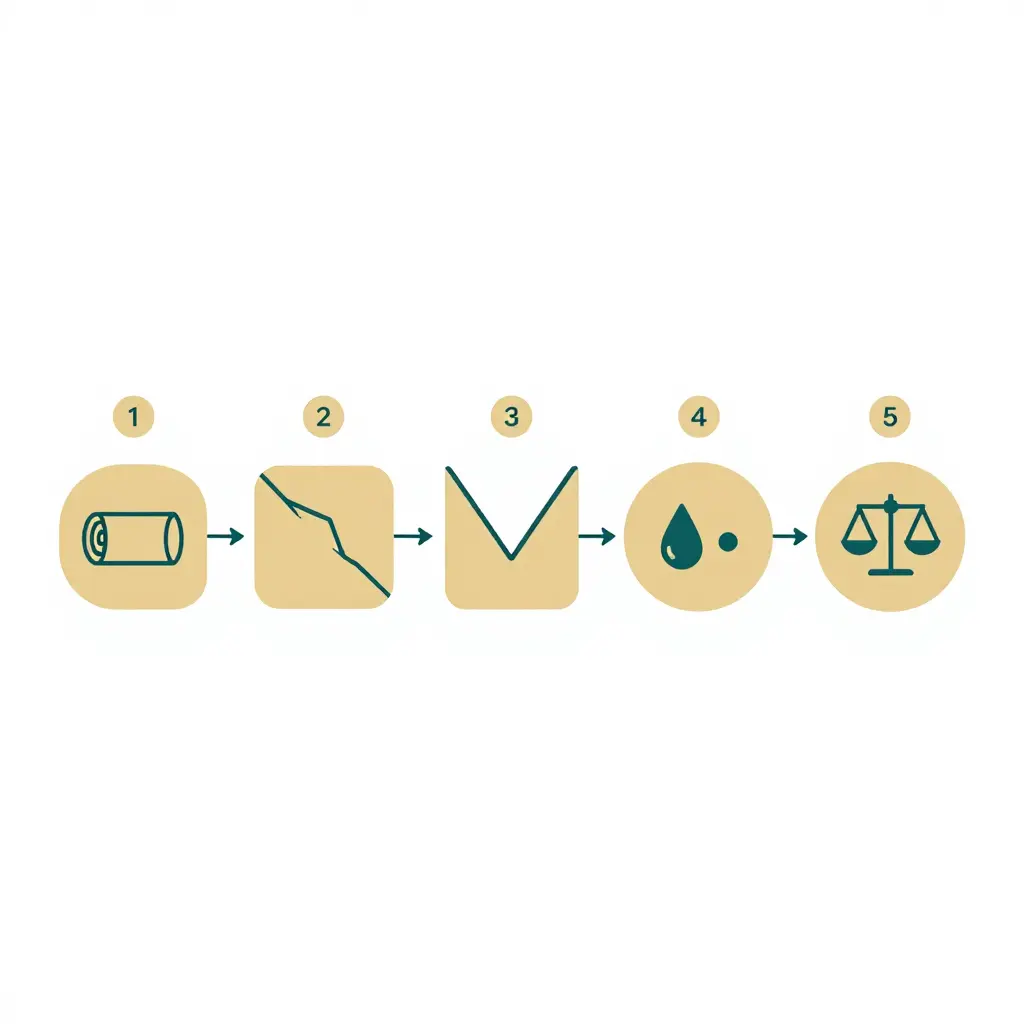
Why the sequence is fixed
- Incoming roll or sheet sample. Pull your sample from the same lot you intend to run, not a hand-cut from the last delivery. Record the liner weight in gsm, the PE thickness, and the resin grade.
- Peel test. This is the stage that predicts fold failure. A controlled peel, T-peel or 90 degrees, tells you whether the lamination bond strength sits in the workable window (typically 1.5-3.0 N/15 mm for PE on kraft board – confirm the figure with your converter and lock it into the purchase order).
- Fold and crease test. A bond that survives a flat peel can still crack when the board is creased, because creasing stretches the film over a tight radius. Score, fold, and inspect under a light.
- Grease and water hold test. Only after the mechanical checks should you expose the box to hot, oily food. This stage catches pinholes, edge wicking and seam gaps rather than bond strength.
- Release or hold decision. Sign off against agreed acceptance criteria, or quarantine the lot and request a re-test from a second sample position on the parent roll.
Running the stages in order stops you from chasing grease resistance with a coating change when the real problem is a weak lamination bond at the crease. If you are specifying a new line, PE-lined kraft takeaway boxes can be compared by board grade and liner option before you write the test protocol into the spec.
PE Weight Selection and Coating Alternatives for Fold-Heavy Formats
PE weight sets crease performance, grease barrier and cost per box in one decision. Thin coatings fold flat but carry little bond through the crease; heavier coatings hold more absolute peel and resist grease, and their stiffness raises peel stress at tight radii. Confirm crease line width against the coating weight before approving artwork.
| PE weight | Crease performance | Grease barrier | Cost index (20 gsm = 1.00) |
|---|---|---|---|
| 15 gsm | Folds flat; lowest creased peel | Low | 0.90 |
| 18 gsm | Good; adequate creased bond | Moderate | 0.95 |
| 20 gsm | Good | Good | 1.00 |
| 25 gsm | Fair; needs a wider radius | High | 1.10 |
| 30 gsm | Poor at tight radii | Very high | 1.22 |
Matte PE scatters light and masks crease whitening; specify it for printed bakery and sushi boxes. Gloss PE gives a lacquer-like surface and faster grease release; specify it for unprinted and single-colour boxes.
PE extrusion coating bonds directly to board at the lowest cost. Adhesive lamination carries heavier film and the highest bond strength, and is specified where film lift repeats. Aqueous dispersion coatings crease more cleanly with no film to delaminate, but hold lower grease limits and supplier-specific repulpability claims. Verify dispersion grades by crease-and-fold testing rather than by bond peel.
Specify 20 gsm matte PE or dispersion coating for high-fold-density takeaway boxes, and 25 to 30 gsm adhesive lamination for straight-line corrugated takeaway box constructions.
Root-Cause Distribution: Where Film Lifting Actually Comes From
The doughnut chart gives an approximate split of root causes drawn from field complaints on PE-lined kraft board. Use it as a starting point for diagnosis, not as a converter-specific figure.
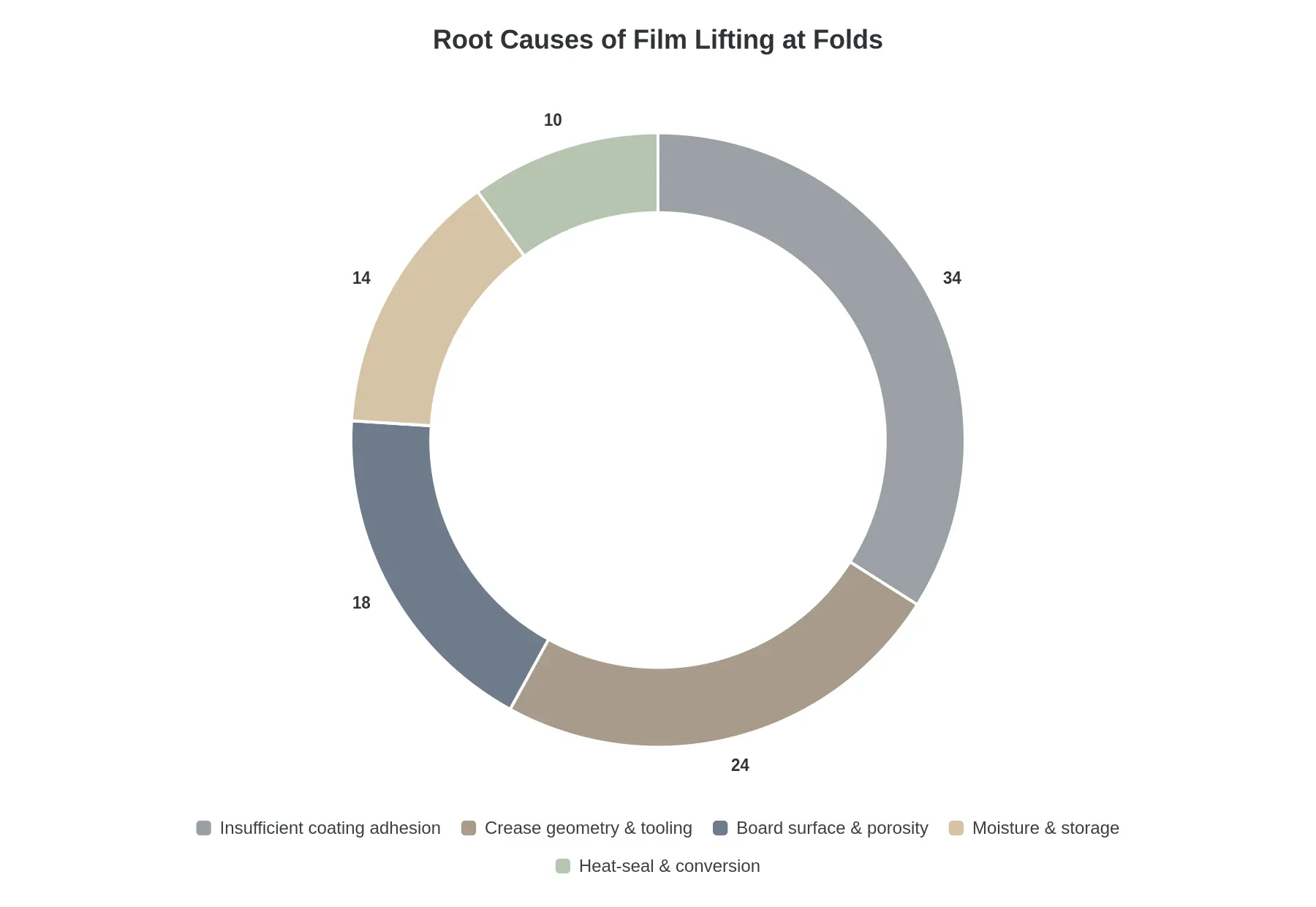
Where the numbers come from
- Insufficient coating adhesion – 34%. The largest single bucket, and the one a bond-strength test exposes fastest.
- Crease geometry and tooling – 24%. A crease that is too tight or too deep stretches the film past its elongation limit.
- Board surface and porosity – 18%. Rough, dusty or highly porous kraft stock leaves the adhesive without a continuous bond line.
- Moisture and storage – 14%. Board picked up from a humid warehouse blisters when heat-sealed.
- Heat-seal and conversion – 10%. Pressure, dwell time and chill-roll settings finish the job.
Adhesion and creasing together account for 58% of the split, and both can be specified before the order is placed – which is why the peel figure belongs in your purchase documentation. When you shortlist PE-lined kraft takeaway boxes, ask for the peel value, the test method and the retention figure after creasing.
Frequently Asked Questions: PE Lining and Lamination Bond Strength
What minimum lamination bond strength should I specify for PE lined kraft takeaway boxes?
Specify a minimum lamination bond strength of 2.5 N/15 mm for standard PE lining, and 3.0 N/15 mm at folds and creases on PE lined fast food boxes. Below 2.0 N/15 mm, film lifting at folds is likely during filling and transport.
Why does film lifting appear on some production lots and not others?
Lamination bond strength varies with coating melt temperature, corona treatment, primer type, board moisture and nip pressure. Lots coated at low extrusion temperatures, or with aged corona treatment, bond weakly, so film lifting at folds appears only in those runs.
Does a thicker PE layer prevent lifting at folds?
No. Raising PE lining thickness from 18 µm to 30 µm does not stop film lifting at folds; thicker film adds fold stiffness and stresses the bond line. Correct bond strength and crease geometry first.
How can a buyer test bond strength without an in-house laboratory?
Ask the supplier for a certificate of analysis showing lamination bond strength per lot, then run a 180° peel check with a spring scale on a 15 mm strip. For dispute resolution, send samples to an external lab.
Are PE lined kraft boxes suitable for microwave or high-fat hot foods?
Only within limits. Standard PE lining tolerates roughly 70-90 °C, so brief microwave reheating of low-fat food is acceptable, but high-fat hot foods above 85 °C can soften the film and cause delamination or wicking. Specify PP lining for microwave-heavy menus.
Procurement Checklist
Fold lifting reflects coating coverage and bond strength far more than handling.
- Specify PE coating weight (g/m²) per side and minimum bond strength in N/15 mm, by peel test to GB/T 2791 or ASTM F904, stating peel direction (machine or cross).
- Require lot-level peel test data for each delivery, not one qualification report.
- Test creased and folded samples; flat sheets understate fold performance.
- Apply an AQL plan to visual lifting at folds and edges.
- Store stock dry and flat.
Ecocupbowl is a manufacturer and supplier of disposable tableware, packaging paper and boxes, emphasizing safety, durability and eco-friendly practice with responsive technical support. Companion formats include stock boxes and paper food trays.
Quality assurance rests on retained lot samples and recorded inspection results traceable to each shipment.