
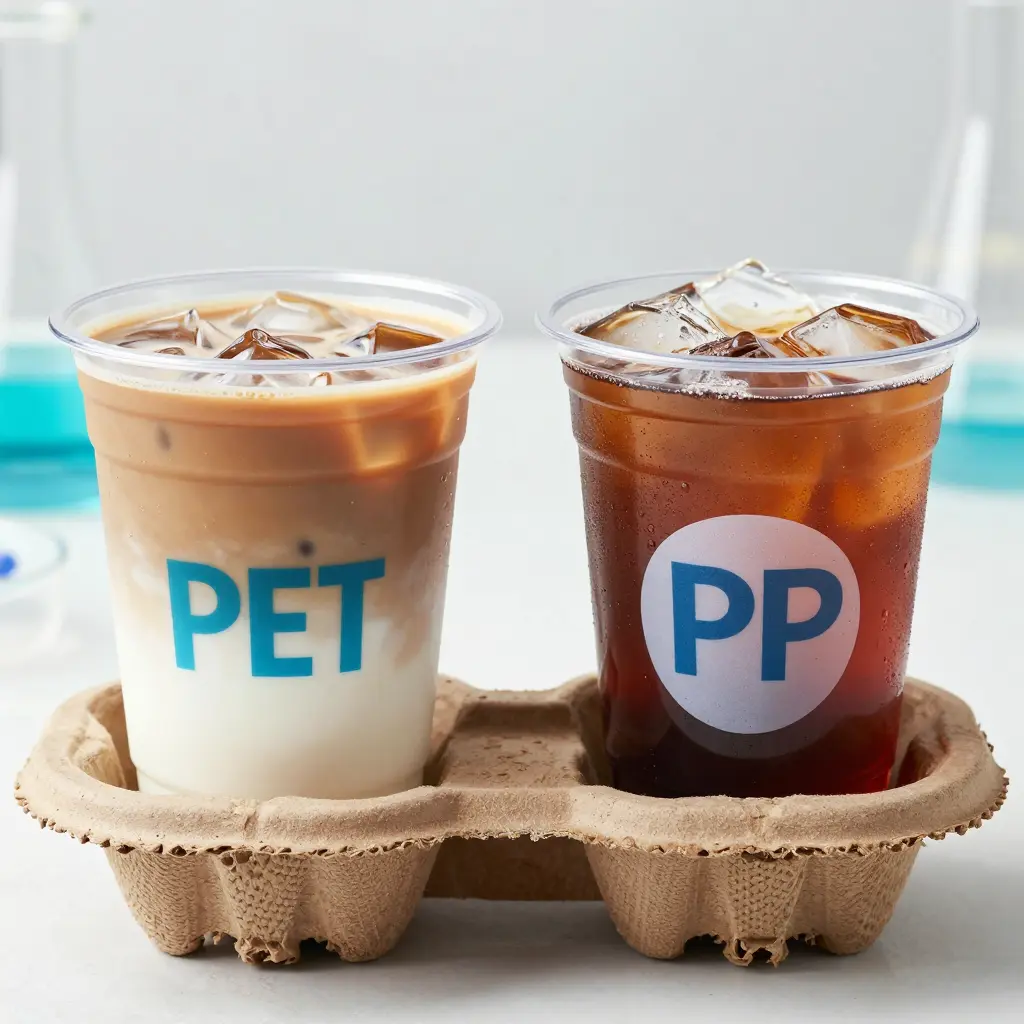
The Material Science Behind PET and PP Cups
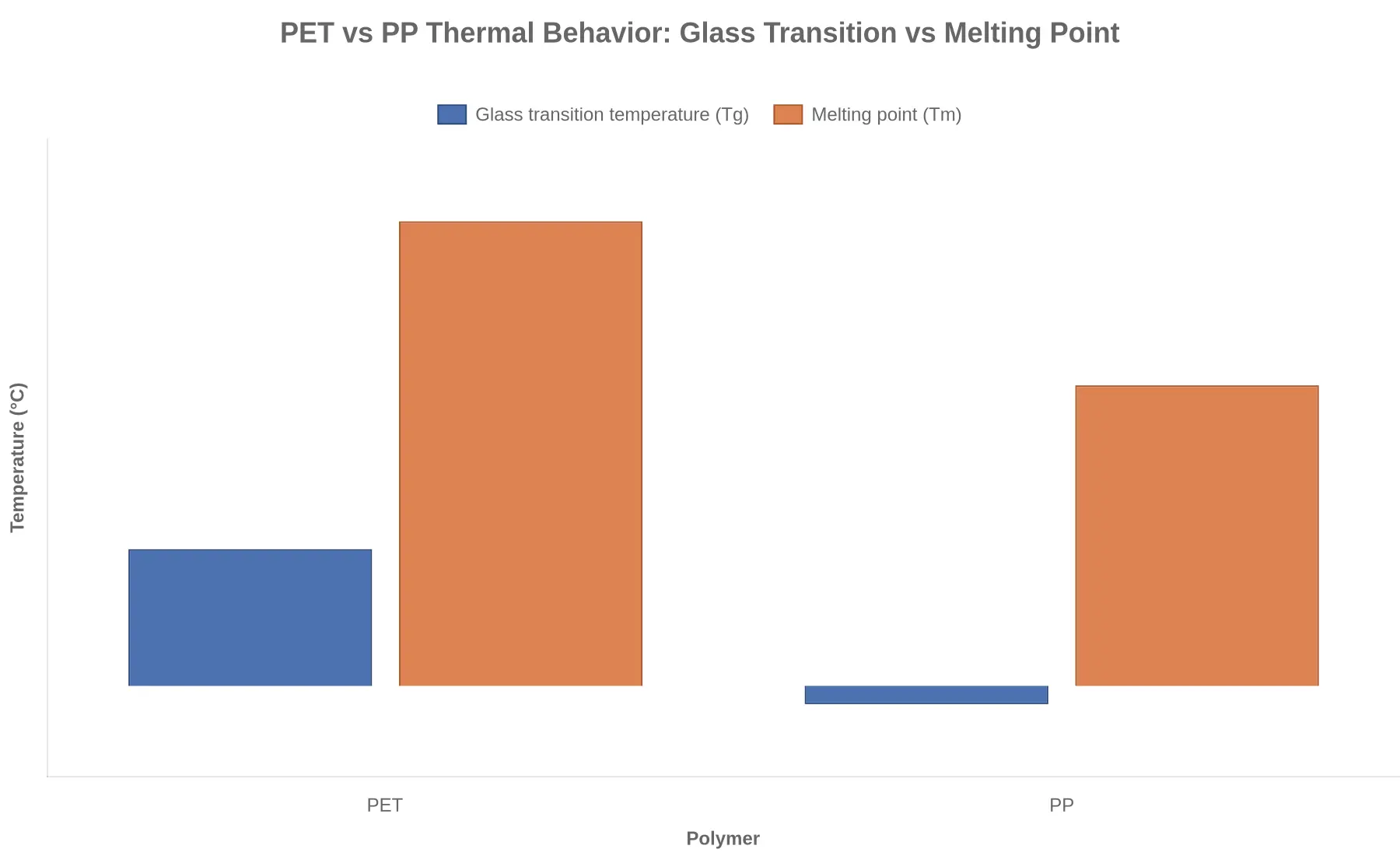
A hot latte can buckle a cup, and a frozen drink base can crack overnight in storage. Neither failure is random. Both come down to how the polymer behaves as the temperature changes. PET (polyethylene terephthalate) is a semi-crystalline polyester whose chains stiffen into a glassy state around 70-80°C, with heat deflection starting at 60-70°C. Polypropylene (PP) is a semi-crystalline polyolefin with a melting point near 160-170°C and a glass transition well below 0°C.
Glass transition and crystallinity, in plain engineering language
Glass transition (Tg) is the temperature at which a polymer stops behaving like rubber and starts behaving like glass. Below Tg the chains are frozen, so the part feels stiff and often brittle. Above it, the chains can slide and the material softens under load. The easy shorthand is the “stiffness switch.”
Crystallinity describes how neatly the chains pack into ordered regions. Semi-crystalline plastics such as PET and PP contain both ordered crystalline zones, which resist heat, and disordered amorphous zones, which add toughness. More crystalline content means better heat resistance. More amorphous content means better toughness at low temperature.
Reading the numbers
| Property | PET | PP | What it means for the SKU |
|---|---|---|---|
| Glass transition (Tg) | ~70-80°C | Well below 0°C | PET softens going into hot fill; PP embrittles going into deep cold |
| Melting point (Tm) | ~255°C | ~160-170°C | Both resist melting in normal service |
| Heat deflection onset | ~60-70°C | ~90-105°C | PET warps first on hot fill |
| Cold behavior | Already below Tg at room temperature | Crosses its Tg in the cold chain | PP is the one whose cold behavior changes |
Why higher Tg resists heat, and lower Tg stays tough
A high Tg, as in PET, holds glassy stiffness up to a high temperature. That sounds ideal until an 85-90°C hot fill pushes PET past its glass transition, softening the walls until they warp. A low Tg, as in PP, keeps the material flexible and impact-resistant at ambient and mildly cold temperatures, which is why polypropylene cups are the default for room-temperature and chilled service.
The flip side matters just as much. Because PP’s Tg sits below freezing, deep freezer temperatures push it toward its own brittle regime, which is why a rigid PP cup can crack when dropped straight from a freezer. PET, already below its Tg at room temperature, stays dimensionally stable as it gets colder; its limit is heat, not cold.
The practical move is to match the polymer to the temperature range the cup will actually see. Building a chilled or frozen program? Start with plastic cups for cold drinks engineered for low-temperature service. Running a hot-fill line? Use a heat-stable material instead.
PET vs. PP: Two Materials, Two Very Different Thermal Windows
Procurement comes down to one idea: the thermal window, the band of temperatures a material can survive without deforming. Get it right and you stop ordering the wrong resin for the wrong drink.
The diagram puts both windows on one horizontal axis, cold on the left and hot on the right, with each material drawn as a colored band.

How to Read the Diagram
- The axis runs from freezing to near-boiling, and everything about cup performance sits somewhere on it.
- PET holds its shape through cold-drink service: chilled soda, iced coffee, iced tea. Push it toward hot-fill temperatures and the polymer chains relax, the cup softens, the base domes, and the sidewall warps. That is the failure behind PET warping on hot fill.
- PP reaches from the cold zone up through hot fill. It is the tough, semi-crystalline workhorse that stays rigid where PET would collapse, but in the freezer it approaches its own glass transition, and a thin wall can crack under impact.
The Takeaway for Buyers
Overlay the bands and the gap is clear: PET stops well short of hot fill, and PP trades clarity and cold-weather toughness for its heat range. A PET cup is the wrong SKU for a hot latte; a homopolymer PP cup is the wrong one for a deep-frozen dessert.
Rather than forcing one resin to do both jobs, split the SKU: one line of clear, cold-facing plastic cups engineered for cold drinks, and a separate hot-facing line specified for the temperature it will actually see.
| Attribute | PET | PP |
|---|---|---|
| Position on axis | Chilled and mid range | Cold through hot fill |
| Best-fit service | Chilled and iced drinks | Hot fill; cold where clarity is optional |
| Failure mode | Warps on hot fill | Cracks under cold impact |
| Key buying move | Keep PET off hot lines | Match grade and wall gauge to duty |
Treat the bands as a spec, not a preference. The resin that suits your hot line is rarely the best one for your cold line, and keeping each material inside its window is the simplest way to avoid field failures.
Why PET Warps on Hot Fill
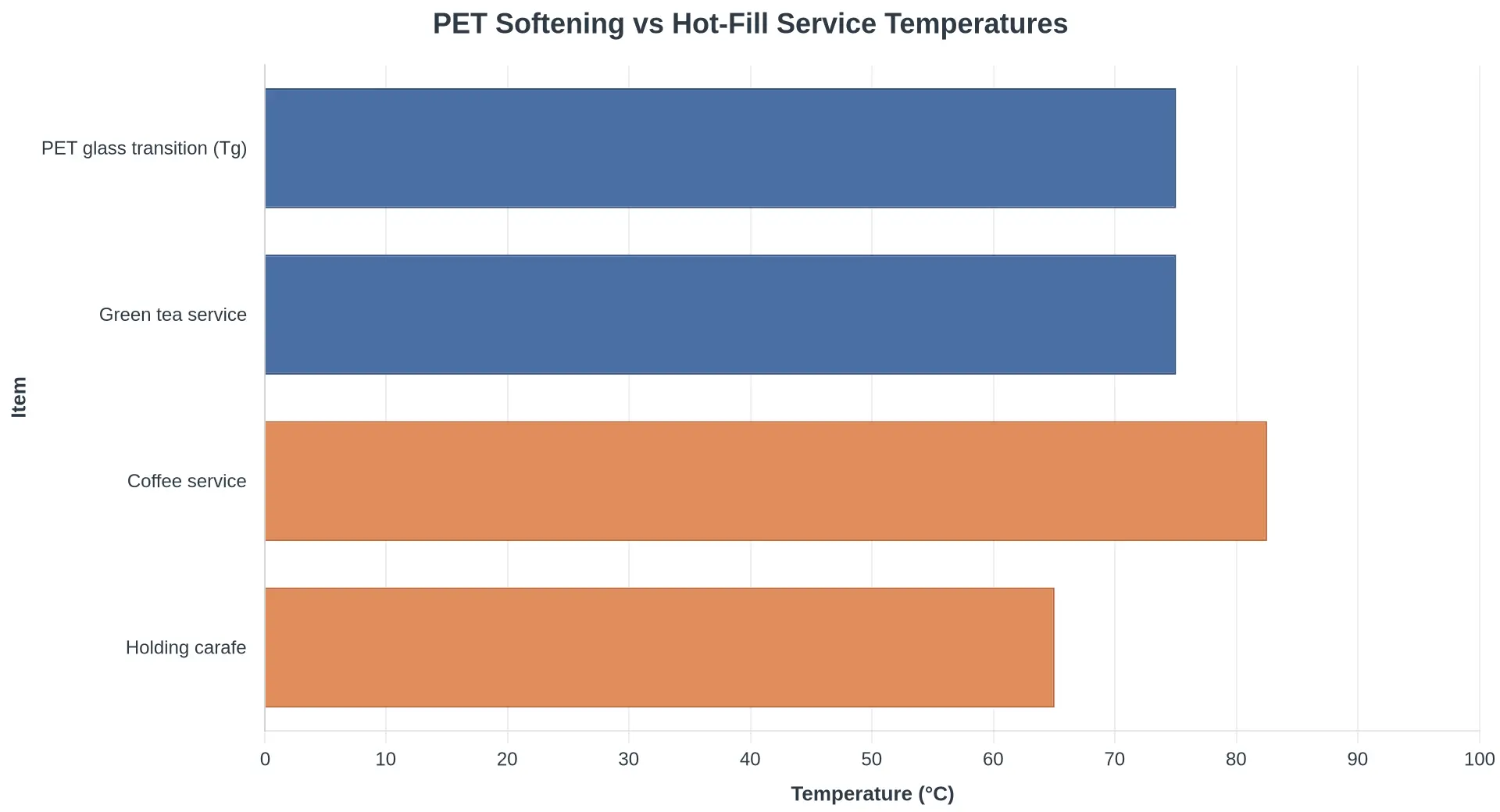
PET has a glass transition temperature of roughly 70-80°C. Pour in liquid at or above that range and the amorphous regions, the non-crystalline zones between the crystallites, soften first. Those regions carry most of the cup’s dimensional stability at room temperature, so once they relax the wall loses rigidity and begins to deform.
Hot-fill service sits right in that danger zone. Coffee and tea are usually dispensed between 60°C and 85°C. Near the lower end, deformation develops gradually; close to 85°C, it can appear within seconds, and even brief contact is enough to warp a coffee cup.
Heat Creep Starts at the Base and Climbs the Wall
Heat does not stay where the liquid lands. Conduction carries it up the sidewall, so the thermal front climbs from the base upward. Each newly heated strip of amorphous PET softens in turn, and the deformation moves up with it. The visible results are predictable:
- The base shrinks as the softened material contracts.
- Panelling, an inward collapse of the thin sidewall.
- Ovalized rims as the opening loses its roundness.
- Lid misalignment once the rim no longer matches the closure.
Residual Stress Accelerates the Damage
Injection molding and thermoforming stretch the PET chains and freeze them in a strained orientation. When heat returns, the chains relax toward their coiled state and release that stored stress, adding to the warping that softening already started. Wall thickness compounds the problem: thin-gauge cups have less material to absorb and spread heat and less stiffness, so they distort faster than thicker-walled versions.
A Practical Warning
Hot fill also costs you the seal. The same softening that distorts the rim breaks the lid-to-cup seal, so the package can leak or spill in transport. For hot beverage programs, a double-wall paper cup sidesteps the failure and still gives customers the insulation they expect.
Why PP Cracks in Cold Storage
Polypropylene earns its place in food service by being tough, cheap to mold, and chemically resistant. That toughness, however, depends on temperature, and cold storage is where PP starts to lose it.
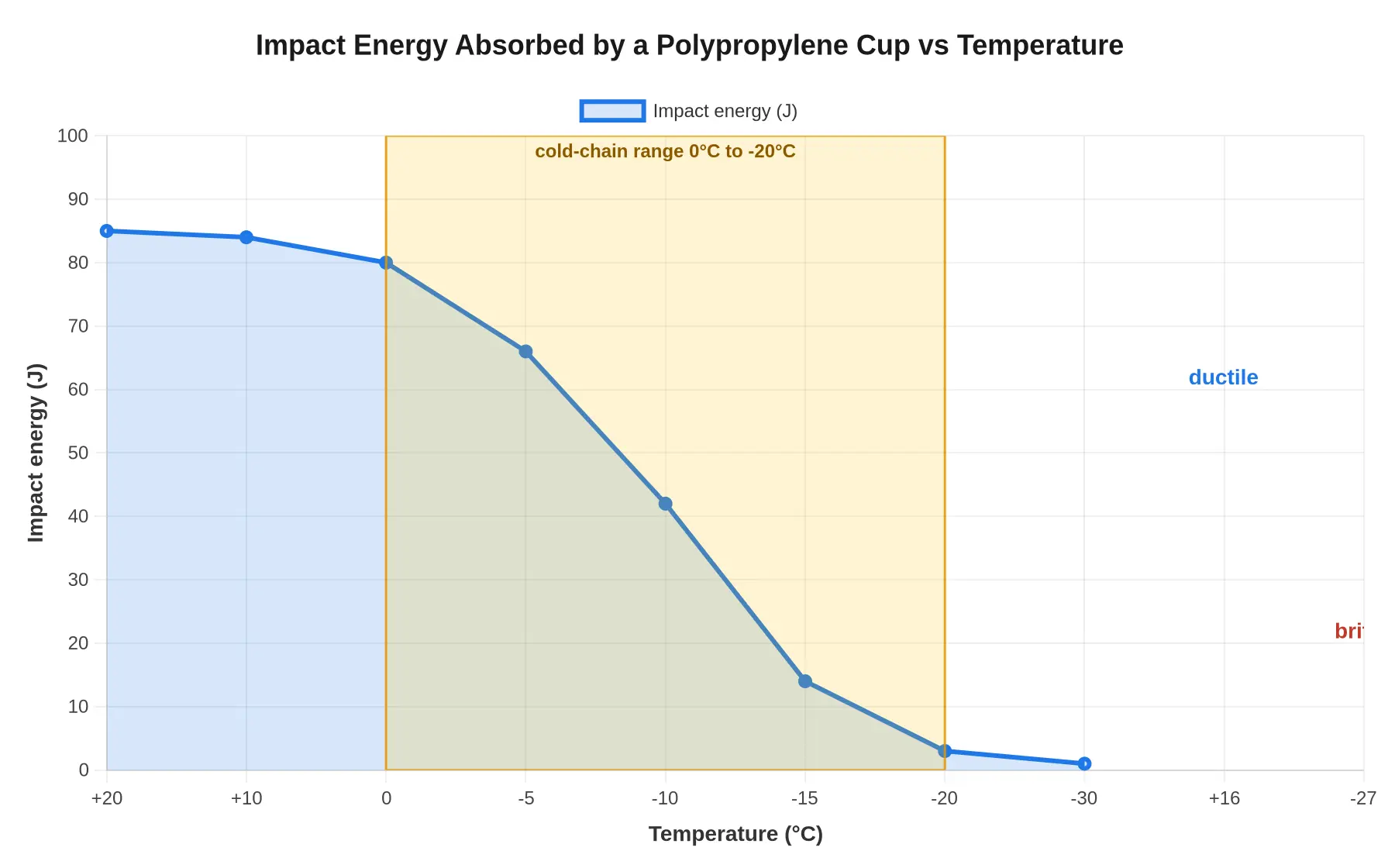
The cause is cold embrittlement. Like other semi-crystalline polymers, PP has a glass transition temperature, and for common grades it falls between about 0°C and -20°C, right inside the cold chain. As a cup cools toward that range, the amorphous regions between the crystalline lamellae lose molecular mobility. Chains that once slid and stretched under impact freeze in place, the material turns brittle, and the impact energy needed to fracture it falls sharply.
That is why PP cracks show up in such familiar patterns:
- Radial cracks fanning out from the base or lid rim, where hoop stress concentrates as the cup contracts.
- Shattered bases when a chilled cup is knocked, dropped into a case, or pried apart.
- Split rims when cups are stacked under load or squeezed together in a tote.
- Freezer cycling makes it worse: repeated warm-cold swings build internal stress until one routine knock finishes the job.
Not all PP behaves the same. Thick-walled designs, talc- or glass-filled grades, and the right nucleating agents refine the crystal structure and push the ductile-to-brittle transition to lower temperatures, which keeps cups serviceable across a 0°C to -20°C cold chain instead of failing at the first freeze.
One caution: PP cold failures often appear only after transport. A cup that left the warehouse perfectly intact can arrive cracked, so the damage shows up as a field complaint rather than an inspection flag. To reduce that risk, specify plastic cups built for cold drinks and freeze-test a sample lot before committing to a bulk SKU.
PET vs. PP Cup Properties at a Glance
| Property | PET | PP |
|---|---|---|
| Glass transition temp (Tg) | ~75 C | ~ -5 C |
| Melting point | ~255 C | ~165 C |
| Recommended service temp | Up to ~60 C | Up to ~100 C |
| Cold-temperature toughness | Good to ~ -20 C | Brittle near 0 C |
| Hot-fill suitability | Poor – warps | Good – holds form |
| Best-fit drink applications | Iced, cold brew, soda | Coffee, tea, hot cocoa |
| Relative clarity | High, glass-like | Lower, hazy |
| Typical wall thickness behavior | Thin, stiff walls | Thicker, flexing walls |
| Cost-per-unit positioning | Economy for cold duty | Priced higher per unit |
The trade-off shows up row by row: PET wins on clarity and cost for cold service but cannot take heat, while PP takes the heat and gives up clarity. That is why one resin cannot do both jobs well. Stock plastic cups for cold drinks for chilled service and a separate PP or PP-lined line for heat.
How to Split the SKU Before Ordering
The most common mistake before a bulk order is treating “a cup” as a single line item. What decides whether a cup survives is thermal duty, not cup color or printed logo. Settle the following criteria in writing before you cut the purchase order.
- Define the temperature envelope, not the drink name. Specify the exact fill and holding range (for example, 85-95 C at hot fill versus 0-5 C ice-hold) rather than labeling it loosely “coffee” or “soda.”
- State the dwell time. How many seconds must a hot-fill cup hold liquid during filling, and how many hours or days does cold product sit before disposal?
- Say whether the cups will be frozen or only chilled. Freezing puts different stress on the material than simple refrigeration and can change the choice entirely.
- Match wall thickness and rim style to the temperature stress, using the gauge and rim geometry the thermal load actually demands.
- Check lid and sleeve compatibility at the intended temperature. A lid that seals cleanly at ambient may leak or pop once the cup is hot or ice-cold.
- Set a minimum order quantity for each dedicated SKU, so every thermal variant clears MOQ on its own and you never compromise one duty to fill another.
For a starting point on cold-duty categories, browse the plastic cups for cold drinks range.
Splitting one “cup” into a hot-duty SKU and a cold-duty SKU is the decision that matters most in the whole order. It keeps material science aligned with service reality, protects the product from warping and cracking, and turns a generic bulk order into a specification you can hold suppliers to.
The One Chart That Justifies Splitting the SKU
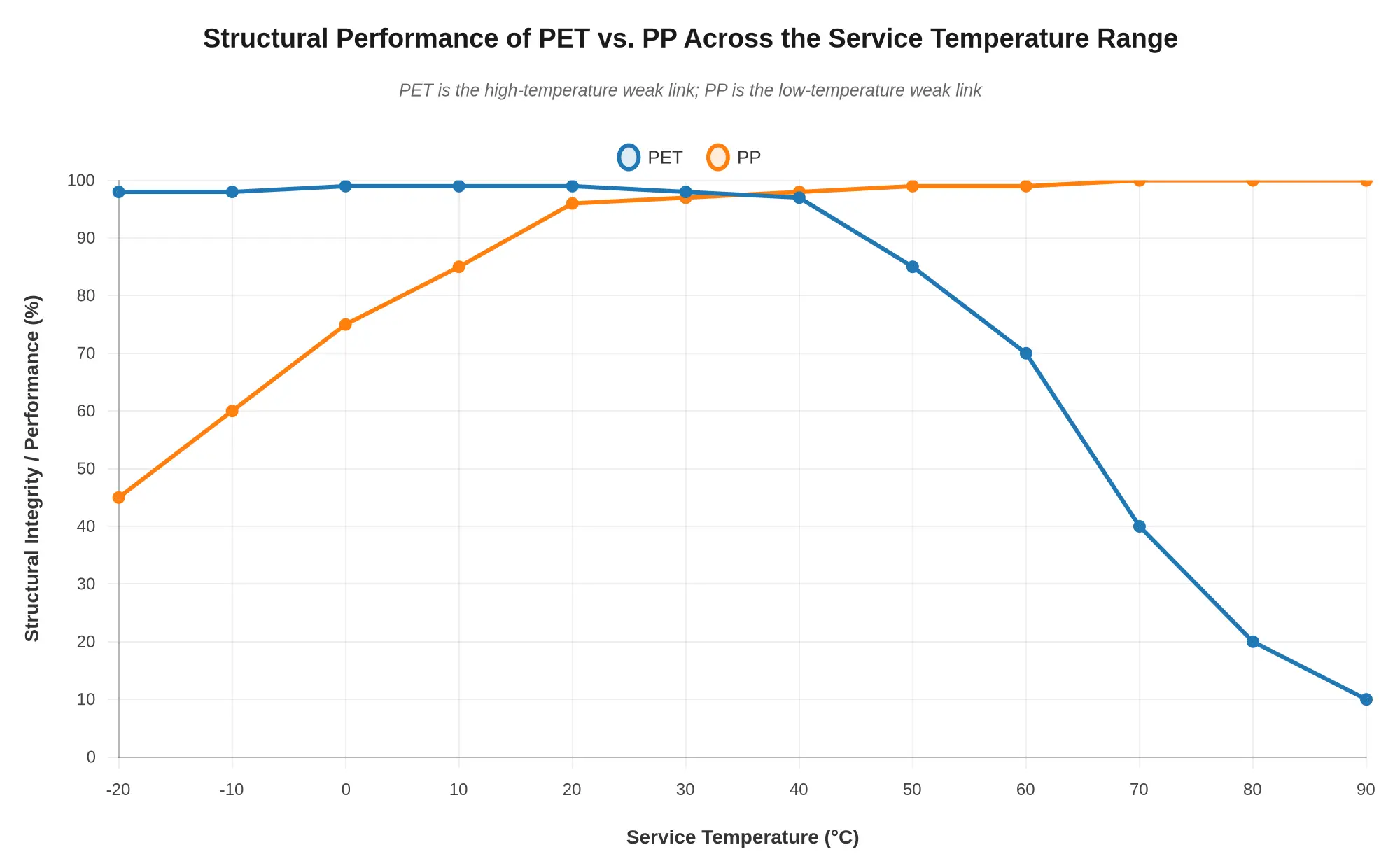
The chart below makes the case on its own. Plot structural integrity against service temperature from -20°C to +90°C and PET and PP fail in opposite temperature corners, with a clean crossover between them.
What the Lines Are Telling You
-
The PET line (blue) holds roughly 95-99% structural integrity from -20°C to about 40°C, so it performs well in the freezer and at ambient temperature. Past 50°C it slides: toward 70% at 60°C, about 40% at 70°C, and near 10% at 90°C. That drop is the warping a thin PET cup shows when it meets near-boiling liquid.
-
The PP line (orange) runs the other way. At -20°C it is already down around 45%, recovers to about 85% by 10°C, and holds near 95-100% from 20°C through 90°C. PP is the stronger performer in heat; in deep cold it is the one that cracks.
The Crossover Is the Business Case
The two lines intersect right around 50-55°C. Below that threshold PET holds up better; above it, PP does. No single material dominates the whole axis, which is the point. A buyer who orders one generic “plastic cup” SKU for both a summer iced-drink menu and a winter hot-fill line is guaranteed failures at one end of the spectrum.
The sourcing answer is to split the SKU: PET for chilled and cold-chain applications, PP for hot-fill and heat-intensive service. Mapping your menu’s temperature range against this chart turns a vague “which cup holds up better?” debate into a data-backed decision.
If your cold-beverage program is the priority, it is worth reviewing a dedicated range of plastic cups built for cold drinks to anchor the PET side of the split.
Translating the Science Into a Purchase Order
With the material science settled, the next step is turning it into a procurement decision. Lock two specs. For hot duty, use a PP cup or a double-wall paper cup with a PP lining: PP’s melting point near 165°C keeps the wall rigid through a 90°C+ fill and avoids the softening that ruins PET. For cold duty, use PET for chilled clarity and the crisp look customers expect from iced drinks, or PP where clarity does not matter. If the drink may be frozen, test the grade rather than assuming either resin will hold up.
Once the two specs exist, the temptation is to add sizes and lid variants. Resist it. Each added size splits demand, pushes the variant below its minimum order quantity (MOQ), and forces partial containers that raise unit cost. Plan the SKU split around volume instead: consolidate compatible sizes, standardize lids and sleeves, and put genuine high-runners into a single bulk order per material. Check what your supplier already stocks before creating a new line; ready inventory often clears the MOQ problem by itself.
Keep two primary SKUs: one PP or PP-lined paper for hot, one PET for cold. Add a third frozen SKU only if you genuinely ship freezer-holding desserts or slush-style drinks at real volume, not because one account asked once. Fewer SKUs protect margin, keep stock allocation simple, and give you more volume to negotiate better pricing on.
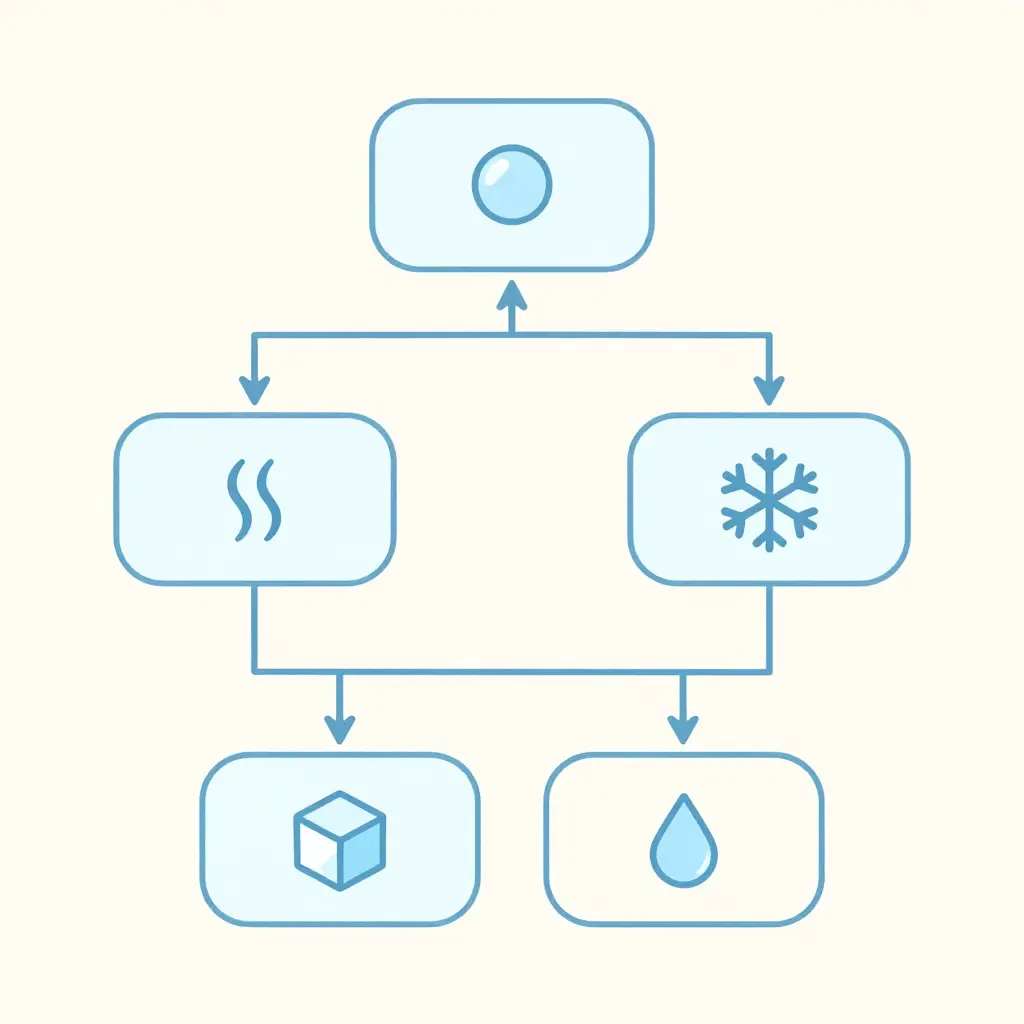
The decision tree maps the guidance above. The single node at the top is your order, and the first question is not “how many cups do I need?” but “what temperature will these cups actually see?” That answer forks the tree.
Reading the branches
- The starting node is the raw order request: no material, no wall thickness, no SKU, just an intent to buy.
- The hot-fill branch (left) is where heat dominates. Anything poured above roughly 65-70 degrees C goes this way and points the choice toward heat-stable formats rather than standard PET.
- The cold/chilled branch (right) looks simpler, but it is the one buyers under-engineer most often. Cold is two conditions, not one.
- The frozen sub-branch covers anything headed for below-freezing storage or transport. Here impact brittleness, not heat, becomes the failure mode.
- The chilled sub-branch covers refrigerated (0-6 degrees C) service, where dimensional stability and clarity matter more than low-temperature toughness.
Why the tree matters before you order
The tree keeps one SKU from being asked to do two incompatible jobs. A single cup number that “works for both” is usually a compromise that fails at one end of the temperature range. Splitting at the first node, then again on the cold side, turns a vague request into a precise specification and a specification into a cup that survives warehouse to customer.
If cold-service volume is the larger share of your order, it is worth reviewing plastic cups for cold drinks as a dedicated line rather than a shared one.
What to Verify With Your Supplier Before You Commit
Treat supplier verification as a technical audit, not a formality. The questions you ask now prevent warped rims, cracked bases, and costly returns later.
- Ask for the exact polymer grade and its glass transition temperature (Tg) data, so you know how it behaves above and below that threshold.
- Get the service temperature range in writing, including continuous-use and short-exposure limits for hot fill and cold storage.
- Sample each cup under hot-fill and freezer conditions, then test it yourself instead of relying on marketing claims.
- Confirm rim and lid tolerance at the temperature extremes, since thermal expansion can break the seal that holds a lid secure.
- Confirm wall thickness tolerance, because uneven walls concentrate stress and encourage premature cracking.
- Confirm MOQ and lead time per dedicated SKU, so the hot and cold lines stay separate and a single spec never has to compromise.
- Ask for dimensional drawings and lot-level test reports, so a deviation can be traced back to a specific production run.
Supplier verification pays for itself the first time a pallet clears the dock intact. Ecocupbowl.com manufactures and supplies disposable tableware, packaging paper, and boxes with an emphasis on safety, durability, and eco-friendly practices. Pairing your order with cup sleeves and disposable cutlery builds a complete, tested service kit, and verified specs reduce field failures and protect the brand.
Frequently Asked Questions
Can I use PET cups for hot drinks at all?
Not for a genuine hot fill. PET’s glass transition temperature is roughly 70-80°C, so liquid above about 60°C lets the amorphous polymer chains relax; the cup hazes, distorts, or collapses. A warm rinse or a mildly warm drink below 55°C is fine. For true hot beverage service, use PP or paper instead, and treat PET as a cold-service material.
Will PP cups really crack in a household freezer or only in commercial cold storage?
Either environment can cause it if the contents freeze solid. PP becomes progressively brittle as it approaches its glass transition temperature, and expanding ice adds stress that can split the wall. A domestic freezer running at -18°C is cold enough. The failure depends on temperature plus frozen expansion, not the size of the facility; commercial cold storage raises the risk because it holds product colder for longer.
Is a double-wall paper cup a substitute for a PP hot cup?
For most hot beverage service, yes. The air gap in a double-wall paper cup insulates well enough for coffee or tea at 85-95°C and gives you a printable, sleeve-free surface. It will not replace PP when you need a recloseable lid, high clarity, or a long-hold leak-proof seam. Many operators use a single-wall paper cup plus a sleeve for shorter drinks to improve unit economics.
How do I know which SKU to order if my café serves both iced and hot drinks?
Start with a demand audit: separate your menu into hot fills and cold service, then estimate weekly unit volume for each. That almost always leads to a deliberate SKU split, PET for cold and PP or paper for hot, because no single material serves both temperature extremes well. Match cup diameter and lid families across the two lines so you can share lids, carriers, and sleeves and keep storage simple.
Does wall thickness change the temperature limits?
Only marginally, and it never changes the material’s chemistry. A thicker PP wall adds rigidity and slows heat transfer slightly, and a thicker PET wall resists deformation a little longer, but neither raises the base temperature ceiling much. Thickness mainly affects crush strength, insulation feel, and cost per unit, not whether the polymer survives a hot fill or a deep freeze.
Is it cheaper to order one universal cup instead of two SKUs?
Usually not, once you count failures. A single cup that tolerates both extremes must be over-engineered, made from a premium or blended material, and it often carries a higher unit price than two purpose-built cups. If it still warps on hot fill or cracks in cold storage, you also absorb replacement costs, refunds, and unhappy customers. A clean SKU split is typically cheaper and more reliable across a full ordering cycle.